
AnimaliaNot EvaluatedacceptedspeciesAccepted
Lunaferamita virginiensis
Utgaard, 1981
GBIF:196202611
0year
ABOUT
Descriptions(5)
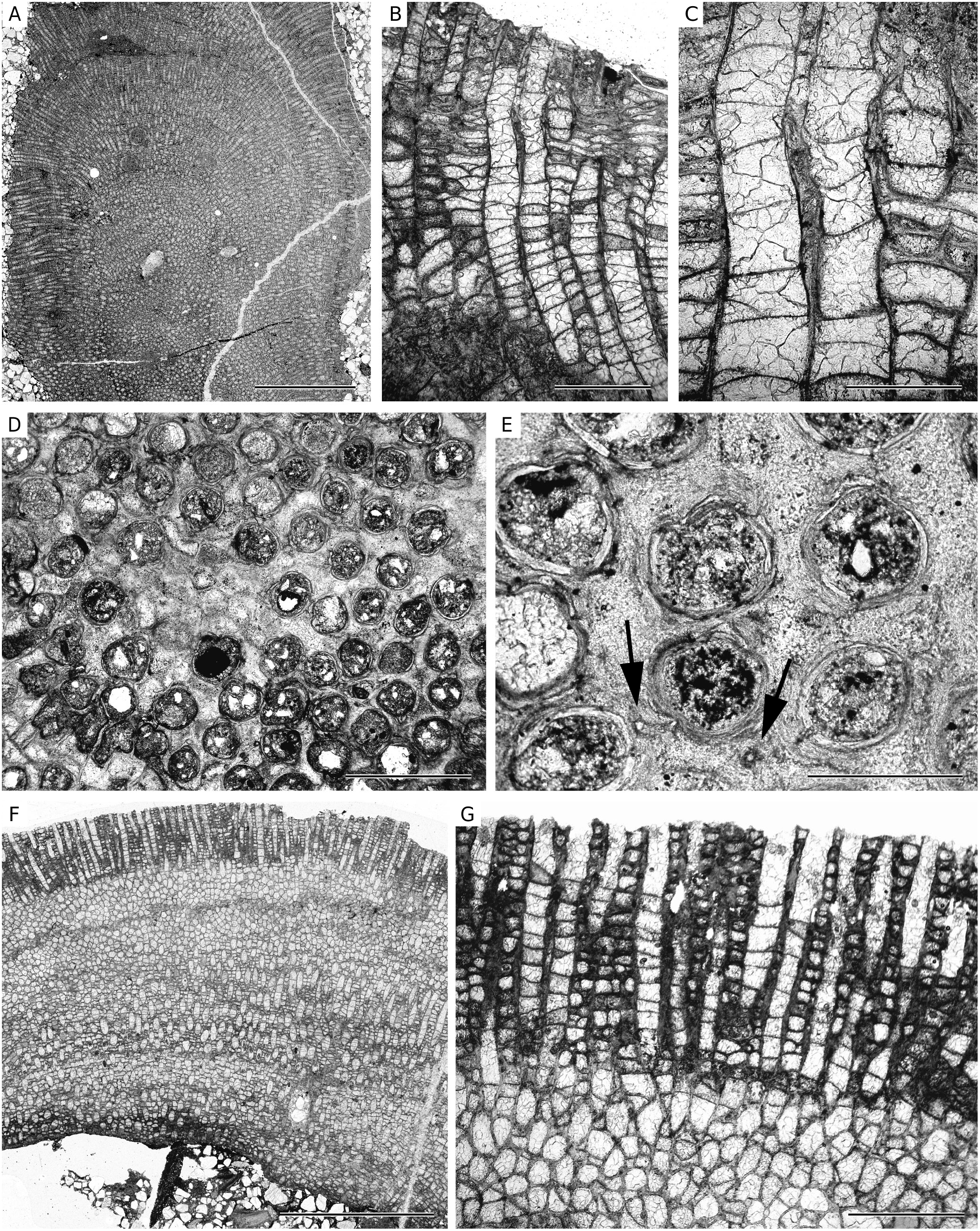
(Fig. 4 A-E; Appendix 1)
Ernst, Andrej, Carrera, Marcelo G. (2022): A cool-water bryozoan association from the La Pola Formation (Sandbian, Ordovician) of Argentine Precordillera. Geodiversitas 44 (20): 563-601, DOI: 10.5252/geodiversitas2022v44a20
DESCRIPTION Massive, encrusting, partly multilayered, or subramose colonies. Massive colony up to 20 mm in height, subramose extensions 3.8 - 5.0 mm in diameter. Autozooecia growing from thin epitheca, bending in the early exozone to the colony surface. Epitheca 0.003 - 0.005 mm thick. Basal diaphragms abundant, straight or inclined, thin. Macrozooecia surrounding maculae, 0.14 - 0.22 mm wide. Autozooecial apertures circular to oval. Lunaria well-developed, rounded to slightly triangular, consisting of granular material; ends of lunaria not indenting autozooecia. Vesicles small to large, not completely separating autozooecia, arranged in 1 - 2 rows between apertures, 4 - 8 surrounding each autozooecial aperture, with rounded to flat roofs, polygonal in tangential section. Autozooecial walls granular prismatic, 0.005 - 0.020 mm thick. Colony surface covered by laminated stereom. Acanthostyles in stereom present, 0.015 - 0.030 mm in diameter, more abundant in maculae. Maculae consisting of vesicular skeleton with larger vesicles, surrounded by macrozooecia, 0.67 - 1.25 mm in diameter, spaced 1.13 - 1.75 mm from centre to centre. COMPARISON
Ernst, Andrej, Carrera, Marcelo G. (2022): A cool-water bryozoan association from the La Pola Formation (Sandbian, Ordovician) of Argentine Precordillera. Geodiversitas 44 (20): 563-601, DOI: 10.5252/geodiversitas2022v44a20
Lunaferamita virginiensis Utgaard, 1981 differs from L. bassleri (Loeblich, 1942) by having smaller autozooecia, less abundant acanthostyles and more abundant diaphragms. Lunaferamita virginiensis differs from L. vesicularis Chang, Yang & Xigiang, 2011 by having encrusting and massive colonies instead of ramose ones in the latter species.
Ernst, Andrej, Carrera, Marcelo G. (2022): A cool-water bryozoan association from the La Pola Formation (Sandbian, Ordovician) of Argentine Precordillera. Geodiversitas 44 (20): 563-601, DOI: 10.5252/geodiversitas2022v44a20
OCCURRENCE. — La Pola Formation, Upper Ordovician, Sandbian; La Pola creek section near Albardon village, San Juan Province, Argentine Precordillera, western Argentina.
Ernst, Andrej, Carrera, Marcelo G. (2022): A cool-water bryozoan association from the La Pola Formation (Sandbian, Ordovician) of Argentine Precordillera. Geodiversitas 44 (20): 563-601, DOI: 10.5252/geodiversitas2022v44a20
MATERIAL EXAMINED. — CEGH-UNC 27506 a, b, CEGH-UNC 27507 c, CEGH-UNC 27513 a-d, CEGH-UNC 27516 c, CEGH-UNC 27520 a, b, CEGH-UNC 27524 a, b, CEGH-UNC 27533 b, CEGH-UNC 27538 b.
Ernst, Andrej, Carrera, Marcelo G. (2022): A cool-water bryozoan association from the La Pola Formation (Sandbian, Ordovician) of Argentine Precordillera. Geodiversitas 44 (20): 563-601, DOI: 10.5252/geodiversitas2022v44a20
Export occurrence data
Darwin Core Archive (ZIP)
CLASSIFICATION
Taxonomic Classification Tree

MULTIMEDIA
Media Files(1)
FIG. 4. — A-E, Lunaferamita virginiensis Utgaard, 1981: A, longitudinal thin section of a colony, CEGH-UNC 27524 a; B, C, longitudinal section of exozone showing autozooecia with diaphragms and vesicles, CEGH-UNC 27513 c; D, tangential thin section showing macula, autozooecial apertures and acanthostyles (arrows), CEGH-UNC 27513 b; F, G, Xenotrypa argentinensis n. sp., longitudinal thin section, holotype CEGH-UNC 27523 b. Scale bars: A, F, 5 mm; B, D, 0.5 mm; C, E, 0.2 mm; G, 1 mm.
Imageimage/png© Ernst, Andrej;Carrera, Marcelo G.Ernst, Andrej;Carrera, Marcelo G.
IMAGES