
AnimaliaNot EvaluatedacceptedspeciesAccepted
Fredericella adrianoi
Wood & Okamura, 2022
GBIF:198576576
0year
ABOUT
Descriptions(5)
(Fig. 2)
Wood, Timothy S., Okamura, Beth (2022): Further species and range extensions of Amazonian bryozoans: chipping away at the iceberg. Zootaxa 5169 (4): 381-391, DOI: 10.11646/zootaxa.5169.4.7
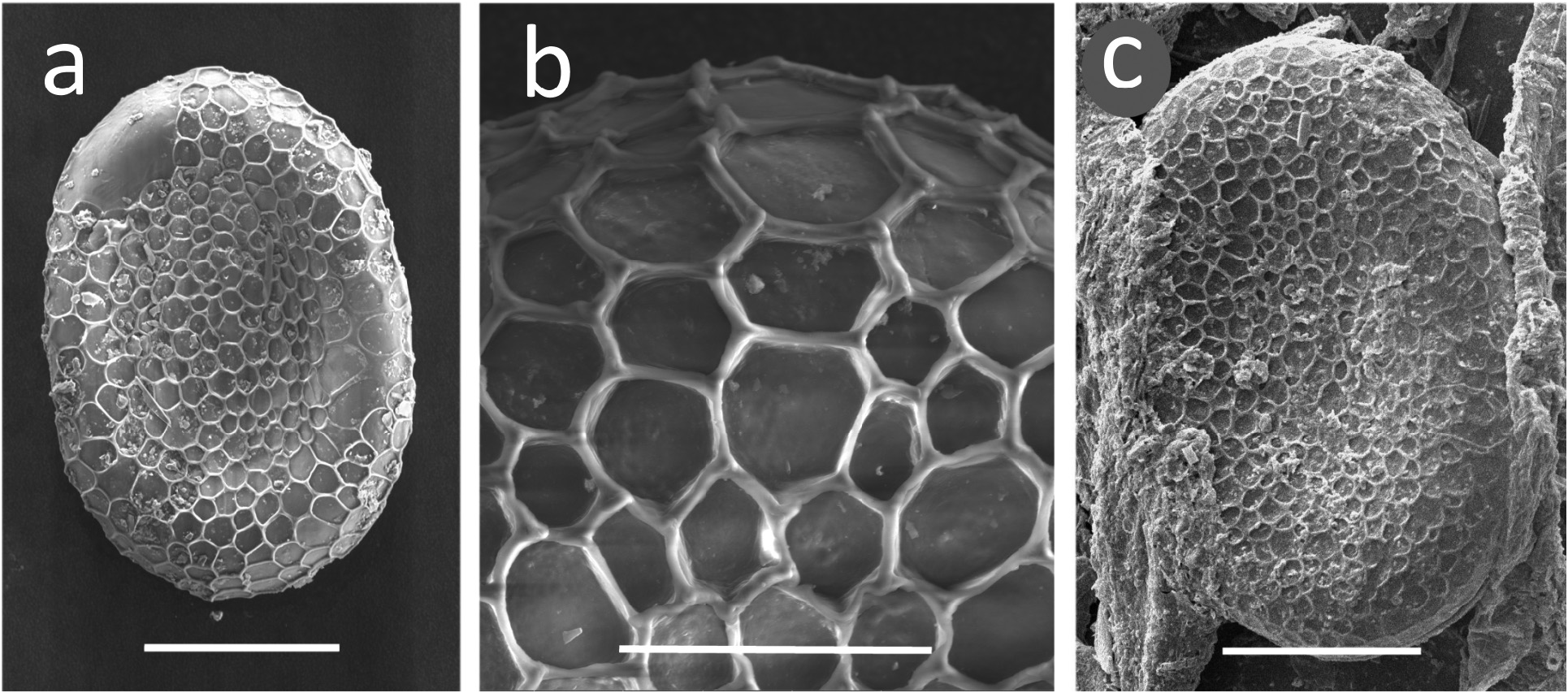
Description. Colonies composed of slender, branching tubules with widely spaced zooids; mostly adherent to the substratum but capable of developing free branches; tentacles numbering 18 – 22; statoblasts produced only in portions of the colony attached to the substratum, seldom more than one statoblast per zooid, a sharply defined reticulum covering both valves of the statoblast with interstices measuring 4 – 12 µm in diameter (Fig. 2 a, b).
Wood, Timothy S., Okamura, Beth (2022): Further species and range extensions of Amazonian bryozoans: chipping away at the iceberg. Zootaxa 5169 (4): 381-391, DOI: 10.11646/zootaxa.5169.4.7
Remarks. This was the most frequently encountered phylactolaemate species during our survey. Colonies appeared to have developed from larvae. They were generally small, with fewer than 20 zooids, and they were most abundant on submerged tree bark in calm waters. Fredericella adrianoi n. sp. is defined by the prominent statoblast reticulation with large interstices, which is qualitatively different from anything seen before. In other species with statoblast reticulation (F. indica, F. borealis, F. crenulata) the interstices are uniform in size, and so small that they often appear as a field of rounded depressions. Other fredericellid species fall into two groups based on statoblast morphology. In one group the statoblast surface is smooth and shiny with no trace of ornamentation (e. g. F. sultana and F. australiensis). In the other group the statoblasts are enveloped in a persistent, wrinkled membrane, a feature attributed only to F. browni (Rogick, 1945), but which may characterise other species not yet described. Statoblasts matching those of F. adrianoi n. sp. have been found in the Republic of Korea, Chungcheongnam-do District, Bongseon Reservoir, 7.3 km northeast of Seocheon (collected by Hyeon Sook Chae and Ho Jin Yang, see Fig. 2 c). It is assumed for now that this is a single species with a disjunct distribution, similar to Asajirella gelatinosa (Oka, 1891) occurring both in eastern Asia and Panama (Wood & Okamura 1999). However, cryptic speciation would not be unexpected, particularly as fredericellid populations exhibit relatively high genetic divergence (Hartikainen et al. 2013, Ruggeri et al. 2019). Future molecular characterization will be helpful to resolve this issue.
Wood, Timothy S., Okamura, Beth (2022): Further species and range extensions of Amazonian bryozoans: chipping away at the iceberg. Zootaxa 5169 (4): 381-391, DOI: 10.11646/zootaxa.5169.4.7
Etymology. The specific name honors Edson Adriano, Professor of Parasitology at Universidade Federal de São Paulo, organizer and leader of the two Amazon expeditions.
Wood, Timothy S., Okamura, Beth (2022): Further species and range extensions of Amazonian bryozoans: chipping away at the iceberg. Zootaxa 5169 (4): 381-391, DOI: 10.11646/zootaxa.5169.4.7
Material examined. Holotype: ZUEC BRY 61, from the Río Negro, municipality of Iranduba, 6 km SW of Manaus, Amazonas State, Brazil, 3 ˚ 9.792 S, 60 ˚ 3.821 ’ W (Site 9), collected 8 May 2018 by T. Wood and B. Okamura. Paratype: NHMUK 2021.11. 23.7 same details as holotype. Additional unregistered material from the Río Tapajos, 15 km N of Santarém, Pará State, Brazil, 2 ˚ 21.194 ’ S, 54 ˚ 44.879 ’ W (Site 13), collected 12 May 2020 by T. Wood and B. Okamura; also from Bongseon Reservoir, 7.3 km NE of Seocheon, Chungcheongnam-do, Republic of Korea, 36.125 ° N, 126.770 ° W, collected 12 October 2016 by Hyeon Sook Chae and Ho Jin Yang.
Wood, Timothy S., Okamura, Beth (2022): Further species and range extensions of Amazonian bryozoans: chipping away at the iceberg. Zootaxa 5169 (4): 381-391, DOI: 10.11646/zootaxa.5169.4.7
Export occurrence data
Darwin Core Archive (ZIP)
CLASSIFICATION
Taxonomic Classification Tree

MULTIMEDIA
Media Files(1)
FIGURE 2. Statoblasts of Fredericella adrianoi n. sp. imaged by scanning electron microscopy. (a) Whole statoblast from Site 9. (b) Enlarged portion of statoblast showing prominent reticulation and large interstices. (c) Whole statoblast from the Republic of Korea, presumed to be the same species and partly enclosed by tubule walls. Scale bars: a, c = 100 µm; b = 40 µm.
Imageimage/png© Wood, Timothy S.;Okamura, BethWood, Timothy S.;Okamura, Beth
IMAGES