
AnimaliaNot EvaluatedacceptedspeciesAccepted
Plumatella spencerjonesae
Wood & Okamura, 2022
GBIF:198576579
0year
ABOUT
Descriptions(5)
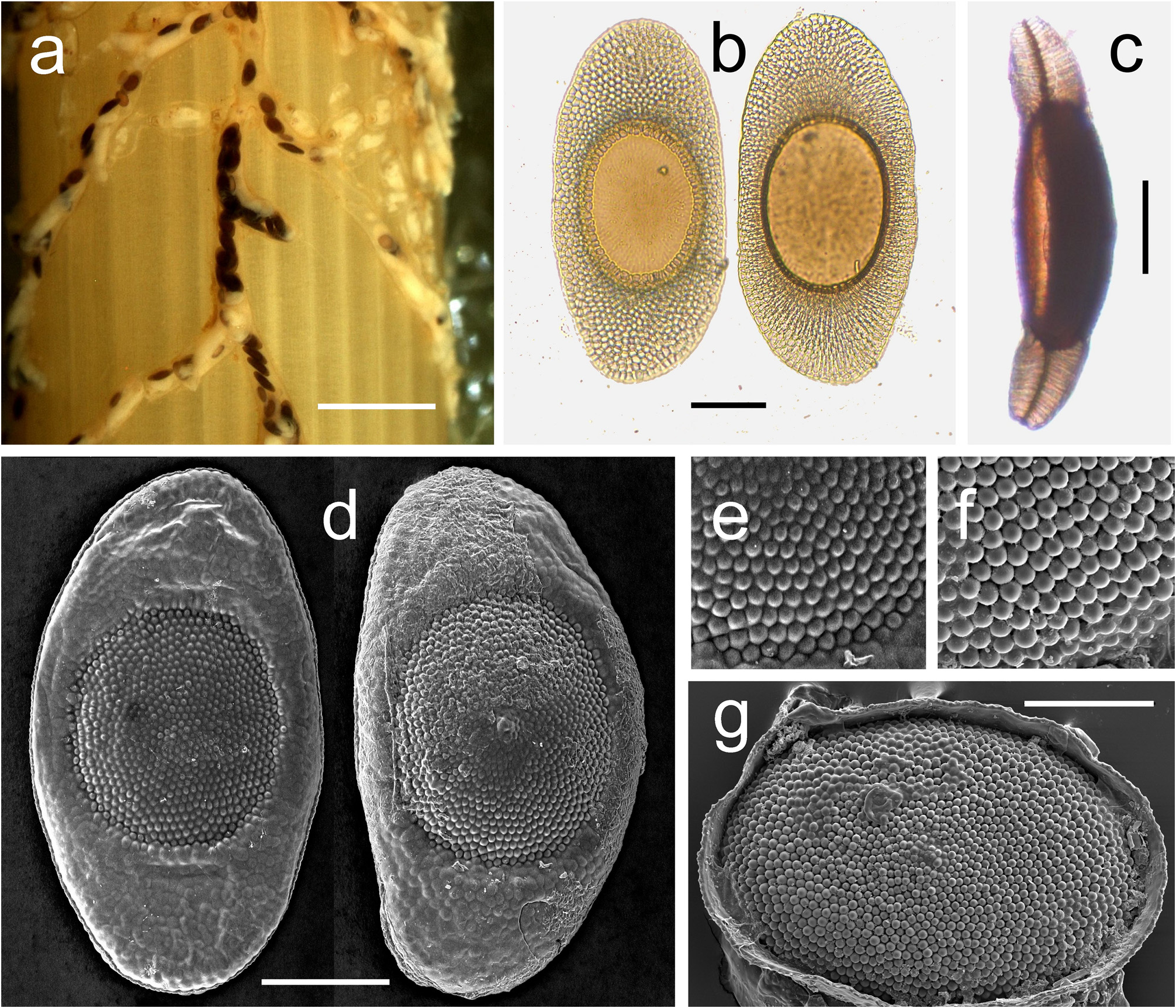
(Fig. 5)
Wood, Timothy S., Okamura, Beth (2022): Further species and range extensions of Amazonian bryozoans: chipping away at the iceberg. Zootaxa 5169 (4): 381-391, DOI: 10.11646/zootaxa.5169.4.7
Description. Colony diffuse, spreading, with zooid tips, entire zooids, or sometimes even short branches raised above the substratum; body wall soft and semitransparent, with statoblasts still easily visible within; raphe apparently absent, but a transparent line (sometimes called a “ furrow ”) extending faintly along the top of the zooecial tubes; floatoblast valves irregularly shaped at the poles (Fig. 5 b, d), lateral profile showing distinct curvature towards the dorsal side (Fig. 5 c), ventral valve convex with the fenestra perimeter matching the capsule outline (Fig. 5 b), fenestra well tuberculated (Fig. 5 d, e), floatoblast dorsal valve slightly concave (Fig. 5 c), the fenestra slightly smaller than the capsule (Fig. 5 b) and the annulus encroaching uniformly all the way around; sessoblast frontal valves with tall, rounded tubercles (Fig. 5 f), annulus showing an indistinct pattern and bearing a slightly thickened rim (Fig. 5 g). Floatoblast dimensions are shown in Table 1.
Wood, Timothy S., Okamura, Beth (2022): Further species and range extensions of Amazonian bryozoans: chipping away at the iceberg. Zootaxa 5169 (4): 381-391, DOI: 10.11646/zootaxa.5169.4.7
Remarks. At first glance this species bears a strong resemblance to P. hartikainenae n. sp. described above. In both species the colonies spread widely on unrestricted substrata, the body wall is colorless and nearly transparent, and the clearly visible floatoblasts appear dark and elongate. However, the straight lateral floatoblast profile in P. hartilainenae n. sp. is distinctive. Plumatella spencerjonesae n. sp. floatoblasts have somewhat irregular shape, a curved lateral profile, and a length: width ratio of 2, which is greater than any other plumatellid examined so far in the Amazon.
Wood, Timothy S., Okamura, Beth (2022): Further species and range extensions of Amazonian bryozoans: chipping away at the iceberg. Zootaxa 5169 (4): 381-391, DOI: 10.11646/zootaxa.5169.4.7
Etymology. The specific name honors Mary Spencer Jones, a scientist at the Natural History Museum in London since 1984, and currently Senior Curator of the Bryozoa Section, in appreciation for her deep expertise and invaluable contributions to the study of marine and freshwater bryozoans.
Wood, Timothy S., Okamura, Beth (2022): Further species and range extensions of Amazonian bryozoans: chipping away at the iceberg. Zootaxa 5169 (4): 381-391, DOI: 10.11646/zootaxa.5169.4.7
Material examined. Holotype: ZUEC BRY 63 from the Río Negro, municipality of Iranduba, 4 km SW of Manaus, Amazonas State, Brazil, 3 ° 9.956 ’ S, 60 ° 3.264 ’ W (Site 4), collected 5 May 2018 by T. Wood and B. Okamura. Paratype: NHMUK 2021.11.23, same details as holotype. Colonies attached to emergent reeds, including floatoblasts and sessoblasts.
Wood, Timothy S., Okamura, Beth (2022): Further species and range extensions of Amazonian bryozoans: chipping away at the iceberg. Zootaxa 5169 (4): 381-391, DOI: 10.11646/zootaxa.5169.4.7
Export occurrence data
Darwin Core Archive (ZIP)
CLASSIFICATION
Taxonomic Classification Tree

MULTIMEDIA
Media Files(1)
FIGURE 5. Plumatella spencerjonesae n. sp. (a) Portion of a colony. (b) Dorsal (left) and ventral (right) floatoblast valves showing irregular outline. (c) Floatoblast in profile showing curvature. (d) SEM image of floatoblasts, dorsal side (left), ventral side (right). (e) Enlarged portion of dorsal side showing fenestra tubercles. (f) Sessoblast frontal valve tubercles. (g) Sessoblast showing heavy tuberculation and slightly thickened rim of the annulus. Scale bars: a = 2 mm; b, c, d, g = 100 µm.
Imageimage/png© Wood, Timothy S.;Okamura, BethWood, Timothy S.;Okamura, Beth
IMAGES