
AnimaliaNot EvaluatedacceptedspeciesAccepted
Plumatella hartikainenae
Wood & Okamura, 2022
GBIF:198576580
0year
ABOUT
Descriptions(5)
(Fig. 4)
Wood, Timothy S., Okamura, Beth (2022): Further species and range extensions of Amazonian bryozoans: chipping away at the iceberg. Zootaxa 5169 (4): 381-391, DOI: 10.11646/zootaxa.5169.4.7
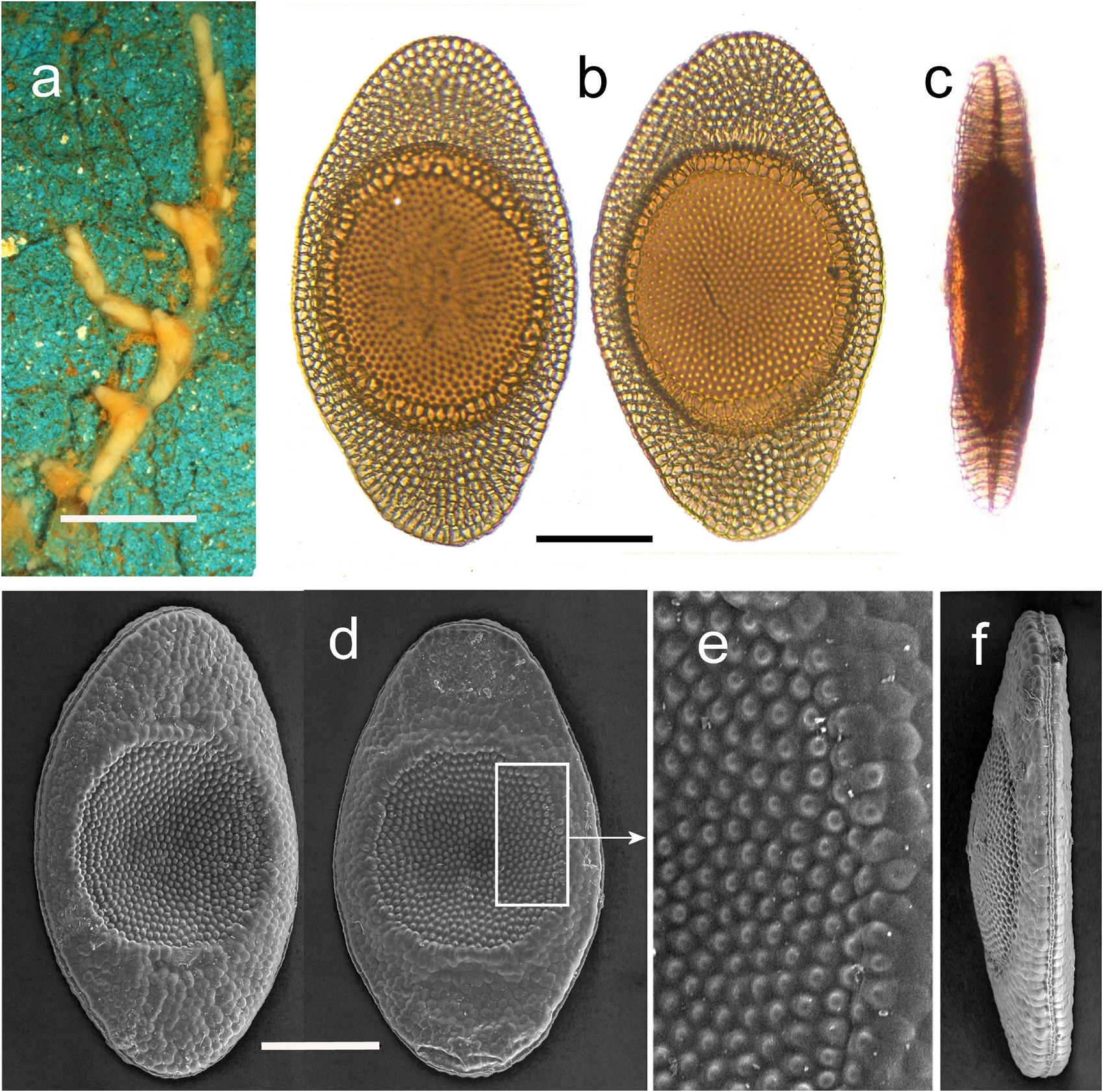
Description. The colony spreads widely, with long branches adhering closely to the substratum, body wall soft, colorless, and transparent, with no trace of raphe or furrow (Fig. 4 a); floatoblasts elongate and often present a diamond shape, widest in the middle and curving gently to broadly rounded ends (Fig. 4 b), lateral profile showing floatoblast unusually thin and characterized by a suture that is entirely linear, not curved (Fig. 4 c, f), dorsal and ventral fenestrae similar in size, with the dorsal annulus encroaching just slightly more over the capsule (Fig. 4 b, d), both fenestrae bearing well defined, rounded tubercles (Fig. 4 e), polar grooves on the dorsal valve indistinct. Floatoblast dimensions are shown in Table 1.
Wood, Timothy S., Okamura, Beth (2022): Further species and range extensions of Amazonian bryozoans: chipping away at the iceberg. Zootaxa 5169 (4): 381-391, DOI: 10.11646/zootaxa.5169.4.7
Remarks. This appears to be the same species noted and illustrated by Wiebach (1970) as Plumatella javanica from the Amazon Basin. That material had reported floatoblast dimensions of 460 by 260 µm, which conform to the measurements of P. hartikainenae n. sp. Corresponding dimensions for P. javanica are considerably smaller (Kraepelin 1906, Wood et al. 2006). Previously, Wiebach (1967) had suggested that P. javanica appears in many forms, so he was prepared to allow for this difference in floatoblast size. However, there is also a difference in the relative dimensions of the floatoblast ventral fenestra: large and oval in P. javanica but smaller and circular in P. hartikainenae n. sp.. So far, no bryozoans matching the holotype of P. javanica have been seen in South America.
Wood, Timothy S., Okamura, Beth (2022): Further species and range extensions of Amazonian bryozoans: chipping away at the iceberg. Zootaxa 5169 (4): 381-391, DOI: 10.11646/zootaxa.5169.4.7
Etymology. The specific name honors Hanna Hartikainen, an assistant professor at the University of Nottingham, who has substantially contributed to the understanding of phylactolaemate evolutionary ecology, diversification and interactions with myxozoan parasites.
Wood, Timothy S., Okamura, Beth (2022): Further species and range extensions of Amazonian bryozoans: chipping away at the iceberg. Zootaxa 5169 (4): 381-391, DOI: 10.11646/zootaxa.5169.4.7
Material examined. Holotype: ZUEC BRY 60, from the Río Negro, municipality of Iranduba, 6 km SW Manaus, Amazonas State, Brazil, 3 ˚ 9.956 ’ S, 60 ˚ 3.264 ’ W (Site 9), collected 8 May 2018 by T. Wood and B. Okamura. Paratype: NHMUK 2021.11. 23.9, same details as holotype. Colonies attached to an abandoned foam rubber sandal, including floatoblasts but no sessoblasts. Additional unregistered material from the Río Tapajos, 10 km N of Santarem, Pará State, Brazil, 2 ˚ 19.700 ’ S, 54 ˚ 45.210 ’ W (Site 14), collected 14 May 2018 by T. Wood and B. Okamura. Colonies attached to emergent reeds, including floatoblasts but no sessoblasts.
Wood, Timothy S., Okamura, Beth (2022): Further species and range extensions of Amazonian bryozoans: chipping away at the iceberg. Zootaxa 5169 (4): 381-391, DOI: 10.11646/zootaxa.5169.4.7
Export occurrence data
Darwin Core Archive (ZIP)
CLASSIFICATION
Taxonomic Classification Tree

MULTIMEDIA
Media Files(1)
FIGURE 4. Plumatella hartikainenae n. sp. (a) Portion of a colony. (b) Dorsal (left) and ventral (right) floatoblast valves. (c) Floatoblast lateral view showing a typical slim profile. (d) SEM image of floatoblasts, dorsal side (left), ventral side (right). (e) Enlarged portion of the ventral side showing hypertubercles. (f) SEM view of floatoblast in profile. Scale bars: a = 2 mm; b, c, d, f = 100 µm.
Imageimage/png© Wood, Timothy S.;Okamura, BethWood, Timothy S.;Okamura, Beth
IMAGES