
AnimaliaNot EvaluatedacceptedspeciesAccepted
Plumatella divae
Wood & Okamura, 2022
GBIF:198576582
0year
ABOUT
Descriptions(5)
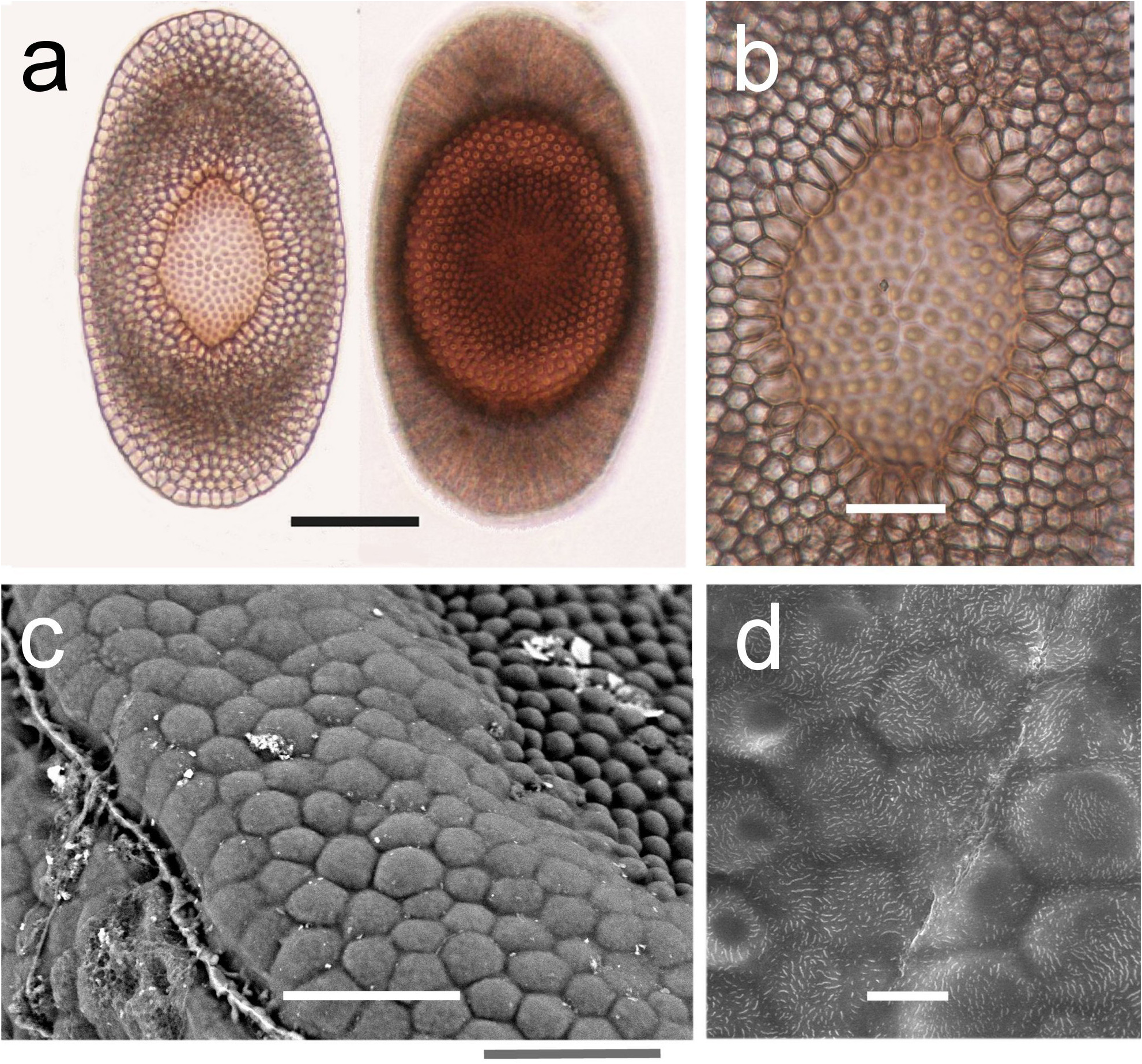
(Fig. 3)
Wood, Timothy S., Okamura, Beth (2022): Further species and range extensions of Amazonian bryozoans: chipping away at the iceberg. Zootaxa 5169 (4): 381-391, DOI: 10.11646/zootaxa.5169.4.7
Description. Colony sparse and spreading across the substratum, with many upright and free branches, keel and furrow prominent along every tubule, ectocyst semitransparent with statoblasts easily visible inside; floatoblasts usually oval and elongate (Fig. 3 a), relatively small, about 423 µm long, but occasionally more broadly oval and less than 370 µm in length, dorsal fenestra less than half overall statoblast length, ventral fenestra dimensions slightly less than those of the capsule, both dorsal and ventral fenestrae strongly tuberculated (Fig. 3 b), floatoblast fenestra and annulus covered with raised lines that appear densely scattered, slightly contorted, and randomly oriented, measuring 0.2 – 2 µm in length and visible only by scanning electron microscopy (Fig. 3 c, d); sessoblasts unknown at this time. Floatoblast dimensions are shown in Table 1.
Wood, Timothy S., Okamura, Beth (2022): Further species and range extensions of Amazonian bryozoans: chipping away at the iceberg. Zootaxa 5169 (4): 381-391, DOI: 10.11646/zootaxa.5169.4.7
Remarks. Other Amazon floatoblasts have a small dorsal fenestra, but all have an overall length greater than 400 µm and the fenestra is not so heavily tuberculated. In this species the small, broadly oval floatoblasts with small dorsal fenestra are unlike any other floatoblasts so far encountered in the Amazon. Similar floatoblasts have been collected (without colonies) from the Presidente Calles reservoir at San Jose de Gracia, Aguascalientes in central Mexico (Wood, unpublished). In that species, however, the floatoblast ventral fenestra is markedly smaller than the capsule.
Wood, Timothy S., Okamura, Beth (2022): Further species and range extensions of Amazonian bryozoans: chipping away at the iceberg. Zootaxa 5169 (4): 381-391, DOI: 10.11646/zootaxa.5169.4.7
Etymology. The specific name honors the Brazilian marine biologist, Diva Diniz Corrêa (1918 – 1993), whose close association with bryozoologists Ernst and Eveline Marcus inspired a lifetime of research on marine invertebrates.
Wood, Timothy S., Okamura, Beth (2022): Further species and range extensions of Amazonian bryozoans: chipping away at the iceberg. Zootaxa 5169 (4): 381-391, DOI: 10.11646/zootaxa.5169.4.7
Material examined. Holotype: ZUEC BRY 62 from the Río Tapajos, 8 km N of Santarém, Pará State, Brazil, 2 ˚ 21.194 ’ S, 54 ˚ 44.879 ’ W (Site 16), collected 14 May 2018 by T. Wood and B. Okamura. Paratype: NHMUK 2021.11.23, same details as holotype. Colonies attached to emergent reeds, including floatoblasts but no sessoblasts.
Wood, Timothy S., Okamura, Beth (2022): Further species and range extensions of Amazonian bryozoans: chipping away at the iceberg. Zootaxa 5169 (4): 381-391, DOI: 10.11646/zootaxa.5169.4.7
Export occurrence data
Darwin Core Archive (ZIP)
CLASSIFICATION
Taxonomic Classification Tree

MULTIMEDIA
Media Files(1)
FIGURE 3. Plumatella divae n. sp. statoblasts. (a) Dorsal (left) and ventral (right) floatoblast valves. (b) dorsal fenestra showing strong tuberculation. (c) SEM image showing floatoblast with ribbed suture and cells of the annulus. (d) Closer SEM view of floatoblast annulus cells with scattered raised lines. Scale bars: a = 100 µm; b = 50 µm; c = 30 µm; d = 5 µm.
Imageimage/png© Wood, Timothy S.;Okamura, BethWood, Timothy S.;Okamura, Beth
IMAGES