
AnimaliaNot EvaluatedacceptedspeciesAccepted

Ascidia tapuni
Monniot C. & Monniot F., 1987
GBIF:202595042
0year
ABOUT
Descriptions(1)
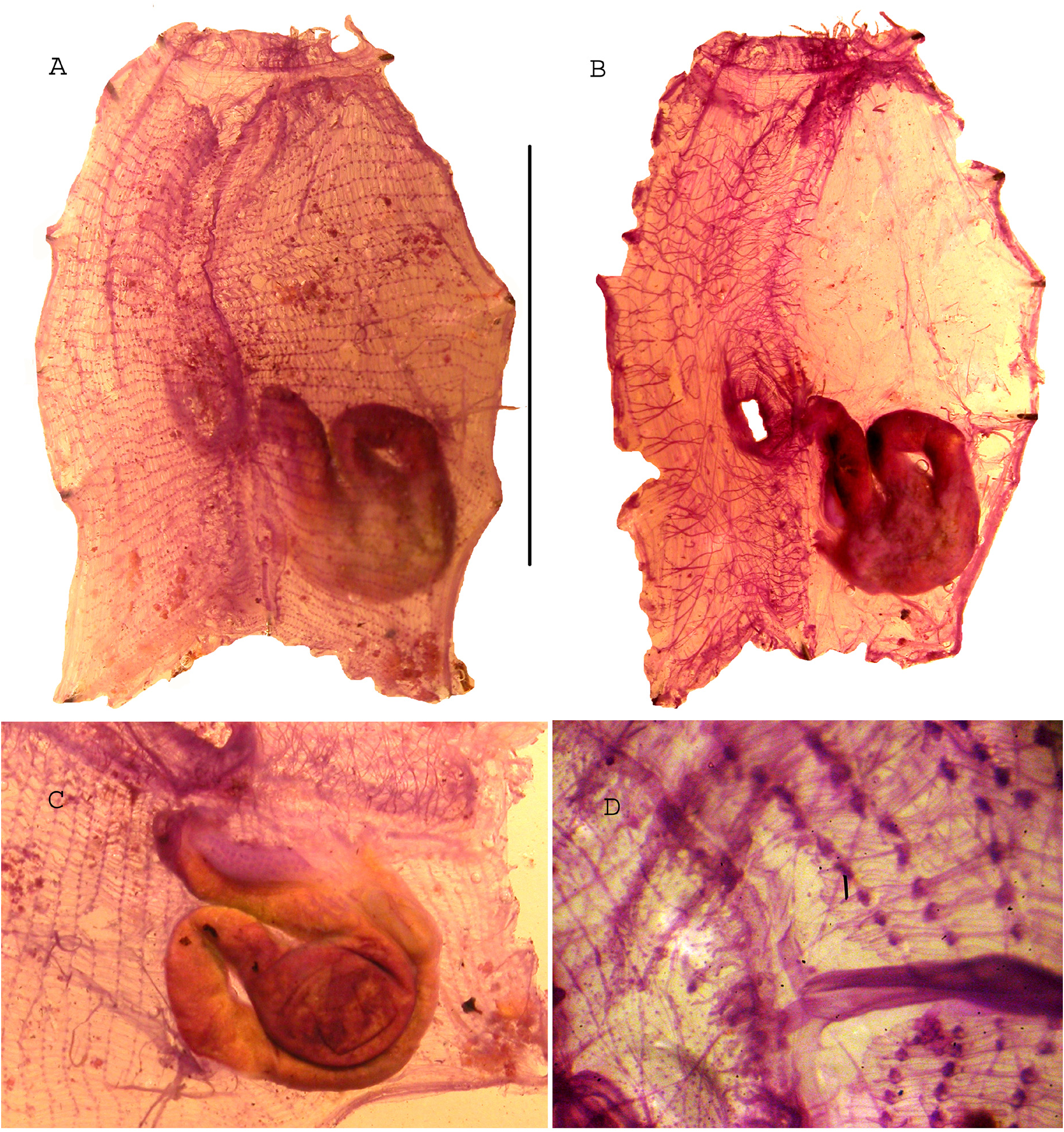
Figures 3 – 4 Station: SPANBIOS: CP 5285: 5 specimens Monniot C. & Monniot F., 1987 a, Polynesia. Monniot C. & Monniot F. 1987 b, Nouvelle Calédonie. Monniot F. & Monniot C. 2003, Fiji. Monniot F. & Monniot C. 2008, Indonesia. The body from 11 mm to 21 mm in length has the same shape in all specimens which is uncommon for the genus Ascidia: the tunic on the dorsal side is smooth, naked and translucent but on the ventral side is covered with dense sandy filaments (Fig. 3 A). The siphons do not protrude. The oral aperture is apical with eight lobes and the atrial aperture with six lobes, is located at half-length or slightly more posteriorly along the body. The body wall is thin with muscles in sphincters around the siphons and making a network of fibres on the right body side only (Fig. 4 B). The oral tentacles are long and thin. The anterior blade of the prepharyngeal band has numerous filiform papillae (Fig. 4 D). The space between the tentacles and the prepharyngeal band is spotted (Fig. 4 D). The neural ganglion is button-like. The branchial sac is flat and wide (Fig. 4 A). Fifty longitudinal vessels were counted on the right side and 40 on the left side. There are generally two stigmata in a mesh and no parastigmatic vessels. The branchial papillae are round. The digestive loop is double (Fig. 4 A, B, C) located in the posterior part of the left side. The stomach is round with five longitudinal folds (observed in one specimen). The intestine draws a closed loop and the rectum is enlarged (Fig. 4 C). The anus has two lips. The ovary lies inside the gut loop and the testis is spread on the gut loop. The genital ducts open close to the anus. The internal anatomy corresponds to that of littoral stations from diverse parts of the Pacific Ocean but the mode of fixation here is different, resulting in a tuft of ventral rhizoids likely due to a sandy habitat.
Exbodi, Françoise Monniot (2022): Additional records of bathyal ascidians (Tunicata) from the New Caledonia region. Zootaxa 5195 (3): 201-223, DOI: 10.11646/zootaxa.5195.3.1
Export occurrence data
Darwin Core Archive (ZIP)
CLASSIFICATION
Taxonomic Classification Tree

IMAGES