
AnimaliaNot EvaluatedacceptedspeciesAccepted
Pharyngodictyon melanesius
Exbodi, 2022
GBIF:202595047
0year
ABOUT
Descriptions(2)
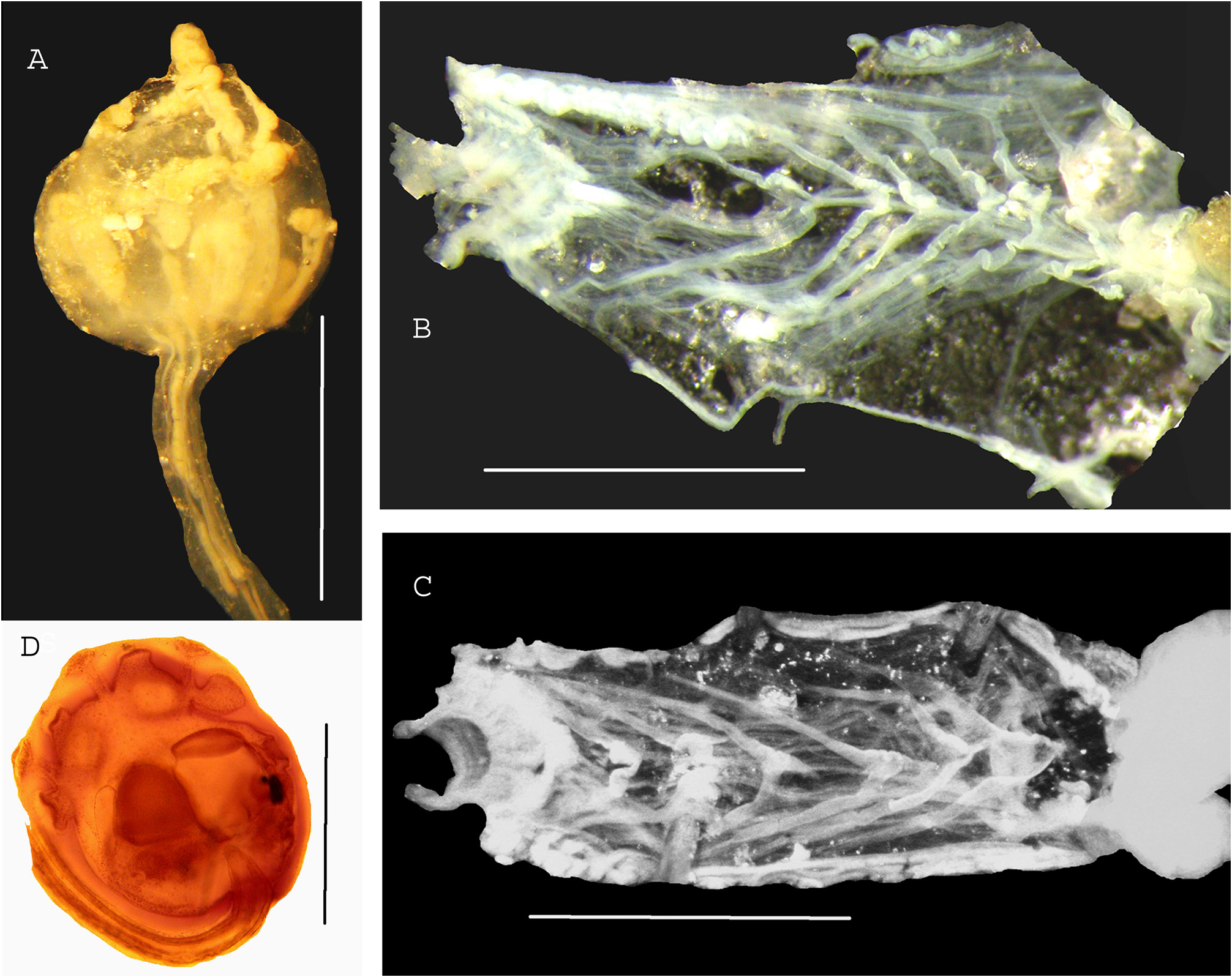
Figure 2
Exbodi, Françoise Monniot (2022): Additional records of bathyal ascidians (Tunicata) from the New Caledonia region. Zootaxa 5195 (3): 201-223, DOI: 10.11646/zootaxa.5195.3.1
Etymology: from Melanesia Stations: SPANBIOS: DW 5227: 1 specimen. DW 5228: 2 specimens designated as syntypes (MNHN IT- 2018 - 77 Paris, France). The colonies are composed of a spherical head above a long thin peduncle (Fig. 2 A). The tunic is soft, translucent, without sand. The heads are 4 to 5 mm in diameter; the longest peduncle is 30 mm. The thoraces and abdomens are included in the head and the post-abdomens with gonads extend into the peduncle. The body wall has muscular fibres in a sphincter at the siphons and a few longitudinal fibres on the thorax. On one zooid two lips can be seen on each aperture. The oral tentacles are thin and numerous but could not be counted. The dorsal tubercle is button-like. The triangular dorsal languets are erect between seven to nine transverse branchial bars (Fig. 2 B, C). The digestive loop forms a right angle with the thorax. The stomach is short and its wall could not be clearly seen. The post-abdomen extends the entire length of the peduncle with the gonads in a long mass in the anterior part. One larva 0.8 mm in diameter was found in the colony head (Fig. 2 D). Two sensitive organs are present as black spots. There are three adhesive papillae in a line each separated by a median protrusion with four round papillae on each larval side (Fig. 2 D). This larva obviously differs from those of other Pharyngodictyon species recorded from the New Caledonian area: P. magnifili has similar colonies and zooids but a different larva. P. bisinus Monniot C. & Monniot F., 1991 has club-shaped sandy colonies but zooids with only two transverse branchial bars. P. cauliformis MonniotC. & Monniot F., 1991 differs by its large sandy ramified colony on a stout peduncle and a larva of three adhesive papillae circled by a ring of digitate vesicles. P. elongatum Millar, 1982 from New Zealand with club-shaped colonies has a naked tunic and the branchial tissue has three transverse bars. P. mirabile Herdman, 1886 from the Antarctic Ocean is bare, club-shaped with five transverse branchial bars according to Millar (1982) who examined the type and Monniot C. & Monniot F. (1985). P. reductum Sluiter, 1906 represents a sessile unique specimen collected on a beach which likely does not belong to the genus Pharyngodictyon.
Exbodi, Françoise Monniot (2022): Additional records of bathyal ascidians (Tunicata) from the New Caledonia region. Zootaxa 5195 (3): 201-223, DOI: 10.11646/zootaxa.5195.3.1
Export occurrence data
Darwin Core Archive (ZIP)
CLASSIFICATION
Taxonomic Classification Tree

IMAGES