
AnimaliaNot EvaluatedacceptedspeciesAccepted
Oligotrema psammites
Bourne, 1903
GBIF:202595058
0year
ABOUT
Descriptions(2)
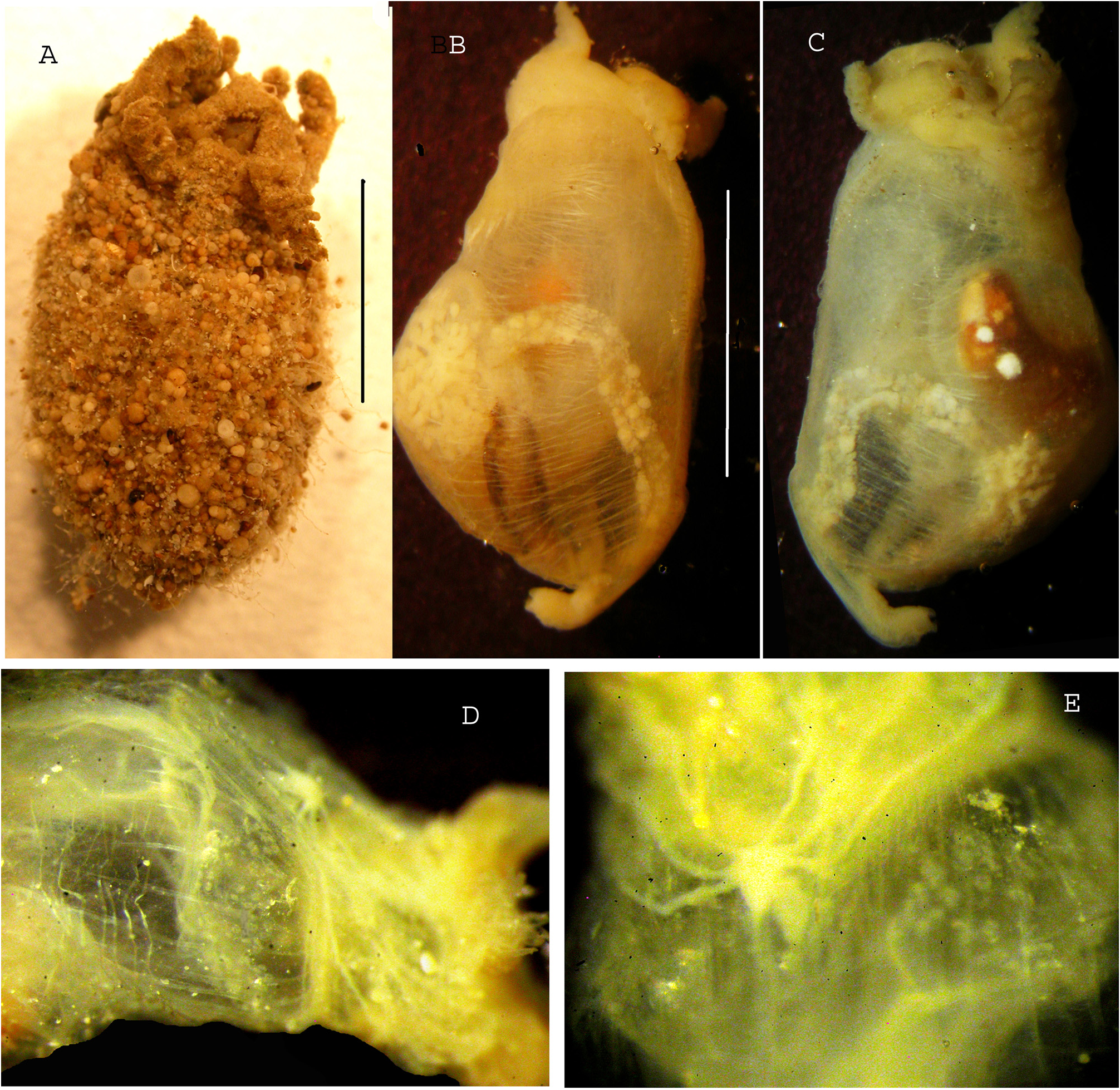
Figure 19 Station: SPANBIOS: DW 5257, 2 specimens. The body is oval covered with thin tunic filaments and coated with sediment. The oral aperture is lined by six pinnate equal lobes (Fig. 19 A). The atrial siphon protrudes slightly at the opposite end of the body (Fig. 19 A). Extracted from the tunic the body wall appears translucent. The oral musculature has a strong sphincter and short longitudinal fibres. Six short strong longitudinal muscles run on the ventral side of the body “ neck ”. Transverse muscular fibres are regularly spaced around the whole body (Fig. 19 B, C). The anal siphon has no sphincter. The oral aperture has a ring of flat tentacles. The neural ganglion is anteriorly prolonged by six stout nerves (Fig. 19 E) and posteriorly extends along the whole dorsal line. The neural gland is situated at the right side of the neural ganglion. The anterior part of the pharynx is enlarged in a funnel with multiple perforations on each side (Fig. 19 D, E). Posteriorly the oesophagus is long and enters into a large stomach pouch. The intestine forms a loop applied to the left side of the stomach. A network of pyloric tubules encloses the intestine. A large kidney containing a concretion occupies the right side of the atrial cavity (Fig. 19 C). A thin-walled endocarp can be seen ventrally on each body side. There is one gonad on each side (Fig. 19 B, C). The testis consists of a group of ramified lobes applied to the left and right sides of the stomach and has a short sperm duct. The ovaries are long curved tubes ending near the atrial aperture (Fig. 19 B, C).
Exbodi, Françoise Monniot (2022): Additional records of bathyal ascidians (Tunicata) from the New Caledonia region. Zootaxa 5195 (3): 201-223, DOI: 10.11646/zootaxa.5195.3.1
Remarks. Kott (1989) synonymised Sorbera unigonas Monniot & Monniot, 1984, Oligotrema psammites Bourne, 1903 and Oligotrema psammathodes (Sluiter, 1905) considering that no major differences occur in samples collected in wide geographical areas. The genus Oligotrema having priority the name Oligotrema psammites was employed by Monniot & Monniot (2003) for specimens from New Caledonia, Philippines and Solomon Islands and is used here for the Spanbios samples. Detailed descriptions of this species under the name Sorbera unigonas can be found in Monniot & Monniot (1984 and 1990).
Exbodi, Françoise Monniot (2022): Additional records of bathyal ascidians (Tunicata) from the New Caledonia region. Zootaxa 5195 (3): 201-223, DOI: 10.11646/zootaxa.5195.3.1
Export occurrence data
Darwin Core Archive (ZIP)
CLASSIFICATION
Taxonomic Classification Tree

IMAGES