
AnimaliaNot EvaluatedacceptedspeciesAccepted

Polycarpa triruga
Monniot F. & Monniot C., 2003
GBIF:202595062
0year
ABOUT
Descriptions(1)
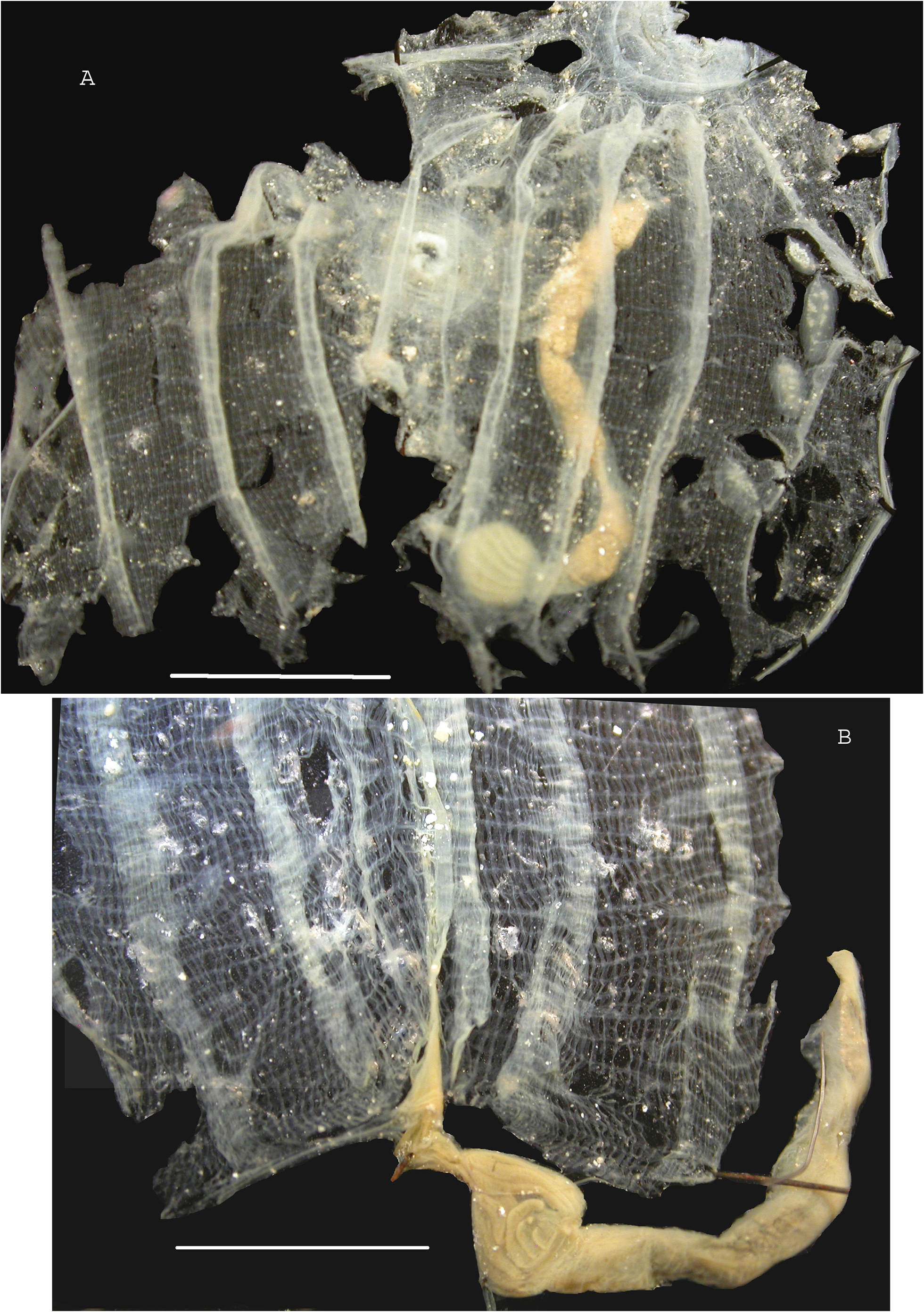
Figures 9 – 10 Stations: SPANBIOS: CP 5130; CP 5219; DW 5237; DW 5246. Many specimens. All specimens are broken, many are empty tunics. The shape looks like an egg and is the same for all samples. The tunic as a shell is hardened by thin sediment and some larger particles (Fig. 9 B). The body wall is very thin and transparent and closely adherent to the tunic. The siphons are sessile and distant by half-length of the body; they have a muscular sphincter with very short longitudinal muscle fibres. No muscles or endocarps have been observed on the body wall. The oral tentacles are large in 3 orders of size planted on a strong rod. The prepharyngeal band is undulated and forms a deep dorsal V (Fig. 9 C). The branchial sac (Figs 9 A; 10 A, B) is only linked to the body wall by thin trabeculae. The dorsal lamina is long. There are four branchial folds on each side, irregular in thickness, well separated by nine to 12 longitudinal vessels. There are one or two large stigmata in a mesh between the folds. The gut loosely attached to the body wall remained more or less linked to the branchial tissue (Figs 9 A; 10 A, B). The oesophagus is short and narrow, followed by a round stomach with seven to 10 longitudinal folds and a small button-like caecum. The long intestine does not form a closed loop; it ends in an undulated anus rim. Loosely attached to the body wall most of the polycarps are missing. When they remain they are placed in a long series on each side along a ventral line (Figs 9 A; 10 A). As many as 30 polycarps were present in one specimen; they are ovoid with short apical genital papillae, the male papilla a little behind the female. The SPANBIOS specimens differ from P. triruga Monniot F. & Monniot C., 2003 by the absence of muscles on the body sides, the constant presence of four branchial folds instead of three on each side and a higher number of polycarps. Nevertheless the egg shape of the body, the closely adherent body wall to the tunic, the gut and absence of endocarps are similar. Some of the numerous specimens collected from Fiji have been re-examined. An important variability was observed in the thickness and extension of the branchial folds and one specimen had four well developed branchial folds on each side. Taking into account the variability commonly observed in deep sea ascidians it seems convenient to group the populations from Fiji and New Caledonia in a single species.
Exbodi, Françoise Monniot (2022): Additional records of bathyal ascidians (Tunicata) from the New Caledonia region. Zootaxa 5195 (3): 201-223, DOI: 10.11646/zootaxa.5195.3.1
Export occurrence data
Darwin Core Archive (ZIP)
CLASSIFICATION
Taxonomic Classification Tree

IMAGES