
AnimaliaNot EvaluatedacceptedspeciesAccepted
Cnemidocarpa pilocincta
Exbodi, 2022
GBIF:202595065
0year
ABOUT
Descriptions(2)
Figure 12
Exbodi, Françoise Monniot (2022): Additional records of bathyal ascidians (Tunicata) from the New Caledonia region. Zootaxa 5195 (3): 201-223, DOI: 10.11646/zootaxa.5195.3.1
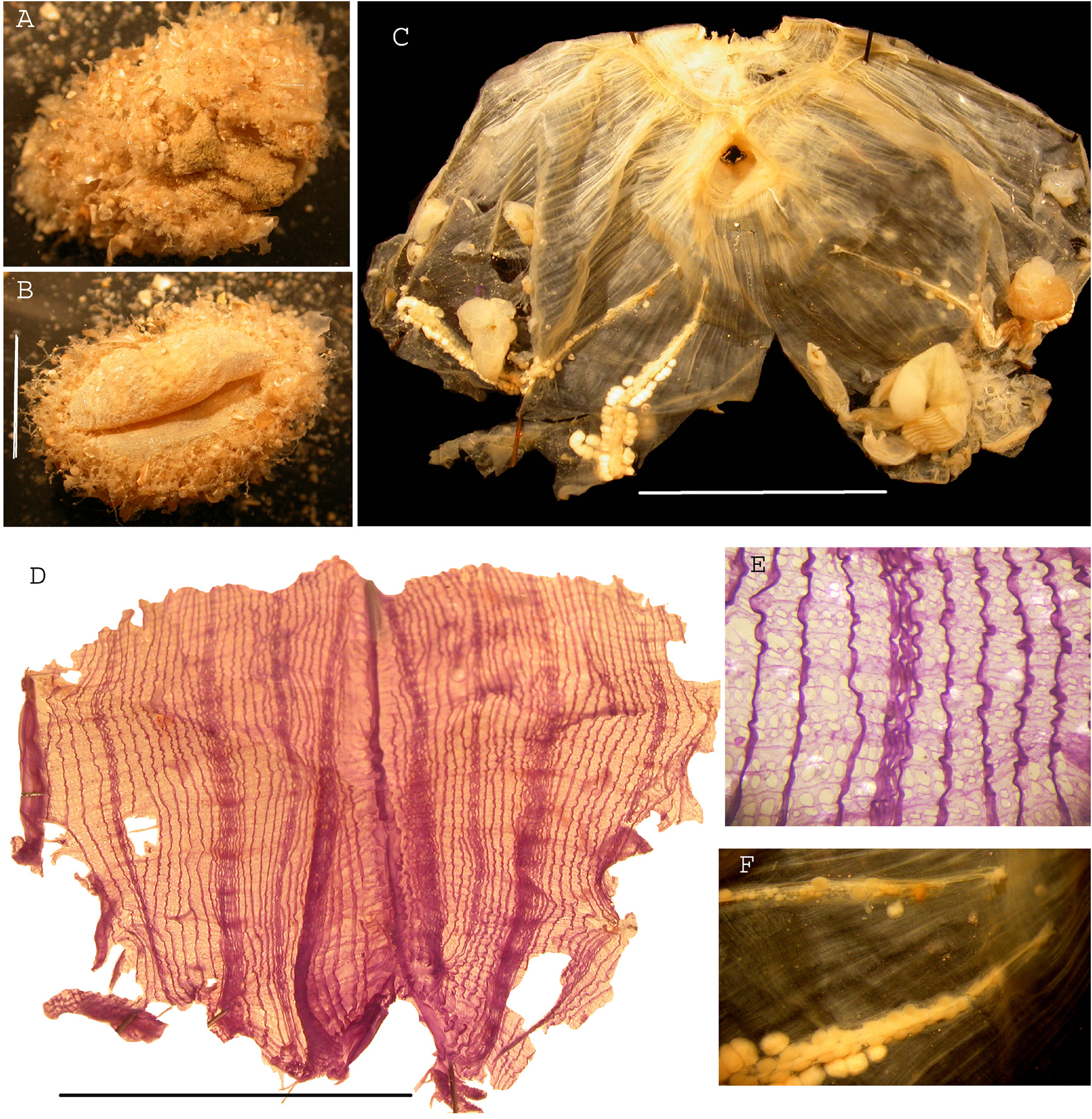
Etymology: circled with hairs. Station: EXBODI: CP 3892, 1 specimen designed as Holotype (Type MNHN-IT- 2018 - 78) The body is almost spherical, 2.6 cm in diameter, coated with sediment with a belt of hair filaments, except on a well delimited naked disk of the tunic on the ventral side (Fig. 12 A, B). The siphons are slightly protruding dorsally and close to each other. Curiously the aspect and size of this specimen is exactly the same as in Bathyoncus lanatus collected at the same station, they would have been confused without dissection. The body wall is thicker dorsally than ventrally with dense longitudinal muscle fibres (Fig. 12 C). Both siphons have a stout sphincter. The oral tentacles are simple in three orders of size. The prepharyngeal band in a single blade is slightly curved dorsally, not in a V. The dorsal tubercle is button-shaped. The long dorsal lamina has a plain edge. There are four branchial folds on each side (Fig. 12 D). The first fold near the endostyle and the third fold on the right side are thinner. On the right side the most dorsal branchial fold begins close to the dorsal lamina but parts from it ventrally (Fig. 12 D). The branchial folds are low and well separated by four to seven longitudinal vessels. The stigmata are irregular, not in the common elongated shape of the Styelidae but round holes pierced in a sheet and strangled by parastigmatic vessels (Fig. 12 E). This design is present in the whole branchial sac. There are two or three stigmata in a mesh between the folds. The digestive loop occupies a small posterior part of the left body side. It is loosely attached to the body wall. The stomach has numerous well marked longitudinal folds (Fig. 12 C) and a small caecum. The primary intestinal loop is narrow, the rectum curves dorsally ending in a denticulate anus. There are two elongate cylindrical gonads on the right side and one on the left side (Fig. 12 C) made up of a central ovary and lateral testis vesicles. The gonoducts open at the base of the atrial aperture with joined but slightly divergent male and female papillae (Fig. 12 F). There are about 10 endocarps on the right body side some very small and others in large ampullae (Fig. 12 C). On the left side there are four endocarps anterior to the gonad and a group of small transparent vesicles posterior to the stomach. Taken together, the body shape, number and disposition of the gonads, shape of stigmata in C. carpocincta do not correspond to any other Cnemidocarpa recorded from the South Pacific Ocean; they justify a new species even if with a single specimen the number of gonads cannot be ascertained as it is often variable in the genus Cnemidocarpa. The unusual aspect of the stigmata may be due to a deep habitat.
Exbodi, Françoise Monniot (2022): Additional records of bathyal ascidians (Tunicata) from the New Caledonia region. Zootaxa 5195 (3): 201-223, DOI: 10.11646/zootaxa.5195.3.1
Export occurrence data
Darwin Core Archive (ZIP)
CLASSIFICATION
Taxonomic Classification Tree

MULTIMEDIA
Media Files(1)
FIGURE 12. Cnemidocarpa pilocincta sp nov.A, dorsal side; B, ventral side of the body; C, body ventrally opened; D, branchial sac stained with hemalum; E, detail of the stained branchial tissue; F, gonads of the right side. Scale bars A,B,C,D = 1cm.
Imageimage/png© Exbodi, Françoise MonniotExbodi, Françoise Monniot
IMAGES