
Phylactolaemata
Allman, 1856
GBIF:203932732
ABOUT
Descriptions(1)
Taxonomic key to Indian Phylactolaemata
1 Zooids arranged in clusters, individual colonies gelatinous, body wall colorless and transparent; floatoblast length> 0.7 mm, annulus curved along the two axes like a saddle; sessoblasts absent. Lophopodidae ................................. 2
- Zooids arranged serially along branching tubules; body wall variable; floatoblast length <0.7 mm, annulus not curved on two axes; sessoblasts may be present......................................................................... 4
2 Individual colonies reaching diameter of 1.5–2.0 cm, compound colonies can be much larger; statoblasts roughly circular with very small hooks around the entire perimeter. (Fig. 18 c, d).......................... Asajirella gelatinosa (Oka, 1890)
- Individual colonies seldom more than 1 cm diameter; statoblasts broadly oval with any hooks or spines restricted to the two polar regions (Fig. 18a, b). Lophopodella .................................................................. 3
3 Floatoblast dorsal fenestra with prominent radiating ridges (Fig. 18a)................ Lophopodella carteri (Hyatt, 1866)
- Floatoblast dorsal fenestra without prominent radiating ridges (Fig. 18b).......... Lophopodella thomasi Rousselet, 1904
4 Lophophore formed by a ring of tentacles of equal length; mature statoblasts bean-like, lacking an annulus for buoyancy or a thin collar around the periphery. Fredericella ............................................................... 5
- Lophophore tentacles not equal in length, arranged in the form of a double U; statoblasts either floatoblasts (unattached, with annulus inflated for buoyancy) or sessoblasts (firmly attached to substratum, anulus not inflated)..................... 10
5 Statoblast outer surface perfectly smooth, appearing shiny when dry and observed with reflected light................. 6
- Statoblast outer surface appearing dull (not shiny) when dry and observed with reflected light........................ 8
6 Statoblast encircled by a minutely toothed keel at the suture (Fig. 13).................... Fredericella carinata sp. nov.
- Statoblast without a keel at the suture..................................................................... 7
7 Statoblast frontal valve perfectly smooth and unmarked..................... Fredericella sultana (Blumenbach, 1779)
- Statoblast frontal valve bearing a faint stippled pattern, especially near the center.................................................................................................. Fredericella toriumii Hirose & Mawatari, 2011
8 Statoblast frontal valve surface bearing a uniform, minute reticulation, often with thickened walls to give the impression of small depressions, like a golf ball........................................................................ 9
- Statoblast surface bearing a persistent, finely wrinkled membrane that disappears after treatment with hot alkali.................................................................................. Fredericella browni (Rogick, 1945)
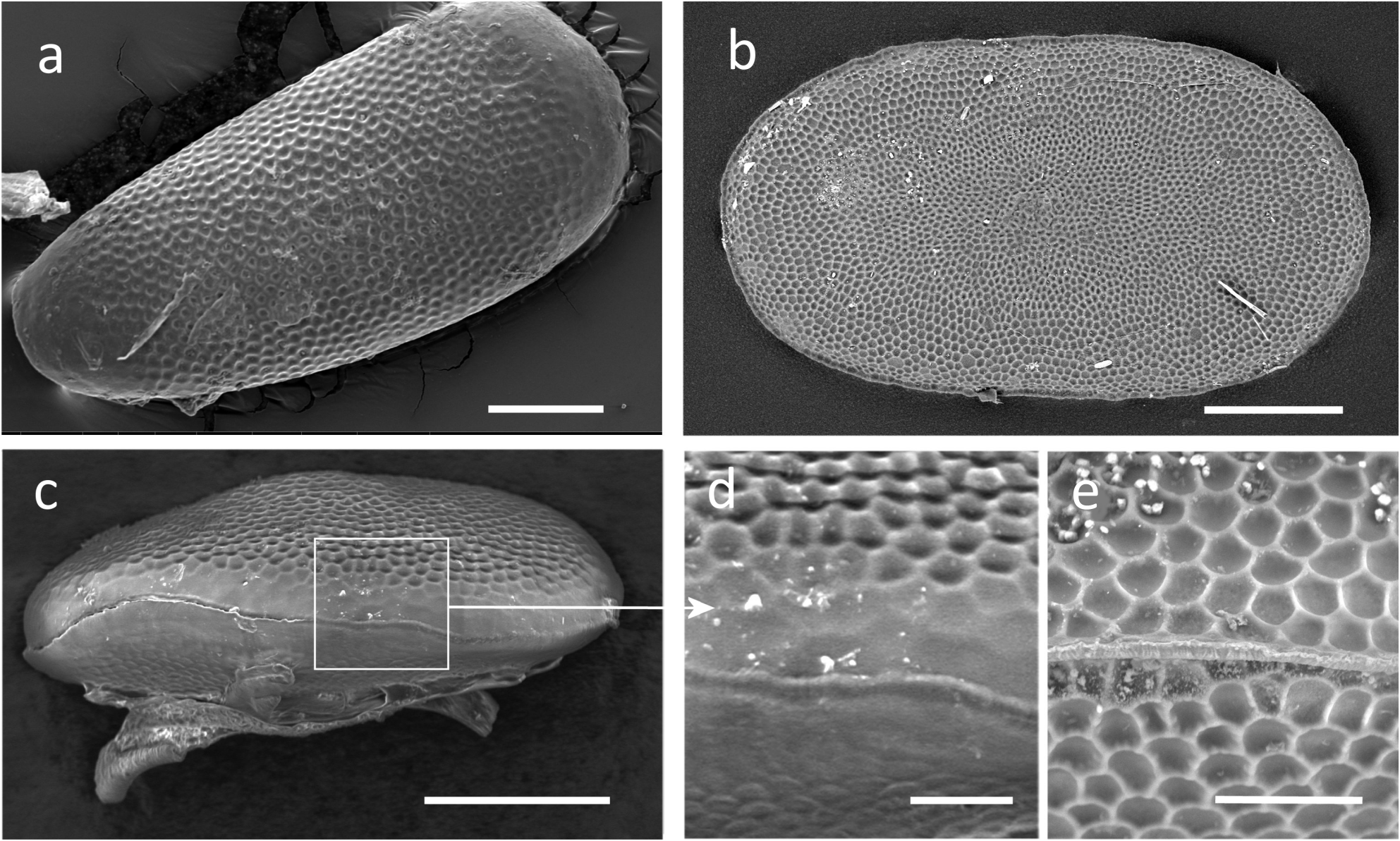
9 Reticulation fading towards the suture (Fig. 1a, c, d)............................ Fredericella indica Annandale, 1909 .
- Reticulation uniform across entire frontal valve, including suture area (Figs. 1b, 12b)........ Fredericella borealis sp. nov.
10 Floatoblast dorsal fenestra mostly smooth, ventral fenestra reticulated or partially so.............................. 11
- Floatoblast dorsal and ventral fenestrae tuberculated........................................................ 12
11 Floatoblast elongate (Table 1), floatoblast ventral fenestra strongly reticulated (Fig 4b), sessoblast frontal valve with a sharply defined tubercle within each interstice of a reticulum (Fig 4c, d); colony variable) Plumatella bombayensis Annandale (1908)
- Floatoblast broadly oval (see Table 1), floatoblast ventral fenestra often not fully reticulated (Fig. 16a, b); sessoblast frontal valve either heavily reticulated or with irregular, lumpy surface (Fig 16c); colony forming loose mat of tangled tubules not closely adherent to the substratum................................................ Plumatella paltensis sp. nov.
12 Floatoblast length LESS than 450 µm, floatoblast dorsal valve either flat or convex............................... 13
- Floatoblast length MORE than 450 µm, floatoblast dorsal valve conspicuously concave (Figs. 2a, b; 5a, b; 20a)................................................................................. Hyalinella lendenfeldi (Ridley, 1886)
13 Floatoblast ventral fenestra relatively large, its length more than half overall floatoblast length...................... 14
- Floatoblast ventral fenestra relatively small, its length less than half overall floatoblast length; sessoblast frontal valve heavily tuberculated, sometimes with large, irregular lumps arranged in a circle between the center and the annulus; sessoblast annulus wide and reticulated (Fig. 20h)............................................... Varunella coronifera Wiebach, 1974
14 Floatoblast dorsal fenestra length MORE than half floatoblast length.......................................... 15
- Floatoblast dorsal fenestra length LESS than half floatoblast length............................................ 21
15 Floatoblast length greater than 350 um; fenestrae bearing tubercles or reticulation................................ 16
- Floatoblasts length less than 350 um; outline broadly oval to nearly circular, fenestra tubercles showing with hypertubercles seen with SEM (Fig. 9)............................................ Rumarcanella himalayana (Annandale, 1911)
16 Floatoblast dorsal fenestra bearing tubercles, sessoblast frontal valve also with tubercles........................... 17
- Floatoblast dorsal fenestra strongly reticulated, tubercles absent; sessoblast with reticulation that may thicken so that enclosed cells resemble a uniform field of small holes................................... Plumatella vaihiriae Hastings, 1929
17 Dorsal fenestra bearing tubercles only, without reticulation................................................... 18
- Dorsal fenestra bearing reticulation with a single tubercle in the center of each cell; Floatoblast annulus bearing tubercles, visible only with scanning electron microscopy (Fig. 3a, b)......................... Plumatella fungosa (Pallas, 1768)
18 Floatoblast dorsal fenestra tubercles well-spaced, not crowded................................................ 19
- Floatoblast dorsal fenestra tubercles so crowded that small spaces between them appear as either pores or bright points of light, depending on the focal plane (Fig. 20d)...................................... Plumatella javanica Kraepelin, 1906 .
19 Floatoblast polar grooves practically inconspicuous when isolated dorsal valve is viewed with substage lighting......... 20
- Floatoblast polar groves encroach conspicuously over the capsule at both poles (Fig. 20i). Varunella indorana Wiebach, 1974
20 Floatoblast dorsal fenestra elongate, length/width>1.5 (Fig. 20c)...................... Plumatella casmiana Oka, 1907
- Floatoblast dorsal fenestra, length/width <1.5 (Fig. 20e)...................... Rumarcanella vorstmani (Toriumi, 1952)
21 Edge of floatoblast appears smooth, without small knobs or spines............................................. 22
- Edge of floatoblast with small knobs or spines protruding from the suture. Swarupella ............................. 24
22 Floatoblast length/width> 1.3, sessoblast annulus thin, blade-like............................................. 23
- Floatoblast length/width <1.3; sessoblast annulus thick and uniquely cellular (Fig. 17)........... Plumatella raoi sp. nov.
23 Twice the floatoblast dorsal fenestra width is MORE than floatoblast width (Fig. 11). Rumarcanella indica Annandale, 1909
- Twice the floatoblast dorsal fenestra width is LESS than floatoblast width (Fig. 6a)........ Plumatella mukai Wood, 2001
24 Floatoblasts tapering to acutely rounded poles; fragile, weakly sclerotized, colorless, almost membranous; dorsal fenestra relatively small, the width less than half overall floatoblast width (Fig. 20f).. Swarupella andamanensis (Shrivastava, 1981)
- Floatoblasts broadly oval, not tapering at each end; not fragile, membranous, or colorless; dorsal fenestra relatively large, the width more than half floatoblast width (Fig. 20g)................................... Swarupella divina Wood, 2006 .
Export occurrence data
Darwin Core Archive (ZIP)

MULTIMEDIA
Media Files(14)
FIGURE 1. Fredericella statoblast valves with pitted exterior. (a) Fredericella indica statoblast valve showing a smooth surface at the ends, from Annandale’s type specimen, ZSI 3479, valve has curled upon drying; (b) Fredericella borealis showing pitted surface at the ends, from Magerøya Island, Norway; (c) Fredericella indica, lateral view showing smooth region near the suture, from NHMUK 1914.10.2.1, Colombo, Sri Lanka; (d) Enlargement of previous photo; (e) Enlarged view of suture area of F. borealis from Illinois, USA, showing reticulation extending to the suture. Scale bars for a–c = 100 µm, scale bars for d–e = 20 µm.
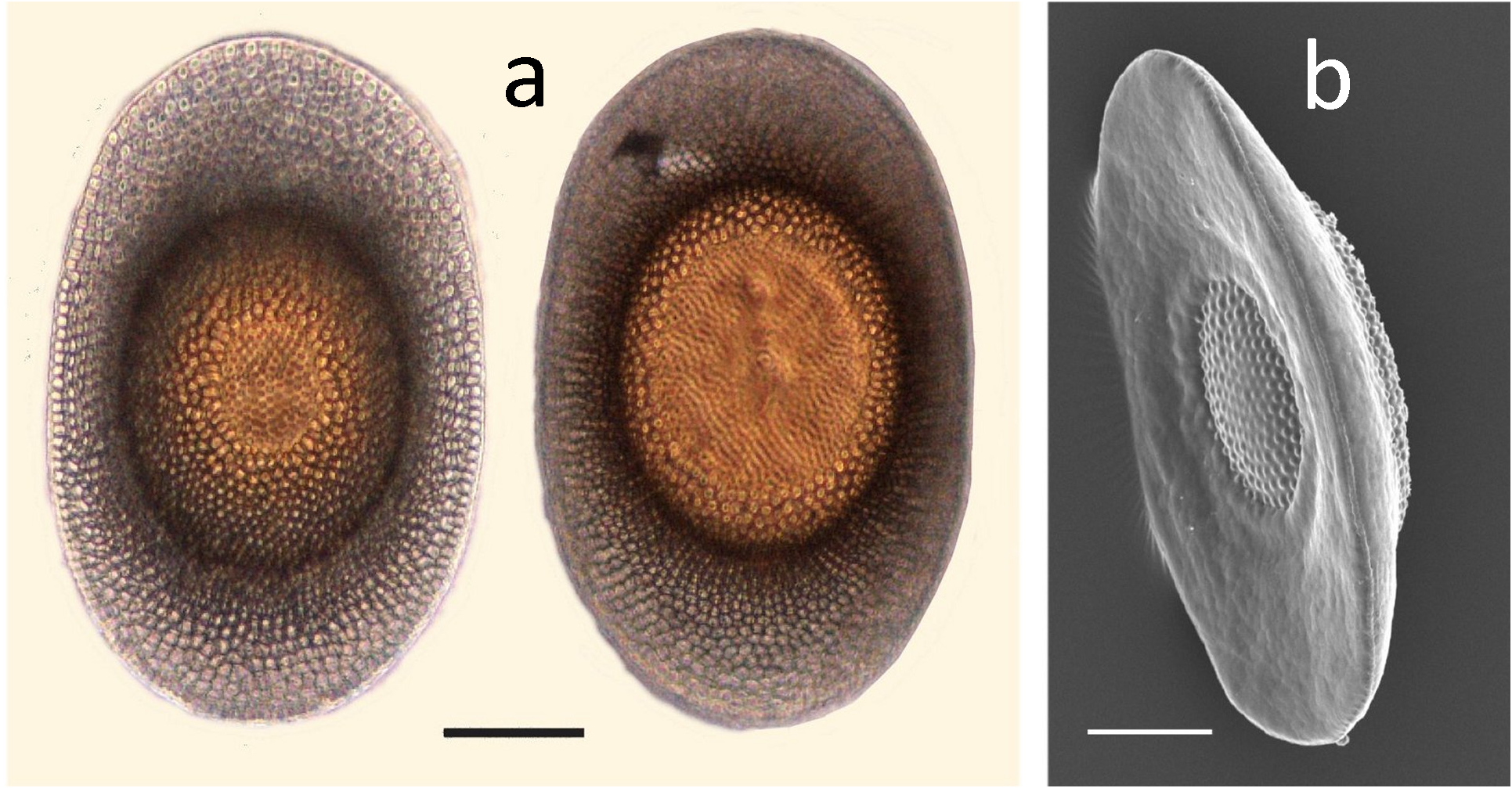
FIGURE2. Floatoblastvalvesof Hyalinella indica, nowidentified as Hyalinellalendenfeldi. (a)Valvesfrom thelectotype,ZEV/7 6750; (b) Floatoblast of confirmed H. lendenfeldi from Thailand showing unique concave dorsal valve. Scale bars = 100 µm.
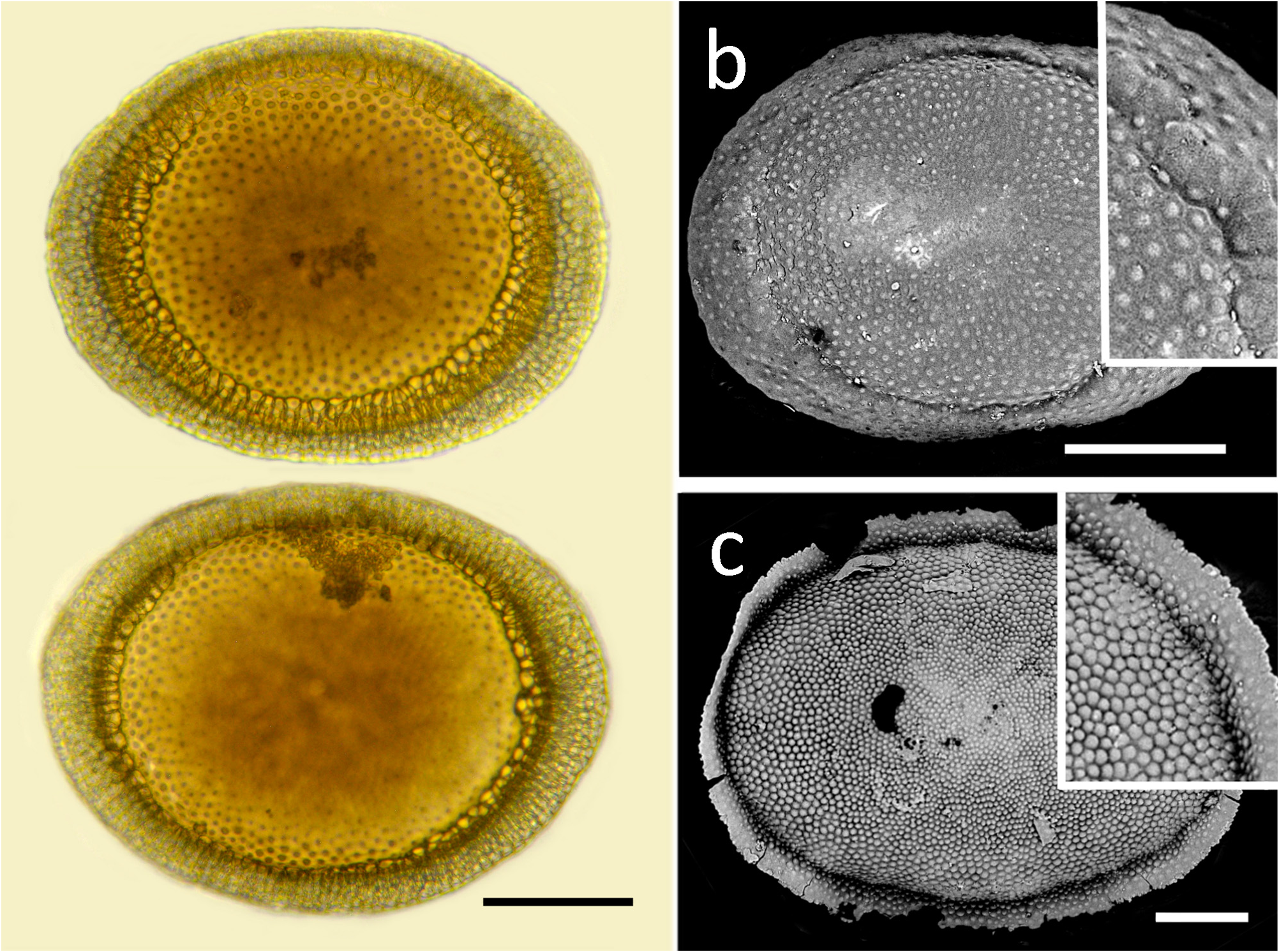
FIGURE 3. Statoblasts from specimen P92 labeled Plumatella bigemmis (Holotype), now identified as Plumatella fungosa. a) Floatoblast valves with dorsal valve above, ventral valve below; b) Scanning electron micrograph of floatoblast ventral valve with inset showing tubercles on the annulus; c) Scanning electron micrograph of sessoblast with inset showing tubercles on annulus. All scale bars = 100 µm.
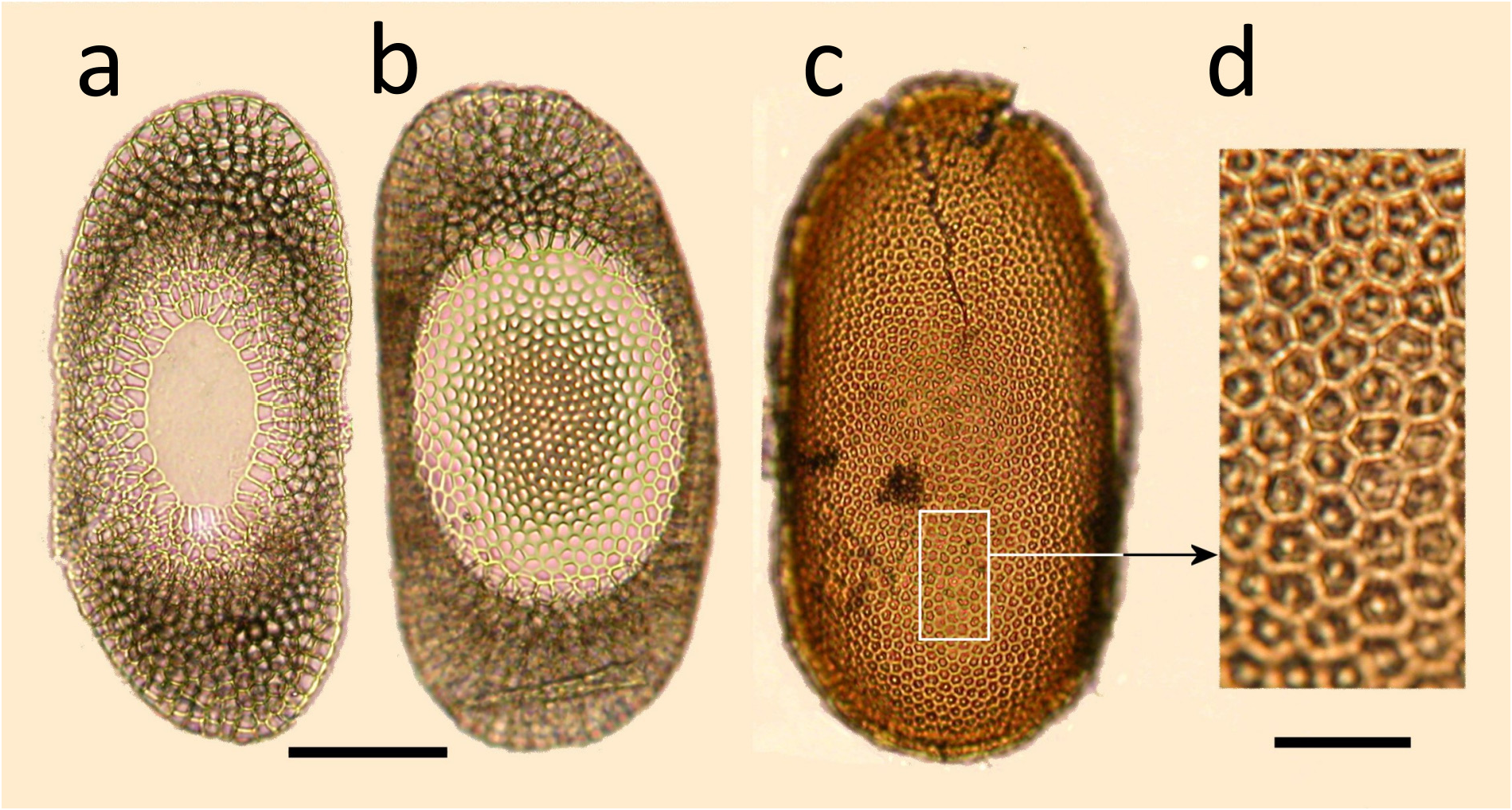
FIGURE 4. Plumatella bombayensis. Statoblasts from ZEV 3804, Zoological Gardens, Kolkata. (a) Floatoblast dorsal valve showing small, unmarked fenestra; (b) Floatoblast ventral valve showing pronounced fenestra reticulation; (c) Sessoblast showing reticulation in which each cell bears a single tubercle; (d) Partial enlargement of previous image. Scale bars for a–c = 100 µm, scale bar for d = 20 µm.
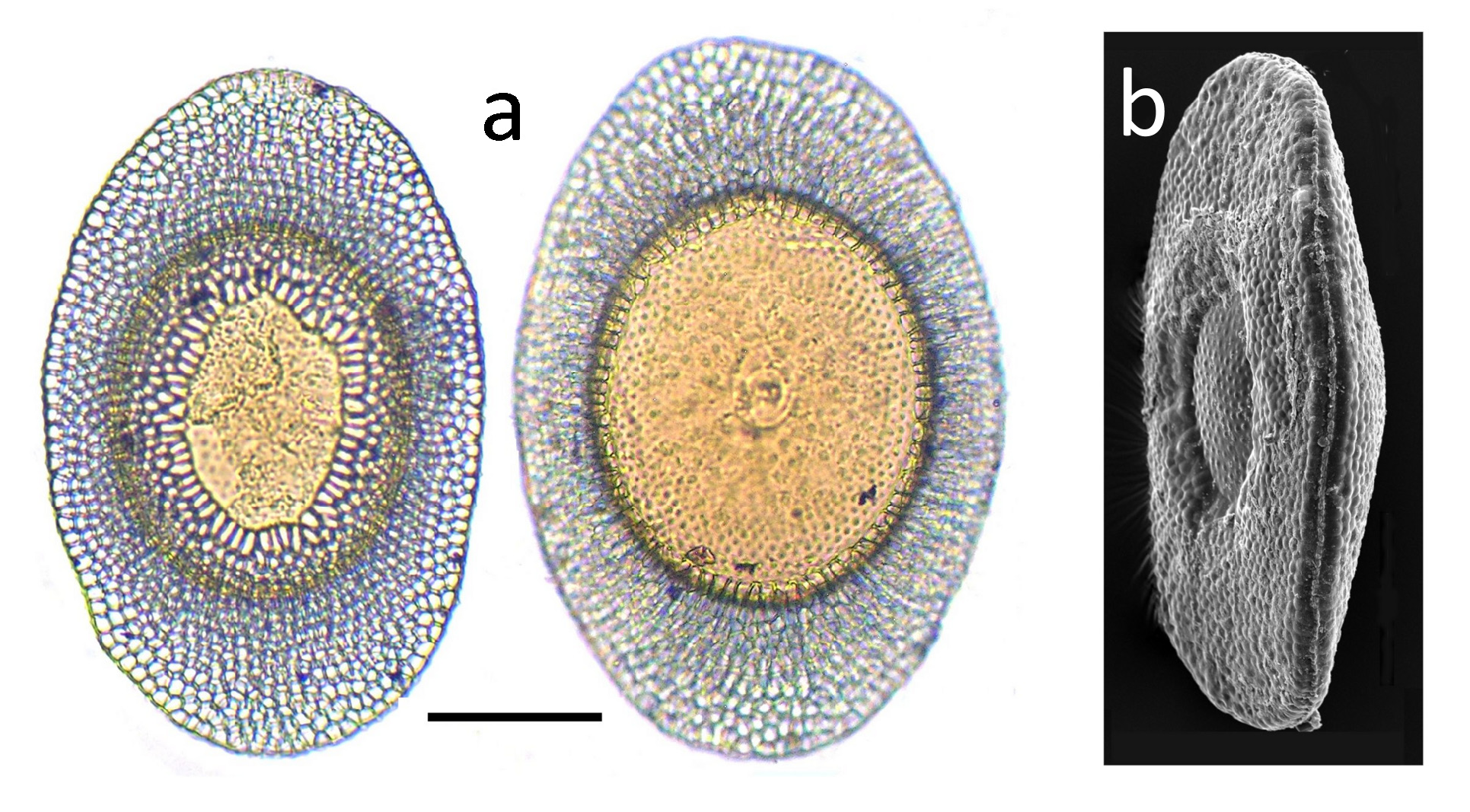
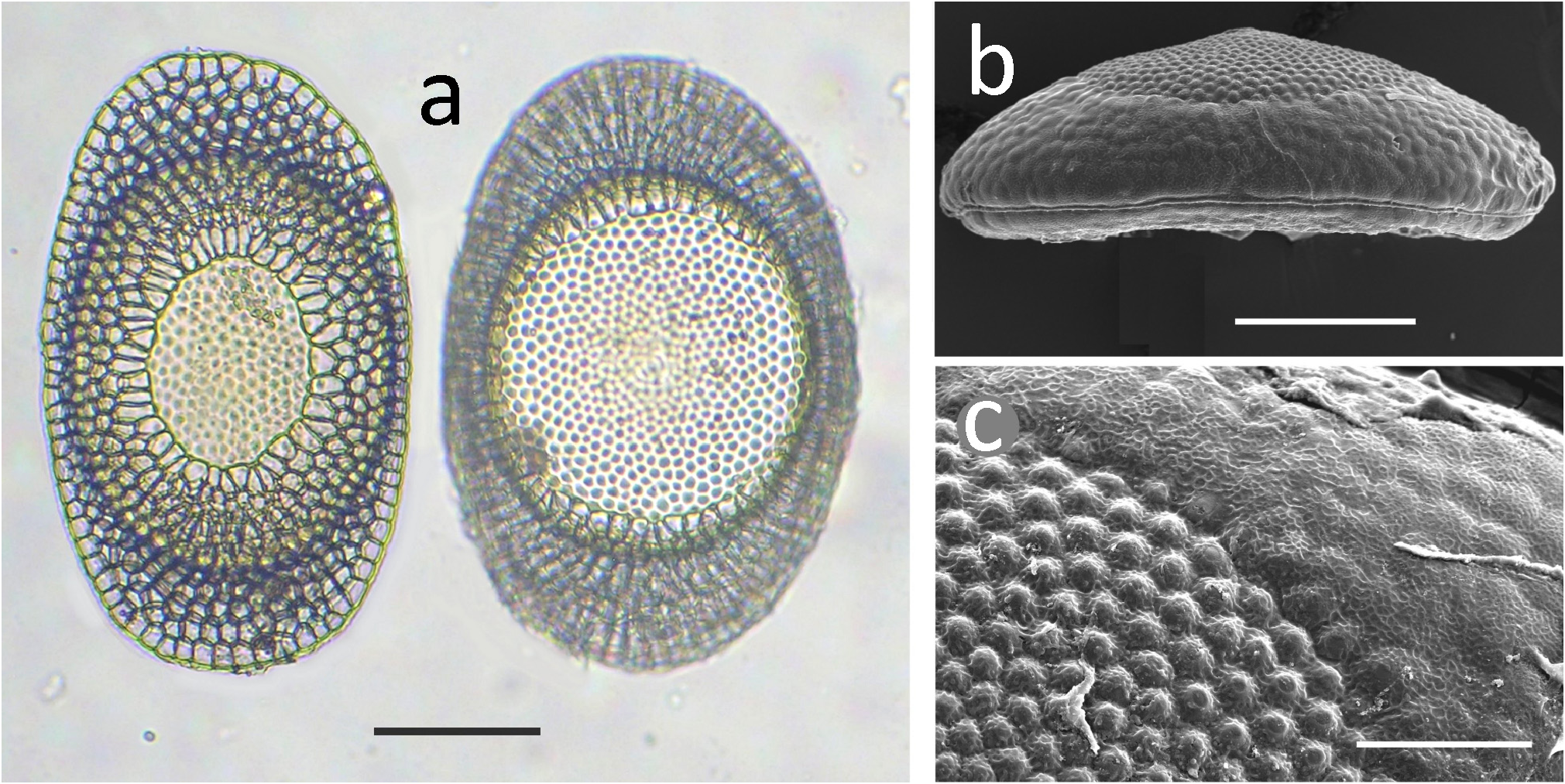
FIGURE 5. Plumatella longigemmis. Statoblasts from specimenP47 labeled Plumatella longigemmis (syntype), now recognized as Hyalinella lendenfeldi. (a) Floatoblast valves with dorsal valve on the left; (b) SEM image showing the floatoblast dorsal side in greater detail. Scale bars = 100 µm.
IMAGES