AnimaliaNot EvaluatedacceptedspeciesAccepted
Fredericella borealis

Fredericella borealis

Wood, 2022

GBIF:203932739

0year

0

Synonyms

ABOUT

Descriptions(7)

(Figs 1 b, e; 12 a, b)
Wood, Timothy S. (2022): Phylactolaemate bryozoans at the Zoological Survey of India and a taxonomic key to Indian Phylactolaemata. Zootaxa 5200 (2): 401-435, DOI: 10.11646/zootaxa.5200.5.1
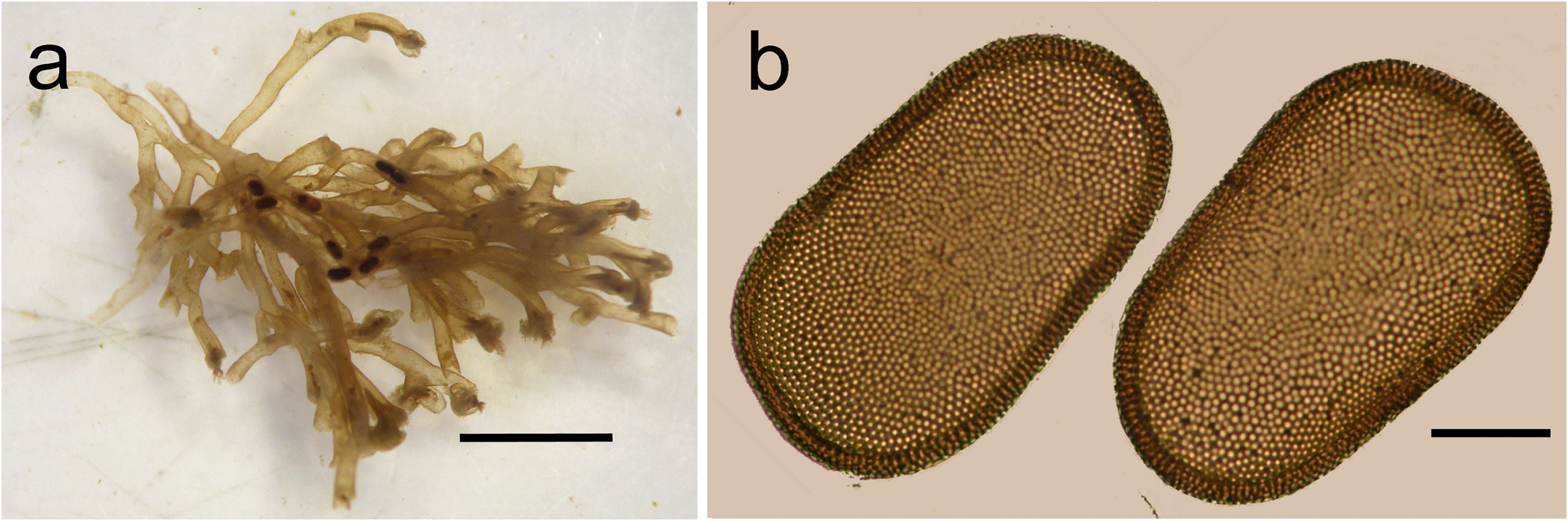
Description. Colony appearing as narrow tubules with zooids and branches widely spaced; an early series of zooids growing along the substratum, those upright zooids later producing new series of branching tubules that may be largely free of the substratum; tubules lightly frosted to nearly opaque, with diameter of 0.18 to 0.37 mm., those along the substratum conspicuously keeled; 18 – 22 lophophore tentacles roughly equal in length and arranged in a circle around the mouth; statoblasts, formed within both attached and free branches, consisting of a naked capsule with no enveloping periblast; entire statoblast surface bearing a fine reticulum that extends to the suture, the reticulum more prominent on the frontal valve than the basal valve, thin vestiges of a weak attachment ring sometimes occurring on the basal valve and merging with a locally sclerotized portion of the ectocyst.
Wood, Timothy S. (2022): Phylactolaemate bryozoans at the Zoological Survey of India and a taxonomic key to Indian Phylactolaemata. Zootaxa 5200 (2): 401-435, DOI: 10.11646/zootaxa.5200.5.1
Diagnosis. Statoblasts heavily reticulated, including areas immediately on either side of the suture, interstices about 5 – 6 µm in diameter.
Wood, Timothy S. (2022): Phylactolaemate bryozoans at the Zoological Survey of India and a taxonomic key to Indian Phylactolaemata. Zootaxa 5200 (2): 401-435, DOI: 10.11646/zootaxa.5200.5.1
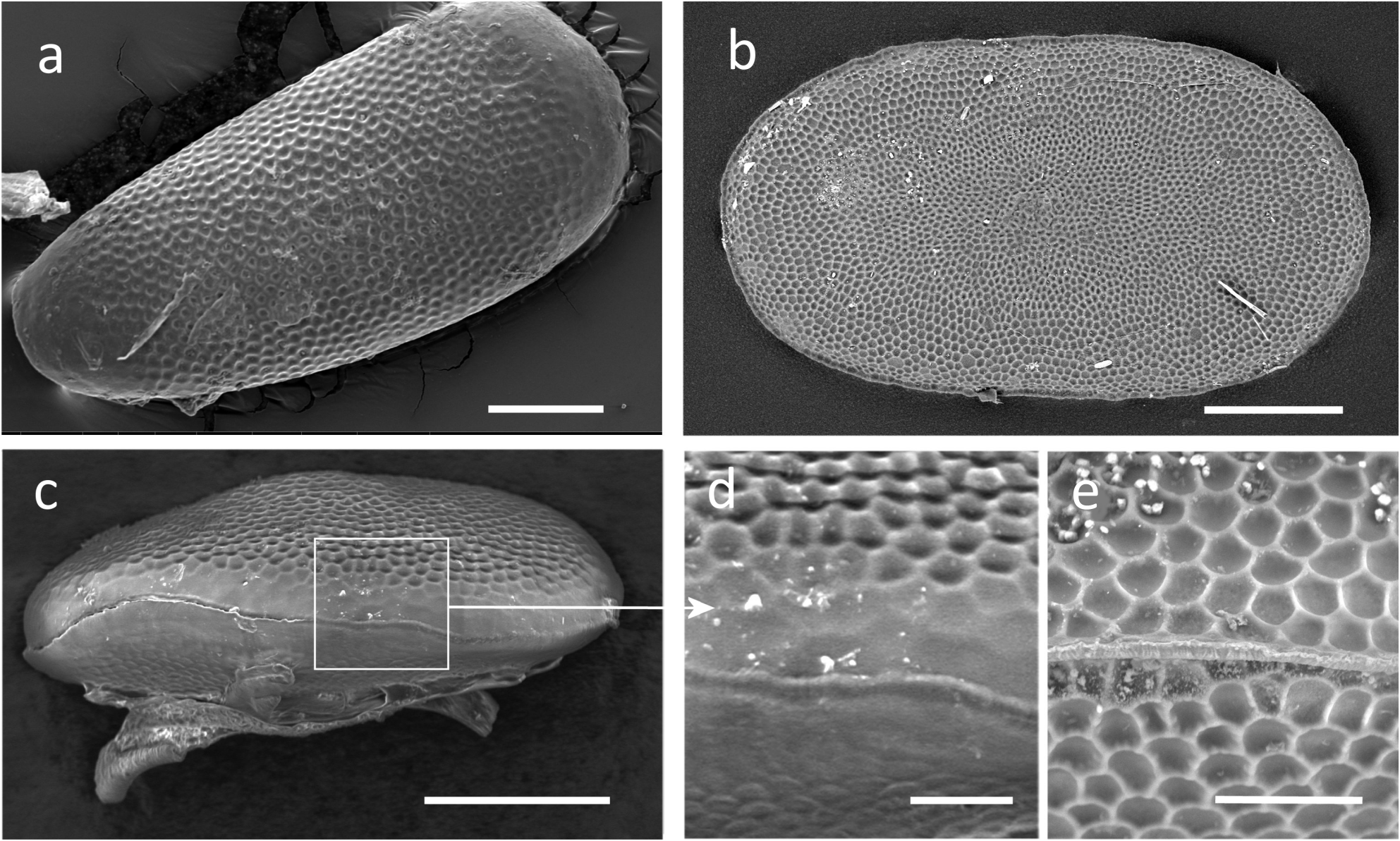
Remarks. Two other fredericellid species are known to have similar reticulation on the statoblast: (1) Fredericella crenulata DuBois-Reymond Marcus, 1946, known only from the vicinity of Lake Titicaca, the statoblast serrated around the entire suture (Fig. 13 c); (2) Fredericella indica Annandale, 1909, known only from India and Sri Lanka, the statoblast reticulation weakening and disappearing towards either side of the suture (Fig. 1 a, c, d).
Wood, Timothy S. (2022): Phylactolaemate bryozoans at the Zoological Survey of India and a taxonomic key to Indian Phylactolaemata. Zootaxa 5200 (2): 401-435, DOI: 10.11646/zootaxa.5200.5.1
Distribution. This is the dominant fredericellid in North America; it has also been reported from Germany (Massard & Geimer 1996), Japan (Hirose & Mawatari 2011 a), and Norway, especially north of the Arctic Circle (Økland & Økland 2001).
Wood, Timothy S. (2022): Phylactolaemate bryozoans at the Zoological Survey of India and a taxonomic key to Indian Phylactolaemata. Zootaxa 5200 (2): 401-435, DOI: 10.11646/zootaxa.5200.5.1
Etymology. The Latin borealis (northern) refers to the northern distribution of the species in North America and Europe, in contrast to F. indica, known so far only from the Indian subcontinent.
Wood, Timothy S. (2022): Phylactolaemate bryozoans at the Zoological Survey of India and a taxonomic key to Indian Phylactolaemata. Zootaxa 5200 (2): 401-435, DOI: 10.11646/zootaxa.5200.5.1
Holotype. NHMUK 2015.3. 14.1, Fredericella borealis, collected 23 September 1994 from traveling screens, Springfield City Water, Light & Power drawing water from Springfield Lake, Springfield, Illinois, USA (in ethanol).
Wood, Timothy S. (2022): Phylactolaemate bryozoans at the Zoological Survey of India and a taxonomic key to Indian Phylactolaemata. Zootaxa 5200 (2): 401-435, DOI: 10.11646/zootaxa.5200.5.1

Export occurrence data

Darwin Core Archive (ZIP)

CLASSIFICATION

Taxonomic Classification Tree

MULTIMEDIA

Media Files(3)

FIGURE 1. Fredericella statoblast valves with pitted exterior. (a) Fredericella indica statoblast valve showing a smooth surface at the ends, from Annandale’s type specimen, ZSI 3479, valve has curled upon drying; (b) Fredericella borealis showing pitted surface at the ends, from Magerøya Island, Norway; (c) Fredericella indica, lateral view showing smooth region near the suture, from NHMUK 1914.10.2.1, Colombo, Sri Lanka; (d) Enlargement of previous photo; (e) Enlarged view of suture area of F. borealis from Illinois, USA, showing reticulation extending to the suture. Scale bars for a–c = 100 µm, scale bars for d–e = 20 µm.

Imageimage/png© Wood, Timothy S.Wood, Timothy S.

FIGURE 12. Fredericella borealis n. sp. (a) A fragment of the holotype colony showing free branches and several statoblasts, scale bar = 3 mm; (b) A pair of separated valves showing reticulation extending to the suture, scale bar = 100 µm.

Imageimage/png© Wood, Timothy S.Wood, Timothy S.

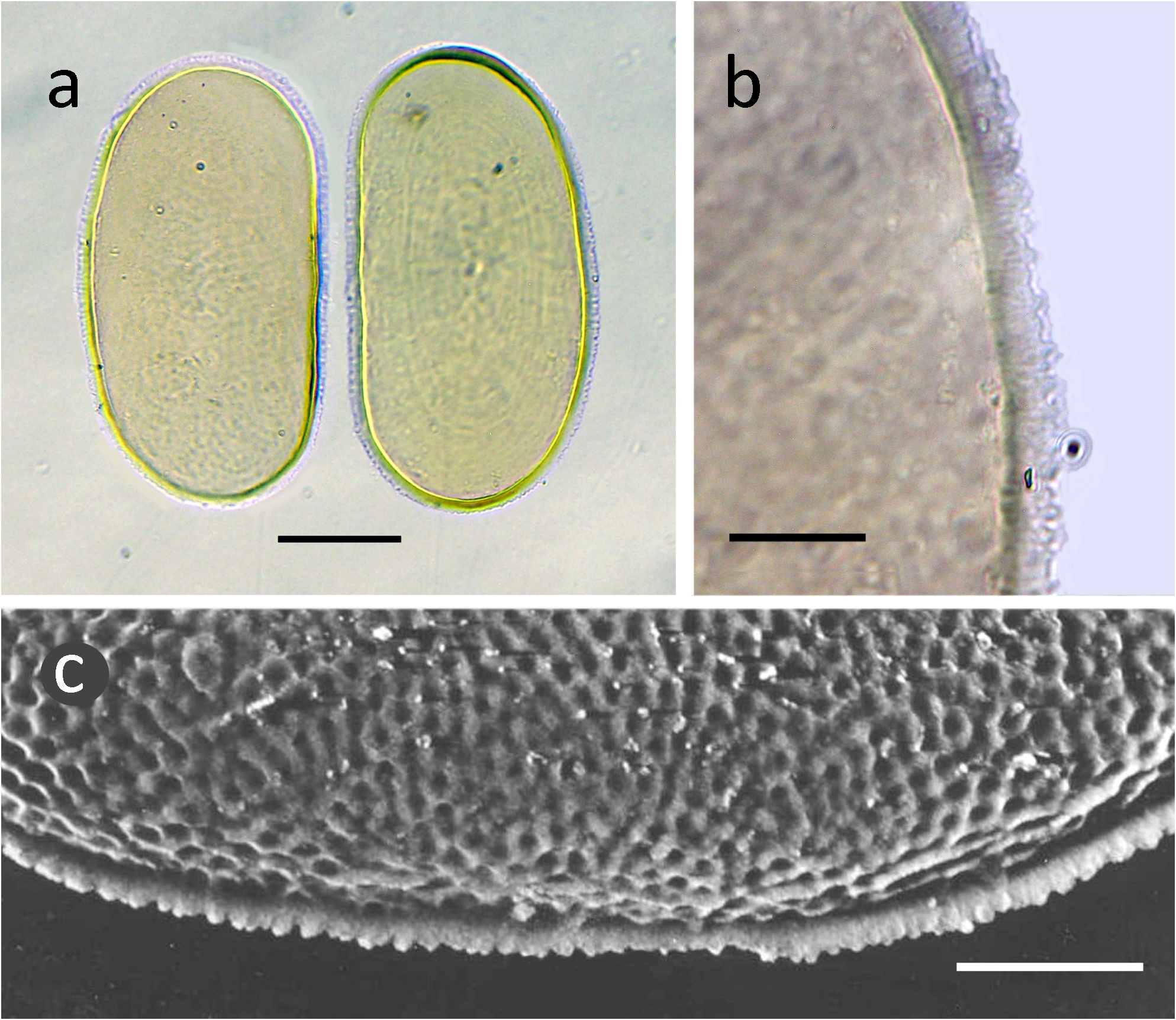
FIGURE 13. Fredericella carinata n. sp. (a) Pair of statoblast valves, scale bar = 100 µm; (b) Closer view with SEM showing a portion of the carina, scale bar = 30 µm; (c) Similar feature in Fredericella crenulata, scale bar = 15 µm.

Imageimage/png© Wood, Timothy S.Wood, Timothy S.

IMAGES

Gallery(3)

See Gallery

Occurrences with images

Source Information

Phylactolaemate bryozoans at the Zoological Survey of India and a taxonomic key to Indian Phylactolaemata

checklist

This dataset contains the digitized treatments in Plazi based on the original journal article Wood, Timothy S. (2022): Phylactolaemate bryozoans at the Zoological Survey of India and a taxonomic key to Indian Phylactolaemata. Zootaxa 5200 (2): 401-435, DOI: 10.11646/zootaxa.5200.5.1

Abstract

A review of the phylactolaemate (freshwater) bryozoan collection at the Zoological Survey of India in Kolkata reaches the following conclusions: (1) Fredericella indica Annandale, 1909 from the Indian subcontinent is not the same as the species widely known as F. indica from the northern temperate zones; the latter species name is now changed to Fredericella borealis; (2) Plumatella bigemmis Annandale, 1919 is a junior synonym of Plumatella fungosa Pallas, 1768; (3) Plumatellia persica Annandale, 1919 is a junior synonym of Plumatella casmiana Oka, 1907; (4) Plumatella (Afrindella) testudinicola Annandale, 1912 combines two previously known species: Plumatella bombayensis Annandale, 1908 and Plumatella casmiana Oka, 1907; (5) Rumarcanella minuta (Toriumi, 1941) is a junior synonym of Stolella himalayana Annandale, 1911 which now becomes Rumarcanella himalayana based on statoblast hypertubercles; (6) Plumatella longigemmis Annandale, 1915 and Hyalinella (Australella) indica Annandale, 1915 are both junior synonyms of Hyalinella lendenfeldi (Ridley, 1886); (7) Stolella indica Annandale, 1909, Swarupella andamanensis Rao, 1961 and Swarupella kasetsartensis Wood, 2006, may all be synonymous. The species Plumatella bombayensis is confirmed, and its holotype is re-described. In addition to Fredericella borealis four new species are presented: Plumatella crispa, P. dhritiae, P. paltensis and P. raoi. Validity is rejected for the genera Afrindella, Australella, Stolella, and Swarupella. The genera Rumarcanella and Varunella require refinement and documentation.A taxonomic key to the Indian Phylactolaemata concludes this paper.

Wood T S, plazi (2022). Phylactolaemate bryozoans at the Zoological Survey of India and a taxonomic key to Indian Phylactolaemata. Plazi.org taxonomic treatments database. Checklist dataset https://doi.org/10.15468/9ygzz4 accessed via GBIF.org on 2026-06-14.

CC0Published 11/1/2022View dataset
GBIF Usage Key
203932739
Dataset Key
58f68688-480d-45c7-bf1b-773e9dfd96a9
Origin
source
Backbone Key
11819770
Taxon ID
762C8786FFE7FFB22390F9EEA23E59E5.taxon
Last Crawled
6/9/2026
Last Interpreted
6/9/2026