
AnimaliaNot EvaluatedacceptedspeciesAccepted

Stolella himalayana
GBIF:203932754
0
Synonyms
ABOUT
Descriptions(4)
(Fig. 9) Original descriptions. Stolella himalayana: Annandale, 1911: p. 246, fig. 49; Annandale & Kemp 1912: p. 143.
Wood, Timothy S. (2022): Phylactolaemate bryozoans at the Zoological Survey of India and a taxonomic key to Indian Phylactolaemata. Zootaxa 5200 (2): 401-435, DOI: 10.11646/zootaxa.5200.5.1
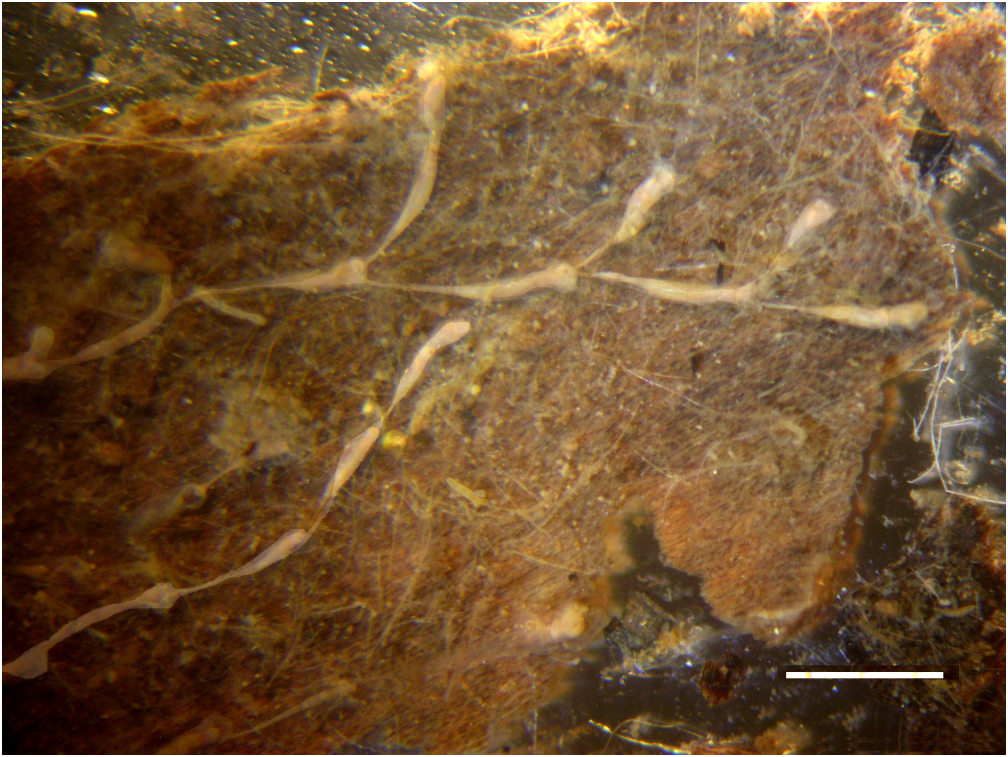
Remarks. At the ZSI there are two jars with the number ZEV 4813 / 7. In one is a large rock with a nice colony, but this is Plumatella casmiana with leptoblasts. It is the second jar with a smaller rock that contains the holotype. There is also another specimen: ZSI No. P 1388 / 1 collected 25 December 1958 at Dhakuria Lake, Kolkata by K. S. Rao and S. N. Paul. Annandale (1911) described this species as Stolella himalayana. At that time his attention was drawn to unusual colony morphology with “ zooecia joined together, often in groups of three, by slender, transparent, tubular processes often of great relative length. ” The processes were formed by certain greatly elongated zooids, which, according to Annandale, gave the colony superficial resemblance to the ctenostome, Paludicella articulata (Ehrenberg, 1831). Of the floatoblasts Annandale said only that they were similar to those of Stolella indica but perhaps more elongate. For the most part Annandale’s description and accompanying illustrations match the type specimens. Curiously, Annandale noted that “ only free statoblasts have been observed, ” while I encountered more sessoblasts than floatoblasts. Unexpectedly long zooids appear from time to time among plumatellid species. Wiebach (1964) found them in his Stolella indica, but his specimens from the Congo have mostly zooids of normal length and only a few elongated (Wood 2020). Colonies of Plumatella emarginata are normally compact, but occasionally grow long, free branches easily mistaken for fredericellid colonies (Wood & Okamura 2005). Even robust Plumatella vaihiriae Hastings, 1929 occasionally appears with zooids that are greatly elongated (Fig. 10). Colony morphology can be highly variable, as Toriumi (1955) pointed out when he re-described and illustrated Hyalinella minuta (Toriumi, 1941 a), a species with occasional elongated zooids and whose floatoblasts are identical to those of Annandale’s Stolella himalayana. Among phylactolaemate bryozoans floatoblasts have be found to carry the most reliable characters for species identification. In this species, the floatoblast features are quite distinctive: small size, fenestrae similar in size and shape, roughened suture, and hypertubercles.
Wood, Timothy S. (2022): Phylactolaemate bryozoans at the Zoological Survey of India and a taxonomic key to Indian Phylactolaemata. Zootaxa 5200 (2): 401-435, DOI: 10.11646/zootaxa.5200.5.1
Distribution. In India the species was first collected at Malwa Tal, a small village near Nainital in the foothills of the Himalaya Range, State of Uttarakhand, about 230 km northeast of New Delhi. Other sites include Kolkata (ZSI No. P 1388 / 1) and the State of Maharashtra (Swami et al. 2016 b). Beyond India the species has been reported from Australia (Mitra et al. 2013), Japan (Hirose & Mawatari 2011 b), Korea (Toriumi 1941 b), Thailand (Wood et al. 2006), and Taiwan (Toriumi 1942).
Wood, Timothy S. (2022): Phylactolaemate bryozoans at the Zoological Survey of India and a taxonomic key to Indian Phylactolaemata. Zootaxa 5200 (2): 401-435, DOI: 10.11646/zootaxa.5200.5.1
Type material. No. ZEV 4813 / 7 (holotype), collected May, 1911 at Malwa Tal, Kumaun, W. Himalayas (3,600 feet) by S. W. Kemp. Characterization. Colony entirely recumbent with no free branches, capable of forming a thin sheet over a wide substratum; body wall colorless, thick, tough, more or less transparent, sometimes with a faint raphe and furrow. Zooids sometimes strikingly elongate and tapered at their base. Floatoblasts small and broadly oval; fenestrae large and very similar on both valves, the dorsal fenestra width at least 80 % of floatoblast width (Fig. 9 a), both valves with faint tubercles easily visible with SEM, some tubercles bearing hypertubercles (one atop another) (Fig. 9 b, c); suture with irregular knots and spikes giving a serrated appearance in frontal view (Fig. 9 d, e); floatoblast dimensions shown in Table 1. Sessoblasts minutely reticulated, with tiny bright spots seen with compound microscopy like scattered tubercles, especially around the margins; sessoblast annulus thin and fragile. Status. Annandale’s S. himalayana appears to be synonymous with Hyalinella minuta (Toriumi, 1941 a) which is now listed in the genus Rumarcanella Hirose & Mawatari, 2011 b. Since Annandale’s species name has chronological priority, the species previously known as Rumarcanella minuta now becomes Rumarcanella himalayana (Annandale, 1911). Additional references. Plumatella punctata densa: Vorstman, 1928, p. 9, fig. 5; Plumatella repens var. minuta: Toriumi, 1941 a, p. 202, fig. 6; 1941 b, p. 417, fig. 4;
Wood, Timothy S. (2022): Phylactolaemate bryozoans at the Zoological Survey of India and a taxonomic key to Indian Phylactolaemata. Zootaxa 5200 (2): 401-435, DOI: 10.11646/zootaxa.5200.5.1
Export occurrence data
Darwin Core Archive (ZIP)
CLASSIFICATION
Taxonomic Classification Tree

NOMENCLATURE
Synonyms(1)
MULTIMEDIA
Media Files(2)
FIGURE 9. Stolella himalayana, holotype, now Rumarcanella himalayana, Specimen No. P1388. (a) Floatoblast valves, scale bar = 100 µm; (b) SEM image of a floatoblast dorsal valve; (c) close-up of a portion of the floatoblast fenestra showing hypertubercles, the key feature of the genus Rumarcanella, scale bar = 10 µm; (d) Floatoblast suture showing the very lumpy structure; (e) Detail of the floatoblast profile showing the serrated appearance, scale bar = 10 µm.
Imageimage/png© Wood, Timothy S.Wood, Timothy S.
IMAGES