
AnimaliaNot EvaluatedacceptedspeciesAccepted
Plumatella dhritiae
Wood, 2022
GBIF:203932758
0year
ABOUT
Descriptions(7)
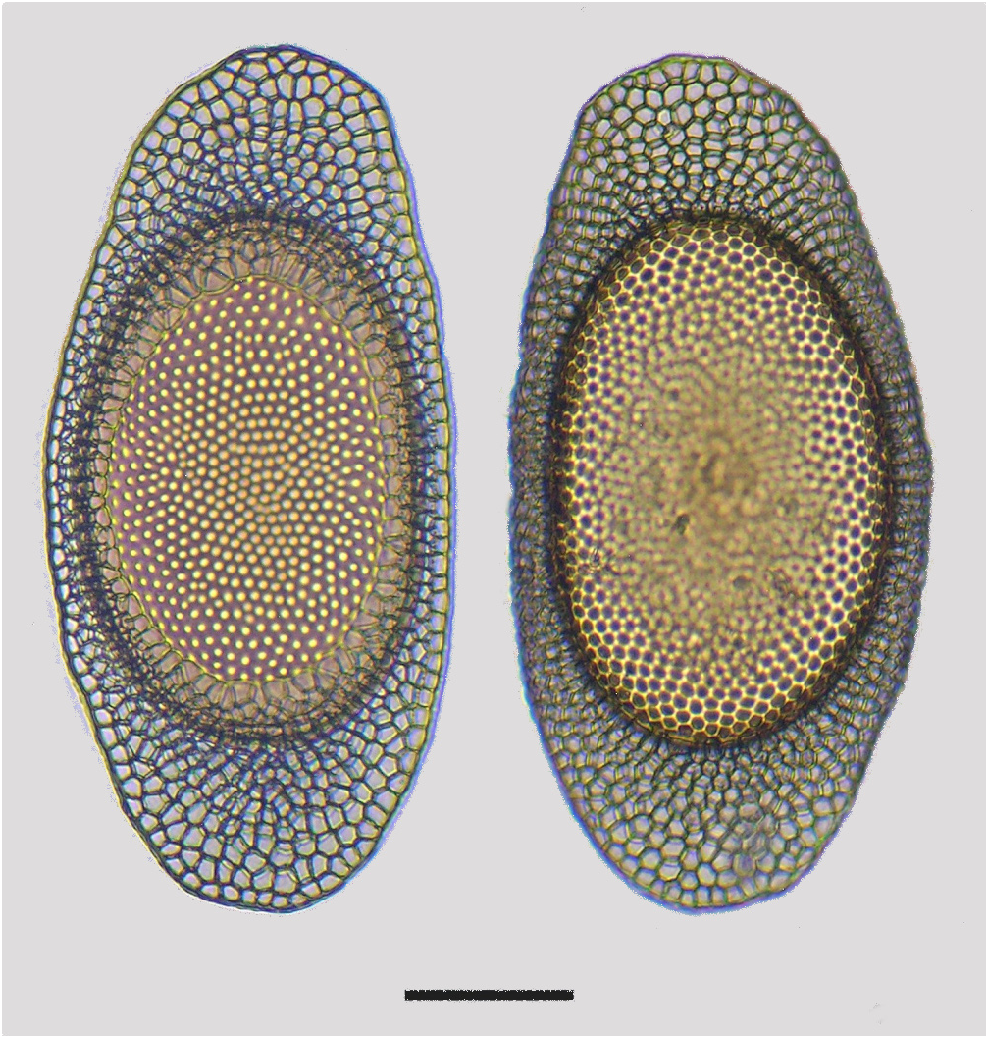
(Fig. 14)
Wood, Timothy S. (2022): Phylactolaemate bryozoans at the Zoological Survey of India and a taxonomic key to Indian Phylactolaemata. Zootaxa 5200 (2): 401-435, DOI: 10.11646/zootaxa.5200.5.1
Description. Colony wall soft, thick and colorless, without a sharp distinction between the nonliving ectocyst and inner living tissues. Floatoblast length around 500 μm, and nearly twice the width (see Table 1), with a straight taper from midpoint to rounded poles, the overall shape giving the impression of the capsule bulging at the center; floatoblast ventral valve convex, dorsal valve nearly flat; dorsal fenestra length slightly less than half floatoblast length, with well defined tubercles spaced more widely near margins with increasing density towards the center; ventral fenestra length slightly greater than half floatoblast length, with tubercles similar to dorsal fenestra.
Wood, Timothy S. (2022): Phylactolaemate bryozoans at the Zoological Survey of India and a taxonomic key to Indian Phylactolaemata. Zootaxa 5200 (2): 401-435, DOI: 10.11646/zootaxa.5200.5.1
Diagnosis. The species distinguished by the unusual length of free statoblasts (exceeding 450 µm) combined with a relatively large dorsal fenestra.
Wood, Timothy S. (2022): Phylactolaemate bryozoans at the Zoological Survey of India and a taxonomic key to Indian Phylactolaemata. Zootaxa 5200 (2): 401-435, DOI: 10.11646/zootaxa.5200.5.1
Remarks. The holotype includes abundant floatoblasts but no sessoblasts. Floatoblasts appear very similar to those of Plumatella pseudostolonata Borg, 1940 from East Africa, except for being much larger: for P. pseudostolonata the average floatoblast dimensions are said to be 383 by 294 µm (Borg 1940) compared to 489 by 250 for P. dhritiae n. sp. (Table 1). Moreover, the ectocyst of P. pseudostolonata is said to be “ chitinous – not gelatinous (and initially) quite transparent and nearly colorless but with increasing age it becomes gradually darker until in old ones it is blackish brown though still semitransparent ” (Borg 1940). In P. dhritiae n. sp. there is no indication that the ectocyst is anything other than soft and colorless. Other similar species include Plumatella bombayensis Annandale, 1910 and P. mukaii Wood, 2001. However, both species have an outer nonliving ectocyst easily distinguished from underlying tissues; both have a floatoblast dorsal fenestra width less than 30 % the overall floatoblast width. The P. bombayensis floatoblast ventral fenestra is reticulated and lacking tubercles; P. mukaii floatoblast length never exceeds 450 μm.
Wood, Timothy S. (2022): Phylactolaemate bryozoans at the Zoological Survey of India and a taxonomic key to Indian Phylactolaemata. Zootaxa 5200 (2): 401-435, DOI: 10.11646/zootaxa.5200.5.1
Distribution. The species is known only from its type locality in Burma (Myanmar).
Wood, Timothy S. (2022): Phylactolaemate bryozoans at the Zoological Survey of India and a taxonomic key to Indian Phylactolaemata. Zootaxa 5200 (2): 401-435, DOI: 10.11646/zootaxa.5200.5.1
Etymology. The specific epithet honors Dr. Dhriti Banerjee, an accomplished entomologist and the first female Director of the Zoological Survey of India.
Wood, Timothy S. (2022): Phylactolaemate bryozoans at the Zoological Survey of India and a taxonomic key to Indian Phylactolaemata. Zootaxa 5200 (2): 401-435, DOI: 10.11646/zootaxa.5200.5.1
Holotype. ZSI P 1189 / 1 collected 4 December 1949 from a weedy tank at Mongyai, Shan State, Burma, by H. S. Rao and B. Chopra, originally labeled Plumatella emarginata. ZSI 1190 is a paratype.
Wood, Timothy S. (2022): Phylactolaemate bryozoans at the Zoological Survey of India and a taxonomic key to Indian Phylactolaemata. Zootaxa 5200 (2): 401-435, DOI: 10.11646/zootaxa.5200.5.1
Export occurrence data
Darwin Core Archive (ZIP)
CLASSIFICATION
Taxonomic Classification Tree

IMAGES