
AnimaliaNot EvaluatedacceptedspeciesAccepted
Plumatella bigemmis
Annandale, 1919
GBIF:203932763
0year
ABOUT
Descriptions(4)
(Fig. 3) Original description. Annandale, 1919, p. 94 – 96, figs 1 – 3
Wood, Timothy S. (2022): Phylactolaemate bryozoans at the Zoological Survey of India and a taxonomic key to Indian Phylactolaemata. Zootaxa 5200 (2): 401-435, DOI: 10.11646/zootaxa.5200.5.1
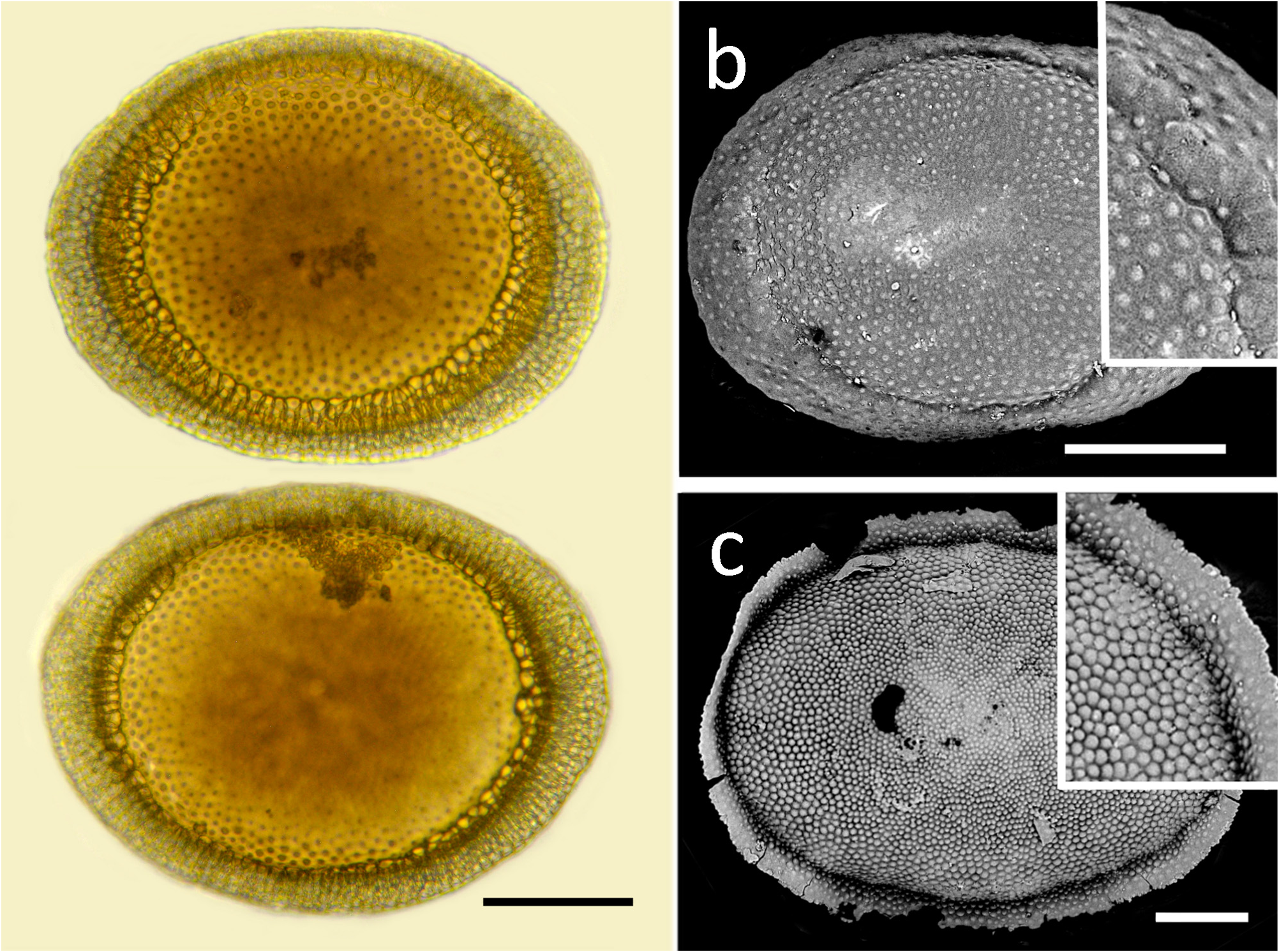
Remarks. Annandale measured the floatoblast length as 357 – 374 µm and the width 255 – 272 µm. My measurements are similar (Table 1). The dorsal fenestra is rather large at 230 by 190 µm and the ventral fenestra measures 255 by 220 µm. My measurement of a single sessoblast was 570 µm long by 460 µm wide. The small floatoblast with its interstitial tubercles together with the relatively large sessoblast place the holotype specimen in the “ Plumatella repens group. ” Species in this group include P. repens (Linnaeus, 1758), P. fungosa (Pallas, 1768), P. rugosa Wood, et al. 1998, and P. nitens Wood, 1996. These species can be distinguished with certainty only by an examination of the floatoblast using SEM. The presence of tubercles on the floatoblast annulus of the P. bigemmis holotype (Fig. 3 b) identifies the species as P. fungosa, capable of forming solid structures several centimeters thick. The toothed margin of the sessoblast annulus (Fig. 3 c) further supports the identification of P. fungosa. The original description by Annandale (1919) is entirely consistent with the thick, compact nature of P. fungosa colonies. “ As the colony develops, the zooecia are pressed together into a compact layer, ” he writes. “ The individual zooecia maintain their identity, but their ectocyst is so thick that their openings have in more congested parts of the colony a honeycomb-like appearance. ” He notes that the ectocyst is “ usually quite hyaline and colourless, but it is sometimes darkened towards the distal extremity of the zooecia. ” However, two features distinguish this specimen from the classic European form of P. fungosa. First, the floatoblast dorsal fenestra of Annandale’s material is large, the width being about 70 % of the overall floatoblast width compared to about 55 % or less in P. fungosa (Geimer & Massard 1986; Wood & Okamura 2005). Second, the sessoblast annulus of Annandale’s specimen bears prominent tubercles on both sides, while in P. fungosa from Luxembourg the annulus has been shown to be reticulated (Geimer & Massard 1986). In my opinion these subtle features do not override the conclusion that P. bigemmis is a junior synonym of P. fungosa.
Wood, Timothy S. (2022): Phylactolaemate bryozoans at the Zoological Survey of India and a taxonomic key to Indian Phylactolaemata. Zootaxa 5200 (2): 401-435, DOI: 10.11646/zootaxa.5200.5.1
Distribution. The specimen came from a site in southeastern Iran near the border with Afghanistan. It is one of three reservoirs in the Chah Nimeh system used for irrigation for the Sistan Plain, fed by the Hirmand River in Sistan-Baluchestan Province. Plumatella fungosa is widespread throughout the temperate regions of North America, Europe, Asia, and Australia. This would be the first reported occurrence from Western Asia.
Wood, Timothy S. (2022): Phylactolaemate bryozoans at the Zoological Survey of India and a taxonomic key to Indian Phylactolaemata. Zootaxa 5200 (2): 401-435, DOI: 10.11646/zootaxa.5200.5.1
Type material. Specimen No. P 92 / 1 (holotype) collected 8 December 1918 at Hamun-i-Helmand near Labibaring, Seistan, E. Persia, by Nelson Annandale and Stanley Wells Kemp. Characterization. Zooids lying flat against the substratum in parallel lines, ectocyst smooth, firm, and transparent; floatoblasts small and broadly oval (Table 1), the fenestrae showing a low, reticulated relief with interstitial tubercles, tubercles continuing onto the annulus itself with no diminution in size or spacing (Fig. 3 b); sessoblasts measuring around 550 µm in length, heavily tuberculated on the frontal valve, outer wall, and on both sides of the annulus; sessoblast annulus finely and unevenly serrated along the outer margin. Status. The specimen belongs to Plumatella fungosa (Pallas, 1768).
Wood, Timothy S. (2022): Phylactolaemate bryozoans at the Zoological Survey of India and a taxonomic key to Indian Phylactolaemata. Zootaxa 5200 (2): 401-435, DOI: 10.11646/zootaxa.5200.5.1
Export occurrence data
Darwin Core Archive (ZIP)
CLASSIFICATION
Taxonomic Classification Tree

MULTIMEDIA
Media Files(1)
FIGURE 3. Statoblasts from specimen P92 labeled Plumatella bigemmis (Holotype), now identified as Plumatella fungosa. a) Floatoblast valves with dorsal valve above, ventral valve below; b) Scanning electron micrograph of floatoblast ventral valve with inset showing tubercles on the annulus; c) Scanning electron micrograph of sessoblast with inset showing tubercles on annulus. All scale bars = 100 µm.
Imageimage/png© Wood, Timothy S.Wood, Timothy S.
IMAGES