
AnimaliaNot EvaluatedacceptedspeciesAccepted
Webbnesia maculata

Webbnesia maculata

Núñez, Barnich & Monterroso, 2022

GBIF:203960334

0year

ABOUT

Descriptions(6)

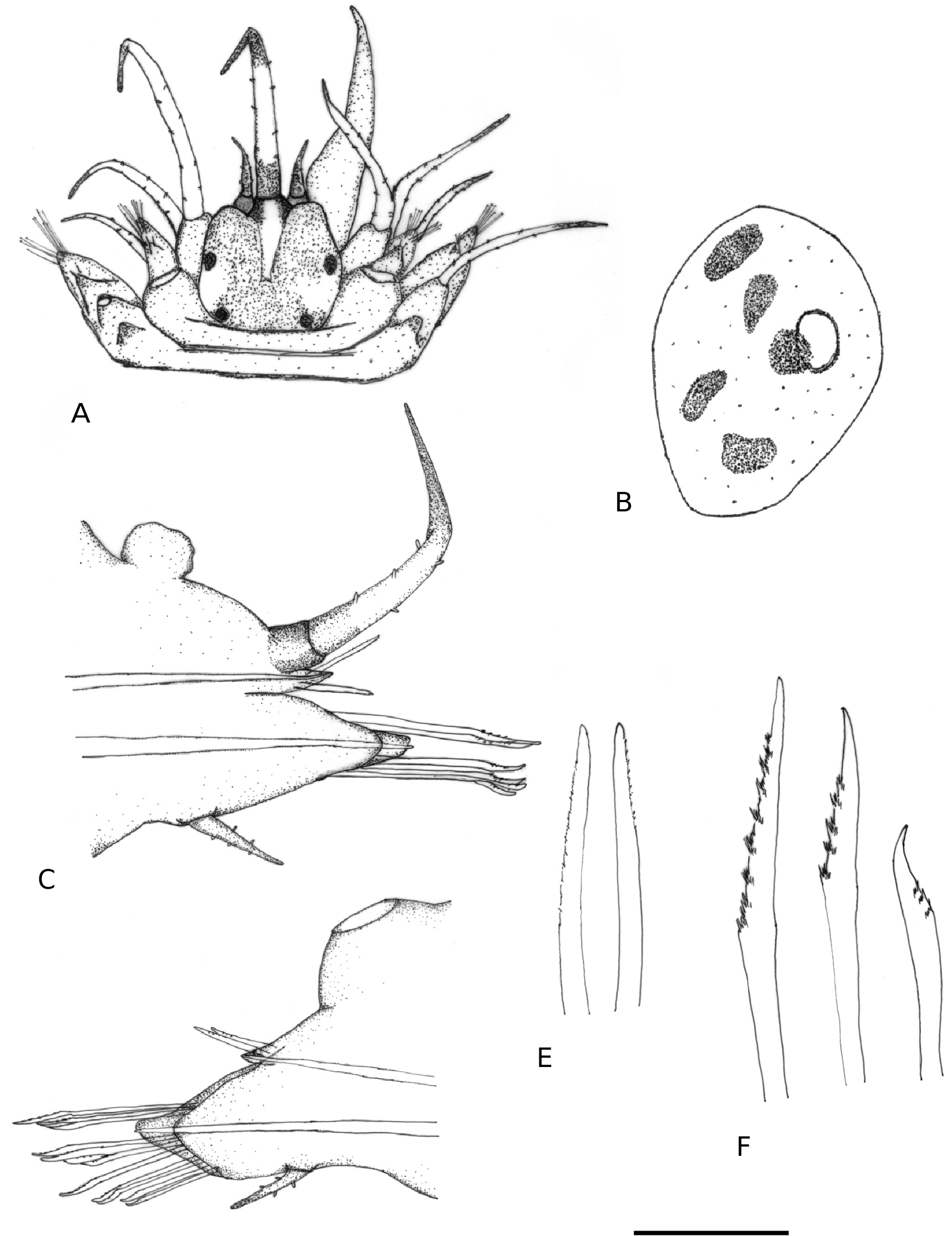
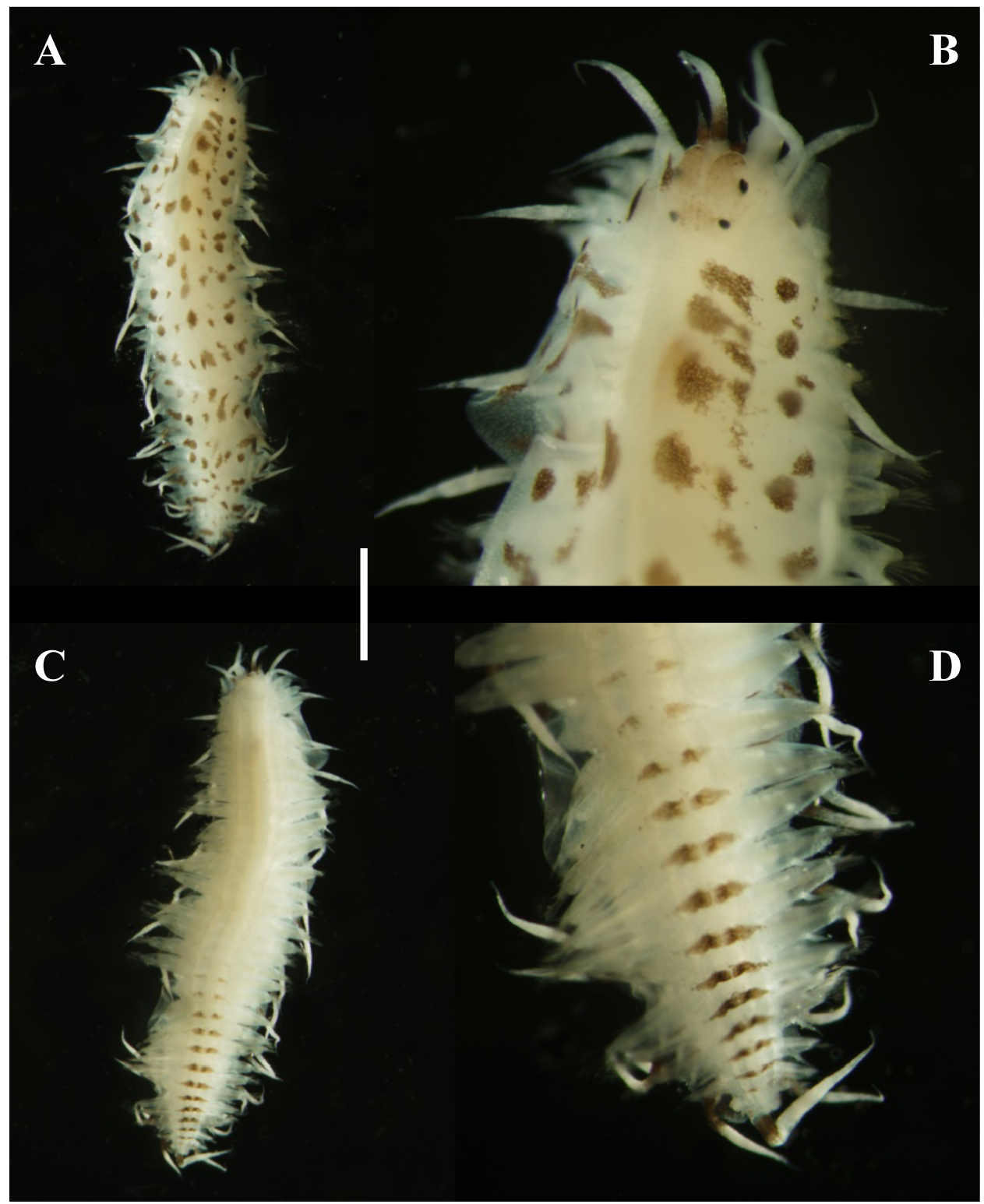
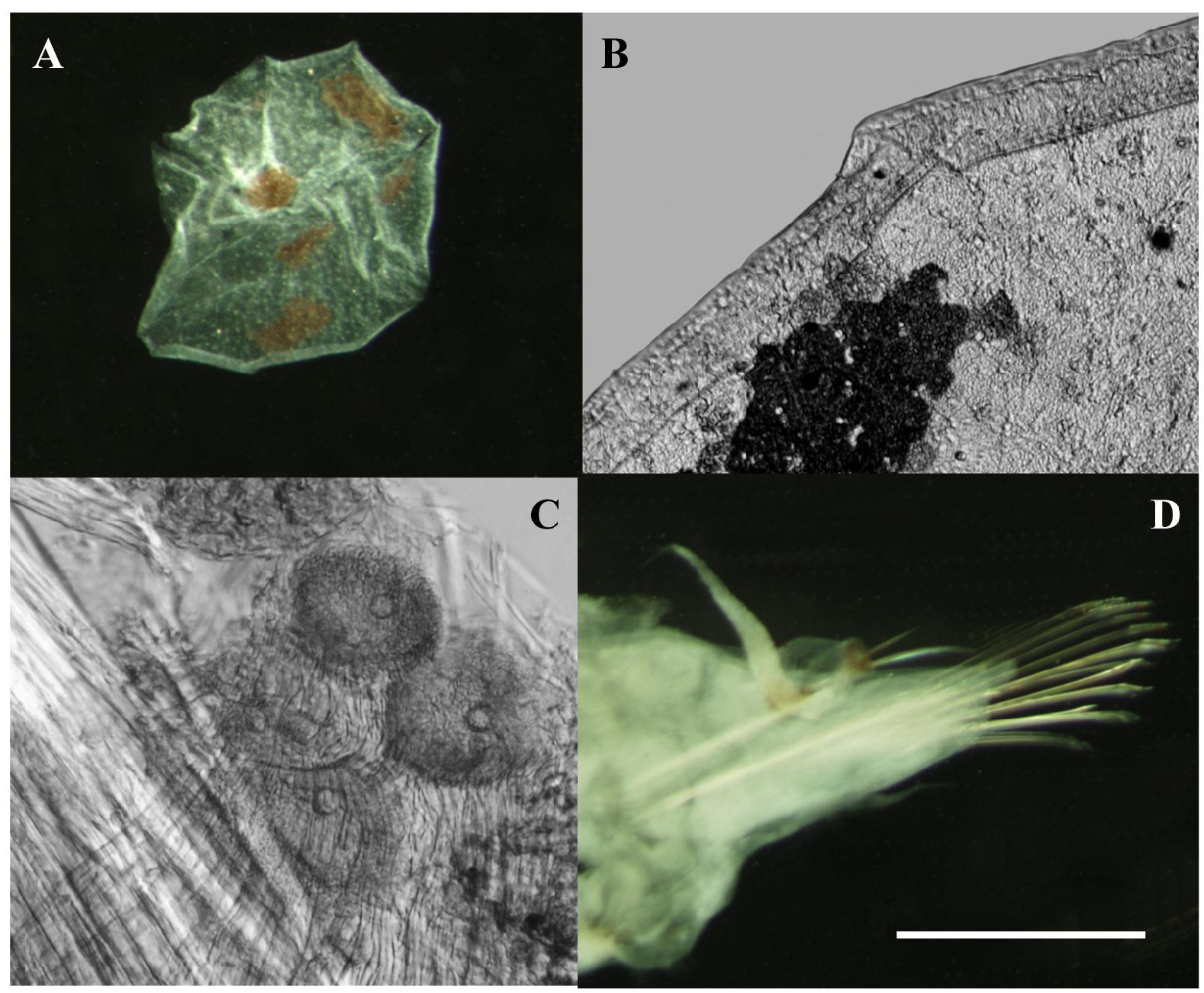
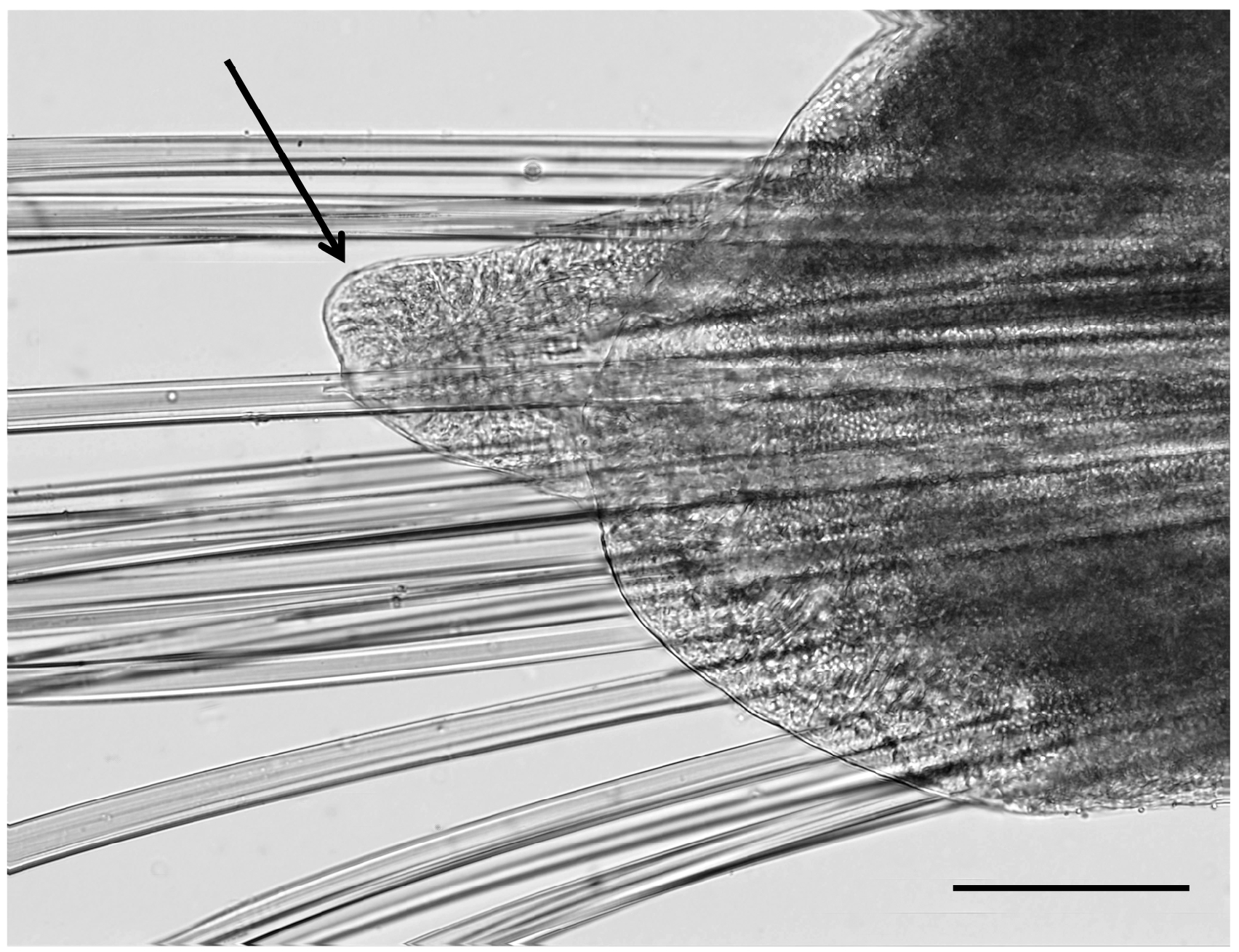
Description of holotype MEASUREMENTS. Holotype, complete specimen of 8 mm length and 2 mm width in anterior body region. BODY. Flattened dorsoventrally, short, with 33 segments, dorsum covered by elytra (Fig. 3 A); ovigerous female (Fig. 4 C – D). PROSTOMIUM. Cephalic peaks absent, lobes anteriorly rounded. Median antenna with ceratophore in anterior notch, style tapering, papillate; lateral antennae with ceratophores inserted ventrally, styles tapering, papillate. Anterior pair of eyes dorsolateral in front of widest part of prostomium, posterior pair dorsal near posterior margin (Figs 2 A, 3 B). TENTACULOPHORES. Inserted laterally to prostomium, with a pair of dorsal and ventral tentacular cirri; styles tapering, papillate (Figs 2 A, 3 B). ELYTRA. Fifteen pairs on segments 2, 4, 5, 7, 9, 11, 13, 15, 17, 19, 21, 23, 26, 29 and 32. Elytral margins smooth; surface with scattered, conical microtubercles and five pigmented patches (Figs 2 B, 3 A – B, 4 A – B). CIRRI. Dorsal cirri from segment 3 on segments without elytra; cirrophore inserted dorsally on notopodium; style tapering, papillate (Figs 2 A, C, 3 A – D, 4 D). Ventral cirri from segment 2 on all segments; first pair distinctly larger than following; style tapering, papillate (Figs 2 C, 3 D). Pair of pygidial cirri similar to dorsal cirri. DORSAL TUBERCLES. Conical, one pair present on all cirrigerous segments, situated on dorsum in line with elytrophores of adjacent segments (Fig. 2 A, C). PARAPODIA. Notopodium reduced, with notoaciculum penetrating distally (may be withdrawn). Neuropodium more prominent, with elongate, conical prechaetal lobe and shorter, rounded postchaetal lobe; prechaetal lobe acicular with minute (i. e., reduced) supra-acicular process and neuroaciculum penetrating subdistally (Figs 2 C – D, 4 D, 5). CHAETAE. Notochaetae few (2 – 3), stout, with faint rows of spines and blunt, entire tip (Figs 2 C – E, 6 A). Neurochaetae more numerous (up to 18), stout, with falcate, entire (i. e., unidentate) tip; upper neurochaetae distally rather straight and spinose region elongate with pronounced rows of spines; middle and lower neurochaetae distally more curved and spinose region shorter with less marked rows of spines (Figs 2 C – D, F, 4 D, 6 B – D). Pigmentation (animals preserved) (Figs 2 A – B, 3 A – D, 4 A) Body dorsally mostly white with brown patches; ventrally with 13 intersegmental, incomplete transverse bands in posterior body region. Prostomial lobes with diffuse pigmentation; basal part of median antenna and all of lateral antennae darkly pigmented. Tentacular cirri unpigmented. Dorsal and ventral cirri pigmented basally throughout body, also pygidial cirri similarly pigmented. Elytra usually with five pigmented patches: one circular above place of attachement to elytrophore, the others irregularlyshaped, two on the inner lateral part and two on the posterior part.
Núñez, Jorge, Barnich, Ruth, Monterroso, Óscar (2022): A new genus and species of Polynoidae (Annelida: Polychaeta) from the Canary Islands, and update on taxa present in the Northeast Atlantic. European Journal of Taxonomy 846 (1): 55-74, DOI: 10.5852/ejt.2022.846.1965, URL: http://dx.doi.org/10.5852/ejt.2022.846.1965
urn: lsid: zoobank. org: act: 3128 B 356 - 28 DC- 4072 - BC 95 - 7 DC 8454 AC 1 D 3 Figs 2 – 6, Tables 2 – 3
Núñez, Jorge, Barnich, Ruth, Monterroso, Óscar (2022): A new genus and species of Polynoidae (Annelida: Polychaeta) from the Canary Islands, and update on taxa present in the Northeast Atlantic. European Journal of Taxonomy 846 (1): 55-74, DOI: 10.5852/ejt.2022.846.1965, URL: http://dx.doi.org/10.5852/ejt.2022.846.1965
Diagnosis PROSTOMIUM. Without cephalic peaks. Lateral antennae inserted ventrally. Two pairs of eyes, anterior pair dorsolateral, posterior pair dorsal. ELYTRA. With smooth margins, surface with scattered, conical microtubercles and pigmented patches. ANTENNAE AND CIRRI. Tapering, papillate. PARAPODIA. With reduced notopodium and prominent neuropodium; neuropodium with minute (i. e., reduced) supra-acicular process, aciculum penetrating subdistally. CHAETAE. Notochaetae stout with faint rows of spines and entire tip. Neurochaetae stout with distinct rows of spines and falcate, entire tip.
Núñez, Jorge, Barnich, Ruth, Monterroso, Óscar (2022): A new genus and species of Polynoidae (Annelida: Polychaeta) from the Canary Islands, and update on taxa present in the Northeast Atlantic. European Journal of Taxonomy 846 (1): 55-74, DOI: 10.5852/ejt.2022.846.1965, URL: http://dx.doi.org/10.5852/ejt.2022.846.1965
Distribution and habitat NE Atlantic, Canary Islands: E and S of Gran Canaria and S of Tenerife; in 22 to 60 m depth. The substrate at the Tufía station is characterised by areas of fine sand and poorly consolidated maerl. The faunal composition is dominated by the polychaetes Paradoneis armata Glémarec, 1966 and Aponuphis ornata (Fauvel, 1928) and the crustaceans Apseudopsis rogi Esquete, 2016 and Urothoe marina (Spence Bate, 1857). At the Castillo del Romeral stations the substrate is characterised by gravel and coarse organogenic sand. The dominant polychaetes are Pisione guanche San Martín, López & Núñez, 1999 and Syllis gerundensis (Alós & Campoy, 1981); the most abundant species are the bivalve Gouldia minima (Montagu, 1803) and the amphipod Photis longicaudata (Spence Bate & Westwood, 1862). At the Granadilla station the substrate is characterised by maerl and coarse sand. The faunal composition is dominated by the amphipod Animoceradocus semiserratus (Spence Bate, 1862) and the polychaetes Chone filicaudata Southern, 1914 and Aponuphis bilineata (Baird, 1870).
Núñez, Jorge, Barnich, Ruth, Monterroso, Óscar (2022): A new genus and species of Polynoidae (Annelida: Polychaeta) from the Canary Islands, and update on taxa present in the Northeast Atlantic. European Journal of Taxonomy 846 (1): 55-74, DOI: 10.5852/ejt.2022.846.1965, URL: http://dx.doi.org/10.5852/ejt.2022.846.1965
Etymology The species epithet refers to the characteristic pigmented patches on the elytra, described by the Latin word ‘ maculatus ’ in its female form.
Núñez, Jorge, Barnich, Ruth, Monterroso, Óscar (2022): A new genus and species of Polynoidae (Annelida: Polychaeta) from the Canary Islands, and update on taxa present in the Northeast Atlantic. European Journal of Taxonomy 846 (1): 55-74, DOI: 10.5852/ejt.2022.846.1965, URL: http://dx.doi.org/10.5852/ejt.2022.846.1965
Material examined Holotype CANARY ISLANDS • ovigerous ♀ (complete, with 33 segments); NE Atlantic, east coast of Gran Canaria, off Tufía; 27 ° 57.91 ′ N, 15 ° 22.63 ′ W; 27 m depth; Feb. 2019; fine sands; TFMCBM-AN / 246. Paratypes CANARY ISLANDS • 1 spec. (anterior fragment of 11 segments); NE Atlantic, south coast of Gran Canaria, off Castillo del Romeral; 27 ° 47.79 ′ N, 15 ° 24.40 ′ W; 39 m depth; Oct. 2020; coarse sands; TFMCBM-AN / 247 • 1 spec. (posterior fragment of 12 segments); NE Atlantic, south coast of Gran Canaria, off Castillo del Romeral; 27 ° 47.73 ′ N, 15 ° 23.49 ′ W; 60 m depth; Oct. 2020; coarse sands; TFMCBM-AN / 248 • 1 spec. (anterior fragment of 16 segments); NE Atlantic, south coast of Tenerife, off Granadilla; 28 ° 3.56 ′ N, 16 ° 30.20 ′ W; 22 m depth; 18 Sep. 2013; coarse sands; SMF 32262.
Núñez, Jorge, Barnich, Ruth, Monterroso, Óscar (2022): A new genus and species of Polynoidae (Annelida: Polychaeta) from the Canary Islands, and update on taxa present in the Northeast Atlantic. European Journal of Taxonomy 846 (1): 55-74, DOI: 10.5852/ejt.2022.846.1965, URL: http://dx.doi.org/10.5852/ejt.2022.846.1965

Export occurrence data

Darwin Core Archive (ZIP)

CLASSIFICATION

Taxonomic Classification Tree

MULTIMEDIA

Media Files(5)

Fig. 2. Webbnesia maculata gen. et sp. nov., holotype (TFMCBM-AN/246). A. Anterior end, elytra removed and left dorsal cirrus of segment 3 missing.B. Right elytron of segment 21. C. Right cirrigerous parapodium of segment 20, posterior view. D. Left elytragerous parapodium of segment 21, posterior view. E. Notochaetae. F. Upper, middle and lower neurochaetae. Scale bar: A= 1.3 mm; B = 1.9 mm; C–D = 0.4 mm; E–F = 40 µm.
Imageimage/png© Núñez, Jorge;Barnich, Ruth;Monterroso, ÓscarNúñez, Jorge;Barnich, Ruth;Monterroso, Óscar

Fig. 3. Webbnesia maculata gen. et sp. nov., holotype (TFMCBM-AN/246). A. Complete specimen, dorsal view. B. Anterior end, dorsal view. C. Complete specimen, ventral view. D. Posterior end, ventral view. Scale bar: A, C = 2 mm; B = 0.6 mm; D = 0.8 mm.
Imageimage/png© Núñez, Jorge;Barnich, Ruth;Monterroso, ÓscarNúñez, Jorge;Barnich, Ruth;Monterroso, Óscar

Fig. 4. Webbnesia maculata gen. et sp. nov., holotype (TFMCBM-AN/246). A. Left elytron of segment 21. B. Elytral margin with part of pigmented patch. C. Eggs within parapodium. D. Right cirrigerous parapodium of segment 20, with eggs in basal part. Scale bar: A = 1.6 mm; B–C = 200 µm; D = 0.5 mm.
Imageimage/png© Núñez, Jorge;Barnich, Ruth;Monterroso, ÓscarNúñez, Jorge;Barnich, Ruth;Monterroso, Óscar

Fig. 5. Webbnesia maculata gen. et sp. nov., holotype (TFMCBM-AN/246). Distal part of neuropodium (posterior view), showing shorter rounded postchaetal lobe and elongate prechaetal acicular lobe with minute supra-acicular process (arrow). Scale bar = 70 µm.

Imageimage/png© Núñez, Jorge;Barnich, Ruth;Monterroso, ÓscarNúñez, Jorge;Barnich, Ruth;Monterroso, Óscar

Fig. 6. Webbnesia maculata gen. et sp. nov., holotype (TFMCBM-AN/246). A. Notochaetae. B. Upper, middle and lower neurochaetae. C. Distal part of upper and middle neurochaetae. D. Distal part of lower neurochaetae. Scale bar: A, C–D = 40 µm; B = 20 µm.

Imageimage/png© Núñez, Jorge;Barnich, Ruth;Monterroso, ÓscarNúñez, Jorge;Barnich, Ruth;Monterroso, Óscar

IMAGES

Gallery(5)

See Gallery

Occurrences with images

Source Information

A new genus and species of Polynoidae (Annelida: Polychaeta) from the Canary Islands, and update on taxa present in the Northeast Atlantic

checklist

This dataset contains the digitized treatments in Plazi based on the original journal article Núñez, Jorge, Barnich, Ruth, Monterroso, Óscar (2022): A new genus and species of Polynoidae (Annelida: Polychaeta) from the Canary Islands, and update on taxa present in the Northeast Atlantic. European Journal of Taxonomy 846 (1): 55-74, DOI: 10.5852/ejt.2022.846.1965, URL: http://dx.doi.org/10.5852/ejt.2022.846.1965

Abstract. A new polynoid, Webbnesia maculata gen. et sp. nov., was discovered during benthic surveys conducted around the Canary Islands. Its generic characters (absence of cephalic peaks, ventrally inserted lateral antennae, reduced notopodium and chaetae all stout) place it close to Antinoe Kinberg, 1856, Hermadion Kinberg, 1856 and Malmgrenia McIntosh, 1874, but the combination is unique and justifies the erection of a new genus. The new genus and species are described, figured and discussed in detail. An updated list of taxa and an identification key to all genera of Polynoinae Kinberg, 1856 sensu lato currently reported from the extended Northeast Atlantic are given.

Núñez J, Barnich R, Monterroso Ó, felipe (2022). A new genus and species of Polynoidae (Annelida: Polychaeta) from the Canary Islands, and update on taxa present in the Northeast Atlantic. European Journal of Taxonomy. Checklist dataset https://doi.org/10.15468/87cntb accessed via GBIF.org on 2026-06-15.

CC0Published 11/1/2022View dataset
GBIF Usage Key
203960334
Dataset Key
00433ad2-66ba-490c-8b61-cb62f64a56ba
Origin
source
Backbone Key
11667002
Taxon ID
039B92151733FFBEFDF20284FB8EFC09.taxon
Last Crawled
6/9/2026
Last Interpreted
6/9/2026