
AnimaliaNot EvaluatedacceptedspeciesAccepted
Aphanipathes flailum

Aphanipathes flailum

Horowitz, Opresko, Molodtsova, Beaman, Cowman & Bridge, 2022

GBIF:205135212

0year

ABOUT

Descriptions(9)

(Figs. 1 – 2 and 6; Supplementary Table 1)
Horowitz, Jeremy, Opresko, Dennis, Molodtsova, Tina N., Beaman, Robin J., Cowman, Peter F., Bridge, Tom C. L. (2022): Five new species of black coral (Anthozoa; Antipatharia) from the Great Barrier Reef and Coral Sea, Australia. Zootaxa 5213 (1): 1-35, DOI: 10.11646/zootaxa.5213.1.1
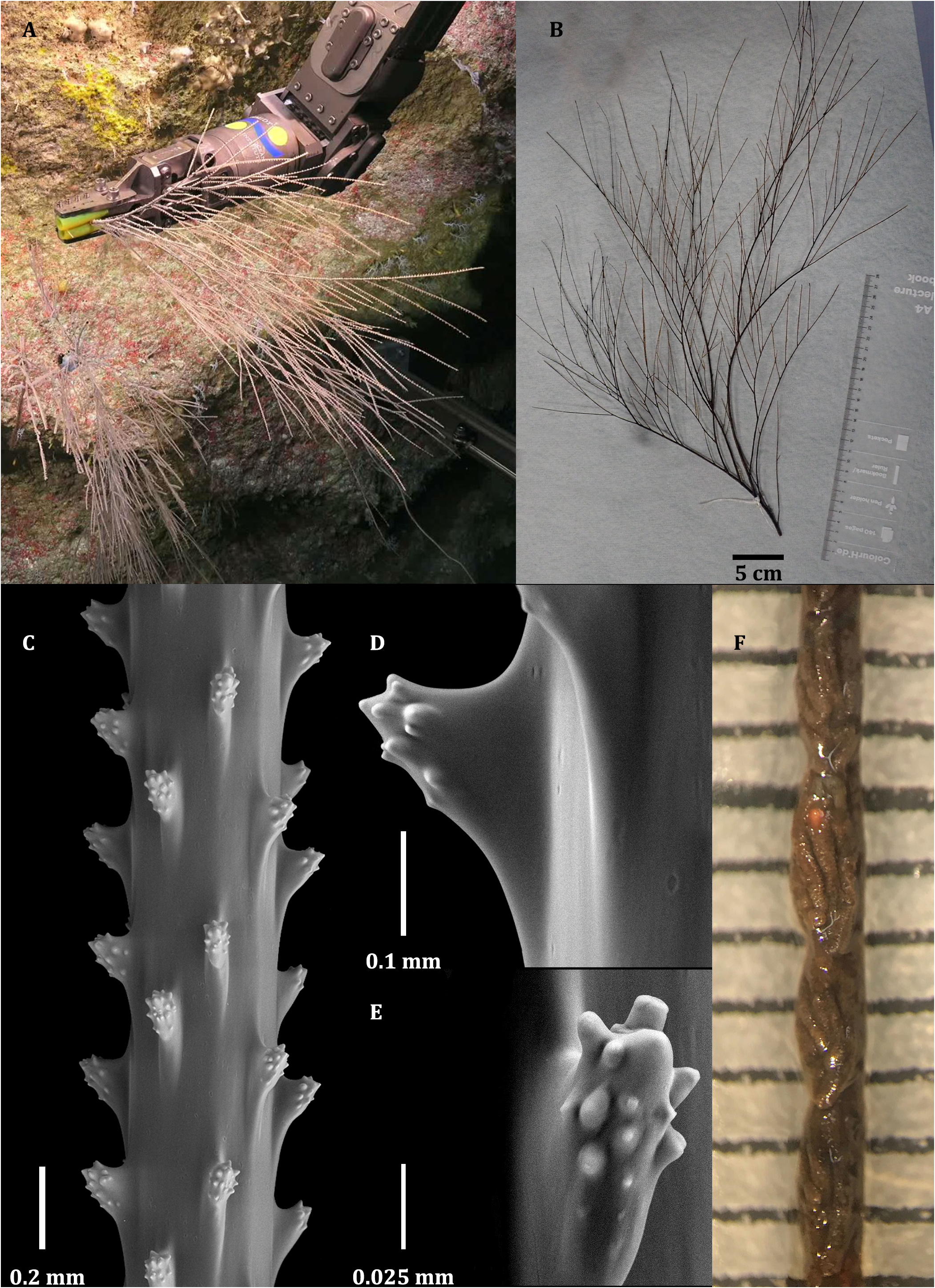
Description of holotype. This colony is upright and consists of several parallel broom-like fronds (Fig. 6 A), each frond is densely branched to the sixth order with long straight and uniserially arranged branches. One 65 cm frond was collected from the colony for this study (Fig. 6 B). Branches begin close to the base of the collected fragment and are uniserial, growing in one row on the upper side of each lower order branch. Branches and terminal branchlets form ~ 30 ° distal angles. Branches are long, ranging from 30 to a maximum of 37 cm in length. Terminal branchlets mostly range from 5 to 10 cm in length. Branches and terminal branchlets occur mostly on the abpolypar side of the lower order ramifications. Terminal branchlets occur from about midway along a lower order branch to the branch tip with distances between terminal branchlets being mostly 2 cm; however, in rare cases distances between terminal branchlets can be as small as 0.4 cm or as large as 3 cm. Branch diameter near the base of the collected frond is 3.2 mm in diameter, and terminal branchlet basal diameter ranges from 0.2 to 0.3 mm. Spines on branchlets from 0.2 to 0.23 mm in diameter range from 0.09 to 0.12 mm in height and five to six axial rows of spines can be counted in a side view (Fig. 6 C). Average distance between spines in one longitudinal row is 0.4 mm (Fig. 6 C). Seven spines can be counted in two mm of one longitudinal row. Spines are subconical with slightly compressed sides and a blunt apex with numerous distinct tubercles (about eight to 12 in one view of one spine) covering from just around the tip of a spine in an inconsistent whorl-like fashion, to midway down the spine, or to almost the base of the spine (Fig. 6 D). Tubercles are larger and more distally directed on the distal sides of spines compared to proximal sides, reaching maximum heights of 0.01 mm (Fig. 6 E). Polyps are roundish with long sagittal tentacles and distal lateral tentacles are shorter than proximal laterals in preserved state. Polyps are white (from in-situ video footage) to brown (after being preserved) in color, occur in one row, are mostly 1.8 to 2 mm in transverse diameter, and seven polyps can be counted in two cm (Fig. 6 F). Comparative diagnosis. This specimen bears resemblance to Aphanipathes sarothamnoides Brook, 1889 and Aphanipathes pedata (Gray 1857) in terms of their fan-like corallums with straight and distally directed branches; however, Ap. flailum sp. nov. has longer branches (25 to 30 vs 15 cm max in both A. sarothamnoides and A. pedata) and longer terminal branchlets (10 cm vs max of 4 and 3.5 cm in A. sarothamnoides and A. pedata, respectively), and a lower polyp density (3.5 to four per cm vs six per cm in A. sarothamnoides and no information on polyp density for the type of A. pedata). Terminal branchlets are also more evenly spaced along lower order branches compared to A. pedata that has terminal branchlets confined mostly to the distal end of the lower order branches. The new species resembles Aphanostichopathes spiessi (Opresko et al. 2021) with regards to ornamentation on the spines where both have tubercles; however, the new species has much shorter spine heights (maximum of 0.12 mm vs maximum of 0.24 mm in Ap. spiessi). Although Ap. flailum sp. nov. has close molecular affinity with Aphanostichopathes cf. paucispina, all species currently in Aphanostichopathes are unbranched while the new species and other species in Aphanipathes are branched.
Horowitz, Jeremy, Opresko, Dennis, Molodtsova, Tina N., Beaman, Robin J., Cowman, Peter F., Bridge, Tom C. L. (2022): Five new species of black coral (Anthozoa; Antipatharia) from the Great Barrier Reef and Coral Sea, Australia. Zootaxa 5213 (1): 1-35, DOI: 10.11646/zootaxa.5213.1.1
Diagnosis. Colony forming fronds of long, straight uniserially arranged branches and terminal branchlets that occur mostly on abpolypar side of lower order branches. Terminal branchlets maximum of 10 cm in length, occur midway and more distal on lower order branches, and are spaced mostly 2 cm apart ranging from 0.4 to 3 cm, and have 0.2 to 0.3 mm basal diameters. Spine heights 0.09 to 0.12 mm tall with no noticeable difference in height between polypar and abpolypar spines. Spines subconical, slightly compressed on sides, and blunt apex with numerous tubercles from apex to midway down the spine or to the base. Five to six axial rows of spines can be counted in one view. Polyps round, 1.8 to 2 mm in transverse diameter, in a single row, with three to four polyps counted per cm (seven per 2 cm).
Horowitz, Jeremy, Opresko, Dennis, Molodtsova, Tina N., Beaman, Robin J., Cowman, Peter F., Bridge, Tom C. L. (2022): Five new species of black coral (Anthozoa; Antipatharia) from the Great Barrier Reef and Coral Sea, Australia. Zootaxa 5213 (1): 1-35, DOI: 10.11646/zootaxa.5213.1.1
Diagnosis: Corallum simple or very sparsely branched, and pinnulate. Pinnules in two lateral rows and in one or two anterior rows. Lateral pinnules simple; anterior pinnules simple or subpinnulate. Anterior primary pinnules and subpinnules sometimes nearly as long as lateral pinnules. Spines subequal in size on primary and secondary pinnules. Polyps 3 to 6 mm in transverse diameter.
Horowitz, Jeremy, Opresko, Dennis, Molodtsova, Tina N., Beaman, Robin J., Cowman, Peter F., Bridge, Tom C. L. (2022): Five new species of black coral (Anthozoa; Antipatharia) from the Great Barrier Reef and Coral Sea, Australia. Zootaxa 5213 (1): 1-35, DOI: 10.11646/zootaxa.5213.1.1
Distribution. Known only from the Coral Sea at 210 m depth. Family Cladopathidae Kinoshita, 1910 Genus Hexapathes Kinoshita, 1910
Horowitz, Jeremy, Opresko, Dennis, Molodtsova, Tina N., Beaman, Robin J., Cowman, Peter F., Bridge, Tom C. L. (2022): Five new species of black coral (Anthozoa; Antipatharia) from the Great Barrier Reef and Coral Sea, Australia. Zootaxa 5213 (1): 1-35, DOI: 10.11646/zootaxa.5213.1.1
Etymology: In reference to the arrangement of tubercles on the new species’ subconical-shaped spines, which resembles a spiked flail, a medieval weapon.
Horowitz, Jeremy, Opresko, Dennis, Molodtsova, Tina N., Beaman, Robin J., Cowman, Peter F., Bridge, Tom C. L. (2022): Five new species of black coral (Anthozoa; Antipatharia) from the Great Barrier Reef and Coral Sea, Australia. Zootaxa 5213 (1): 1-35, DOI: 10.11646/zootaxa.5213.1.1
Material examined. Holotype, MTQ G 80019, Australia, Coral Sea, Malay Reef, expedition Schmidt Ocean Institute R / V Falkor Seamounts, Canyons, and Reefs of the Coral Sea expedition FK 200802, ROV SuBastian dive S 0377, collected on August 10, 2020, 17.9076 ° S, 149.3327 ° E, 210 m depth, collector Jeremy Horowitz.
Horowitz, Jeremy, Opresko, Dennis, Molodtsova, Tina N., Beaman, Robin J., Cowman, Peter F., Bridge, Tom C. L. (2022): Five new species of black coral (Anthozoa; Antipatharia) from the Great Barrier Reef and Coral Sea, Australia. Zootaxa 5213 (1): 1-35, DOI: 10.11646/zootaxa.5213.1.1
Type Locality: Japan
Horowitz, Jeremy, Opresko, Dennis, Molodtsova, Tina N., Beaman, Robin J., Cowman, Peter F., Bridge, Tom C. L. (2022): Five new species of black coral (Anthozoa; Antipatharia) from the Great Barrier Reef and Coral Sea, Australia. Zootaxa 5213 (1): 1-35, DOI: 10.11646/zootaxa.5213.1.1
Type Species: Hexapathes heterosticha Kinoshita, 1910
Horowitz, Jeremy, Opresko, Dennis, Molodtsova, Tina N., Beaman, Robin J., Cowman, Peter F., Bridge, Tom C. L. (2022): Five new species of black coral (Anthozoa; Antipatharia) from the Great Barrier Reef and Coral Sea, Australia. Zootaxa 5213 (1): 1-35, DOI: 10.11646/zootaxa.5213.1.1

Export occurrence data

Darwin Core Archive (ZIP)

CLASSIFICATION

Taxonomic Classification Tree

MULTIMEDIA

Media Files(3)

FIGURE 1. Locations where specimens were collected shown on a bathymetric surface map of the Great Barrier Reef and Coral Sea. Blue boxes represent specimens hand collected while on SCUBA, and red circles represent specimens collected via a remotely operated vehicle.
Imageimage/png© Horowitz, Jeremy;Opresko, Dennis;Molodtsova, Tina N.;Beaman, Robin J.;Cowman, Peter F.;Bridge, Tom C. L.Horowitz, Jeremy;Opresko, Dennis;Molodtsova, Tina N.;Beaman, Robin J.;Cowman, Peter F.;Bridge, Tom C. L.

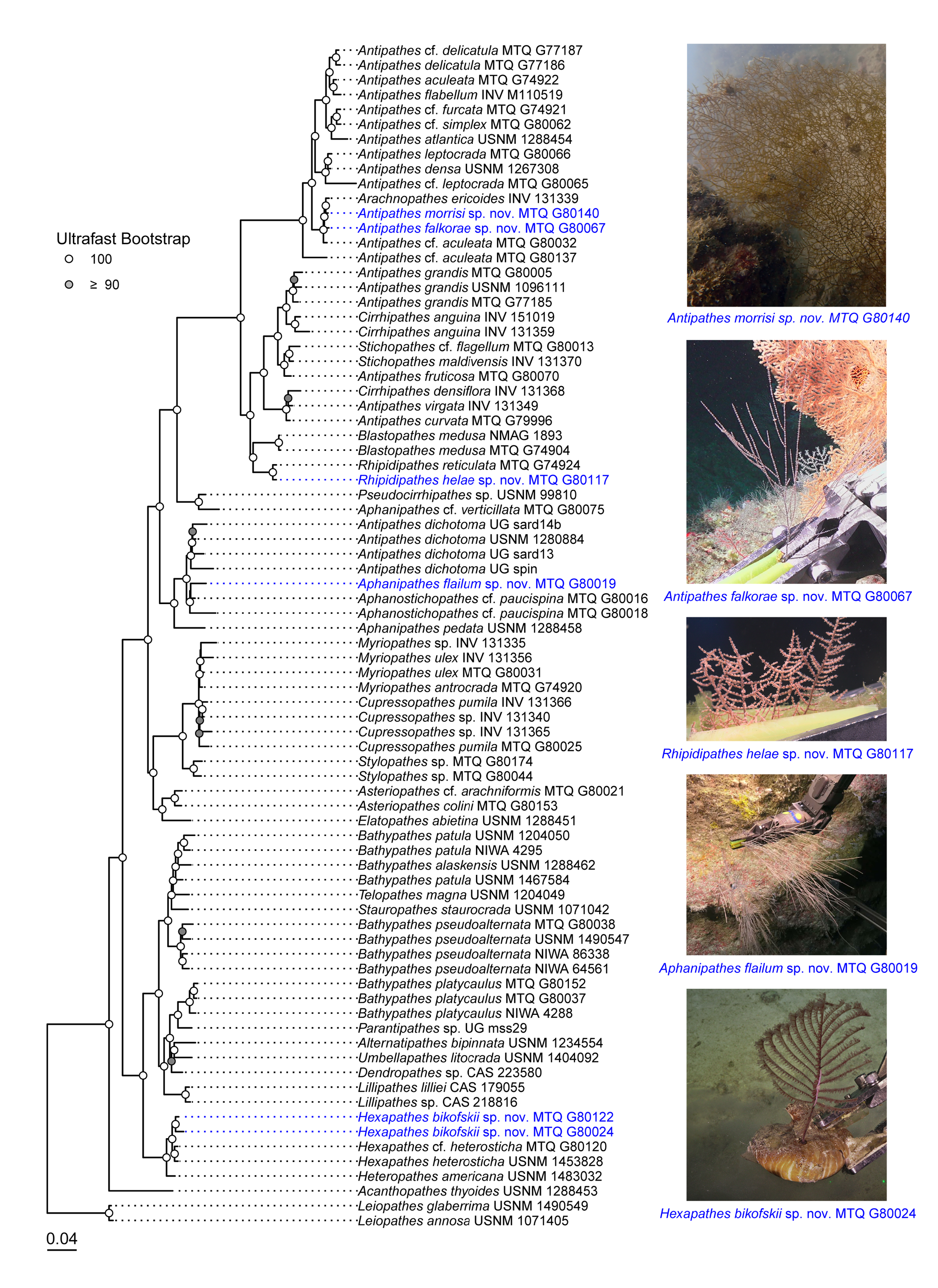
FIGURE 2. Maximum likelihood phylogeny of the Antipatharia based on a 50% complete matrix containing 1,047 loci. Taxa in blue and imaged represent species described in this study.
Imageimage/png© Horowitz, Jeremy;Opresko, Dennis;Molodtsova, Tina N.;Beaman, Robin J.;Cowman, Peter F.;Bridge, Tom C. L.Horowitz, Jeremy;Opresko, Dennis;Molodtsova, Tina N.;Beaman, Robin J.;Cowman, Peter F.;Bridge, Tom C. L.

FIGURE 6. Aphanipathes flailum sp. nov. Holotype, MTQ G80019: A, in-situ image of colony; B, image of colony showing branching pattern; C, section of terminal branchlet showing spines with tubercles; D–E, close-up of spines showing tubercle arrangement; F, image of polyps on a branch (distances between horizontal lines represent 1 mm).

Imageimage/png© Horowitz, Jeremy;Opresko, Dennis;Molodtsova, Tina N.;Beaman, Robin J.;Cowman, Peter F.;Bridge, Tom C. L.Horowitz, Jeremy;Opresko, Dennis;Molodtsova, Tina N.;Beaman, Robin J.;Cowman, Peter F.;Bridge, Tom C. L.

IMAGES

Gallery(3)

See Gallery

Occurrences with images

Source Information

Five new species of black coral (Anthozoa; Antipatharia) from the Great Barrier Reef and Coral Sea, Australia

checklist

This dataset contains the digitized treatments in Plazi based on the original journal article Horowitz, Jeremy, Opresko, Dennis, Molodtsova, Tina N., Beaman, Robin J., Cowman, Peter F., Bridge, Tom C. L. (2022): Five new species of black coral (Anthozoa; Antipatharia) from the Great Barrier Reef and Coral Sea, Australia. Zootaxa 5213 (1): 1-35, DOI: 10.11646/zootaxa.5213.1.1

Abstract

We describe five new species of black corals from the Great Barrier Reef and Coral Sea, collected at depths ranging from 14 to 789 m: two in the family Antipathidae (Antipathes falkorae sp. nov. and Antipathes morrisi sp. nov.), two in the family Aphanipathidae (Aphanipathes flailum sp. nov. and Rhipidipathes helae sp. nov.), and one in the family Cladopathidae (Hexapathes bikofskii sp. nov.). We also present a phylogeny of 80 black corals reconstructed from a target capture dataset of ultraconserved elements and exons, to show the systematic relationships among new and nominal species. This phylogeny also represents a backbone for future species descriptions and research into the evolutionary history of the Antipatharia.

Horowitz J, Opresko D, Molodtsova T N, Beaman R J, Cowman P F, Bridge T C L, plazi (2022). Five new species of black coral (Anthozoa; Antipatharia) from the Great Barrier Reef and Coral Sea, Australia. Plazi.org taxonomic treatments database. Checklist dataset https://doi.org/10.15468/sjch2y accessed via GBIF.org on 2026-06-17.

CC0Published 11/23/2022View dataset
GBIF Usage Key
205135212
Dataset Key
ae2ed5e5-8a85-42d9-86ef-9e558a02512f
Origin
source
Backbone Key
12228967
Taxon ID
03DD87941233FF97A29F226FAEA6FA00.taxon
Last Crawled
6/9/2026
Last Interpreted
6/9/2026