AnimaliaNot EvaluatedacceptedspeciesAccepted
Megalothorax anterolenis

Megalothorax anterolenis

Schneider, Minor & D'Haese, 2023

GBIF:208977939

0year

ABOUT

Descriptions(5)

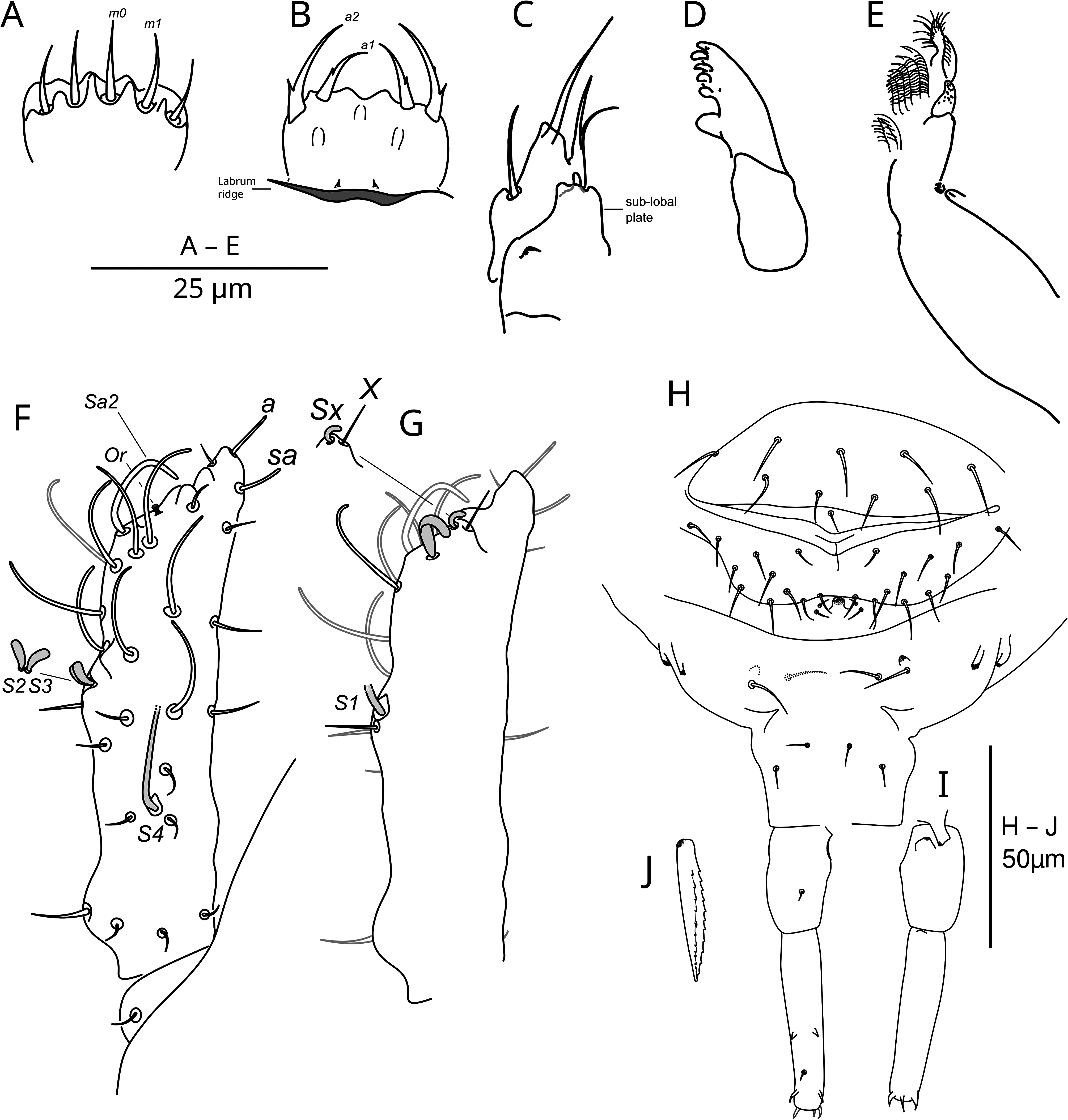
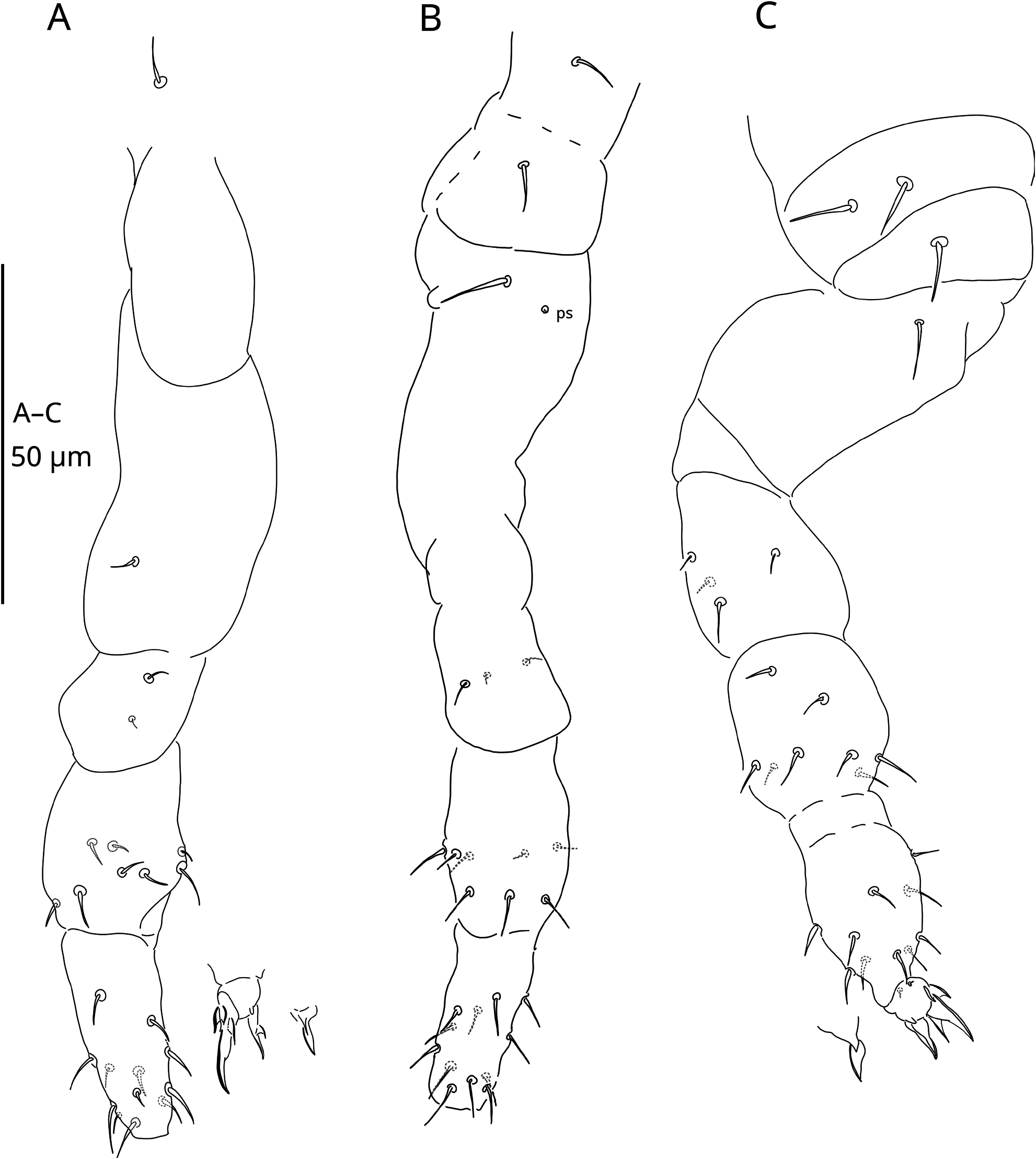
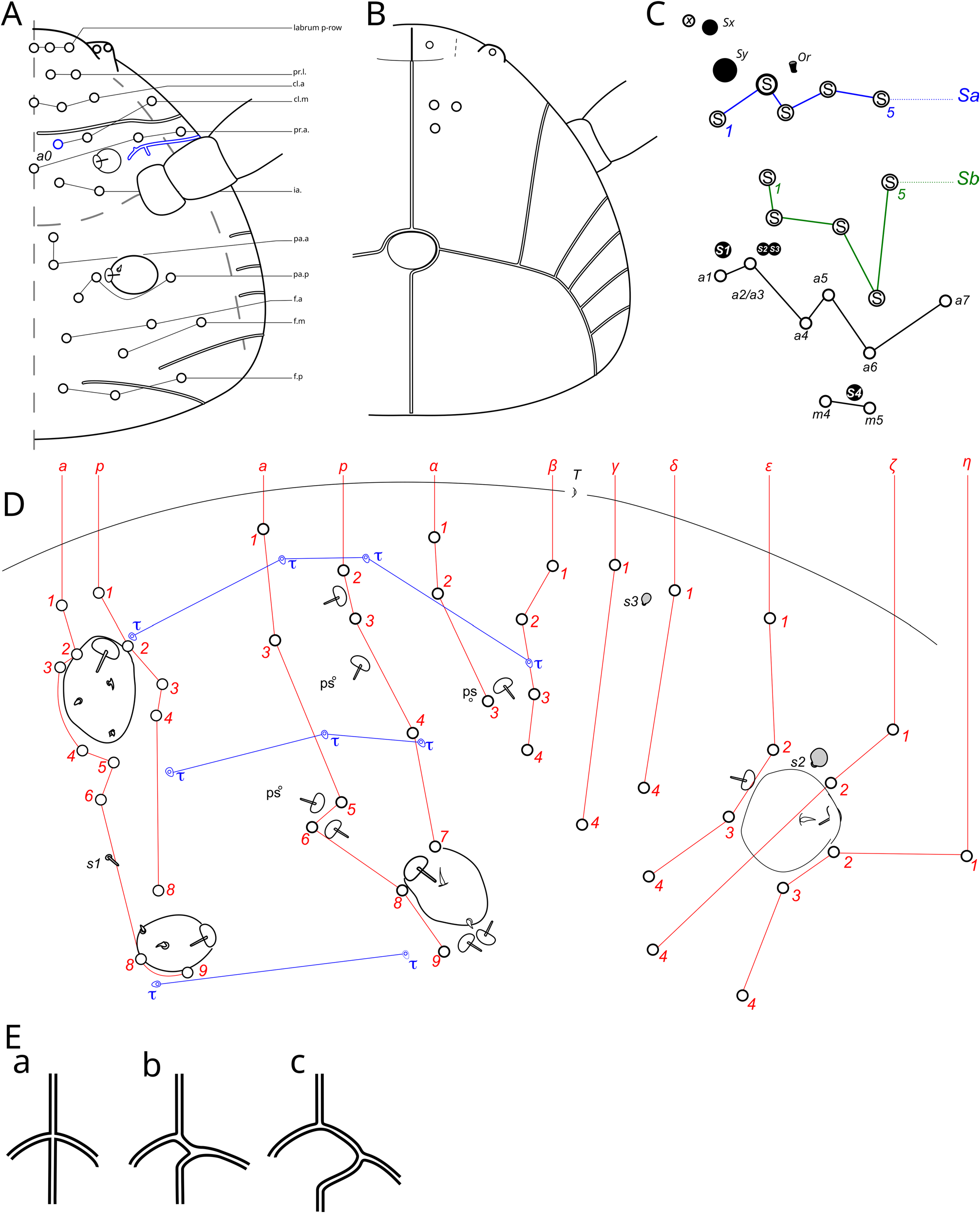
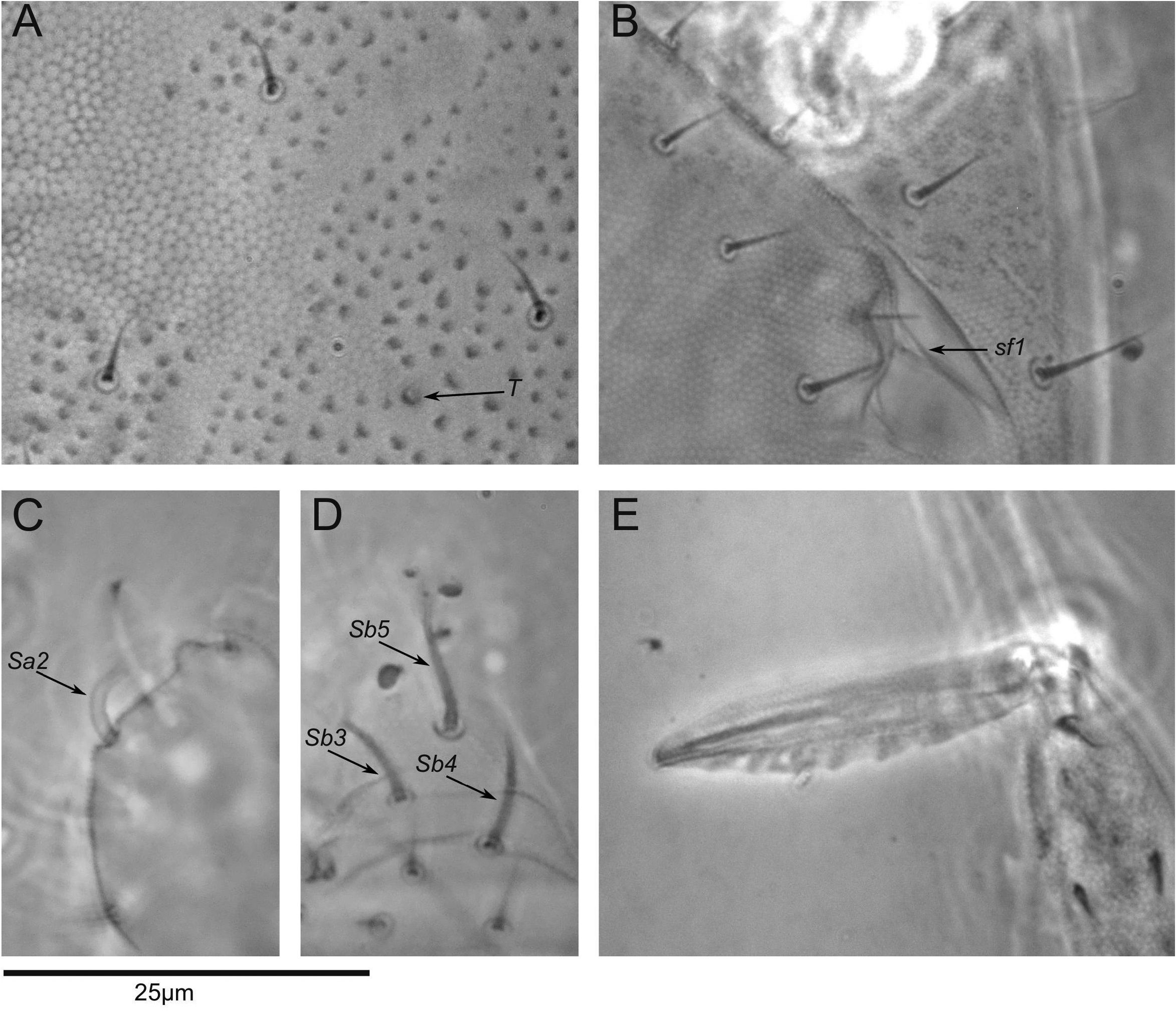
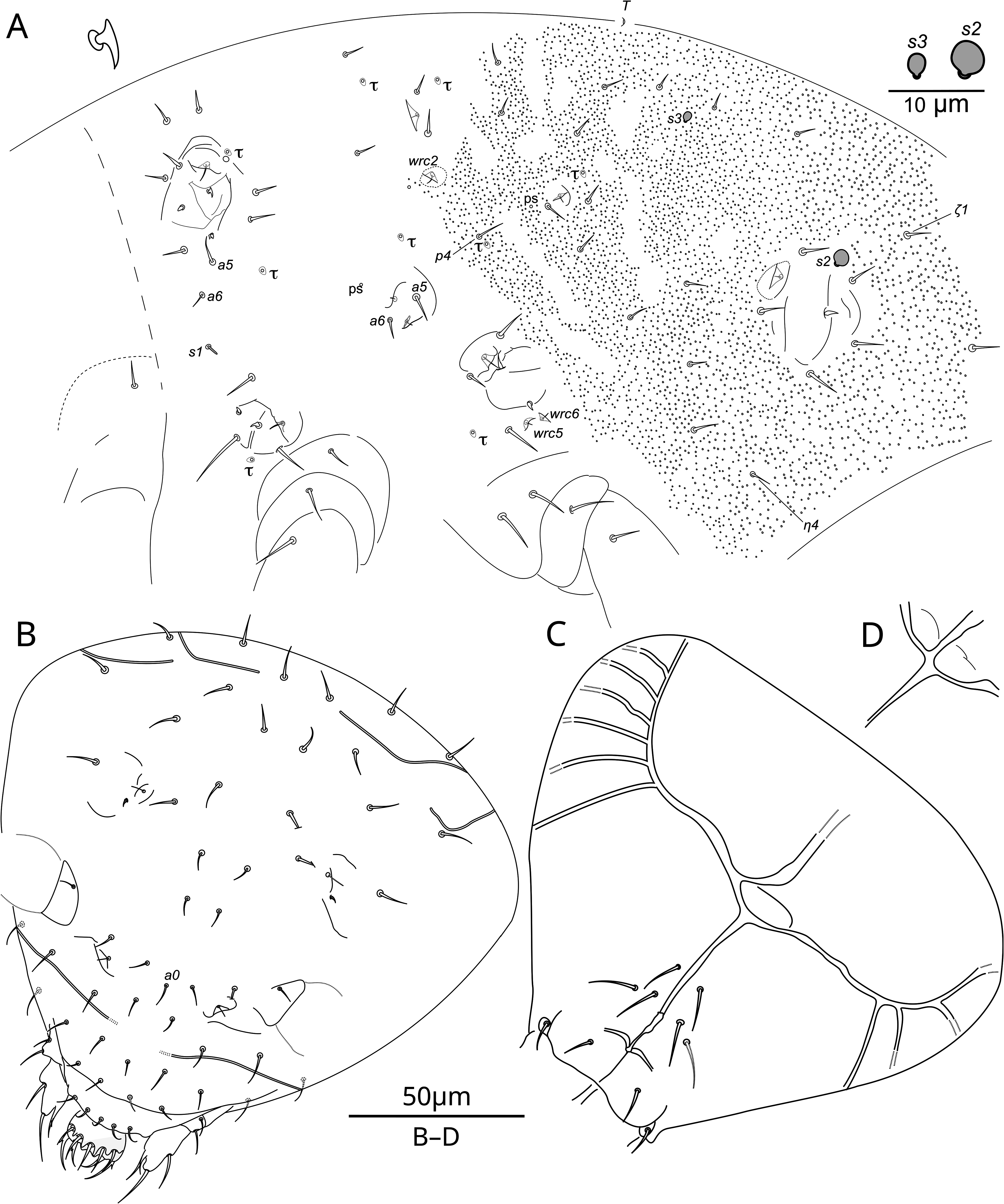
Description. General aspect. Habitus and segmentation typical of the genus. Length from labrum to anus: up to 450 µm. Specimens whitish to red (in 96 % ethanol). All typical chaetal types of the genus are accounted for, without any remarkable development. Integument. The ordinary secondary granulation is limited to the posterior half of the trunk (roughly corresponding to the abdominal region), absent on the head, the thoracic region and Abd. VI (Fig. 1 A). Anteriorly on the abdomen, dorso-median line also without secondary granulation until the terminal secondary granule T (same as in Fig. 9 A). Primary granulation pattern distinctly visible dorsally on the head and the thorax: primary grains stronger and hexagons surface larger than on the secondary granulated part of the abdomen (same as in Fig. 9 A). On the clypeal area, a speckled pattern of hexagons with enlarged primary grain yielding superficial resemblance to ordinary secondary granulation (same as in Fig. 9 B). Integumentary channels moderately developed on the head (Fig. 1 B, C). On each side of the head, the basal channel splits successively. At each split, the external branch is always terminal (never splitting). The first external branch extending to the antero-dorsal region of the head, then up to four branches extending to the latero-posterior part of the head. Finally, the two most posterior branches reaching the dorso-posterior part of the head. Channels connection with linea ventralis from circular (mostly observed, Fig. 1 C) to almost crossed (seen in one specimen, Fig. 1 D). Channels absent on trunk. Sensory fields and wax rods. Ordinary distribution of sensory fields and wax rods secretory crypts: 2 + 2 wrc on head, 12 + 12 wrc on body; including the ones associated with the 6 + 6 sensory fields (Fig. 1 A, B). Sensory fields include the swollen inner chaetae in the usual distribution (from sf 1 – 6: 0, 1, 3, 2, 2, 1). The swollen inner chaetae are all short and flame-shaped, some with a tendency toward the T-shape (Fig. 1 A). Level of separation of wrc 5 and 6 from sf 5 cannot be quantified with the amount of secondary granules (non applicable). Head chaetotaxy. Postero-dorsal chaetae without remarkable thickening, only subtly stronger than antero-dorsal chaetae (Fig. 1 B). Number of chaetae: 12 + 12 in the postero-dorsal region, 8 + 8 and 2 unpaired in the antero-dorsal region, 2 + 2 in the antero-lateral region (Fig. 1 B, 8 A). Ventrally, 3 + 3 chaetae in the sub-labial region (Fig. 1 C, 8 B). Diagram of head chaetotaxy provided in Fig. 8 A, B. Labium. Basomedian fields of labium with 1 + 1 chaetae, basolateral fields of labium with 1 + 1 chaetae on a small papilla (Fig. 1 C). Labial palps ordinary. Labrum. Chaetae a 1 and a 2 thicker than chaetae m 0 - 2; a 1 shorter than a 2; m 0 - 2 smooth; a 1 and a 2 acuminate, with inward curvature, each with one external, basal tooth (Fig. 2 A, B). A median, very fine tooth can sometimes be perceived on a 2 (Fig. 2 B). Labral anterior process apparently as in M. minimus, with a continued transversal crest separating a 1 - 2 from m 0 - 2. Ridge of the labrum with at least two small teeth (Fig. 2 B). Other mouthparts. Oral fold with 2 + 2 chaetae (Fig. 1 B). Maxilla outer lobe with two chaetae (apical and basal) and with a strong bifurcate hair in subapical internal position (Figs 1 B, 2 C). Sub-lobal plate without hair, but with a small lobe near the anterior ridge (Fig. 2 C). Mandibula with the ordinary asymmetry: one strong basal tooth on the left mandibula (Fig. 2 D), missing on the other side. Maxilla with a well developed apical lamella (Fig. 2 E). Antenna. Ant. I with one chaeta (Fig. 2 F). Ant. II with four chaetae, the anterior one stronger than the three others (Fig. 2 F). Ant. III with eight chaetae and five S-chaetae including S 1 – S 4 from the sensory organ and Sb 4; S 2 and S 3 small but clearly protruding from the cupule; without perceptible ornamentation in light microscopy (Fig. 2 F, G). Ant. IV with five chaetae (X present) and 11 S-chaetae (Sb 1 – 3, Sb 5, Sa 1 – 5, Sx and Sy); Sa 2 is notably enlarged in regard to the others common S-chaetae Sa and Sb (as in Fig. 8 C); apical and subapical rods (a, sa) present (Fig. 2 F, G). Diagram of antennal chaetotaxy provided in Fig. 8 C. Thoracic tergites. Th. II with 12 + 12 ordinary chaetae, 1 + 1 s-chaetae s 1 and three τ-chaetae (only the bases of τ-chaetae could be perceived using light microscopy); chaetae a 5, a 6 present and chaeta a 7 missing; the laterodorsal τ-chaeta is far from chaeta p 4, in the lateral direction (Fig. 1 A). Th. III with 10 + 10 ordinary chaetae, 6 + 6 wrc, 4 + 4 τ-chaetae and 2 + 2 pseudopores (ps); a 5 sensibly bigger than a 6, wrc 2 distant from p 4 (Fig. 1 A). Diagram of chaetotaxy provided in Fig. 8 D. Abd. I – V tergites. With 22 + 22 ordinary chaetae, 2 + 2 globular s-chaetae (s 2, s 3) s 3 notably smaller than s 2, 2 + 2 τ-chaetae, 1 + 1 pseudopores and 2 + 2 wrc; chaetae ζ 1 and η 4 present (Fig. 1 A). Abd. VI. Tergite with 4 + 4 and 1 unpaired chaetae. Each anal valves with one small chaeta. Sternite with 10 + 10 chaetae (Fig. 2 H). Genital plate. Ordinary: female with 2 + 2 chaetae (Fig. 2 H). Males present, but the genital plate could not be studied in detail. Abd. IV sternites. With 2 + 2 usual neosminthuroid chaetae, usually with 2 + 2 ordinary chaetae and 1 + 1 small lobes but anomalous asymmetry observed in one specimen (Fig. 2 H). Abdominal appendages. Manubrium with 2 + 2 posterior chaetae (Fig. 2 H). Dens ordinary: basal part of dens with 1 + 1 posterior chaetae, apical part of dens with 1 + 1 posterior chaetae and 7 + 7 small spines (Fig. 2 H, I). Mucro elliptical, with moderately wide lamellae, with a dozen of teeth on each posterior lamellae (Fig. 2 J). Ventral tube with 2 + 2 apical chaetae, retinaculum with 3 + 3 teeth. Legs. Chaetal composition on each legs subcoxa 1, 2, coxa, trochanter, femur and tibiotarsus: Leg I, 1, 0, 1, 2, 8, 12 chaeta (e) (Fig. 3 A); leg II, 1, 1, 1, 3, 8, 12 chaeta (e) (Fig. 3 B); leg III, 2, 1, 1, 4, 8, 10 chaeta (e) (Fig. 3 C). Claws ordinary, as in Fig. 3 A, C., with short external basal lamellae.
Schneider, Clément, Minor, Maria A., D’Haese, Cyrille A. (2023): A new group of species of the genus Megalothorax (Collembola, Neelidae) with Gondwanan distribution, and introducing an open interactive identification key of Megalothorax species. Zootaxa 5228 (2): 101-121, DOI: 10.11646/zootaxa.5228.2.1

Figs. 1 – 3, 8 A – D.
Schneider, Clément, Minor, Maria A., D’Haese, Cyrille A. (2023): A new group of species of the genus Megalothorax (Collembola, Neelidae) with Gondwanan distribution, and introducing an open interactive identification key of Megalothorax species. Zootaxa 5228 (2): 101-121, DOI: 10.11646/zootaxa.5228.2.1
Diagnosis. Colour varying from whitish to red (in 96 % ethanol), labrum a 1 chaetae ordinary with acuminate tip, maxillary palp with an internal bifurcate hair, basomedian and basolateral fields of labium each with 1 + 1 chaetae, secondary granulation limited to the abdominal I – IV tergites, s-chaetae s 3 present on the abdomen, tenaculum with 3 + 3 teeth, posterior lamellae of the mucro moderately enlarged and finely serrated.
Schneider, Clément, Minor, Maria A., D’Haese, Cyrille A. (2023): A new group of species of the genus Megalothorax (Collembola, Neelidae) with Gondwanan distribution, and introducing an open interactive identification key of Megalothorax species. Zootaxa 5228 (2): 101-121, DOI: 10.11646/zootaxa.5228.2.1
Differential diagnosis. Megalothorax anterolenis sp. nov. shares some uncommon chaetotaxic similarities with M. granulosus: only 1 + 1 chaetae on the basomedian field of labium, and presence of chaetae a 5 and a 6 on Th. II and chaetae ζ 1 and η 4 on the abdomen. However M. anterolenis sp. nov. and M. granulosus are clearly distinct on many aspects, such as the shape of the connection of the head integumentary channels (circular vs crossed), the secondary granulation (ordinary vs coarse), the antennal chaetotaxy and the mucro lamellae (toothed vs smooth). In general, the repartition of the secondary granulation clearly distinguish Megalothorax anterolenis sp. nov. from any species of the incertus and minimus - group (absent on head and anterior part of trunk vs full dorsal coverage). Name etymology. Combination of the Latin anterior and lçnis (smooth).
Schneider, Clément, Minor, Maria A., D’Haese, Cyrille A. (2023): A new group of species of the genus Megalothorax (Collembola, Neelidae) with Gondwanan distribution, and introducing an open interactive identification key of Megalothorax species. Zootaxa 5228 (2): 101-121, DOI: 10.11646/zootaxa.5228.2.1
Material examined. Holotype. Female on slide (CSCOL _ 104), Chile, X Región de Los Lagos, Llanquihue, Parque Nacional Alerce Andino, 2011. xi. 23, 41.5838 ° S, 72.5698 ° W, dwelling among epiphytic plants on a living tree, sample CHL 002. Paratypes. Four females on a single slide (CSCOL _ 105), same data as the holotype; two females and two males on two slides (CSCOL _ 111, 113), same data as the holotype but sampled on another tree: 41.5836 ° S, 72.5692 ° W, sample CHL 004. Other material. One female, one juvenile on two slides (CSCOL _ 190, 191), Chile, X Región de Los Lagos, Llanquihue, Parque Nacional Alerce Andino, 2011. xi. 24, 41.5882 ° S, 72.5808 ° W, among mosses on dead wood, sample CHL 015. One female on slide (CSCOL _ 125), Chile, X Región de Los Lagos, Llanquihue, Parque Nacional Alerce Andino, 2011. xi. 26, 41.5787 ° S, 72.5599 ° W, among mosses and epiphytic plants naturally fallen from the host tree, sample CHL 028. Three females on slide (CSCOL _ 213, 214, 221), Chile, Región de Aysén, Sendero Laguna Los Pumas, 2011. xii. 04, 44.2354 ° S, 72.5195 ° W, among mosses growing on the base of a tree, sample CHL 218. All material collected by C. Schneider. Material deposit. The holotype and two paratypes (CSCOL _ 104, CSCOL _ 111) will be deposited at the Museo Nacional de Historia Natural de Chile, Santiago, Chile. Four paratypes (CSCOL _ 105) will be deposited at the Muséum National d’Histoire Naturelle, Paris, France. Rest of the material will be deposited at the Senckenberg Museum für Naturkunde, Görlitz, Germany. Obtained molecular data and genbank accession number. One specimen from sample CHL 002 (same a holotype): 28 S rDNA: OP 942371 (808 bp). One specimen from sample CHL 004, COI: OP 933760 (658 bp), 16 S rDNA: OP 942368 (454 bp), 28 S rDNA: OP 942372 (808 bp). One specimen from sample CHL 218, COI: OP 933759 (658 bp), 16 S rDNA: OP 942369 (468 bp), 28 S rDNA: OP 942373 (784 bp). Vouchers could not be recovered.
Schneider, Clément, Minor, Maria A., D’Haese, Cyrille A. (2023): A new group of species of the genus Megalothorax (Collembola, Neelidae) with Gondwanan distribution, and introducing an open interactive identification key of Megalothorax species. Zootaxa 5228 (2): 101-121, DOI: 10.11646/zootaxa.5228.2.1

Export occurrence data

Darwin Core Archive (ZIP)

CLASSIFICATION

Taxonomic Classification Tree

MULTIMEDIA

Media Files(5)

FIGURE 1. Megalothorax anterolenis sp. nov. (A) Chaetotaxy of trunk tergites from Th. I toAbd. IV, with representation of the secondary granulation. (B, C, D) Head, (B) dorsal side including labrum and maxillary palp, (C) ventral side including labium basal fields, (D) variant morphology of the connection between linea ventralis and integumentary channels.

Imageimage/png© Schneider, Clément;Minor, Maria A.;D’Haese, Cyrille A.Schneider, Clément;Minor, Maria A.;D’Haese, Cyrille A.

FIGURE 2. Megalothorax anterolenis sp. nov. (A, B) Labrum anterior process, (A) posterior side, (B) anterior side. (C) Maxillary outer lobe internal side. (D) Mandibula. (E) Maxilla. (F, G) Antenna (F) posterior side, (G) anterior side. (H) Abd. VI tergite and sternite, Abd. V and IV sternites, and posterior side of manubrium and dens (furca), chaeta and lobe in dotted line are missing on the figured specimen but normally present. (I) dens anterior side. (J) Mucro.

Imageimage/png© Schneider, Clément;Minor, Maria A.;D’Haese, Cyrille A.Schneider, Clément;Minor, Maria A.;D’Haese, Cyrille A.

FIGURE 3. Megalothorax anterolenis sp. nov. (A) Leg I, (B) Leg II, (C) Leg III.

Imageimage/png© Schneider, Clément;Minor, Maria A.;D’Haese, Cyrille A.Schneider, Clément;Minor, Maria A.;D’Haese, Cyrille A.

FIGURE 8. (A) Diagram of dorsal head chaetotaxy, chaeta in blue present only in M. tasmanterolenis sp. nov. and M. zealanterolenis sp. nov., channel in blue present only in M. tasmanterolenis sp. nov. (B) Diagram of ventral head chaetotaxy. (C) Diagram of antenna chaetotaxy. (D) Body chaetotaxy diagram, s-chaetae shape based on M. anterolenis sp. nov. (E) Connection of integumentary channels and linea ventralis: (a) crossed, (b) transitional form, (c) circular.

Imageimage/png© Schneider, Clément;Minor, Maria A.;D’Haese, Cyrille A.Schneider, Clément;Minor, Maria A.;D’Haese, Cyrille A.

FIGURE 9. Megalothorax tasmanterolenis sp. nov. (A) Integument with secondary granules and area of enlarged primary hexagons devoid of secondary granules, abdominal region dorsal side. (B) Integument, with area of enlarged primary granules, dorso-anterior part of head. (C) Enlarged and clear S-chaeta Sa2 on Ant. IV, compared with (D) normal, dark S-chaetae (e.g. Sb3, Sb4, Sb5) on Ant. IV. Megalothorax zealanterolenis sp. nov. (E) mucro with focus on the smooth and waved internal posterior lamella.

Imageimage/png© Schneider, Clément;Minor, Maria A.;D’Haese, Cyrille A.Schneider, Clément;Minor, Maria A.;D’Haese, Cyrille A.

IMAGES

Gallery(5)

See Gallery

Occurrences with images

Source Information

A new group of species of the genus Megalothorax (Collembola, Neelidae) with Gondwanan distribution, and introducing an open interactive identification key of Megalothorax species

checklist

This dataset contains the digitized treatments in Plazi based on the original journal article Schneider, Clément, Minor, Maria A., D’Haese, Cyrille A. (2023): A new group of species of the genus Megalothorax (Collembola, Neelidae) with Gondwanan distribution, and introducing an open interactive identification key of Megalothorax species. Zootaxa 5228 (2): 101-121, DOI: 10.11646/zootaxa.5228.2.1

Abstract

Megalothorax Willem, 1900 is a genus of Neelidae (Collembola) with worldwide distribution. Three new species are described here: Megalothorax anterolenis sp. nov. (Patagonia, Chile), Megalothorax tasmanterolenis sp. nov. (Tasmania, Australia) and Megalothorax zealanterolenis sp. nov. (the South Island, New Zealand). New descriptive elements are also provided for Megalothorax rubidus. Two of the new species were sequenced (COI, 16S rDNA, 28S rDNA). Within the genus, the three new species form a new group of species characterised by the absence of secondary granulation dorsally on the head and the thorax, a reduced chaetotaxy of the basomedian field of labium, a bifurcate hair on the maxillary outer lobe and an enlarged S-chaeta (Sa2) on Ant. IV. The molecular based phylogeny further supports the sistership of the two sequenced species. The possible Gondwanan origin of the new group is discussed. Elements of discussion are also provided regarding the possible function of the incomplete coverage of secondary granulation. Finally, an open interactive identification key for the Megalothorax species of the world is introduced.

Schneider C, Minor M A, D’Haese C A, plazi (2023). A new group of species of the genus Megalothorax (Collembola, Neelidae) with Gondwanan distribution, and introducing an open interactive identification key of Megalothorax species. Plazi.org taxonomic treatments database. Checklist dataset https://doi.org/10.15468/fmf6b9 accessed via GBIF.org on 2026-06-15.

CC0Published 1/12/2023View dataset
GBIF Usage Key
208977939
Dataset Key
819e7189-366e-4967-8cc9-60bcf42615ee
Origin
source
Backbone Key
12253562
Taxon ID
01379830FFFE507EE0E90BF7BD9DD419.taxon
Last Crawled
6/9/2026
Last Interpreted
6/9/2026