AnimaliaNot EvaluatedacceptedspeciesAccepted
Megalothorax tasmanterolenis

Megalothorax tasmanterolenis

Schneider, Minor & D'Haese, 2023

GBIF:208977941

0year

ABOUT

Descriptions(5)

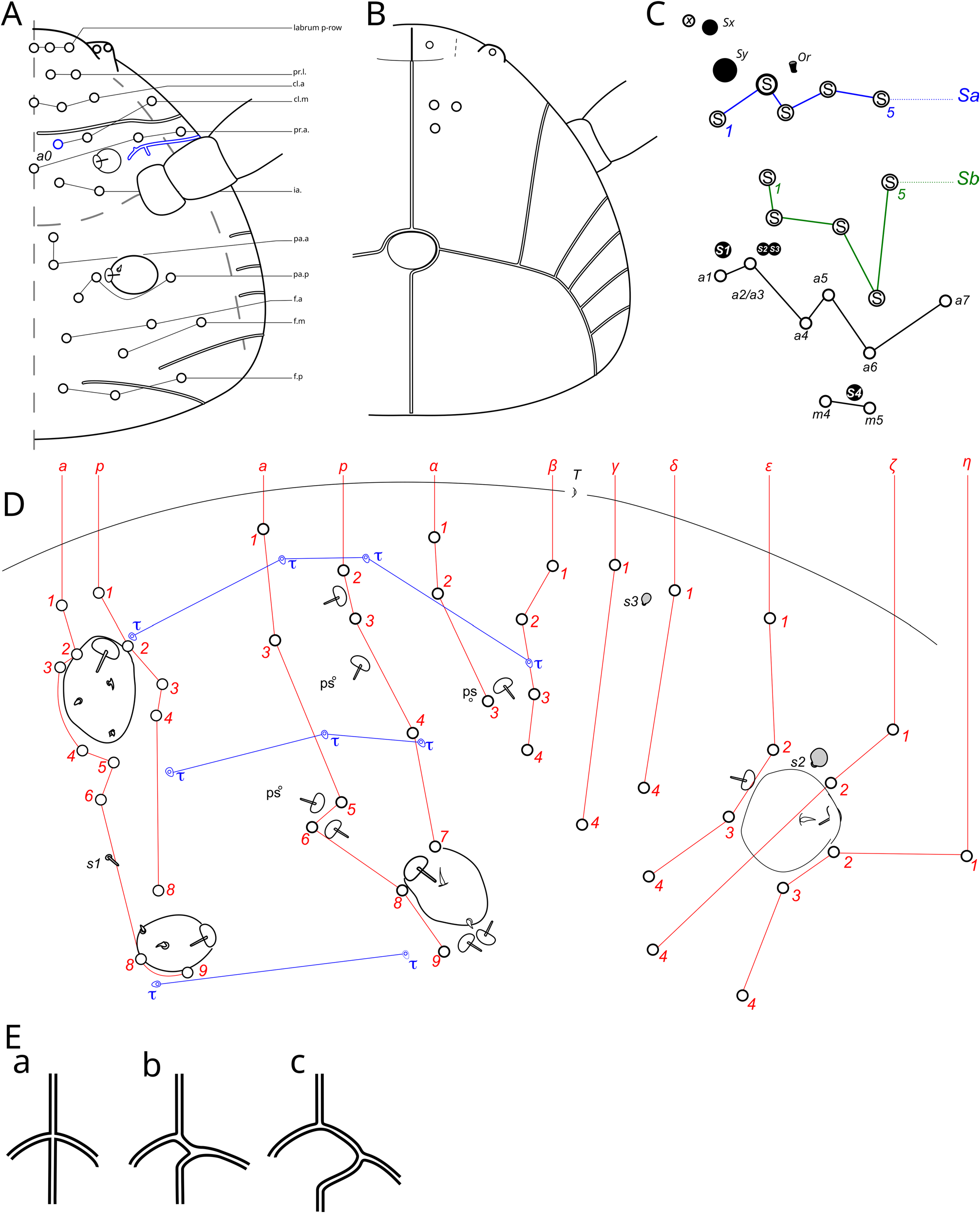
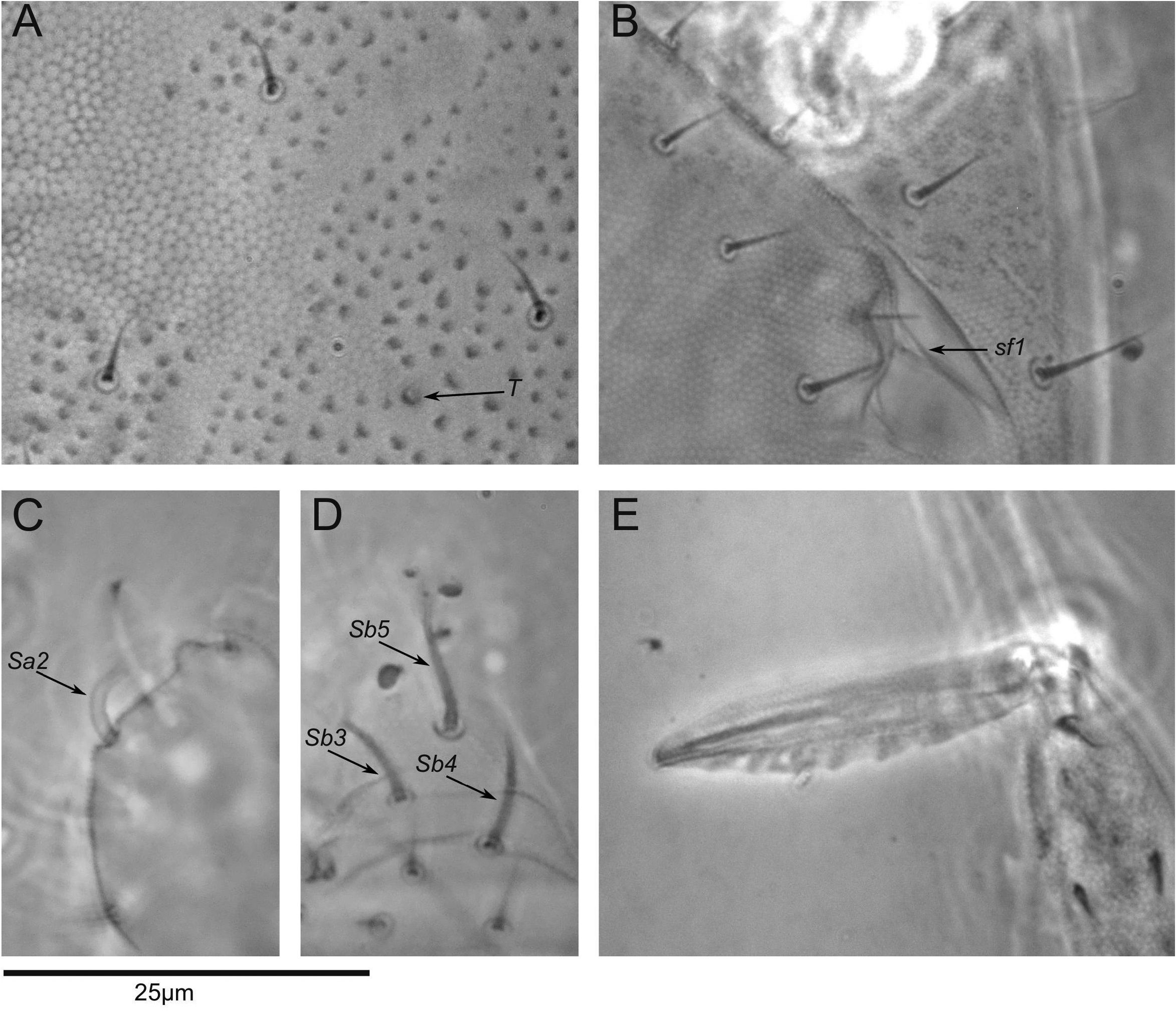
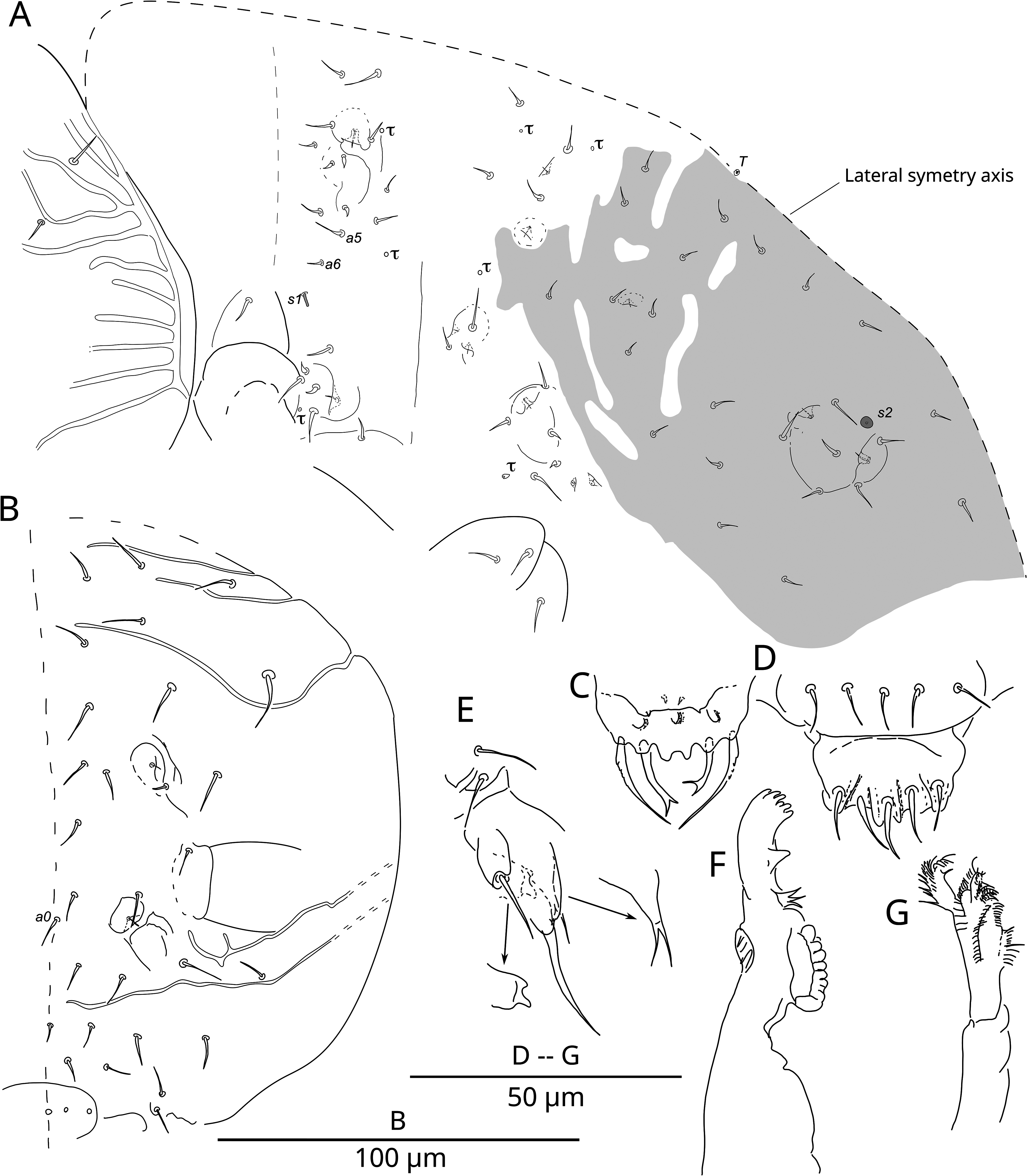
Description. General aspect. Habitus and segmentation typical of the genus. Length from labrum to anus: up to 500 µm. Specimens whitish (in 96 % ethanol). All typical chaetal types of the genus are accounted for, without any remarkable development. Integument. Distribution of the secondary granulation identical to M. anterolenis sp. nov. (Fig. 4 A); the speckle of enlarged primary granules on the clypeal area is present but subtle on our available specimens. Integumentary channels moderately developed on the head (Fig. 4 A, B). On each side of the head, the basal channel splits nine times successively. First the two external branches extend to the antero-dorsal region of the head, then up to five branches extend to the latero-posterior part of the head, finally the five most posterior branches reaching the dorsoposterior part of the head. Head channels connection with linea ventralis circular. Channels absent on trunk. Sensory fields and wax rods. Same observation as in M. anterolenis sp. nov. (also see Fig. 4 A, B). Head chaetotaxy. Postero-dorsal chaetae without remarkable thickening, only subtly stronger than antero-dorsal chaetae. Number of chaetae: 12 + 12 in the postero-dorsal region, 9 + 9 and 2 unpaired in the antero-dorsal region, 2 + 2 in the antero-lateral region (Fig. 4 B). Ventrally, 3 + 3 chaetae in the sub-labial region. Diagram of head chaetotaxy provided in Fig. 8 A, B. Labium. Basomedian fields of labium with 1 + 1 chaetae, basolateral fields of labium with 1 + 1 chaetae on a small papilla. Labial palps ordinary. Labrum. Chaetae a 1 and a 2 thicker than chaetae m 0 - 2; a 1 shorter than a 2; m 0 - 2 smooth (Fig. 4 D); apex of a 1 with bifurcate tip (Fig. 4 C); apex of a 2 acuminate, with inward curvature, subtly serrated (Fig. 4 C). Organisation of the labral anterior process not studied in detail. Two small teeth near the ridge of the labrum (Fig. 4 C). Other mouthparts. Oral fold with 2 + 2 chaetae (Fig. 4 E). Maxilla outer lobe with two chaetae (apical and basal) and with a strong bifurcate hair in subapical internal position (Fig. 4 E). Sub-lobal plate without hair, with two lobes on the anterior ridge (Fig. 4 E). Mandibula ordinary (Fig. 4 F). Maxilla with a well developed apical lamella (Fig. 4 G). Antenna. As in Fig. 5 A, same observations as M. anterolenis sp. nov., but with 9 to 10 normal chaetae on Ant. III (either 4 or 5 chaetae in the apical whorl) and Sb 6 above S 2, S 3. Sa 2 with a swollen aspect in comparison to the other Sa and Sb chaetae. Thoracic and abdominal tergites. As in Fig. 4 A, same observations as in M. anterolenis sp. nov., but with schaetae s 3 absent. Pseudopores not studied. Abd. VI. Ordinary, with nine chaetae on tergites, a small chaetae on each anal valves, and with 10 + 10 chaetae on sternites. Genital plate. Female with 2 + 2 chaetae, male not seen. Abd. IV sternites. With 2 + 2 usual neosminthuroid chaetae and 2 + 2 ordinary chaetae, the internal chaetae longer than the external ones. Abdominal appendages. Manubrium with 2 + 2 posterior chaetae (Fig. 5 E). Dens ordinary (Fig. 5 E): basal part of dens with 1 + 1 posterior chaetae, apical part of dens with 1 + 1 posterior chaetae and 7 + 7 small spines; basal spines with blunt apex, apical spines with filamentous apex. Mucro elliptical, with moderately wide lamellae; internal posterior lamella with around seven teeth (but could not precisely studied), external lamella without hardened teeth, but with an irregular aspect (Fig. 5 E). Ventral tube with 2 + 2 apical chaetae, retinaculum with 4 + 4 teeth. Legs. Chaetal composition on legs (subcoxa 1, 2, coxa, trochanter, femur and tibiotarsus): leg I, 1, 0, 1, 2, 8, 12 chaeta (e); leg II, 1, 1, 1, 3, 8, 12 chaeta (e); leg III, 2, 1, 1, 4, 8, 10 chaeta (e). Claws ordinary, as in Fig. 5 B – D; with external basal lamellae short.
Schneider, Clément, Minor, Maria A., D’Haese, Cyrille A. (2023): A new group of species of the genus Megalothorax (Collembola, Neelidae) with Gondwanan distribution, and introducing an open interactive identification key of Megalothorax species. Zootaxa 5228 (2): 101-121, DOI: 10.11646/zootaxa.5228.2.1

Figs 4, 5, 8 A, B, 9 A – D
Schneider, Clément, Minor, Maria A., D’Haese, Cyrille A. (2023): A new group of species of the genus Megalothorax (Collembola, Neelidae) with Gondwanan distribution, and introducing an open interactive identification key of Megalothorax species. Zootaxa 5228 (2): 101-121, DOI: 10.11646/zootaxa.5228.2.1
Diagnosis. Yellow-orange in ethanol, labrum a 1 chaetae with bifurcate tip, maxillary palp with an internal bifurcate hair, basomedian and basolateral fields of labium each with 1 + 1 chaetae, secondary granulation limited to the abdominal I – IV tergites, s-chaeta s 2 globular, s 3 absent on the abdomen, tenaculum with 4 + 4 teeth, posterior lamellae of the mucro moderately enlarged, internal lamella serrated, external lamella irregular.
Schneider, Clément, Minor, Maria A., D’Haese, Cyrille A. (2023): A new group of species of the genus Megalothorax (Collembola, Neelidae) with Gondwanan distribution, and introducing an open interactive identification key of Megalothorax species. Zootaxa 5228 (2): 101-121, DOI: 10.11646/zootaxa.5228.2.1
Differential diagnosis. Very similar to M. anterolenis sp. nov., but differs from the latter by the shape of the labral chaetae a 1, the morphology of posterior lamellae of the mucro, the number of teeth on the retinaculum, and dorsally on the forehead by the additional pair of chaetae and the additional integumentary channel branch. After much scrutinization, we concluded on the absence of s 3 on the abdomen (present in M. anterolenis sp. nov.). Name etymology. Derived from the name of M. anterolenis sp. nov. combined with the region of discovery (Tasmania).
Schneider, Clément, Minor, Maria A., D’Haese, Cyrille A. (2023): A new group of species of the genus Megalothorax (Collembola, Neelidae) with Gondwanan distribution, and introducing an open interactive identification key of Megalothorax species. Zootaxa 5228 (2): 101-121, DOI: 10.11646/zootaxa.5228.2.1
Material examined. Holotype. Female on slide (CSCOL _ 98), Australia, Tasmania, Ida Bay, 26. iii. 2015, 43.5070 ° S, 146.8755 ° E, mosses on the ground and rotten branches, sample number TAS 001 d. Paratype. Female on slide (CSCOL _ 99), same data as the holotype. All material collected by C. D’Haese. Material deposit. The holotype will be deposited at the Senckenberg Museum für Naturkunde, Görlitz, Germany. Paratype will be deposited at the Muséum National d’Histoire Naturelle, Paris, France. Obtained molecular data. One specimen from TAS 001 d (same as holotype), 28 S rDNA: OP 942370 (806 bp), 16 S rDNA: OP 942367 (468 bp). Voucher could not be recovered.
Schneider, Clément, Minor, Maria A., D’Haese, Cyrille A. (2023): A new group of species of the genus Megalothorax (Collembola, Neelidae) with Gondwanan distribution, and introducing an open interactive identification key of Megalothorax species. Zootaxa 5228 (2): 101-121, DOI: 10.11646/zootaxa.5228.2.1

Export occurrence data

Darwin Core Archive (ZIP)

CLASSIFICATION

Taxonomic Classification Tree

MULTIMEDIA

Media Files(4)

FIGURE 4. Megalothorax tasmanterolenis sp. nov. (A) Chaetotaxy of trunk tergites from Th. I to Abd. IV, area of repartition of the secondary granulation represented in grey, (B) Head dorsal side. (C, D) anterior side of the labrum anterior process, (D) labrum posterior side. (E) Maxillary outer lobe. (F) Mandibula. (G) Maxilla.

Imageimage/png© Schneider, Clément;Minor, Maria A.;D’Haese, Cyrille A.Schneider, Clément;Minor, Maria A.;D’Haese, Cyrille A.

FIGURE 5. Megalothorax tasmanterolenis sp. nov. (A) Chaetotaxy of antenna, arrow indicates a facultative chaeta. (B) Claw I. (C) Claw II. (D) Claw III. (E) Furca posterior side.

Imageimage/png© Schneider, Clément;Minor, Maria A.;D’Haese, Cyrille A.Schneider, Clément;Minor, Maria A.;D’Haese, Cyrille A.

FIGURE 8. (A) Diagram of dorsal head chaetotaxy, chaeta in blue present only in M. tasmanterolenis sp. nov. and M. zealanterolenis sp. nov., channel in blue present only in M. tasmanterolenis sp. nov. (B) Diagram of ventral head chaetotaxy. (C) Diagram of antenna chaetotaxy. (D) Body chaetotaxy diagram, s-chaetae shape based on M. anterolenis sp. nov. (E) Connection of integumentary channels and linea ventralis: (a) crossed, (b) transitional form, (c) circular.

Imageimage/png© Schneider, Clément;Minor, Maria A.;D’Haese, Cyrille A.Schneider, Clément;Minor, Maria A.;D’Haese, Cyrille A.

FIGURE 9. Megalothorax tasmanterolenis sp. nov. (A) Integument with secondary granules and area of enlarged primary hexagons devoid of secondary granules, abdominal region dorsal side. (B) Integument, with area of enlarged primary granules, dorso-anterior part of head. (C) Enlarged and clear S-chaeta Sa2 on Ant. IV, compared with (D) normal, dark S-chaetae (e.g. Sb3, Sb4, Sb5) on Ant. IV. Megalothorax zealanterolenis sp. nov. (E) mucro with focus on the smooth and waved internal posterior lamella.

Imageimage/png© Schneider, Clément;Minor, Maria A.;D’Haese, Cyrille A.Schneider, Clément;Minor, Maria A.;D’Haese, Cyrille A.

IMAGES

Gallery(4)

See Gallery

Occurrences with images

Source Information

A new group of species of the genus Megalothorax (Collembola, Neelidae) with Gondwanan distribution, and introducing an open interactive identification key of Megalothorax species

checklist

This dataset contains the digitized treatments in Plazi based on the original journal article Schneider, Clément, Minor, Maria A., D’Haese, Cyrille A. (2023): A new group of species of the genus Megalothorax (Collembola, Neelidae) with Gondwanan distribution, and introducing an open interactive identification key of Megalothorax species. Zootaxa 5228 (2): 101-121, DOI: 10.11646/zootaxa.5228.2.1

Abstract

Megalothorax Willem, 1900 is a genus of Neelidae (Collembola) with worldwide distribution. Three new species are described here: Megalothorax anterolenis sp. nov. (Patagonia, Chile), Megalothorax tasmanterolenis sp. nov. (Tasmania, Australia) and Megalothorax zealanterolenis sp. nov. (the South Island, New Zealand). New descriptive elements are also provided for Megalothorax rubidus. Two of the new species were sequenced (COI, 16S rDNA, 28S rDNA). Within the genus, the three new species form a new group of species characterised by the absence of secondary granulation dorsally on the head and the thorax, a reduced chaetotaxy of the basomedian field of labium, a bifurcate hair on the maxillary outer lobe and an enlarged S-chaeta (Sa2) on Ant. IV. The molecular based phylogeny further supports the sistership of the two sequenced species. The possible Gondwanan origin of the new group is discussed. Elements of discussion are also provided regarding the possible function of the incomplete coverage of secondary granulation. Finally, an open interactive identification key for the Megalothorax species of the world is introduced.

Schneider C, Minor M A, D’Haese C A, plazi (2023). A new group of species of the genus Megalothorax (Collembola, Neelidae) with Gondwanan distribution, and introducing an open interactive identification key of Megalothorax species. Plazi.org taxonomic treatments database. Checklist dataset https://doi.org/10.15468/fmf6b9 accessed via GBIF.org on 2026-06-15.

CC0Published 1/12/2023View dataset
GBIF Usage Key
208977941
Dataset Key
819e7189-366e-4967-8cc9-60bcf42615ee
Origin
source
Backbone Key
12171827
Taxon ID
01379830FFFA5071E0E90FE6BF78D6D5.taxon
Last Crawled
6/9/2026
Last Interpreted
6/9/2026