
AnimaliaNot EvaluatedacceptedspeciesAccepted
Chloeia bemisae

Chloeia bemisae

Salazar-Vallejo, 2023

GBIF:209295569

0year

0

Synonyms

ABOUT

Descriptions(8)

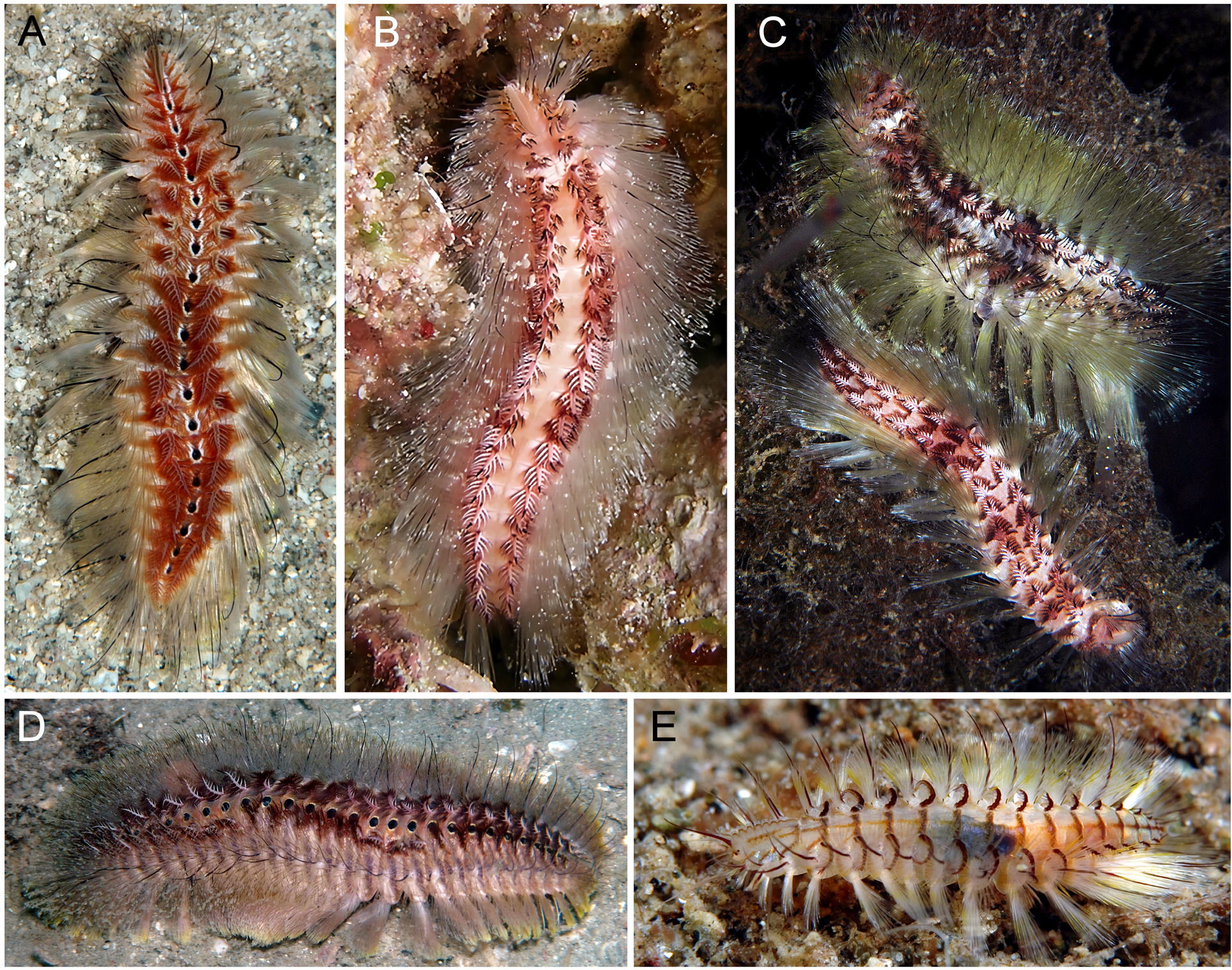
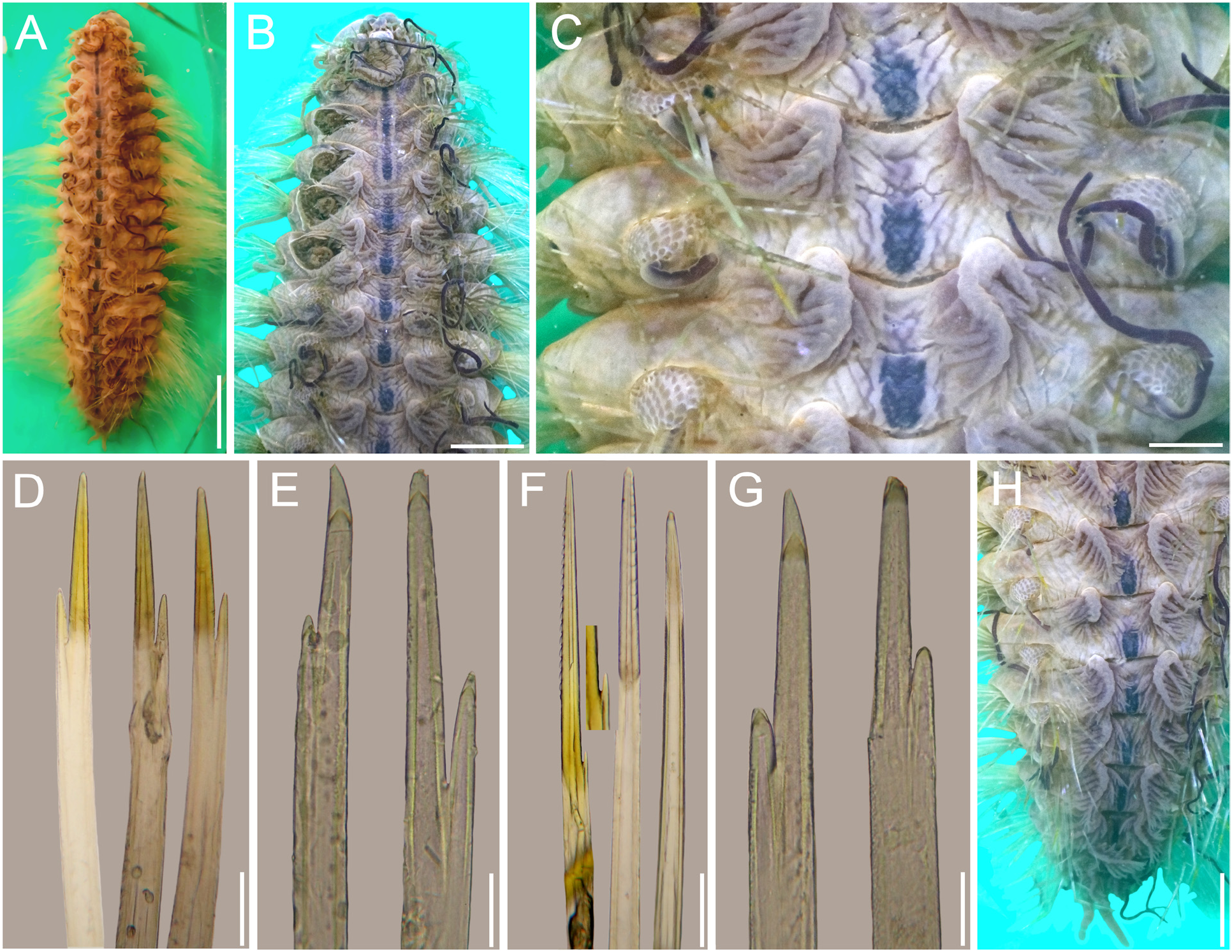
Description. Holotype (UF 4388) complete, slightly bent ventrally; body 19 mm long, 4 mm wide, 23 chaetigers. Body pale; dorsal cirri pale; branchiae pale with a dark red spot basally, branches reddish, at least along posterior region (Fig. 12 A); anterior prostomial area pale; lips greenish; chaetae transparent to whitish. Two reddish interramal spots per parapodium (Fig. 5 C). Venter cream, midventral band whitish, with one pair of red dots per segment (in paratypes, Fig. 12 D). Prostomium anteriorly entire, anterior region pale (greenish in paratypes UF 4388 b). Eyes red, anterior eyes 2 – 3 × larger than posterior ones. Median antenna pale, inserted at anterior caruncular margin, without tip, half as long as caruncle, 2 × longer than lateral antennae. Lateral antennae bases close to each other, about 2 × longer than palps. Mouth ventral on chaetiger 2 – 3. Pharynx slightly exposed, rings greenish. Caruncle whitish, straight, trilobed, tapered, reaching chaetiger 5 (Fig. 12 B). Median ridge plicate, blackish, with about 26 vertical folds. Lateral lobes narrow, visible, with about 20 vertical folds. Bipinnate branchiae from chaetiger 4, parallel along body, progressively larger to chaetiger 8 – 10, progressively smaller thereafter; in median segments branchiae with 6 – 7 lateral branches (Fig. 5 B). Parapodia biramous, notopodia with cirriform branchiae along chaetigers 1 – 3, 1 / 3 as long as dorsal cirri (Fig. 5 A). Dorsal cirri 3 – 4 × longer than bipinnate branchiae along median chaetigers, 5 – 6 × longer in posterior chaetigers. Second ventral cirri with cirrophores and cirrostyles 2 × longer than adjacent ones, directed laterally. Other ventral cirri directed ventrolaterally, about as long as one subsequent segment. Chaetae most complete with hoods pointed, rarely eroded, some with adsorbed materials. Notochaetae in anterior chaetigers furcates, major tines 3 – 4 × longer than minor ones (Fig. 12 E). Median chaetigers with one type of notochaetae, harpoon chaetae with denticulate tines 3 × longer than smooth ones (Fig. 12 G). Neurochaetae all furcates, in anterior chaetigers with major tines 2 — 3 × longer than minor ones (Fig. 12 F), in median chaetigers furcates with thinner tines of similar proportions (Fig. 12 H). Posterior region tapered; pygidium with anus terminal, anal cirri lost in holotype (in paratype UF 4388 b whitish, digitate, truncate, 3 × longer than wide, Fig. 12 D). Live pigmentation (Figs 1 B, C, 13 D, Sivad (2017), Naturefootage (2019 a, b), and Belle (2022 a )). Dorsum pink with whitish areas in chaetigers 6 and 9 – 10; dorsal cirri dark purple; branchial stems pink or white, with a basal dark purple spot, and branches tips reddish to dark purple; caruncle whitish with median ridge dark purple; chaetae transparent, with whitish distal banding. Rarely almost colorless.
Salazar-Vallejo, Sergio I. (2023): Revision of Chloeia Savigny in Lamarck, 1818 (Annelida, Amphinomidae). Zootaxa 5238 (1): 1-134, DOI: 10.11646/zootaxa.5238.1.1, URL: http://dx.doi.org/10.11646/zootaxa.5238.1.1
Figs 1 B, C, 5, 12, 13
Salazar-Vallejo, Sergio I. (2023): Revision of Chloeia Savigny in Lamarck, 1818 (Annelida, Amphinomidae). Zootaxa 5238 (1): 1-134, DOI: 10.11646/zootaxa.5238.1.1, URL: http://dx.doi.org/10.11646/zootaxa.5238.1.1
Variation. The paratype (UF 4356) has black or dark purple pigmentation (Fig. 13 A), instead of being red as in UF 4388. Eyes blackish, anterior eyes 3 – 4 × larger than posterior ones (Fig. 13 B); branchiae bipinnate from chaetiger 4, and another cirriform one in the same chaetiger. Median antenna purple, about 1 / 3 as long as caruncle. Bipinnate branchiae with large basal blackish spots, and other spots subdistally in median stem, and in some lateral ones. Parapodia with two interramal spots, upper ones larger (Fig. 13 C). Dorsal cirri dark purple; ventral cirri pale. Lower pharynx ring greenish. Venter with two black spots per segment separated from each other by whitish midventral band.
Salazar-Vallejo, Sergio I. (2023): Revision of Chloeia Savigny in Lamarck, 1818 (Annelida, Amphinomidae). Zootaxa 5238 (1): 1-134, DOI: 10.11646/zootaxa.5238.1.1, URL: http://dx.doi.org/10.11646/zootaxa.5238.1.1
Diagnosis. Bipinnate branchiae from chaetiger 4, progressively smaller posteriorly; dorsum without middorsal spots; dorsal cirri and branchiae colorful; branchial stems pale with reddis to blackish spots basally and distally in median chaetigers, distally in some lateral branches; harpoon notochaetae furcates; neurochaetae furcates.
Salazar-Vallejo, Sergio I. (2023): Revision of Chloeia Savigny in Lamarck, 1818 (Annelida, Amphinomidae). Zootaxa 5238 (1): 1-134, DOI: 10.11646/zootaxa.5238.1.1, URL: http://dx.doi.org/10.11646/zootaxa.5238.1.1
Remarks. Chloeia bemisae sp. n. is described with specimens from The Philippines and Indonesia; it belongs in the group tumida because its dorsum does not have dots, bands or complex pigmentation pattern, but it shares the presence of branchiae from chaetiger 4, decreasing progressively posteriorly. After the key above, it approaches C fauveli sp. n. from the Bay of Bengal, and C. murrayae from Australia by having purplish branchiae, at least basally. However, C. bemisae differs by having branchial stems pale with distinct spots basally, either reddish or purplish, and distally along median chaetigers, whereas there are no basal or distal spots in the branchiae of the two other species. Horst (1912) included three lots as unidentified species. He illustrated the first one, 3 mm long, about 12 chaetigers, and with branchiae from chaetiger 4 (Sta. 303, Haingsisi, Samau Island, 36 m). He described and illustrated the pigmentation pattern restricted to four black dots per segment: two in each of branchial bases, and two others before neuropodia. This pigmentation pattern matches some photos available on the internet, that can be regarded as C. bemisae (Naturefootage 2019 a, Belle 2022 a); they show that dorsal pigmentation might be homogeneously pale, and that chaetae, usually longer than body width, can be transparent or have a greenish hue. The diagnostic features of having short bipinnate branchiae, and that each has at least one basal spot (red to black), would confirm their affinity. The revision of Chloeia let me confirm that red pigments fade off sooner than black or brown ones. Especially after the study of the specimen being photographed alive (Fig. 13 D), and then studied after a few years in ethanol, its pigmentation was completely faded off. Further, because there were no major differences in chaetae, the variation in intensity of the pigments were not regarded as diagnostic, and consequently these specimens were regarded as belonging to the same species. On the other hand, one specimen from Mariana Islands (Burdik 2022) shows larger eyes and itsbranchiae have pigmented bipinnate branchial stems, instead of having a single spot, and they probably belong elsewhere, but no material was available for clarifying this.
Salazar-Vallejo, Sergio I. (2023): Revision of Chloeia Savigny in Lamarck, 1818 (Annelida, Amphinomidae). Zootaxa 5238 (1): 1-134, DOI: 10.11646/zootaxa.5238.1.1, URL: http://dx.doi.org/10.11646/zootaxa.5238.1.1
Distribution. Philippines to Indonesia, in shallow mixed bottoms, 3 – 22 m water depth.
Salazar-Vallejo, Sergio I. (2023): Revision of Chloeia Savigny in Lamarck, 1818 (Annelida, Amphinomidae). Zootaxa 5238 (1): 1-134, DOI: 10.11646/zootaxa.5238.1.1, URL: http://dx.doi.org/10.11646/zootaxa.5238.1.1
Etymology. The specific epithet is derived after Amanda Bemis, collection manager in the University of Florida Natural History Museum, in recognition of her long-standing support of my research activities. The specific name is a noun in the genitive case (ICZN 1999, Art. 31.1.2).
Salazar-Vallejo, Sergio I. (2023): Revision of Chloeia Savigny in Lamarck, 1818 (Annelida, Amphinomidae). Zootaxa 5238 (1): 1-134, DOI: 10.11646/zootaxa.5238.1.1, URL: http://dx.doi.org/10.11646/zootaxa.5238.1.1
Type material. Philippine Islands. Holotype (UF 4388), and two paratypes (UF 4388 b), Mindoro, Puerto Galera, off Sabang Beach (13.52207, 120.97522; 13 ° 31´19.4514 ″ N, 120 ° 58´30.7914 ″ E), 4 – 6 m, gentle sand slope with some reef, 19 Apr. 2015, G. Paulay, coll. (paratypes pale, eyes reddish, bases of bipinnate branchiae with a red spot, venter with two round red spots per segment; one complete, and an anterior fragment; complete 18 mm long, 5 mm wide, 20 chaetigers). One paratype (UF 4356), Mindoro, Puerto Galera, Fantasea Reef (13.52362, 120.97408; 13 ° 31 ' 25.0314 " N, 120 ° 58 ' 26.688 " E), 3 – 7 m, gentle slope of sand and patch reef, 9 Apr. 2015, G. Paulay, coll. (data used for variation; body bent dorsally, gut exposed in posterior region, without posterior end; body 15 mm long, 3 mm wide, 19 chaetigers). Additional material. Philippine Islands. Two juveniles (CAS 197425), Batangas Province, Maricaban Island, Cemetery Beach (13.68 ° N, 120.83 ° E; 13 ° 40´47.9994 ″ N, 120 ° 49´47.9994 ″ E), 3 – 6 m, 26 Apr. 2014, C. Piotrowski, coll. (complete, white dorsum, antennae and dorsal cirri dark purple; branchiae with spots in basal stem, and in lowest and terminal branches; anterior eyes 2 – 4 × larger than posterior ones; median antenna 4 / 5 as long as caruncle; venter with paired spots along most chaetigers; body 9 – 10 mm long, 3 – 4 mm wide, 18 chaetigers). Two juveniles (CAS 201297), Verde Island Passage Expedition, Luzon Island, Batangas Province, Calatagan, Verde Island Passage coast, Dead Fish dive site (13.93 ° N, 120.61 ° E; 13 ° 55 ' 47.9994 " N, 120 ° 36 ' 35.9994 " E), 19 May 2014, T. M. Gosliner, coll. (chaetae longer than body width; one with anterior eyes slightly larger than posterior ones, anterior eyes 4 – 5 × larger than posterior ones in the smallest specimen; antennae and dorsal cirri dark purple; two interramal dark purple spots, superior one larger than inferior one; branchiae with dark purple dots on base of stem, and in distal stem area; ventral paired spots well-defined; body 5 – 7 mm long, 1.9 – 2.0 mm wide, 16 – 17 chaetigers). One specimen (CAS 214348), Verde Island Passage Expedition 2016, Mindoro, Oriental Mindoro, Puerto Galera, Coral Cove dive site (13.52 ° N, 120.99 ° E; 13 ° 31´11.9994 ″ N, 120 ° 59´23.9994 ″ E), 6 – 22 m, coral rubble slope, 31 Mar. 2015, C. Piotrowski, coll. (complete, bent ventrally; anterior eyes slightly larger than posterior ones; antennae and dorsal cirri dark purple; two interramal dark purple spots, superior one larger than inferior one; branchiae with dark purple dots on base of stem, in some lateral branches, and in distal stem area; ventral paired spots barely visible; body 19 mm long, 4.5 mm wide, 21 chaetigers). Indonesia. One specimen (NTM W 17191), Tulamben, 3 – 5 m, under rocks, 19 Oct. 2000, K. L. Gowlett-Holmes, coll. (slightly bent ventrally, partially dehydrated; colorless; eyes reddish, anterior ones 3 – 4 × larger than posterior ones; median antenna 1 / 3 – 1 / 4 as long as caruncle; neurochaetae as long and as wide as notochaetae from chaetiger 4; body 19 mm long, 6 mm wide, 21 chaetigers).
Salazar-Vallejo, Sergio I. (2023): Revision of Chloeia Savigny in Lamarck, 1818 (Annelida, Amphinomidae). Zootaxa 5238 (1): 1-134, DOI: 10.11646/zootaxa.5238.1.1, URL: http://dx.doi.org/10.11646/zootaxa.5238.1.1

Export occurrence data

Darwin Core Archive (ZIP)

CLASSIFICATION

Taxonomic Classification Tree

NOMENCLATURE

Synonyms(1)

MULTIMEDIA

Media Files(5)

FIGURE 1. Living specimens of four Philippine species of Chloeia Savigny in Lamarck, 1818. A. C. amphora Horst, 1910, dorsal view. B. C. bemisae sp. n., pink variant, dorsal view. C. Same, reddish and brownish variants, dorsal view. D. C. flava (Pallas, 1766), oblique right dorsal view. E. C. violacea Horst, 1910, oblique left dorsal view (scales not available; photos: Philippe Poppe; © Philippe & Guido Poppe – www.poppe-images.com).

Imageimage/png© Salazar-Vallejo, Sergio I.Salazar-Vallejo, Sergio I.

FIGURE 5. Chloeia bemisae sp. n., paratype, anterior fragment (UF 4388b). A) Chaetiger 3, right parapodium, posterior view, cirriform branchia cut (insets matched: 1, branchial cut tip; 2, branchial basal region; 3, dorsal cirrophore; 4, dorsal cirrostyle tip). B) Chaetiger 5, right parapodium, posterior view (insets matched: 1 and 2, branchial filament tip; 3, dorsal cirrostyle tip) (Br: branchia, DCs: dorsal cirrostyle). Scale bars: A, 0.20 mm; B: 0.38 mm.
Imageimage/png© Salazar-Vallejo, Sergio I.Salazar-Vallejo, Sergio I.

FIGURE 9. Chloeia amphora Horst, 1910, lectotype (ZMA V.Pol 149.4). A. Oblique dorsal view. B. Anterior region, dorsal view. C. Chaetigers 10-12, dorsal view. D. Chaetiger 3, notochaetae. E. Same, neurochaetal tips. F. Chaetiger 12, notochaetal tips (inset: spur). G. Same, neurochaetal tips. Scale bars: A, 4.2 mm; B, 2.4 mm; C, 0.6 mm; D, 130 μm; E, G, 30 μm; F, 90 μm; H, 1.7 mm.

Imageimage/png© Salazar-Vallejo, Sergio I.Salazar-Vallejo, Sergio I.

FIGURE 12. Chloeia bemisae sp. n., holotype (UF 4388).A. Dorsal view. B. Anterior end, dorsal view. C. Left lateral view. D. Paratype (UF 4388b), ventral view. E. Same, chaetiger 4, notochaetal tips. F. Same, neurochaetal tips. G. Chaetiger 11, harpoon notochaetae. H. Same, neurochaetae. Scale bars: A, 1.8 mm; B, 0.5 mm; C, 2.3 mm; D, 1.6 mm; E, 110 μm; F, 25 μm; G, 90 μm; H, 100 μm.

Imageimage/png© Salazar-Vallejo, Sergio I.Salazar-Vallejo, Sergio I.

FIGURE 13. Chloeia bemisae sp. n. A. Paratype (UF 4356), anterior region, dorsal view. B. Anterior end, dorsal view. C. Anterior end, right lateral view. D. Non-type specimen (NTM W17191), living, dorsal view. Scale bars: A, 1.8 mm; B, 0.8 mm; C, 0.7 mm; D, 2.4 mm (Photo D: Karen L. Gowlett-Holmes).

Imageimage/png© Salazar-Vallejo, Sergio I.Salazar-Vallejo, Sergio I.

IMAGES

Gallery(5)

See Gallery

Occurrences with images

Source Information

Revision of Chloeia Savigny in Lamarck, 1818 (Annelida, Amphinomidae)

checklist

This dataset contains the digitized treatments in Plazi based on the original journal article Salazar-Vallejo, Sergio I. (2023): Revision of Chloeia Savigny in Lamarck, 1818 (Annelida, Amphinomidae). Zootaxa 5238 (1): 1-134, DOI: 10.11646/zootaxa.5238.1.1, URL: http://dx.doi.org/10.11646/zootaxa.5238.1.1

Abstract

Chloeia Savigny in Lamarck, 1818 is the largest genus in the Amphinomidae by including more species than other genera. Members of Chloeia species thrive in mixed substrates or sediments, mostly in tropical waters, and rarely reach deep water, or cold-temperate environments. A recent revision dealt with the species from tropical American seas and resulted in the redescription of five species, and the description of two other new ones. The objective for this additional contribution was to revise type and non-type specimens deposited in 12 of the largest world collections, and by applying a slightly modified approach from the precedent revision. Species were grouped herein after the type of branchiae, the first chaetiger with branchiae, and the dorsal pigmentation pattern. The results include the redescription of 16 species, with C. flava (Pallas, 1766) and C. fusca M’Intosh, 1885 being restricted, and three others reinstated: C. incerta de Quatrefages, 1866; C. fucata de Quatrefages, 1866, and C. pulchella Baird, 1868; 10 species are regarded as indeterminable: C. ancora Frickhinger, 1916; C. bengalensis Kinberg, 1867; C. candida Kinberg, 1857; C. egena Grube, 1855; C. furcigera de Quatrefages, 1866; C. macleayi Haswell, 1879; C. malaica Kinberg, 1867; C. nuda de Quatrefages, 1866; C. quatrefagesii Baird, 1868; and C. rupestris Risso, 1826. Further, 10 recently described species are being diagnosed and compared to their most similar species, but not redescribed; and 17 species are newly described: C. amoureuxi sp. n. from Madagascar, C. bemisae sp. n. from The Philippines, C. boucheti sp. n. from Indonesia, C. fauveli sp. n. from the Bay of Bengal, C. fiegei sp. n. from the Red Sea, C. gesae sp. n. from the Northeastern Atlantic, C. gilleti sp. n. from Western Africa, C. hutchingsae sp. n. from Australia, C. keablei sp. n. from Papua New Guinea, C. mezianei sp. n. from Western Africa, C. murrayae sp. n. from Australia, C. piotrowskiae sp. n. from The Philippines, C. poupini sp. n. from the French Polynesia, C. richeri sp. n. from New Caledonia, C. slapcisnkyi sp. n. from The Philippines, C wangi sp. n. from The Philippines, and C. zibrowii sp. n. from the French Polynesia. Keys to all archinomin genera and to all species of Chloeia are also included.

Salazar-Vallejo S I, plazi (2023). Revision of Chloeia Savigny in Lamarck, 1818 (Annelida, Amphinomidae). Plazi.org taxonomic treatments database. Checklist dataset https://doi.org/10.15468/sqdwvp accessed via GBIF.org on 2026-06-15.

CC0Published 2/7/2023View dataset
GBIF Usage Key
209295569
Dataset Key
751096f2-4b5b-43c3-9748-4d07afe044c3
Origin
source
Backbone Key
12181802
Taxon ID
03C79010FFEAD701FF707AD1279DFBB2.taxon
Last Crawled
6/9/2026
Last Interpreted
6/9/2026