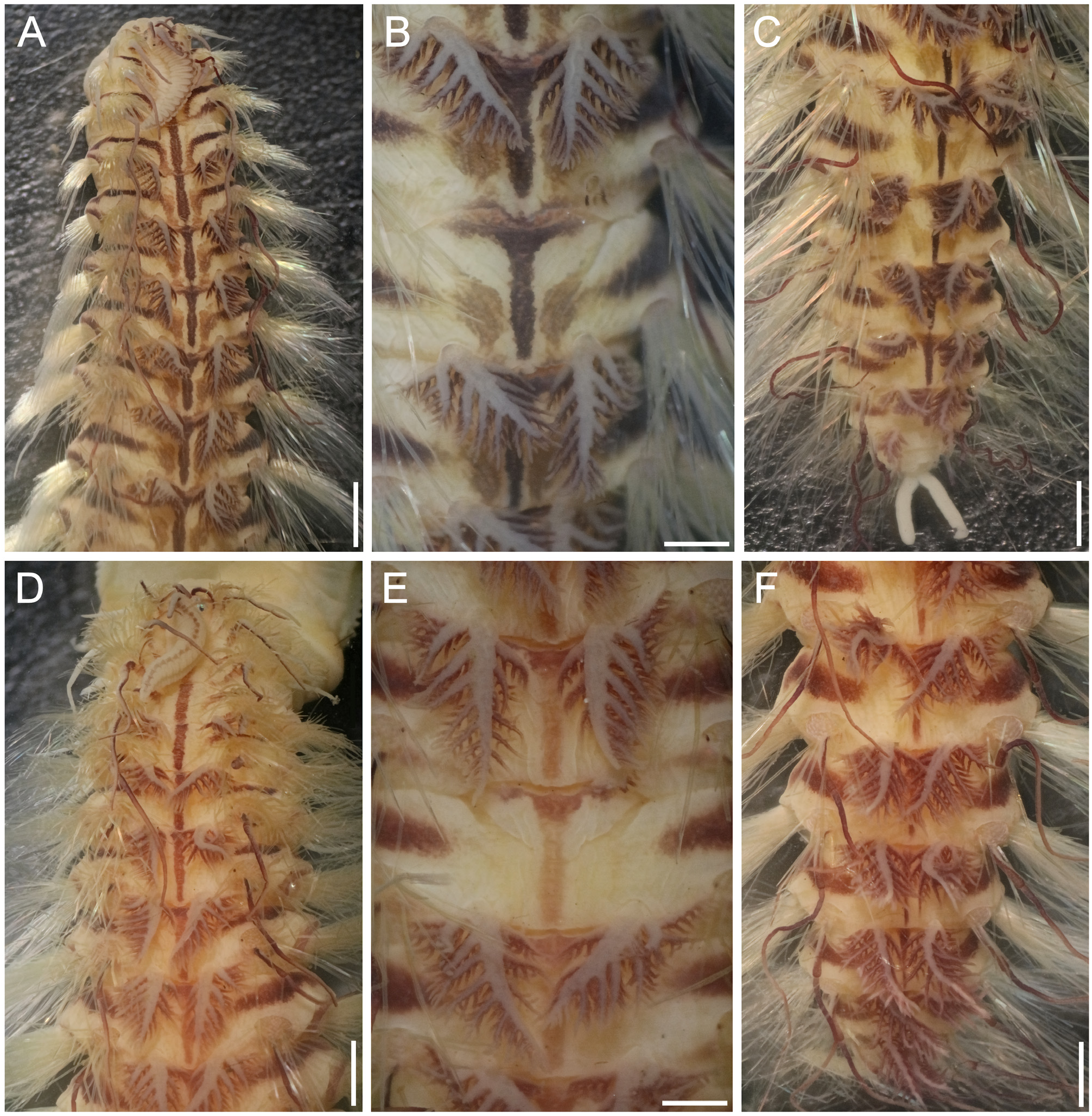
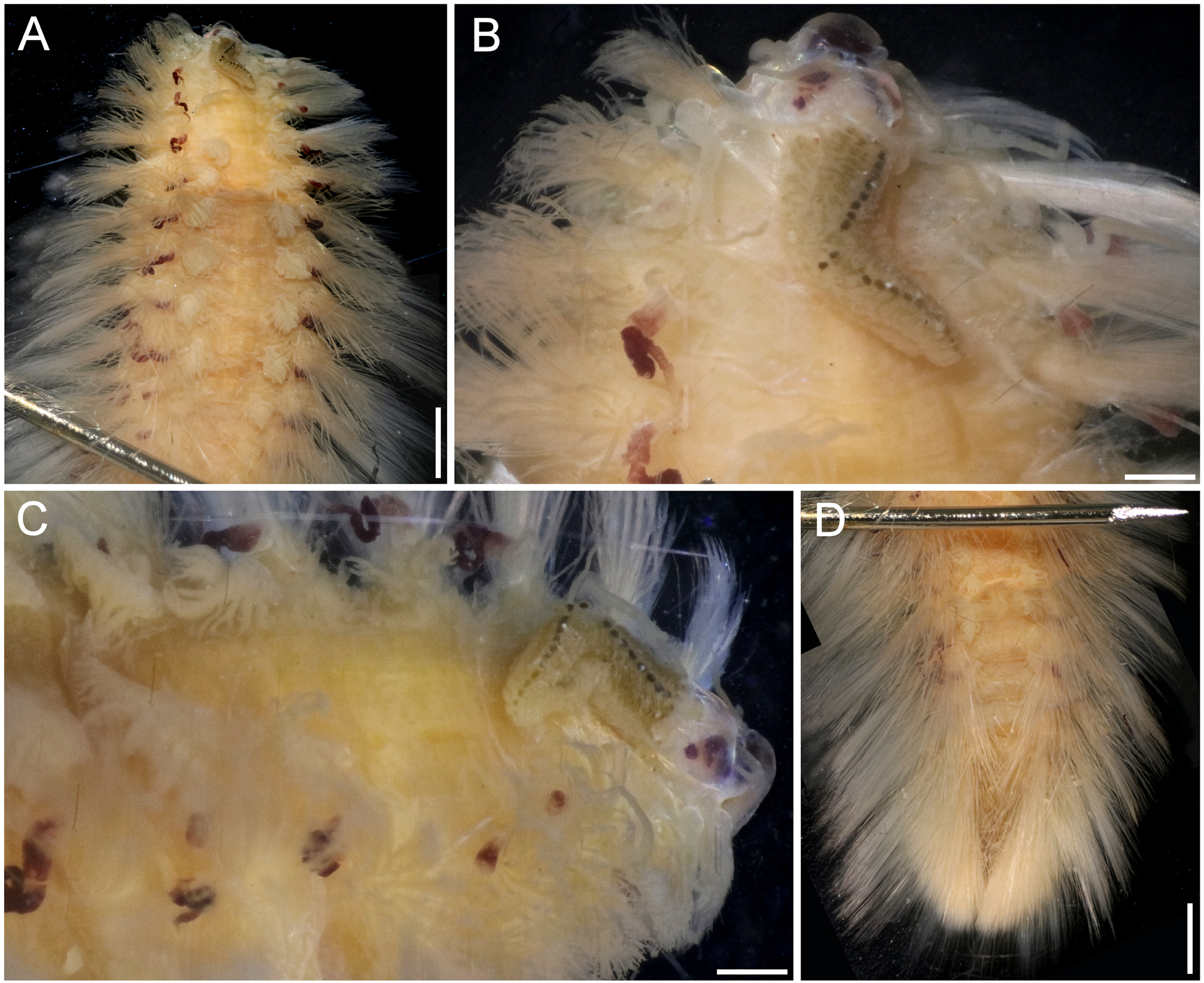
Description. Holotype (MMSUCO Amp 2), with anterior end distorted by compression in small container (Fig. 7 A); body fusiform, 60 mm long, 11 mm wide, 36 chaetigers. Body cream, middorsal spots reddish, wide irregular bands, in median segments anteriorly thinner, expanded posteriorly, laterally reaching branchial bases (Fig. 7 C); branchial stems pale, margins and branches brownish; dorsal cirri dark purple; chaetae transparent to yellowish. Venter cream, midventral band thin, paler. Prostomium anteriorly entire, anterior area brownish. Eyes blackish, anterior eyes 2 – 3 × larger than posterior ones (Fig. 7 B). Antennae and palps dark purple, at least basally. Median antenna inserted at anterior caruncular margin, 1 / 3 as long as caruncle, 2 × larger than lateral antennae. Lateral antennae bases close to each other, slightly larger than palps. Mouth ventral on chaetiger 2 / 3. Pharynx not exposed. Caruncle pale, straight, trilobed, tapered, reaching chaetiger 4. Median ridge pale, plicate, with about 38 vertical folds, partially concealing lateral lobes. Lateral lobes narrow, with about 36 vertical folds. Bipinnate branchiae from chaetiger 4, continued throughout body, alignment: parallel or convergent; progressively larger to chaetigers 15 – 16, smaller posteriorly. In median segments each branchia with 10 – 11 lateral branches. Parapodia biramous, notopodia with cirriform branchiae along chaetigers 1 – 3, most lost, 1 / 3 as long as dorsal cirri. Dorsal cirri slightly longer than bipinnate branchiae along median chaetigers, 2 – 3 × longer in posterior chaetigers. Second ventral cirri with cirrophores 4 × longer and 3 × wider, and cirrostyle 6 × longer than adjacent ones, directed dorsally. Other ventral cirri directed ventrolaterally, as long as one subsequent segment. Chaetae most complete with distal fragile hoods, rarely eroded. Notochaetae in anterior chaetigers furcates, major tines 3 – 7 × longer than minor ones (Fig. 7 D). Median chaetigers with one type of notochaetae: harpoon-chaetae without spurs, core brownish, as long as denticulate tip (Fig. 7 E). Neurochaetae all furcates, major tines 3 – 7 × longer than minor ones (Fig. 7 F), 6 — 12 × longer in median chaetigers (Fig. 7 G). Posterior region tapered; pygidium with anus terminal; anal cirri cream, digitate, 4 – 5 × longer than wide (Fig. 7 H). Epitoke. One specimen (MNHN 860.1) is regarded as a pre-natatory epitoke, and conspecific with this species. Body wall delicate; body slightly bent laterally, 25 mm long, 6 mm wide, 28 chaetigers. Dorsum irregularly brownish, no banding distinct (Fig. 8 A). Dorsal cirri dark purple. Branchiae pale. Caruncle brownish, median ridge dark purple. Chaetae yellowish to transparent. Venter cream, midventral band wide, paler. Prostomium anteriorly entire; anterior prostomial area swollen, blackish (Fig. 8 B, C). Eyes blackish, anterior eyes oval, 8 – 10 × larger than posterior round ones. Median antenna inserted at anterior caruncular margin, convoluted, without tip, 1 / 3 as long as caruncle, about 2 × longer than lateral antennae. Lateral antennae bases separate from each other, slightly longer than palps. Mouth ventral on chaetiger 2. Pharynx not exposed. Caruncle darker than surrounding areas, sigmoid, trilobed, tapered, reaching chaetiger 4. Median ridge plicate, blackish, with about 27 vertical folds, partially concealing lateral lobes (Fig. 8 C). Lateral lobes narrow, with about 26 vertical folds. Bipinnate branchiae from chaetiger 4, left one detaching, right one lost, parallel throughout body, progressively larger to chaetiger 7 – 8, smaller posteriorly. Median segments with 7 – 8 lateral branches. Parapodia biramous, notopodia with cirriform branchiae along chaetigers 1 – 3, lost on right side, progressively shorter, about as long as dorsal cirri in chaetiger 1. Dorsal cirri convolute, slightly longer than bipinnate branchiae along median chaetigers, 2 – 3 × longer in posterior chaetigers. Second ventral cirri with cirrophores 2 × longer and wider than adjacent ones, cirrostyles lost, directed dorsally. Most other ventral cirri lost, directed ventrolaterally, as long as one subsequent segment. Chaetae most complete with hoods, rarely eroded. Notochaetae in anterior chaetigers furcates, major tines 3 – 5 × longer than minor ones. Median chaetigers with two types of notochaetae: furcates with major tines 3 – 4 × longer than minor ones, and harpoon – chaetae with basal tines, denticulate tines 3 – 5 × longer than smooth ones. Median chaetigers with furcate neurochaetae, major tines longer than in anterior chaetigers, up to 16 × longer than minor tines. Posterior notopodia with abundant capillaries, and harpoon-chaetae with denticulate tines 4 × longer than smooth ones, but both tines very thin. Posterior neurochaetae with abundant capillaries and furcates, major tines 10 – 20 × longer than minor ones. Posterior region tapered with very long chaetae (Fig. 8 D); anus terminal; anal cirri brownish, digitate, 3 – 4 × longer than wide. Live pigmentation. A living specimen has a salmon background with the amphora-like middorsal spot with pigmentation more intense form the middle to the posterior margin in each segment, and a brownish band running along the anterior parapodial surface (Rendive 2010).
Salazar-Vallejo, Sergio I. (2023): Revision of Chloeia Savigny in Lamarck, 1818 (Annelida, Amphinomidae). Zootaxa 5238 (1): 1-134, DOI: 10.11646/zootaxa.5238.1.1, URL: http://dx.doi.org/10.11646/zootaxa.5238.1.1