
AnimaliaNot EvaluatedacceptedspeciesAccepted
Malasudis vernae
Haitlinger, 2001
GBIF:209473833
0year
ABOUT
Descriptions(4)
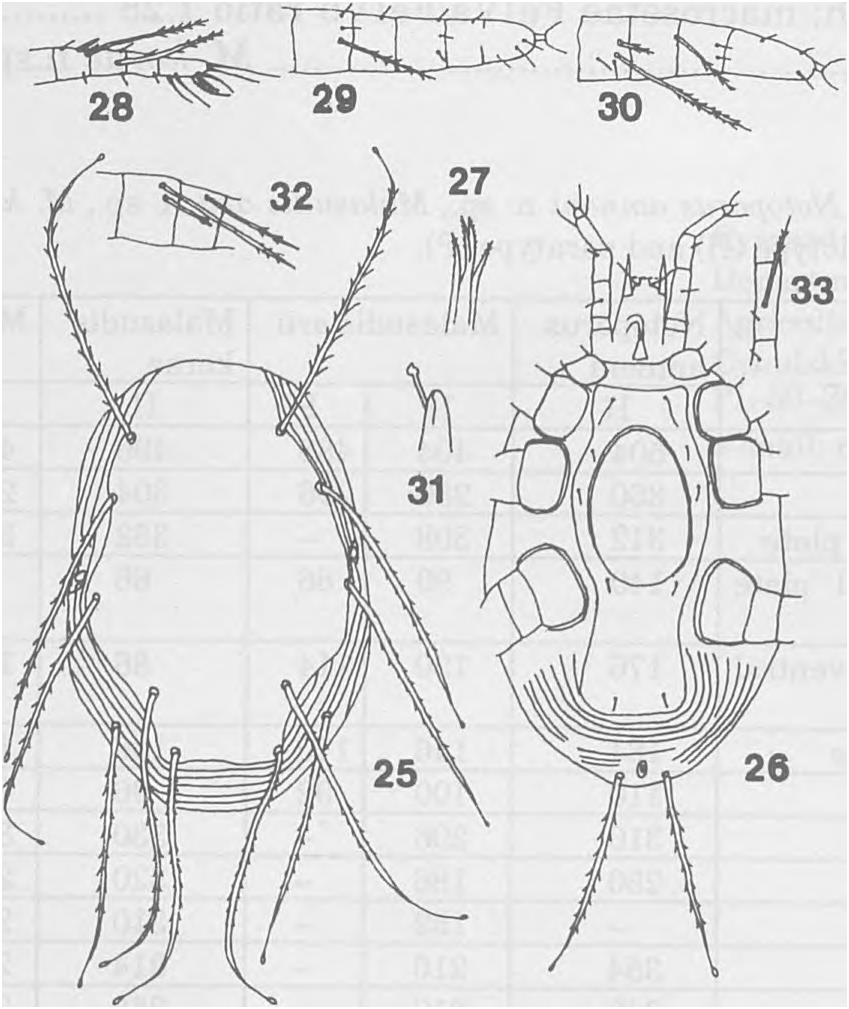
Description Dorsal plate covers whole idiosoma except of area at lateral and posterior margins of idiosoma (fig. 25). This area is distinctly striated. Dorsal plate bears five pairs of ultralong barbed setae of which ml is the longest. Setae m 3 placed on pleural membrane. Ventrum with sternoventral plate bearing five pairs of short setae; of them the first pair the longest. Postgenital setae placed near posterior margin of the plate. Area beyond the plate with striation. Borders of the anal plate unvisible (fig. 26). Tectum with three delicately fringid rami, lateral rami shorter than middle bifurcate ramus (fig. 27). Epigynial plate oval. Malae externae rather slender, malae internae delicate. Genu and femur of leg I each with barbed macroseta; macroseta on femur is longer (fig. 28). Terminala rather short, longer than subterminala. Leg II with one macroseta on femur (fig. 29). Legs III-IV each with one macroseta on genu and two macrosetae on femur. Macrosetae on femora (fig. 30) III unequal in length (74 - 104 to 12 - 34). Macrosetae on femora IV (fig. 32) also unequal in length (88 — 114 to 30 — 40). Chelicerae with cheliceral spur widened at the tip (fig. 31). Palps with only one relatively long and barbed seta (fig. 33). Measurements are given in Tab. I. Malasudis vernae n. sp. can be separated from the remaining species of the genus by macrosetae on femora III-IV; each femur have two macrosetae of which one is a many times shorter than concomitant seta; in other Malasudis species between these setae haven't such differences in length.
Haitlinger, Ryszard (2001): Four new diarthrophallid mites (Acari, Mesostigmata, Diarthrophallidae) from tropical Africa. Annals of the Upper Silesian Museum (Entomology) 10 - 11: 169-177, DOI: 10.5281/zenodo.7781787
Diagnosis M. vernae is similar to M. tribulus. It can be separated by macrosetae on femora III-IV which are unequalin length (Fe III 74 - 104 to 12 - 34; Fe IV 88 - 114 to 30 — 40). In M. tribulusthese setae are subequal.
Haitlinger, Ryszard (2001): Four new diarthrophallid mites (Acari, Mesostigmata, Diarthrophallidae) from tropical Africa. Annals of the Upper Silesian Museum (Entomology) 10 - 11: 169-177, DOI: 10.5281/zenodo.7781787
ETYMOLOGY The name of the species has been derived from the name Verna.
Haitlinger, Ryszard (2001): Four new diarthrophallid mites (Acari, Mesostigmata, Diarthrophallidae) from tropical Africa. Annals of the Upper Silesian Museum (Entomology) 10 - 11: 169-177, DOI: 10.5281/zenodo.7781787
Material examined Holotype female (figs 25 - 33), Madagascar,? Berarasy; 2 ?? paratypes,? Ambrotalasy and? Berarasy; all from undetermined Passalidae; all in MIZPAS.
Haitlinger, Ryszard (2001): Four new diarthrophallid mites (Acari, Mesostigmata, Diarthrophallidae) from tropical Africa. Annals of the Upper Silesian Museum (Entomology) 10 - 11: 169-177, DOI: 10.5281/zenodo.7781787
Export occurrence data
Darwin Core Archive (ZIP)
CLASSIFICATION
Taxonomic Classification Tree

MULTIMEDIA
Media Files(1)
Figs 25-33. Malasudis vernae n.sp.,?: 25 - idiosoma, dorsal view; 26 —idiosoma, ventral view; 27 - tectum; 28 - leg I, tarsus-femur; 29 - leg II, tarsus-femur; 30 - leg III, tarsus-femur; 31 - chelicerae; 32 - leg IV, genu-femur; 33 - palp, macroseta, dorsal view.
Imageimage/png© Haitlinger, RyszardHaitlinger, Ryszard
IMAGES