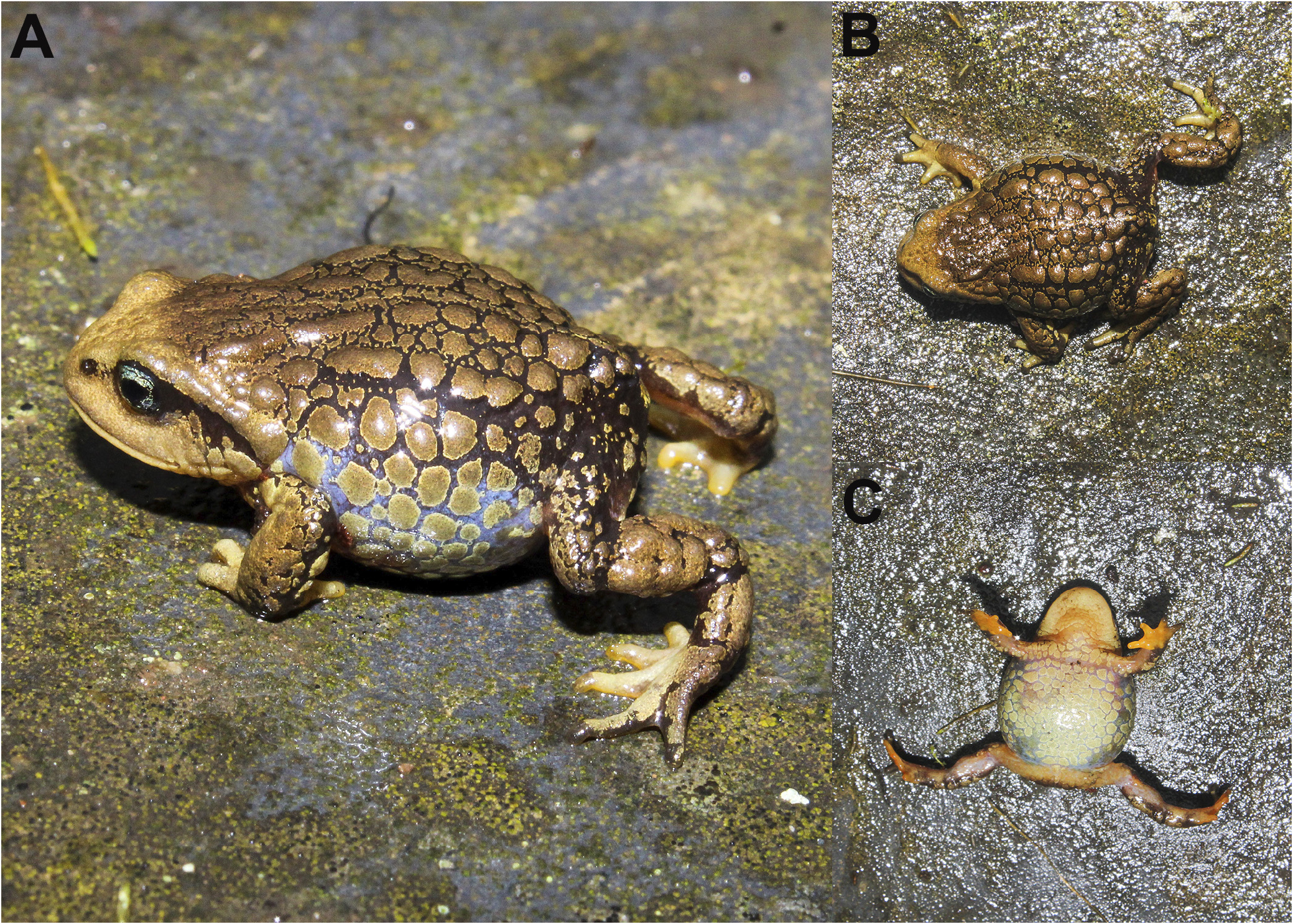
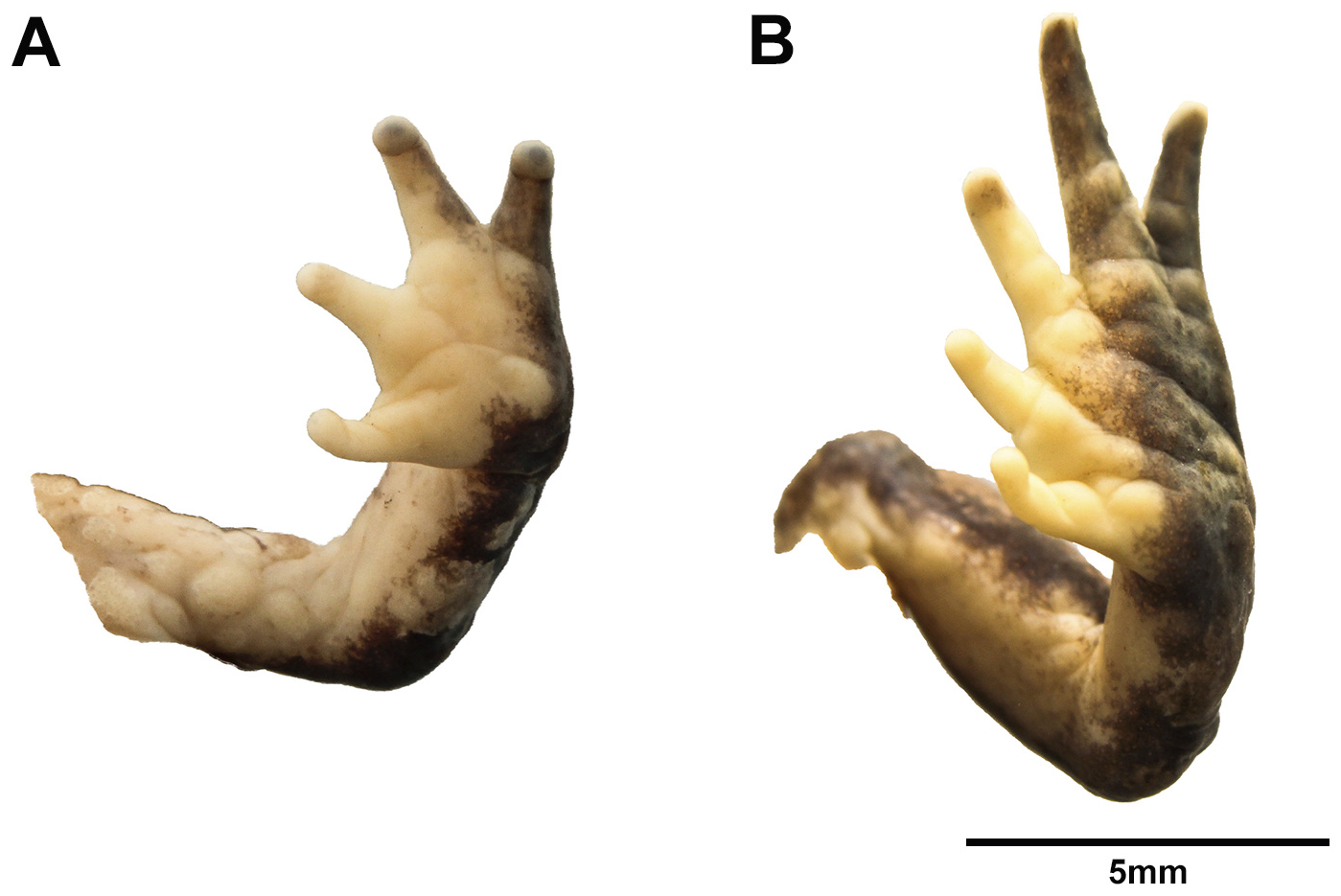
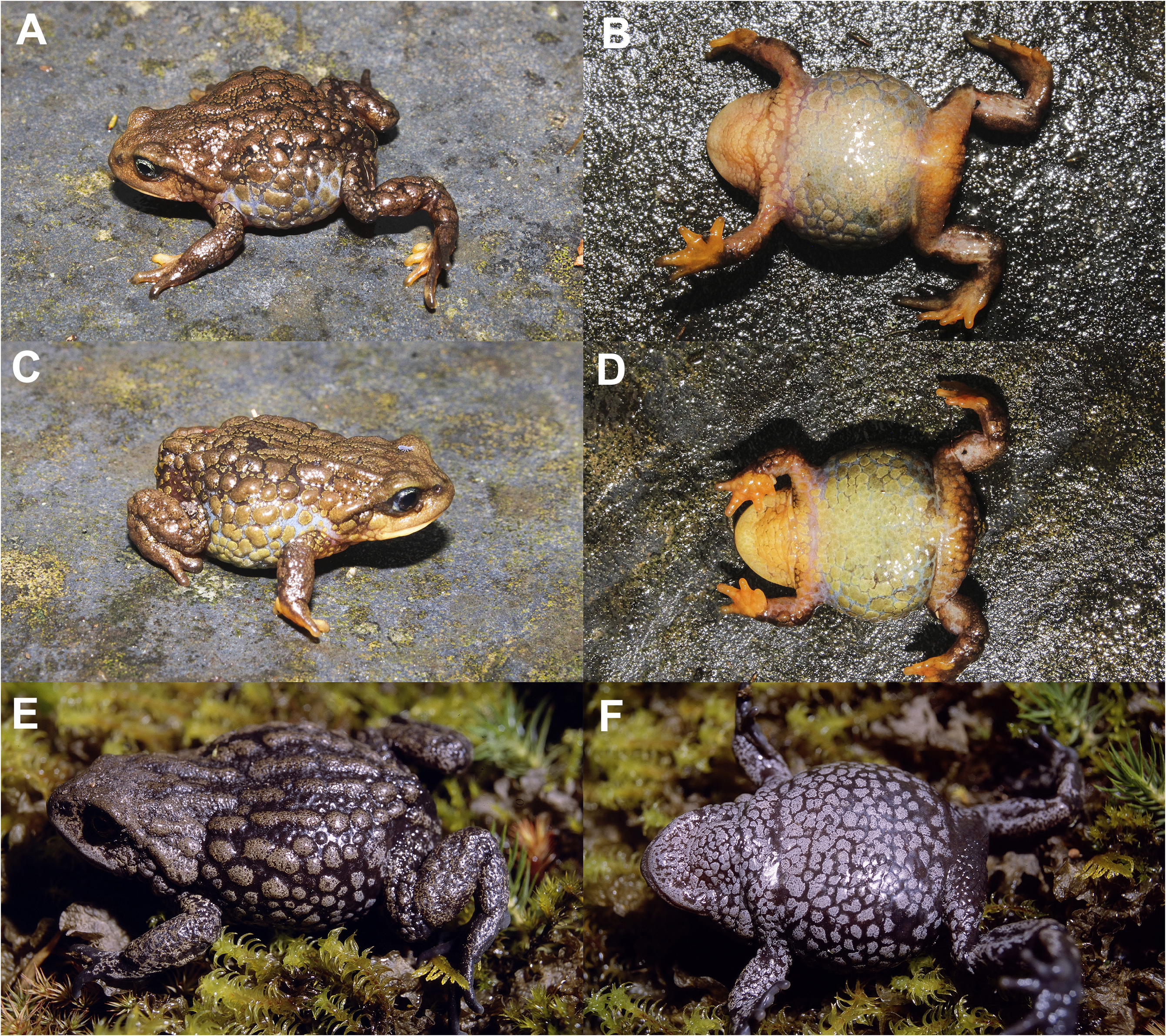
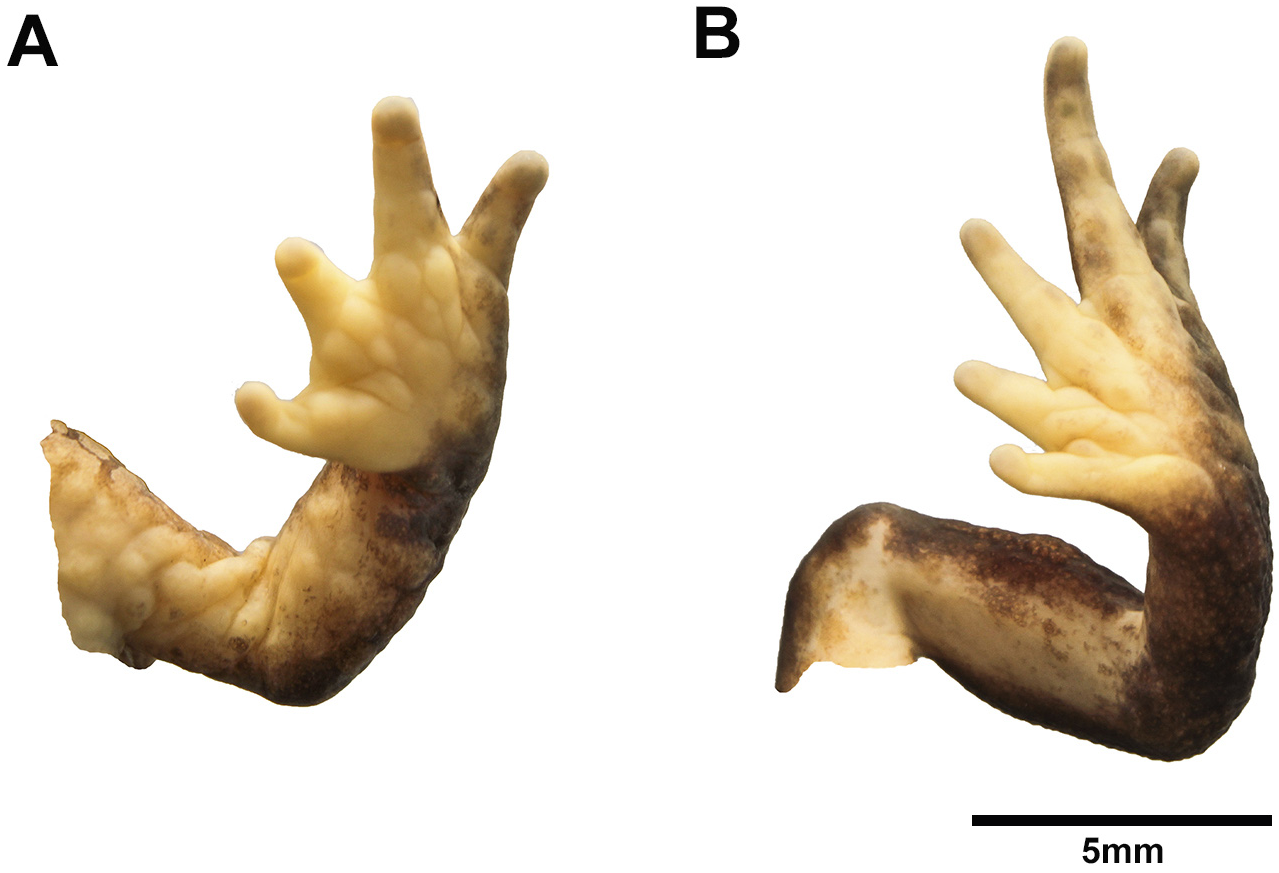
Description of holotype Head nearly as wide as body, wider than long; head width 107 % of head length; head width 37 % of snout-vent length; head length 35 % of SVL. Snout short, rounded in dorsal view, curved anteroventrally in lateral view (Figs. 3 – 5), eye-to-nostril distance 48 % of eye diameter; nostrils not protuberant; canthus rostralis slightly curved in dorsal view, rounded in profile; loreal region slightly concave; lips rounded; upper eyelid lacking tubercles, narrower than interorbital distance (EW 66 % of IOD); postocular and tympanic region with prominent folds (Fig. 3); tympanic membrane and tympanic annulus absent, tympanic region with discontinuous pustules; choanae small, ovoid, partly concealed by palatal of maxilla, dentigerous processes of vomers absent; tongue broad, about 1.7 as long as wide, notched posteriorly, posterior half free; vocal slits absent. Skin on dorsum with circular pustules of varying dimensions (Fig. 4); skin on flanks shagreened with scattered rounded pustules; skin on throat, chest and belly strongly areolate (Fig. 3 B); discoidal and thoracic folds absent; cloacal sheath absent; cloacal region with prominent pustules. Outer surface of forearm with prominent pustules; outer palmar tubercle barely visible, low, ovoid, smaller than ovoid inner palmar tubercle; supernumerary tubercles absent; subarticular tubercles absent; fingers without lateral fringes; Finger I slightly shorter than Finger II (Fig. 5); tips of digits rounded, bulbous, lacking circumferential grooves. Hind limbs short and slender, tibia length 34 % of SVL; foot length 37 % of SVL; dorsal surface of hind limbs with irregular pustules; anterior surfaces of thighs smooth, posterior surfaces of thighs pustulate; heel with low rounded, irregular tubercles; outer surface of tarsus bearing pustules like those on dorsum; outer metatarsal tubercle rounded and prominent, slightly larger than the ovoid inner metatarsal tubercle; supernumerary plantar tubercles absent; subarticular tubercles low, not distinguishable; toes without lateral fringes; basal webbing absent; toe tips bulbous, rounded, lacking circumferential grooves, about as large as those on fingers; relative lengths of toes: 1 <2 <3 <5 <4; Toe V slightly longer than Toe III (Fig. 5). Measurements of holotype (in mm). SVL, 19.5; TL, 6.6; HL, 6.8; IND, 1.7; IOD, 2.3; EW, 1.6; HW, 7.3; FL, 7.3; E-N, 1.1; ED, 2.2 (Table 1). Variation Female PFAUNA 550 is larger (SVL = 22.2 mm) than both the holotype and male PFAUNA 551 (SVL = 20.7 mm; Table 1). Furthermore, the female has the first subarticular tubercle entire in Finger I and IV, and divided in Fingers II and III (all subarticular tubercles entire in both males; Fig. 7). Coloration of holotype in life The holotype had a light brown to golden dorsum, with dark brown reticulations that appear to divide the pustules, and similar coloration on the dorsal part of the limbs; the flanks were golden brown with gray and dark brown reticulations; the belly was cream to yellow with gray to light brown reticulations, the groin and throat were orange; there is a dark brown halo on the nose and on the eye, extending as a post ocular stripe that ends in the tympanic palms and soles were orange, but fingers IV and V were dark brown in dorsal and ventral view, fading to orange at about half of palms (Fig. 3). Coloration of holotype in preservative The holotype in preservation maintains the same general color patterns described above, only decreasing in intensity (Fig. 4).
Díaz, Vladimir, Mamani, Luis, Catenazzi, Alessandro (2023): A new species of Andean frog of the genus Phrynopus (Anura: Strabomantidae) from southeastern Peru. Zootaxa 5293 (2): 333-348, DOI: 10.11646/zootaxa.5293.2.7, URL: http://dx.doi.org/10.11646/zootaxa.5293.2.7