AnimaliaNot EvaluatedacceptedspeciesAccepted
Tripedalia maipoensis

Tripedalia maipoensis

Sun, Tsui, Wong, Cheung, Ng, Or & Qiu, 2023

GBIF:209694577

0year

ABOUT

Descriptions(5)

(Figs. 1, 2, Fig. S 1) urn: lsid: zoobank. org: act: 68 BA 7074 - 70 C 9 - 400 A- 9 F 49 - 572 E 6 DC 3622 B
Sun, Yanan, Tsui, Justin Hon Yin, Wong, Rachel Ting Huen, Cheung, Ringo Nga Ching, Ng, Murphy Kam Pui, Or, Carmen K. M., Qiu, Jian-Wen (2023): A New Species of Box Jellyfish (Cnidaria: Tripedaliidae: Tripedalia) from Hong Kong, China. Zoological Studies 62 (17): 1-7, DOI: 10.6620/ZS.2023.62-17, URL: http://dx.doi.org/10.15468/6c8dme

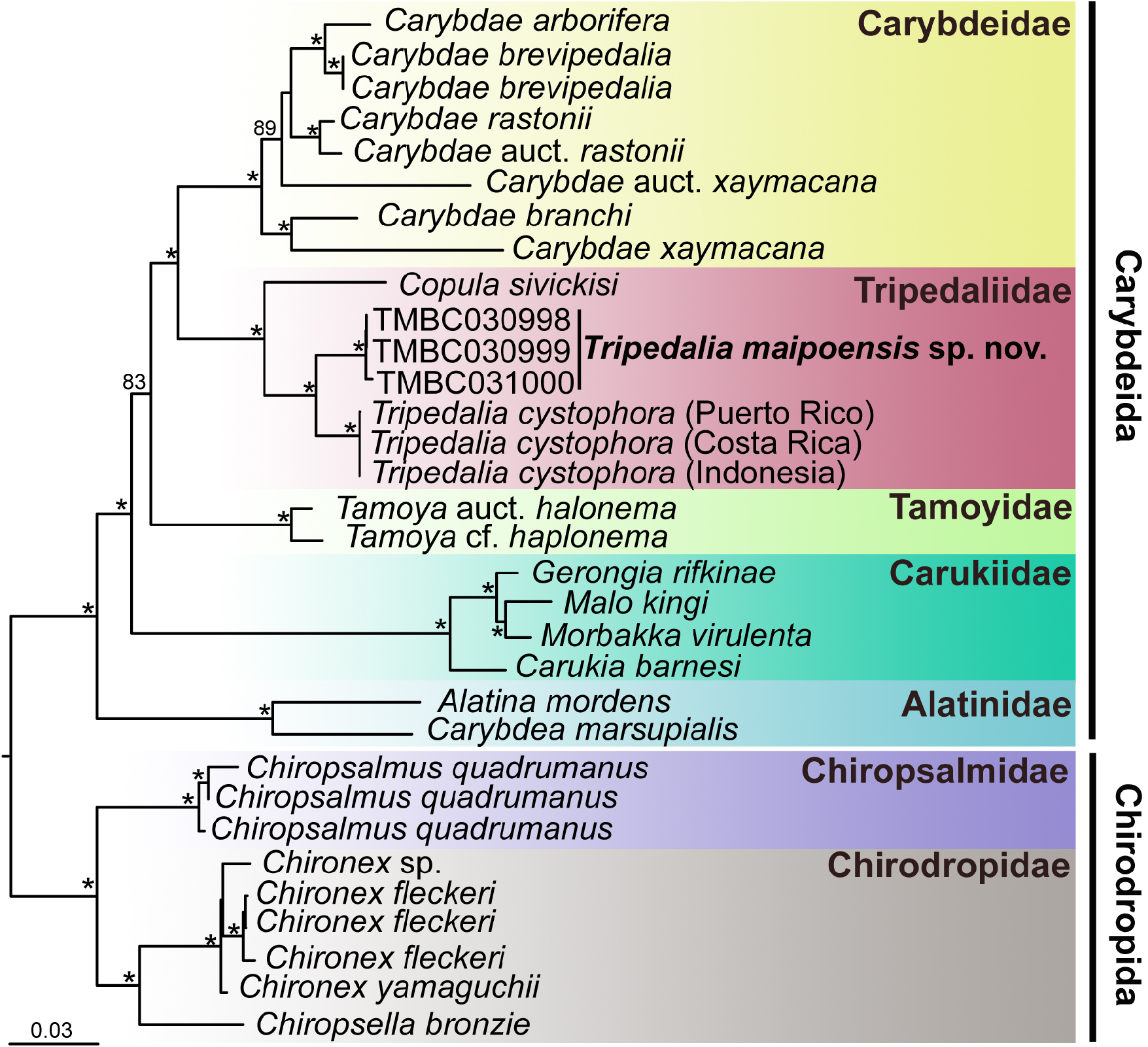
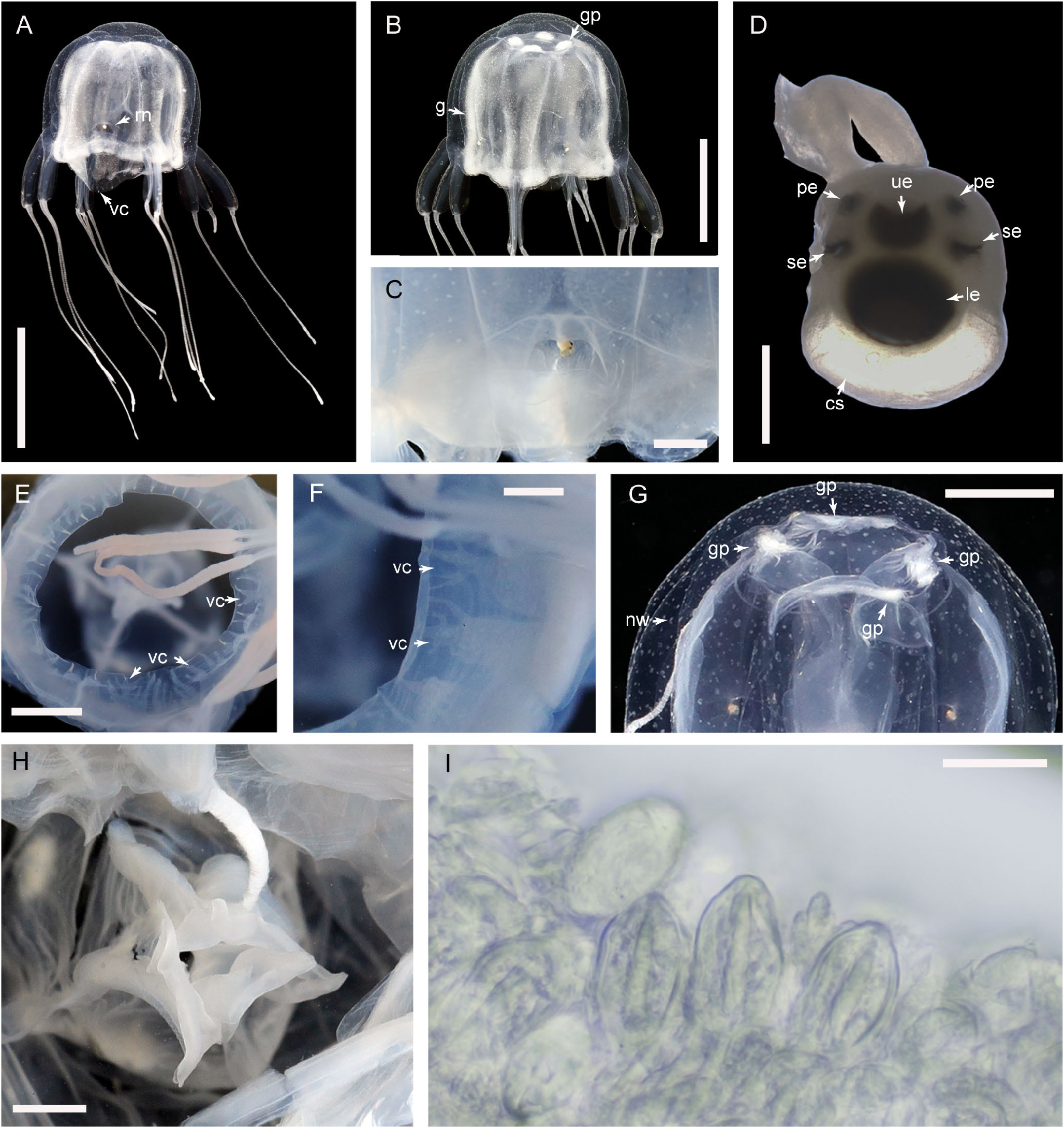
Description: The bell is transparent, colourless, cuboidal-shaped with smooth, edges rounded, roof slightly arched, with white nematocyst warts of different shapes and sizes densely scattered from apex to bell margin (Fig. 1 A – B, G; Fig. S 1 C – E). There is a pair of gonads at each corner of the bell, extending from stomach rim to velarium in both sexes (Fig. 1 A, Fig. S 1 C). There are four frown-shaped rhopalial niches, each located between two bell corners. Each rhopalial niche ostium has a prominent upper covering scale, and a small lower scale (Fig. 1 A, C). Each ropalial niche has a rhopalium suspended from the roof with a stalk. Each of the four rhopalia bears six eyes: two lateral pit eyes, two lateral slit eyes, a smaller upper lens eye, and a larger lower lens eye (Fig. 1 D). Each rhopalium also bears a large crystalline statolith below the lower lens eye. The velarium is smooth, without nematocyst warts. The velarial canals are biforked to multi-branched with 3 – 6 branches, with sharp tips (Fig. 1 E – F). The velarial canal tips are white in mature specimens (Fig. 1 E). The manubrium extends from the bell roof to 1 / 2 – 2 / 3 bell height (Fig. S 1 C, E); they are cruciform with four terminal lobes that are free of nematocyst warts (Fig. 1 H). The stomach is flat, with its four corners each connected to a brush-like gastric phacella (Fig. 1 G, Fig. S 1 F). The pedalia are flat and unbended, each with one pedalial canal inside (Fig. 1 A – B, Fig. S 1 C – D) and nematocyst warts on the outer surface (Fig. 1 B, Fig. S 1 D). Pedalial canal straight, extending through pedalium, slightly tapering at distal end, knee bend rounded without appendage. Each pedalium bears a single unbranched tentacle. Nematocysts from tentacles are oval-shaped (Fig. 1 I). Juvenile medusae are similar with adults in gross morphology. At ~ BH 3.2 mm, they developed from two to three pedalia per bell corner (Fig. S 1 G – H). Sexual Dimorphism: Female gonad ‘ wings’ are slender, extending from the stomach to the velarium; whitish to light yellow in live specimens (Fig. 1 A – B). Male gonad ‘ wings’ are broad with a rounded top, extending from the stomach to the velarium; whitish in live specimen (Fig. S 1 C). Measurements: n = 8 adults. Mean BH 12.5 (± 3.3) mm, mean DBW 15.2 (± 6.9) mm, mean IRW 1.4 (± 0.7) mm, mean DRT 2.7 (± 1.3) mm, mean PL 4.9 (± 1.1) mm, mean PW 1.5 (± 0.5) mm. Distribution and ecology: The new species is currently known only from the type locality, but may also occur in the adjacent waters of the Pearl River Estuary as the ponds are connected to the estuary through a tidal channel. The new species was found every year since 2020 in some of the brackish water intertidal shrimp ponds of Mai Po Nature Reserve during April and May, and also extending to June in 2021 when water temperature ranged from 20 ° C to 29 ° C, and salinity from 5.8 psu to 18 psu. The new species was recorded in water channels flanked by Common Reed (Phragmites australis) or mangroves of mainly Kandelia obovata mixed with the golden leather fern Acrostichum aureum. Genetic analyses: A 567 base pair (bp) fragment of 16 S, 1734 bp fragment of 18 S and 1809 bp fragment of 28 S was used in the genetic analyses. Phylogenetic analyses based on the combined dataset of three genes strongly supported the monophyly of Tripedalia (Fig. 2). Specimens of T. maipoensis sp. nov. were grouped to a distinctive clade and sister to the T. cystophora group comprising specimens from Costa Rica and Indonesia with strong support (UFBoot = 100, Fig. 2). The Tripedalia clade is then sister to Copula sivickisi (Fig. 2). For 16 S, the intraspecific p - distance of T. maipoensis sp. nov. for 16 S is 0.1 %, while the interspecific p- distance between T. maipoensis sp. nov. and T. cystophora is 17.5 %. The percentage of genetic distance for 16 S between T. maipoensis sp. nov. and Copula sivickisi is 26.6 %, while the value between T. cystophora and C. sivickisi is 28.3 %.
Sun, Yanan, Tsui, Justin Hon Yin, Wong, Rachel Ting Huen, Cheung, Ringo Nga Ching, Ng, Murphy Kam Pui, Or, Carmen K. M., Qiu, Jian-Wen (2023): A New Species of Box Jellyfish (Cnidaria: Tripedaliidae: Tripedalia) from Hong Kong, China. Zoological Studies 62 (17): 1-7, DOI: 10.6620/ZS.2023.62-17, URL: http://dx.doi.org/10.15468/6c8dme
Diagnosis: Medusa with three pedalia per bell corner, each pedalium with one tentacle, velarium with forked canals.
Sun, Yanan, Tsui, Justin Hon Yin, Wong, Rachel Ting Huen, Cheung, Ringo Nga Ching, Ng, Murphy Kam Pui, Or, Carmen K. M., Qiu, Jian-Wen (2023): A New Species of Box Jellyfish (Cnidaria: Tripedaliidae: Tripedalia) from Hong Kong, China. Zoological Studies 62 (17): 1-7, DOI: 10.6620/ZS.2023.62-17, URL: http://dx.doi.org/10.15468/6c8dme
Etymology: maipoensis is the Latinized form of the type locality Mai Po.
Sun, Yanan, Tsui, Justin Hon Yin, Wong, Rachel Ting Huen, Cheung, Ringo Nga Ching, Ng, Murphy Kam Pui, Or, Carmen K. M., Qiu, Jian-Wen (2023): A New Species of Box Jellyfish (Cnidaria: Tripedaliidae: Tripedalia) from Hong Kong, China. Zoological Studies 62 (17): 1-7, DOI: 10.6620/ZS.2023.62-17, URL: http://dx.doi.org/10.15468/6c8dme
Material examined: TMBC 030991 (holotype): adult medusa, female (Fig. 1 A – B), collected 21 April 2022, preserved in 4 % formalin, stored in 90 % ethanol. TMBC 030992 – TMBC 031003 (paratypes): adult medusa, one individual each, same sampling location as holotype, TMBC 030992 (male), TMBC 030993 (female), TMBC 030994 (male), TMBC 030995 (female), TMBC 030996 (sex cannot be determined), TMBC 030997 (male), TMBC 030998 (female), TMBC 030999 (female), TMBC 031000 (male), TMBC 031001 (male), TMBC 031002 (female), TMBC 031003 (female), TMBC 030992 – TMBC 030995 collected on 21 April 2022, TMBC 030996 – TMBC 031003 collected in August 2020, TMBC 030992 – TMBC 030997 preserved in 4 % formalin and stored in 90 % ethanol, TMBC 030998 – TMBC 031003 preserved in 95 % ethanol. Type locality: Mai Po Nature Reserve, Hong Kong. 22. 4887 ° N, 114.0417 ° E.
Sun, Yanan, Tsui, Justin Hon Yin, Wong, Rachel Ting Huen, Cheung, Ringo Nga Ching, Ng, Murphy Kam Pui, Or, Carmen K. M., Qiu, Jian-Wen (2023): A New Species of Box Jellyfish (Cnidaria: Tripedaliidae: Tripedalia) from Hong Kong, China. Zoological Studies 62 (17): 1-7, DOI: 10.6620/ZS.2023.62-17, URL: http://dx.doi.org/10.15468/6c8dme

Export occurrence data

Darwin Core Archive (ZIP)

CLASSIFICATION

Taxonomic Classification Tree

MULTIMEDIA

Media Files(2)

Fig. 1. Morphological characteristics and phylogenetic position of Tripedalia maipoensis sp. nov. (A–B) holotype (TMBC030991), female, living specimen, lateral view showing the gross morphology (A), and oblique top view showing gastric phacellus (B); (C) Rhopalial niche, preserved specimen, paratype (TMBC030992); (D) Rhopalium, showing six eyes and a statolith; (E) Upside down view of the bell showing the velarial canals, preserved specimen, paratype (TMBC030992), male; (F) details of the velarial canals, preserved specimen, holotype (TMBC030991), female; (G) oblique top view, showing nematocyst warts and gastric phacellus, living specimen, paratype TMBC030992; (H) manubrium, preserved, paratype (TMBC030997); (I) Nematocyst batteries from tentacle, paratype (TMBC030997). Scale bars: A–B = 1 cm; C, F, H = 1 mm; D = 0.3 mm; E, G = 5 mm; I = 10 µm. Abbreviations: cs, crystalline statolith; g, gonad; gp, gastric phacellae; le, lower lens eye; nw, nematocyst wart; pe, pit eye; rn, rhopalial niche; se, slit eye; ue, upper lens eye; vc, velarial canal.

Imageimage/png© Sun, Yanan;Tsui, Justin Hon Yin;Wong, Rachel Ting Huen;Cheung, Ringo Nga Ching;Ng, Murphy Kam Pui;Or, Carmen K. M.;Qiu, Jian-WenSun, Yanan;Tsui, Justin Hon Yin;Wong, Rachel Ting Huen;Cheung, Ringo Nga Ching;Ng, Murphy Kam Pui;Or, Carmen K. M.;Qiu, Jian-Wen

Fig. 2. Maximum-likelihood tree of cubozoans based on a concatenated dataset of 16S, 18S and 28S. Ultrafast bootstrap (UFBoot) values higher than 75 are shown on nodes. Asterisks indicate UFBoot values> 90.

Imageimage/png© Sun, Yanan;Tsui, Justin Hon Yin;Wong, Rachel Ting Huen;Cheung, Ringo Nga Ching;Ng, Murphy Kam Pui;Or, Carmen K. M.;Qiu, Jian-WenSun, Yanan;Tsui, Justin Hon Yin;Wong, Rachel Ting Huen;Cheung, Ringo Nga Ching;Ng, Murphy Kam Pui;Or, Carmen K. M.;Qiu, Jian-Wen

IMAGES

Gallery(2)

See Gallery

Occurrences with images

Source Information

A New Species of Box Jellyfish (Cnidaria: Tripedaliidae: Tripedalia) from Hong Kong, China

checklist

This dataset contains the digitized treatments in Plazi based on the original journal article Sun, Yanan, Tsui, Justin Hon Yin, Wong, Rachel Ting Huen, Cheung, Ringo Nga Ching, Ng, Murphy Kam Pui, Or, Carmen K. M., Qiu, Jian-Wen (2023): A New Species of Box Jellyfish (Cnidaria: Tripedaliidae: Tripedalia) from Hong Kong, China. Zoological Studies 62 (17): 1-7, DOI: 10.6620/ZS.2023.62-17, URL: http://dx.doi.org/10.15468/6c8dme

Sun Y, Tsui J H Y, Wong R T H, Cheung R N C, Ng M K P, Or C K M, Qiu J, valdenar (2023). A New Species of Box Jellyfish (Cnidaria: Tripedaliidae: Tripedalia) from Hong Kong, China. Plazi.org taxonomic treatments database. Checklist dataset https://doi.org/10.15468/k25gkt accessed via GBIF.org on 2026-06-18.

CC0Published 3/20/2023View dataset
GBIF Usage Key
209694577
Dataset Key
d9367c2e-9977-48dd-b86c-0576291bc59f
Origin
source
Backbone Key
12185925
Taxon ID
03FF9559EC3F794CE8CCAAB45002EE89.taxon
Last Crawled
6/9/2026
Last Interpreted
6/9/2026