AnimaliaNot EvaluatedacceptedspeciesAccepted
Cryptops datviensis

Cryptops datviensis

Tuf, Barjadze & Maghradze, 2022

GBIF:210361647

0year

ABOUT

Descriptions(6)

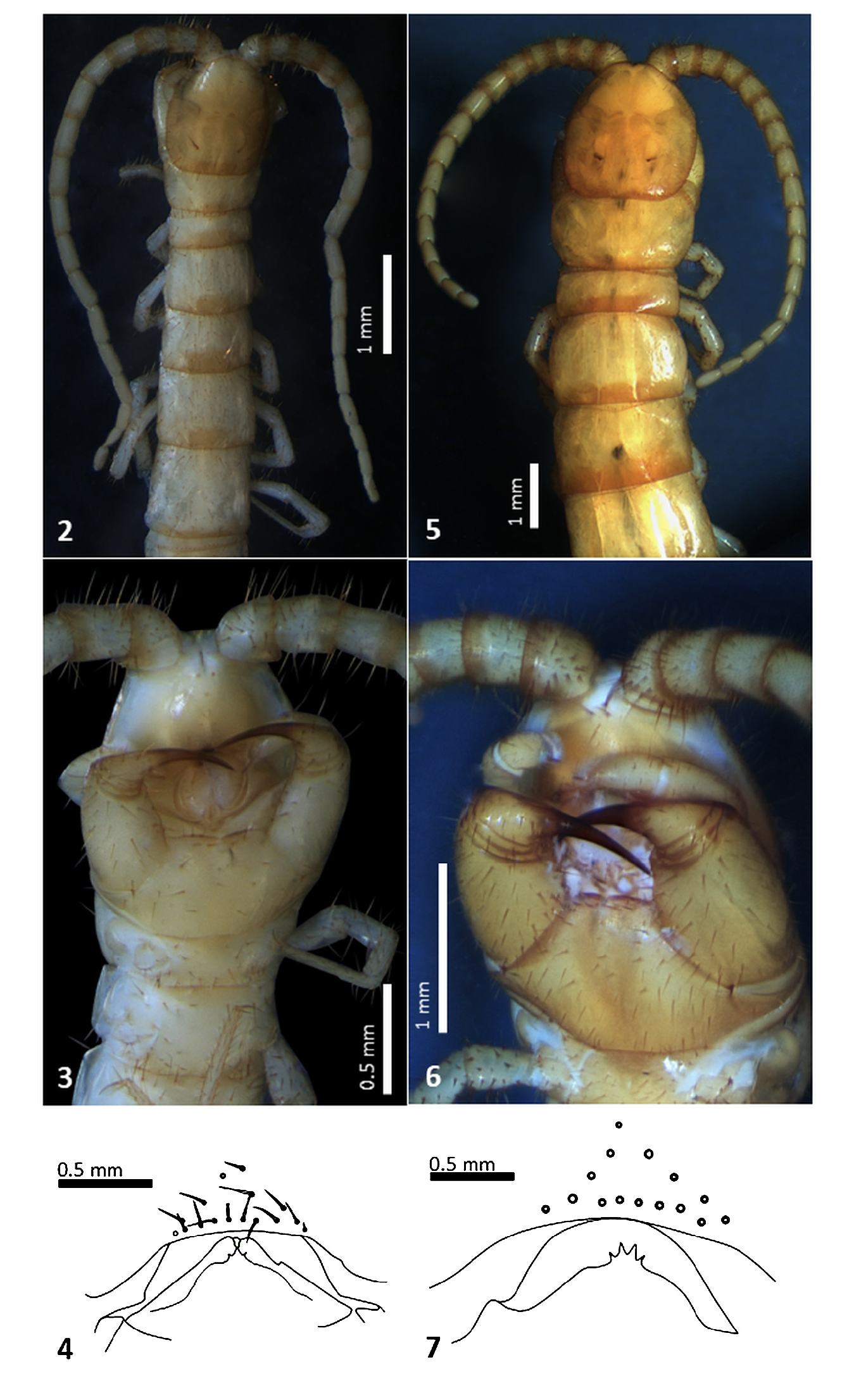
Description. Length 19 mm (holotype). In ethanol stored specimen, head pale yellow and trunk (including legs) whitish with pale yellow posteromedian parts of tergites (Fig. 2). Length and width of cephalic plate nearly equal (1.2 mm), posterior corners rounded, sides weakly convex outwards for much of their length; two paramedian sutures on cephalic plate are incomplete, expressed anteriorly and posteriorly up to one fourth of cephalic plate length only. Antennae 7 mm long (holotype), with 17 elongated articles; basal article stout, articles then gradually increasing in length to a maximum along articles 6 – 14 (ca 2 times longer than their width), then gradually shortening along articles 15 – 17. Articles 1 – 3 bearing strong setae of various length, these setae round proximal end of articles 4 – 5; from article 6, short fine setae form a fur-like covering. Clypeus well defined anteriorly, with a triangular group of about 16 setae (Fig. 4), about 10 of them arranged in line along the posterior border. Labrum with side-pieces notched at their medial angle, tridentate, although the middle tooth is shorter (Fig. 4). Forcipular coxosternum with anterior edge slightly rounded with weak median notch (Fig. 3). Coxosternum bearing only a few sparse, moderately long or short setae. Trochanteroprefemur scattered with long, fine setae. Tarsungulum long, slender. Apical claw of second maxilla with slender hook and a flange along its inner edge. Dorsal brush dense, running along distal two-thirds of article 3. Tergites 2 – 7 broader than long, tergites 8 – 19 longer than broad. Overlap of tergite 1 by cephalic plate hides complete anterior transverse suture. Tergites 2 – 20 with anterior transverse suture hidden by preceding tergite. Tergites 3 – 20 with longitudinal paramedian sutures; oblique lateral sutures on tergites 3 – 5. Tergite of ultimate legbearing segment slightly longer than wide, posterior margin rounded; shallow longitudinal median depression on its posterior half. Sternites sparsely scattered with moderately long, thin setae. Posterior margin of sternite of ultimate leg-bearing segment rounded. Legs relatively long and slender. All tarsi strongly bipartite. All legs covered by sparse long setae, ventral face of tarsi with row of slender setae. Pair of accessory spurs half-length of pretarsus on legs 1 – 20. Ultimate leg of holotype (Fig. 8): prefemur 1.5 mm long, femur 1.2 mm, tibia 0.8 mm, tarsus 1 0.6 mm, tarsus 2 0.9 mm; prefemur and femur ca 4 times and 5 times longer than their maximal widths at distal ends, respectively. Robust setae on anterior, posterior and ventral sides of prefemur and femur, mostly slender setae on dorsal side; tibial and tarsal setae slender; 7 saw teeth on tibia, 4 on tarsus 1 (Fig. 9, the same situation on paratypes); inner margin of tarsus 2 a ridge. Apical claw well developed, without basal sensory spur. Coxopleural pore field elliptical, with ca 35 – 40 pores and 4 – 5 slender, short setae interspersed among the pores.
Tuf, Ivan Hadrián, Barjadze, Shalva, Maghradze, Eter (2022): The first troglobiotic cryptopid centipede (Chilopoda: Scolopendromorpha: Cryptopidae) from the Caucasus. Zootaxa 5205 (5): 436-444, DOI: 10.11646/zootaxa.5205.5.2

Figs 2 – 4, 8, 9
Tuf, Ivan Hadrián, Barjadze, Shalva, Maghradze, Eter (2022): The first troglobiotic cryptopid centipede (Chilopoda: Scolopendromorpha: Cryptopidae) from the Caucasus. Zootaxa 5205 (5): 436-444, DOI: 10.11646/zootaxa.5205.5.2
Diagnosis. A Cryptops species, about 2 cm long with antenna extending back to tergite 6; incomplete paramedian sutures on cephalic plate; anterior transverse suture on tergite 1; labrum tridentate; prefemur and femur of ultimate leg at least 4 times longer than wide, femur and tibia of ultimate leg lacking distal spinose processes; tibia with 7, tarsus 1 with 4 saw teeth.
Tuf, Ivan Hadrián, Barjadze, Shalva, Maghradze, Eter (2022): The first troglobiotic cryptopid centipede (Chilopoda: Scolopendromorpha: Cryptopidae) from the Caucasus. Zootaxa 5205 (5): 436-444, DOI: 10.11646/zootaxa.5205.5.2
Distribution. The new species is known from the type locality only. Probably it can be found in the neighbouring caves.
Tuf, Ivan Hadrián, Barjadze, Shalva, Maghradze, Eter (2022): The first troglobiotic cryptopid centipede (Chilopoda: Scolopendromorpha: Cryptopidae) from the Caucasus. Zootaxa 5205 (5): 436-444, DOI: 10.11646/zootaxa.5205.5.2
Etymology. The specific name originates from the type locality.
Tuf, Ivan Hadrián, Barjadze, Shalva, Maghradze, Eter (2022): The first troglobiotic cryptopid centipede (Chilopoda: Scolopendromorpha: Cryptopidae) from the Caucasus. Zootaxa 5205 (5): 436-444, DOI: 10.11646/zootaxa.5205.5.2
Material examined. Holotype: Georgia, Imereti region, Sataplia-Tskaltubo karst massif, Tskaltubo Municipality, Datvi Cave (42 ° 22 ' 28.0 " N 42 ° 35 ' 45.0 " E), dark zone of cave, 8 August 2020, Eter Maghradze leg., 1 spm (IZISU TM-T- 00001). Paratypes: same locality and collector: 1 spm (IZISU TM-T- 00002), 3 November 2020, Eter Maghradze leg.; 1 spm (NHMW MY 10321), 30 November 2020, Eter Maghradze leg.
Tuf, Ivan Hadrián, Barjadze, Shalva, Maghradze, Eter (2022): The first troglobiotic cryptopid centipede (Chilopoda: Scolopendromorpha: Cryptopidae) from the Caucasus. Zootaxa 5205 (5): 436-444, DOI: 10.11646/zootaxa.5205.5.2

Export occurrence data

Darwin Core Archive (ZIP)

CLASSIFICATION

Taxonomic Classification Tree

MULTIMEDIA

Media Files(2)

FIGURES 2–7. Cryptops datviensis sp. nov. and C. caucasius Verhoeff, 1934. 2–4. Cryptops datviensis sp. nov.: 2. Anterior part of body (holotype, IZISU TM-T-00001), dorsal view. 3. Head and forcipular segment (holotype, IZISU TM-T-00001), ventral view. 4. Clypeus and labrum (paratype, IZISU TM-T-00002), ventral view. 5–7. Cryptops caucasius Verhoeff, 1934: 5. Anterior part of body, dorsal view. 6. Head and forcipular segment ventral view. 7. Clypeus and labrum, ventral view.

Imageimage/png© Tuf, Ivan Hadrián;Barjadze, Shalva;Maghradze, EterTuf, Ivan Hadrián;Barjadze, Shalva;Maghradze, Eter

FIGURES 8–11. Cryptops datviensis sp. nov. and C. caucasius Verhoeff, 1934. 8, 9. Cryptops datviensis sp. nov.: 8. Posterior part of body (holotype, IZISU TM-T-00001), lateral view. 9. End of right ultimate leg (paratype, IZISU TM-T-00002), lateral view. 10, 11. Cryptops caucasius Verhoeff, 1934: 10. Posterior part of body, lateral view. 11. End of right ultimate leg, lateral view.

Imageimage/png© Tuf, Ivan Hadrián;Barjadze, Shalva;Maghradze, EterTuf, Ivan Hadrián;Barjadze, Shalva;Maghradze, Eter

IMAGES

Gallery(2)

See Gallery

Occurrences with images

Source Information

The first troglobiotic cryptopid centipede (Chilopoda: Scolopendromorpha: Cryptopidae) from the Caucasus

checklist

This dataset contains the digitized treatments in Plazi based on the original journal article Tuf, Ivan Hadrián, Barjadze, Shalva, Maghradze, Eter (2022): The first troglobiotic cryptopid centipede (Chilopoda: Scolopendromorpha: Cryptopidae) from the Caucasus. Zootaxa 5205 (5): 436-444, DOI: 10.11646/zootaxa.5205.5.2

Abstract

Cryptops (Cryptops) datviensis sp. nov. from Datvi Cave in Georgia, is the first troglobiotic species of the genus Cryptops Leach, 1814 to be described from the Caucasus. The new species morphologically resembles the common epigean Caucasian species Cryptops caucasius Verhoeff, 1934, but differs in typical troglomorphic features, such as elongation of antennae and legs. A key to species of the genus Cryptops from the Caucasus is presented. A list of the invertebrates inhabiting Datvi Cave is provided.

Tuf I H, Barjadze S, Maghradze E, plazi (2022). The first troglobiotic cryptopid centipede (Chilopoda: Scolopendromorpha: Cryptopidae) from the Caucasus. Plazi.org taxonomic treatments database. Checklist dataset https://doi.org/10.15468/6gfucv accessed via GBIF.org on 2026-06-14.

CC0Published 11/10/2022View dataset
GBIF Usage Key
210361647
Dataset Key
0e38201e-1c55-425c-9f76-eda1695fef9f
Origin
source
Backbone Key
12257595
Taxon ID
03C687B72C46FFC3FF32FA50A9BBF849.taxon
Last Crawled
6/9/2026
Last Interpreted
6/9/2026