
AnimaliaNot EvaluatedacceptedspeciesAccepted
Pherecardites parva
Horst, 1912
GBIF:212419341
0year
ABOUT
Descriptions(5)
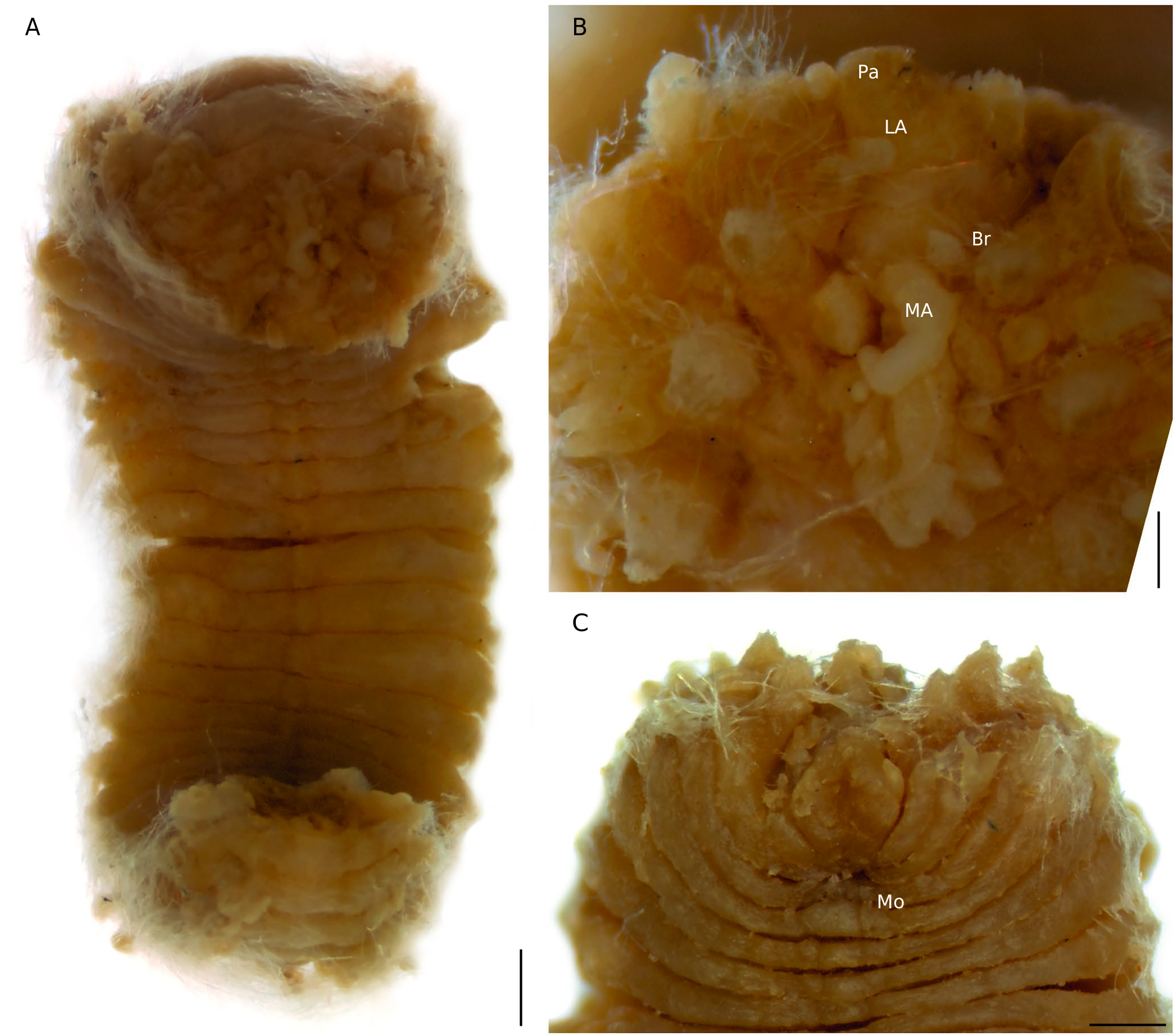
(Fig. 1)
Bleeker, Joke, Harris, Leslie, Ten Hove, Harry A., Salazar-Vallejo, Sergio I. (2023): Pherecardites Horst, 1912 and Branchamphinome Hartman, 1967 are synonyms (Annelida, Amphinomidae, Amphinominae). Zoosystema 45 (13): 435-443, DOI: 10.5252/zoosystema2023v45a13
OBSERVATIONS Lectotype (ZMA V. Pol 1072.1) colorless, without posterior region, bent ventrally, breaking in two (Fig. 1 A). Body about 10 mm long, 2.5 mm wide, 30 chaetigers. Prostomium (Fig. 1 B) slightly eroded, left lateral antenna lost, right one present, inserted close to median antennal base. Median antenna thick, bent laterally, without tip. 2 / 3 as long as caruncle. Palps lost. Eyes not seen. Caruncle straight, with a median ridge and 4 digitate lateral lobes, directed posteriorly. Branchiae from chaetiger 1 lost; chaetiger 2 with 2 digitate filaments, in anterior chaetigers branchiae with about 5 filaments. Pharynx not exposed (Fig. 1 C). Posterior end lost; pygidial features unknown.
Bleeker, Joke, Harris, Leslie, Ten Hove, Harry A., Salazar-Vallejo, Sergio I. (2023): Pherecardites Horst, 1912 and Branchamphinome Hartman, 1967 are synonyms (Annelida, Amphinomidae, Amphinominae). Zoosystema 45 (13): 435-443, DOI: 10.5252/zoosystema2023v45a13
REMARKS Horst (1912: 33) did not see eyes in his specimens (longest one slightly more than 7 mm in length) but noted some black spots. Kudenov (1993: 96 - 97) noted in P. antarctica (Hartman, 1967) n. comb., specimens of different size (8 - 12 mm long) had eyes well developed and their pigments were retained despite being in ethanol for over 30 years, whereas in P. parva eyes were not seen. Horst (1912: 33) characterized the caruncle in the diagnosis for Pherecardites, and in the description of P. parva, as having a median ridge and lateral lamellae, directed posteriorly, extended along three segments. Branchiae were noted as starting in chaetiger 1 but the number of filaments was not given. Likewise, the presence of branchiae along posterior chaetigers was not indicated, nor the shape of the posterior end.
Bleeker, Joke, Harris, Leslie, Ten Hove, Harry A., Salazar-Vallejo, Sergio I. (2023): Pherecardites Horst, 1912 and Branchamphinome Hartman, 1967 are synonyms (Annelida, Amphinomidae, Amphinominae). Zoosystema 45 (13): 435-443, DOI: 10.5252/zoosystema2023v45a13
DISTRIBUTION. — Indonesia, in sediments at 397 - 1264 m water depth.
Bleeker, Joke, Harris, Leslie, Ten Hove, Harry A., Salazar-Vallejo, Sergio I. (2023): Pherecardites Horst, 1912 and Branchamphinome Hartman, 1967 are synonyms (Annelida, Amphinomidae, Amphinominae). Zoosystema 45 (13): 435-443, DOI: 10.5252/zoosystema2023v45a13
TYPE MATERIAL. — Indonesia. Lectotype • 1 specimen; RV Siboga; Sta. 122; 01 ° 58.5 ’ N, 125 ° 0.5 ’ E; 1264 - 1165 m depth; 17. VII. 1899; ZMA V. Pol 1072.1. g. PARALECTOTYPES. — Indonesia • 1 specimen; RV Siboga; Sta. 139; 00 ° 11 ’ S, 127 ° 25 ’ E; 397 m depth; 4. VIII. 1899; ZMA V. Pol. 1072.2 • 1 specimen; RV Siboga; Sta. 173; 03 ° 27 ’ S, 131 ° 0.5 ’ E; 567 m depth; 28. VIII. 1889; ZMA V. Pol. 1072.3.
Bleeker, Joke, Harris, Leslie, Ten Hove, Harry A., Salazar-Vallejo, Sergio I. (2023): Pherecardites Horst, 1912 and Branchamphinome Hartman, 1967 are synonyms (Annelida, Amphinomidae, Amphinominae). Zoosystema 45 (13): 435-443, DOI: 10.5252/zoosystema2023v45a13
Export occurrence data
Darwin Core Archive (ZIP)
CLASSIFICATION
Taxonomic Classification Tree

MULTIMEDIA
Media Files(1)
FIG. 1.— Pherecardites parva Horst, 1912, lectotype, ZMA V.Pol 1072.1: A, ventral view; B, anterior end, dorsal view; C, anterior end, ventral view. Abbreviations: Br, branchia; LA, lateral antenna; MA, median antenna; Mo, mouth; Pa, palp. Scale bars: A, 0.36 mm; B, 0.14 mm; C, 0.26 mm. Photos: Frank Loggen.
Imageimage/png© Bleeker, Joke;Harris, Leslie;Ten Hove, Harry A.;Salazar-Vallejo, Sergio I.Bleeker, Joke;Harris, Leslie;Ten Hove, Harry A.;Salazar-Vallejo, Sergio I.
IMAGES