
AnimaliaNot EvaluatedacceptedspeciesAccepted
Pherecardites antarctica
(Hartman, 1976) Bleeker, Harris, Ten, Hove & Salazar-Vallejo, 2023
GBIF:212419342
0year
0
Synonyms
ABOUT
Descriptions(5)
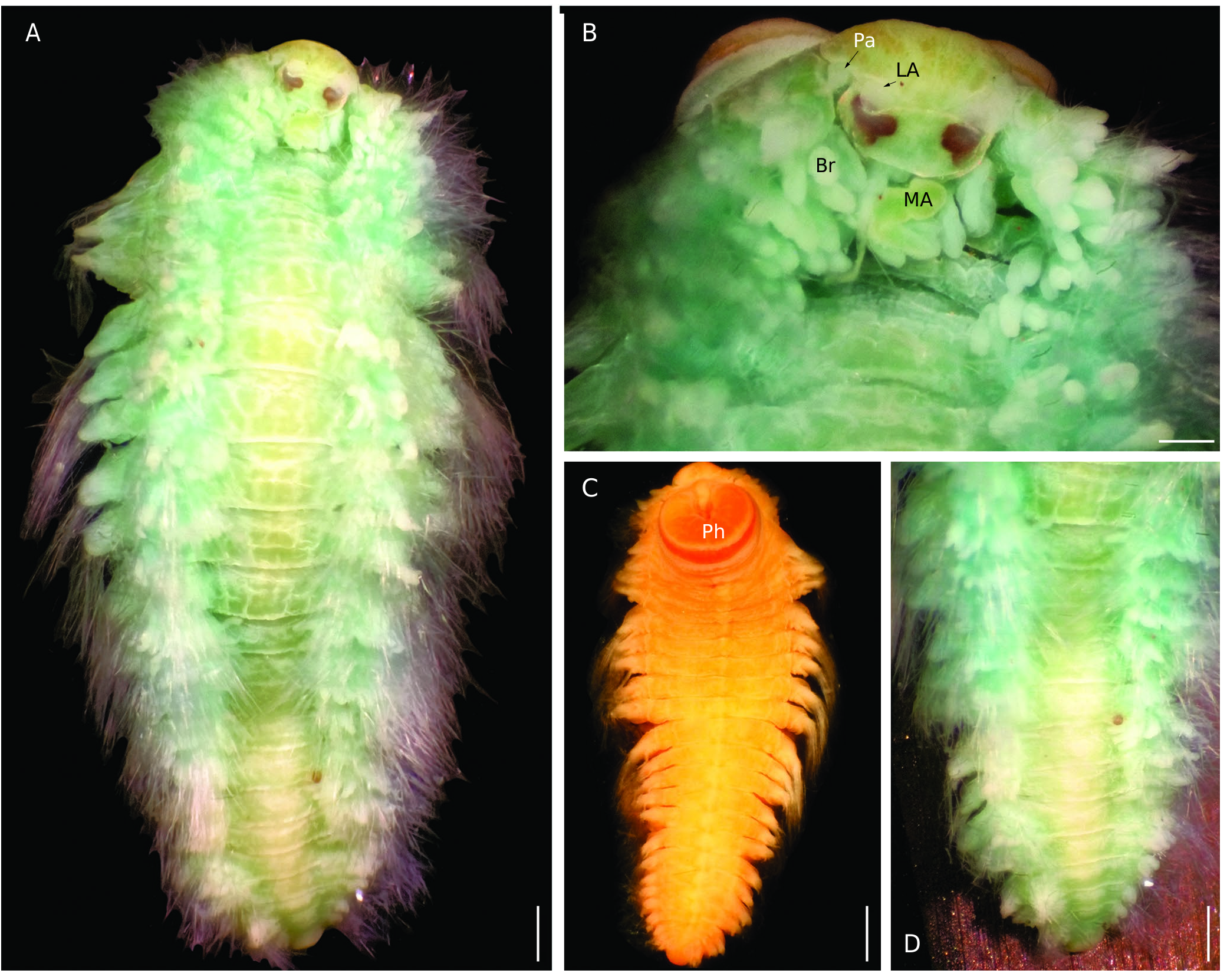
(Fig. 2)
Bleeker, Joke, Harris, Leslie, Ten Hove, Harry A., Salazar-Vallejo, Sergio I. (2023): Pherecardites Horst, 1912 and Branchamphinome Hartman, 1967 are synonyms (Annelida, Amphinomidae, Amphinominae). Zoosystema 45 (13): 435-443, DOI: 10.5252/zoosystema2023v45a13
OBSERVATIONS Non-type specimen (LACM, only one available) colorless, complete, oval (Fig. 2 A), slightly bent ventrally, pharynx partially exposed (Fig. 2 C). Body 8 mm long, 3.5 mm wide, 26 chaetigers. Prostomium (Fig. 2 B) distorted due to eversion of pharynx, bent posteriorly; lateral antennae eroded, inserted ahead of anterior eyes; median antenna thin, tapered, longer than caruncle. Palps conical, directed laterally. Eyes dark brown, anterior and posterior eyes fused laterally; anterior eyes reniform, twice as large as posterior round eyes. Caruncle distorted, with a median ridge and 3 - 4 lateral digitate lobes directed posteriorly. Branchiae with digitate filaments from chaetiger 1, with about 10 filaments along anterior chaetigers, becoming less abundant medially and posteriorly, continued to last chaetigers (Fig. 2 D). Pharynx with a short smooth basal ring, and a longer distal ring; a middorsal ridge visible in the aperture. Posterior end tapered; pygidium with anus terminal, anal plate round, without cirri.
Bleeker, Joke, Harris, Leslie, Ten Hove, Harry A., Salazar-Vallejo, Sergio I. (2023): Pherecardites Horst, 1912 and Branchamphinome Hartman, 1967 are synonyms (Annelida, Amphinomidae, Amphinominae). Zoosystema 45 (13): 435-443, DOI: 10.5252/zoosystema2023v45a13
REMARKS Hartman (1967, pl. 12, fig. A) only included a schematic illustration of the anterior end. Her figure shows the lateral antennae are ahead of the anterior eyes, the median antenna is inserted behind the posterior eyes, and palps are directed laterally and inserted ahead of lateral antennae. The caruncle includes a median, longer ridge with six lateral lobes, with the proximal ones apparently arising from the posterior prostomial margin. The eyes were depicted as circular, slightly separate from each other, and the anterior eyes slightly larger than posterior ones. Kudenov (1993) proposed a lectotype, noted several differences regarding the original illustration, and consequently illustrated several specimens of different size. Kudenov also illustrated the ontogenetic changes of P. antarctica n. comb. regarding its prostomium and caruncle. He showed that smaller specimens (8 mm long) have eyes distinct, anterior eyes 2 - 3 times larger than posterior ones, and closer to each other, and the caruncle is a small blunt ridge with two pairs of short (about as long as wide), digitate lateral branches. In medium-sized specimens, the eyes remain distinct and with similar size proportions, but the caruncle changes with the median ridge becoming tapered, and the lateral branches grow into digitate long lobes (2 - 3 times longer than wide), becoming a palmate structure. Larger specimens have eyes coalescent into 8 - shaped spots, with anterior eyes oval to reniform, and the caruncle now includes some additional short, digitate lobes, crowded along the posterolateral prostomial margins, whereas the lateral branches are retained in size and position. Kudenov (1993) also gave a detailed account of the types of chaetae and branchial branching pattern, and this explains why these features are not included in our observations. The only confusion was regarding the affinities to other amphinomid genera, because Pherecardites was not taken into account, but Branchamphinome was only compared to Benthoscolex Horst, 1912. Consequently, because most diagnostic features for Branchamphiome are also present in Pherecardites, and because the latter genus-group name has priority over Branchamphinome, we are regarding them as synonyms, retaining the older name, and have newly combined Hartman’s species in this genus.
Bleeker, Joke, Harris, Leslie, Ten Hove, Harry A., Salazar-Vallejo, Sergio I. (2023): Pherecardites Horst, 1912 and Branchamphinome Hartman, 1967 are synonyms (Annelida, Amphinomidae, Amphinominae). Zoosystema 45 (13): 435-443, DOI: 10.5252/zoosystema2023v45a13
DISTRIBUTION. — Antarctic, in sediments at 333 - 1153 m water depth.
Bleeker, Joke, Harris, Leslie, Ten Hove, Harry A., Salazar-Vallejo, Sergio I. (2023): Pherecardites Horst, 1912 and Branchamphinome Hartman, 1967 are synonyms (Annelida, Amphinomidae, Amphinominae). Zoosystema 45 (13): 435-443, DOI: 10.5252/zoosystema2023v45a13
TYPE MATERIAL. — Antarctica. Not seen (examined and redescribed by Kudenov 1993). ADDITIONAL MATERIAL. — Antarctica • 1 specimen; RV Eltanin; Sta. 1346; 54 ° 49 ’ to 54 ° 50 ’ S, 129 ° 48 ’ to 129 ° 46 ’ W; 549 m depth; 7. XI. 1964; LACM.
Bleeker, Joke, Harris, Leslie, Ten Hove, Harry A., Salazar-Vallejo, Sergio I. (2023): Pherecardites Horst, 1912 and Branchamphinome Hartman, 1967 are synonyms (Annelida, Amphinomidae, Amphinominae). Zoosystema 45 (13): 435-443, DOI: 10.5252/zoosystema2023v45a13
Export occurrence data
Darwin Core Archive (ZIP)
CLASSIFICATION
Taxonomic Classification Tree

NOMENCLATURE
Synonyms(1)
MULTIMEDIA
Media Files(1)
FIG. 2.— Pherecardites antarctica (Hartman,1967) n. comb., non-type specimen,LACM:A, complete specimen,dorsal view;B, anterior end, dorsal view;C, complete specimen, ventral view, pharynx partially exposed; D, posterior region, dorsal view. Abbreviations: Br, branchia; LA, lateral antenna; MA, median antenna; Pa, palp; Ph, pharynx. Scale bars: A, 0.42 mm: B, 0.03 mm; C, 0.76 mm; D, 0.34 mm. Photos: S.I. Salazar-Vallejo.
Imageimage/png© Bleeker, Joke;Harris, Leslie;Ten Hove, Harry A.;Salazar-Vallejo, Sergio I.Bleeker, Joke;Harris, Leslie;Ten Hove, Harry A.;Salazar-Vallejo, Sergio I.
IMAGES