
AnimaliaNot EvaluatedacceptedspeciesAccepted
Megalothorax boerneri
Schneider & Panina, 2023
GBIF:212419407
0year
ABOUT
Descriptions(4)
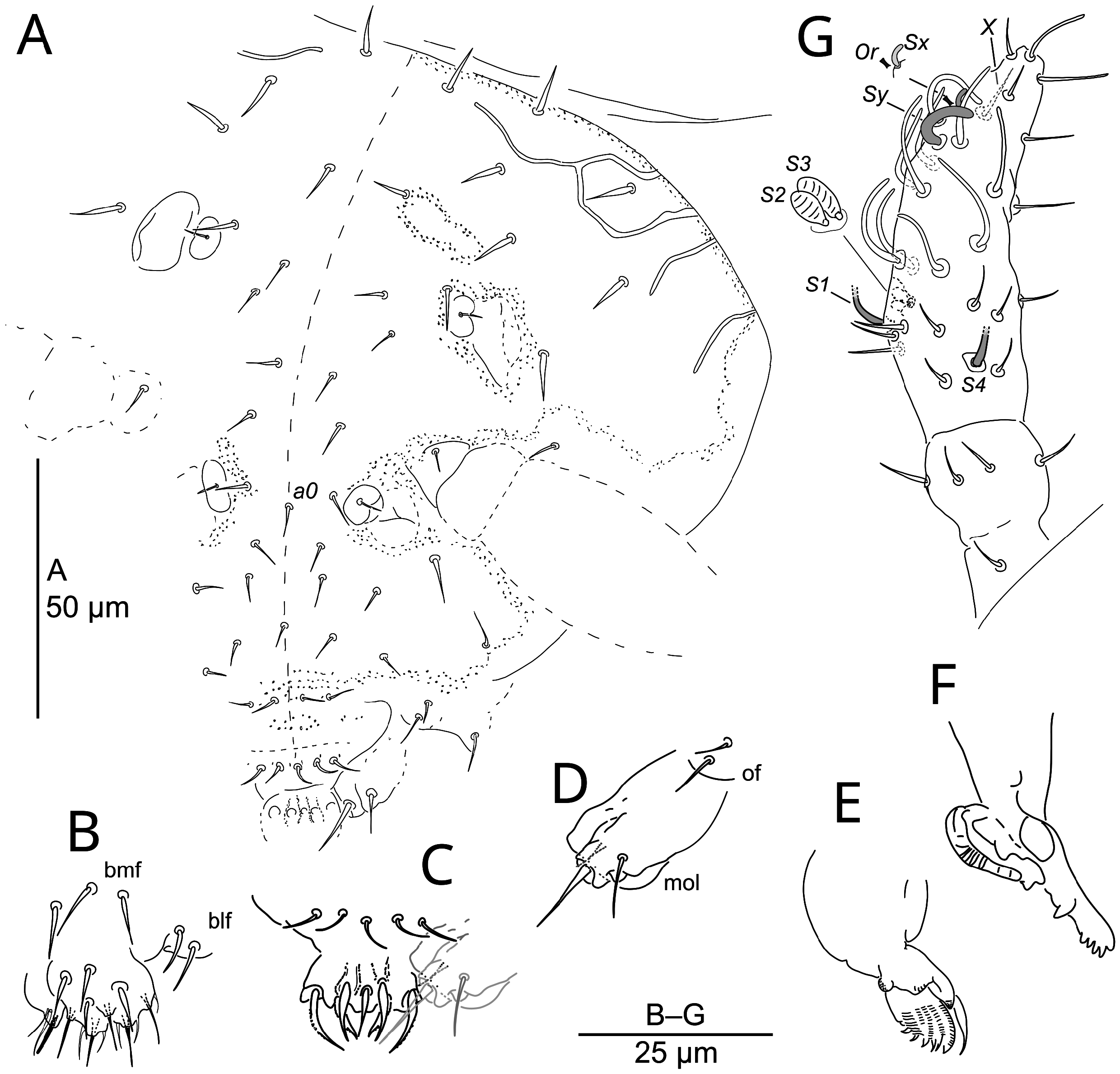
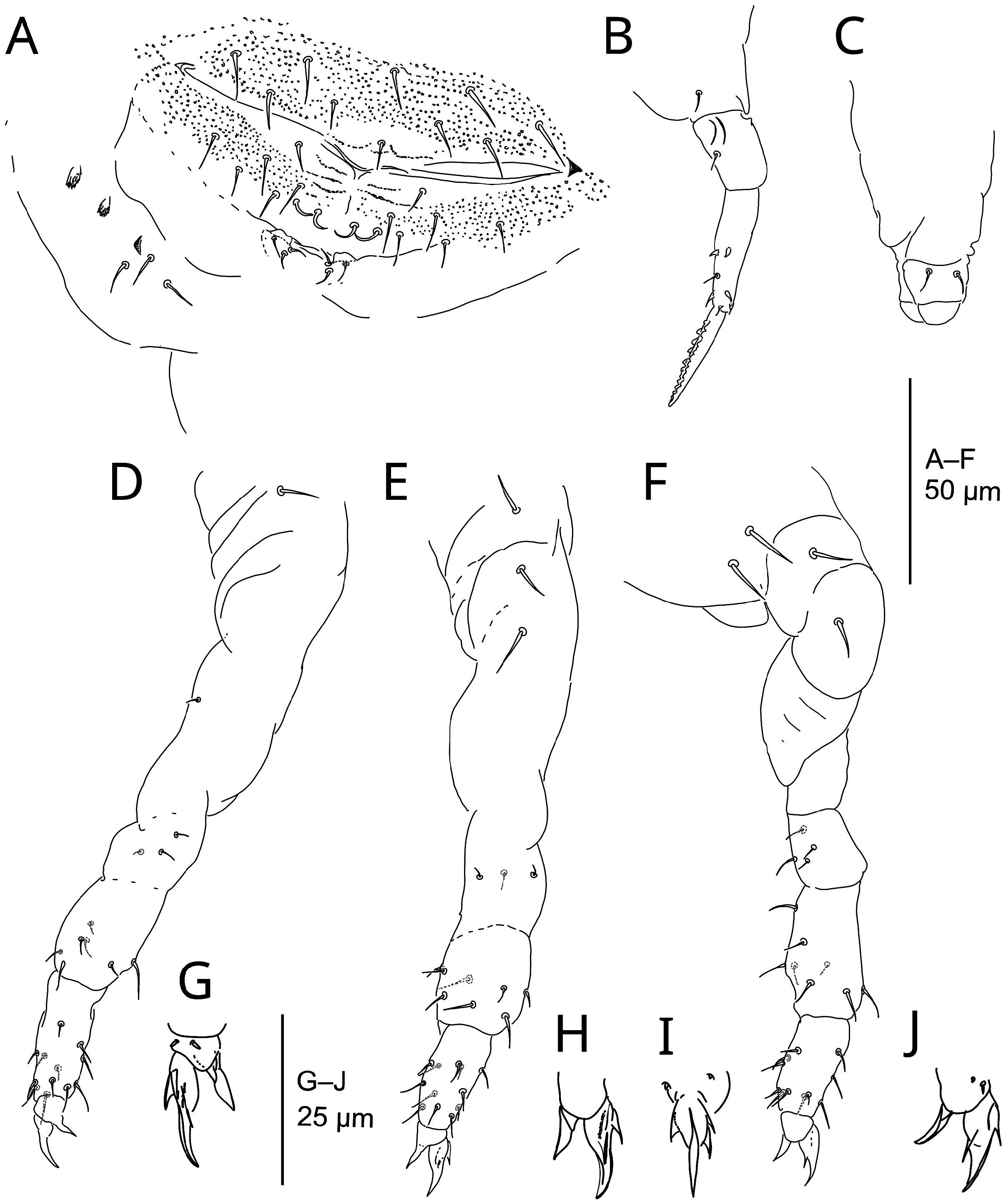
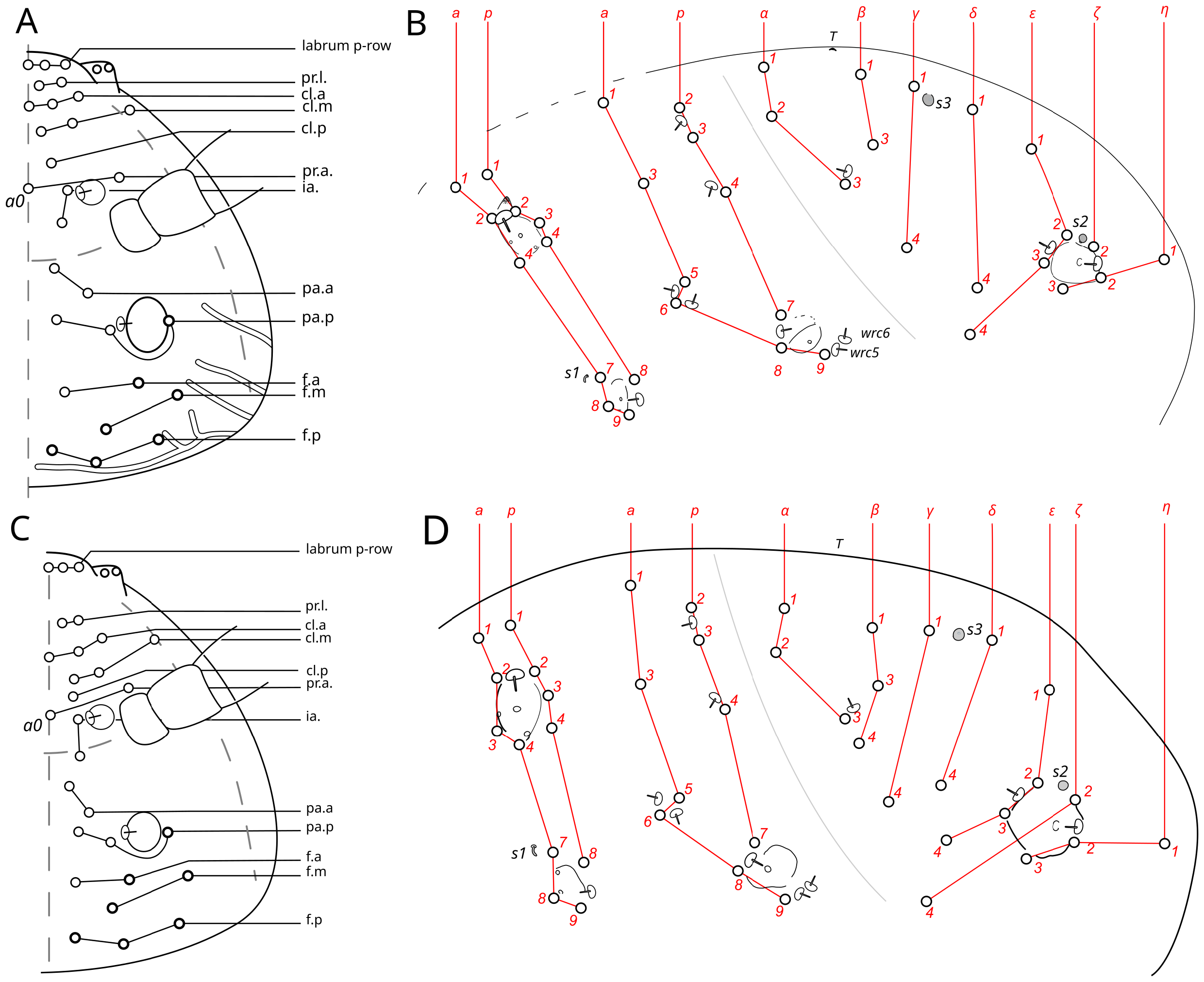
Description. General aspect. Habitus and segmentation typical of the genus. Length from labrum to anus: up to 400 µm. Colour whitish (in 96 % ethanol). Integument. Secondary granulation present dorsally on the head (Fig. 5 A), the thoracic region, the abdominal region and Abd. VI sternite (Fig. 7 A). Integumentary channels limited to the lateral and posterior part of the head, cycling around the postero-lateral chaetae (Fig. 5 A); no anterior channel, connection with linea ventralis crossed. Channels absent on the trunk. Sensory fields and wax rods. Ordinary distribution of sensory fields and wax rods secretory crypts: 2 + 2 wrc on head, 12 + 12 wrc on body; including the ones associated with the 6 + 6 sensory fields (Fig. 6). Sensory fields include the swollen inner chaetae, all globular: sf 1 – 6: 0, 1, 3, 2, 1, 1. wrc 5 and 6 separated from sf 5 by ~ 4 granules (Fig. 6). Head chaetotaxy. Number of chaetae: 12 + 12 in the postero-dorsal region, 10 + 10 and 2 unpaired in the antero-dorsal region, 1 + 1 in the antero-lateral region (Fig. 5 A, 8 C). With 7 + 7 postero-dorsal chaetae thickened (Fig. 5 A), anterior chaetae short and ordinary (Fig. 5 A). Ventrally with 3 + 3 post-labial chaetae sub-equally sized. Labium. Basomedian fields of labium with 3 + 3 chaetae, basolateral fields of labium with 2 + 2 chaetae (Fig. 5 B). Labial palps ordinary, as is Fig. 5 B. Labrum. Chaetae a 1, a 2 with external teeth, a 1 with apical outward curvature (Fig. 5 C). Other mouthparts. Oral fold with 2 + 2 chaetae (Fig. 5 D). Maxilla outer lobe with two chaetae (apical and basal), sublobal plate with a hair (Fig. 5 D). Maxilla and mandibula as in Fig. 5 E, F. Antenna. As in Fig. 5 G. Ant. I with one chaeta. Ant. II with four chaetae, the anterior one stronger than the three others. Ant. III with 9 chaetae and the four S-chaetae S 1 – S 4 from the sensory organ; S 2 and S 3 clearly protruding from the cupule; all S 1 – S 4 rather indistinct in our preparations. Ant. IV with six ordinary chaetae (including X) and 10 + 2 S-chaetae (Sb 1 – 5, Sa 1 – 5, Sx and Sy), Sb 3 implanted basally, slightly above S 2 and S 3 of Ant. III. Organite (Or) small. Thoracic tergites. As in Fig. 6. Pseudopores and τ-chaetae indistinct, not studied. Th. II with 12 + 12 chaetae and 1 + 1 s-chaetae s 1. Th. III with 10 + 10 chaetae, a 5 slightly stronger than a 6, p 4 close to wrc 2. Diagram of chaetotaxy provided in Fig. 8 D. Abd. I – V tergites. With 19 + 19 ordinary chaetae, 2 + 2 globular s-chaetae (s 2, s 3) with s 3 slightly bigger than s 2; chaetae β 2 absent (Figs 6, 8 D). Abd. VI. Tergite with 4 + 4 and 1 unpaired chaetae (Fig. 7 A). Each anal valve with one chaeta (Fig. 7 A). Sternite with 7 + 7 chaetae, the two axial pairs strongly curvated (Fig. 7 A). Genital plate. Female with 3 + 3 chaetae (Fig. 7 A). Male unknown. Abd. IV sternite. With 2 + 2 usual neosminthuroid chaetae, 3 + 3 ordinary chaetae and 1 + 1 small lobes (Fig. 7 A). Abdominal appendages. Manubrium with 1 + 1 posterior chaetae (Fig. 7 B). Dens ordinary, as in Fig. 7 B. Mucro with thin lamellae, with ~ 10 – 12 teeth on each posterior lamellae (Fig. 7 B). Ventral tube with 2 + 2 apical chaetae (Fig. 7 C), retinaculum with 4 + 4 distinct teeth. Legs. Chaetal composition on each legs subcoxa 1, 2, coxa, trochanter, femur and tibiotarsus: leg I — 1, 0, 1, 3, 7, 12 chaeta (e) (Fig. 7 D); leg II — 1, 1, 1, 3, 8 and 12 chaeta (e) (Fig. 7 E); leg III — 2, 1, 1, 4, 8 and 11 chaeta (e) (Fig. 7 F). Claw as in Fig. 7 G – J, ordinary, subequal in length. Basal and posterior auxiliary lamellae of unguis well developed, anterior crest indistinct. Basal lobe of unguiculus not or feebly protruding. Affinities. The most similar species are M. perspicillum, M. incertus sensu nov. and M. laevis. The differential diagnosis is provided in Table 2. Also see the updated interactive key of the Megalothorax species of the world (Schneider 2022).
Schneider, Clément, Panina, Ksenia (2023): Revision of Megalothorax incertus Börner, 1903 reveals it to be another widespread Palearctic species of the genus (Collembola, Neelidae). Zootaxa 5318 (4): 474-488, DOI: 10.11646/zootaxa.5318.4.2, URL: http://dx.doi.org/10.11646/zootaxa.5318.4.2
Figs 5 – 7, 8 C, D; Tables 1 – 2 Material examined. Holotype: female on slide (SMNG-APT-AA 00023), France, Haute-Marne, Charmes, 10 Apr. 2011, 47.9262 ° N, 5.3420 ° E, mosses growing on a rock, leg. C. Schneider, original collection code: Fr. 021. Paratypes: three females on slides (SMNG-APT-AA 0024 – 26), same data as the holotype. All types deposited in the Apterygota collection of the Senckenberg Museum f ̧ r Naturkunde G ̂ rlitz.
Schneider, Clément, Panina, Ksenia (2023): Revision of Megalothorax incertus Börner, 1903 reveals it to be another widespread Palearctic species of the genus (Collembola, Neelidae). Zootaxa 5318 (4): 474-488, DOI: 10.11646/zootaxa.5318.4.2, URL: http://dx.doi.org/10.11646/zootaxa.5318.4.2
Diagnosis. Colour whitish (in 96 % ethanol), connection of head channels with linea ventralis crossed, without channels on trunk, basomedian fields of labium with 3 + 3 chaetae, basolateral fields of labium with 2 + 2 chaetae, abdomen without β 2; but β 4 and ζ 4 present, abdominal s-chaetae s 3 present, only slightly larger than s 2, 3 + 3 chaetae on Abd. IV sternite, retinaculum with 4 + 4 teeth, posterior lamellae of the mucro thin and serrated.
Schneider, Clément, Panina, Ksenia (2023): Revision of Megalothorax incertus Börner, 1903 reveals it to be another widespread Palearctic species of the genus (Collembola, Neelidae). Zootaxa 5318 (4): 474-488, DOI: 10.11646/zootaxa.5318.4.2, URL: http://dx.doi.org/10.11646/zootaxa.5318.4.2
Other material. Two females on slides (SMNG-APT-AA 00027, 28), France, Hautes-Pyrénées, Saint-Lary-Soulan, 26 Jun. 2011, 42.8268 ° N, 0.3114 ° E, Mosses and litter on the side of a path, leg. C. Schneider, original collection codes: Fr. 031 py, Fr. 033 py Molecular data. One individual from Fr. 021 (same data as holotype) and one individual from Fr. 033 py (Genbank accession number in Table 1). Vouchers have not been recovered.
Schneider, Clément, Panina, Ksenia (2023): Revision of Megalothorax incertus Börner, 1903 reveals it to be another widespread Palearctic species of the genus (Collembola, Neelidae). Zootaxa 5318 (4): 474-488, DOI: 10.11646/zootaxa.5318.4.2, URL: http://dx.doi.org/10.11646/zootaxa.5318.4.2
Export occurrence data
Darwin Core Archive (ZIP)
CLASSIFICATION
Taxonomic Classification Tree

MULTIMEDIA
Media Files(4)
FIGURE 5. Megalothorax boerneri sp. nov., (A) Head; (B) labium, bmf=basomedian field, blf=basolateral field; (C) labrum; (D) maxillary outer lobe (mol) and oral fold (of); (E) maxilla; (F) mandibula; (G) Antenna.
Imageimage/png© Schneider, Clément;Panina, KseniaSchneider, Clément;Panina, Ksenia
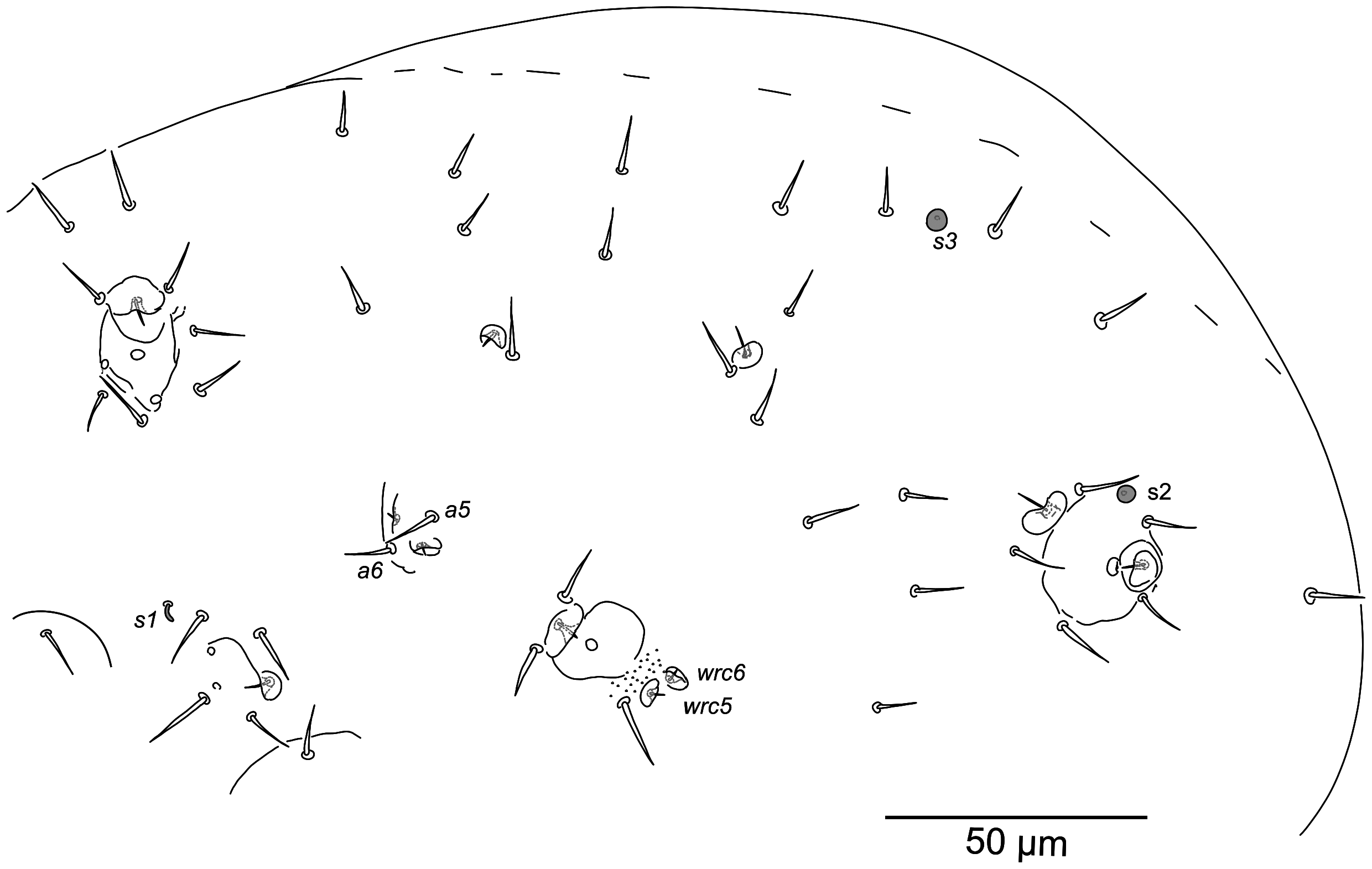
FIGURE 6. Megalothorax boerneri sp. nov., trunk tergites chaetotaxy (Th. I–Abd. V).
Imageimage/png© Schneider, Clément;Panina, KseniaSchneider, Clément;Panina, Ksenia
IMAGES