AnimaliaNot EvaluatedacceptedspeciesAccepted
Megalothorax incertus

Megalothorax incertus

Borner, 1903

GBIF:212419408

0year

ABOUT

Descriptions(5)

Ecology. The species seems widespread, and is mostly found in anthropized environments. In the garden of the Laboratory of Tropical Ecology (France), it was co-existing with both M. willemi and M. minimus (found in the same sample). In Sicily, it was found in close proximity with M. perspicillum. This species assemblage is possibly resulting from the input of soils of various origins throughout the history of the laboratory. In Russia, this species was found in a dry meadow, which was used for a long time as pasture for cows and on agricultural fields using mulch. There, M. incertus sensu nov. also co-existed with both M. willemi and M. perspicillum. These species have not been found in natural habitats in Russia. It is also confirmed from Shanghai, China (see discussion).
Schneider, Clément, Panina, Ksenia (2023): Revision of Megalothorax incertus Börner, 1903 reveals it to be another widespread Palearctic species of the genus (Collembola, Neelidae). Zootaxa 5318 (4): 474-488, DOI: 10.11646/zootaxa.5318.4.2, URL: http://dx.doi.org/10.11646/zootaxa.5318.4.2

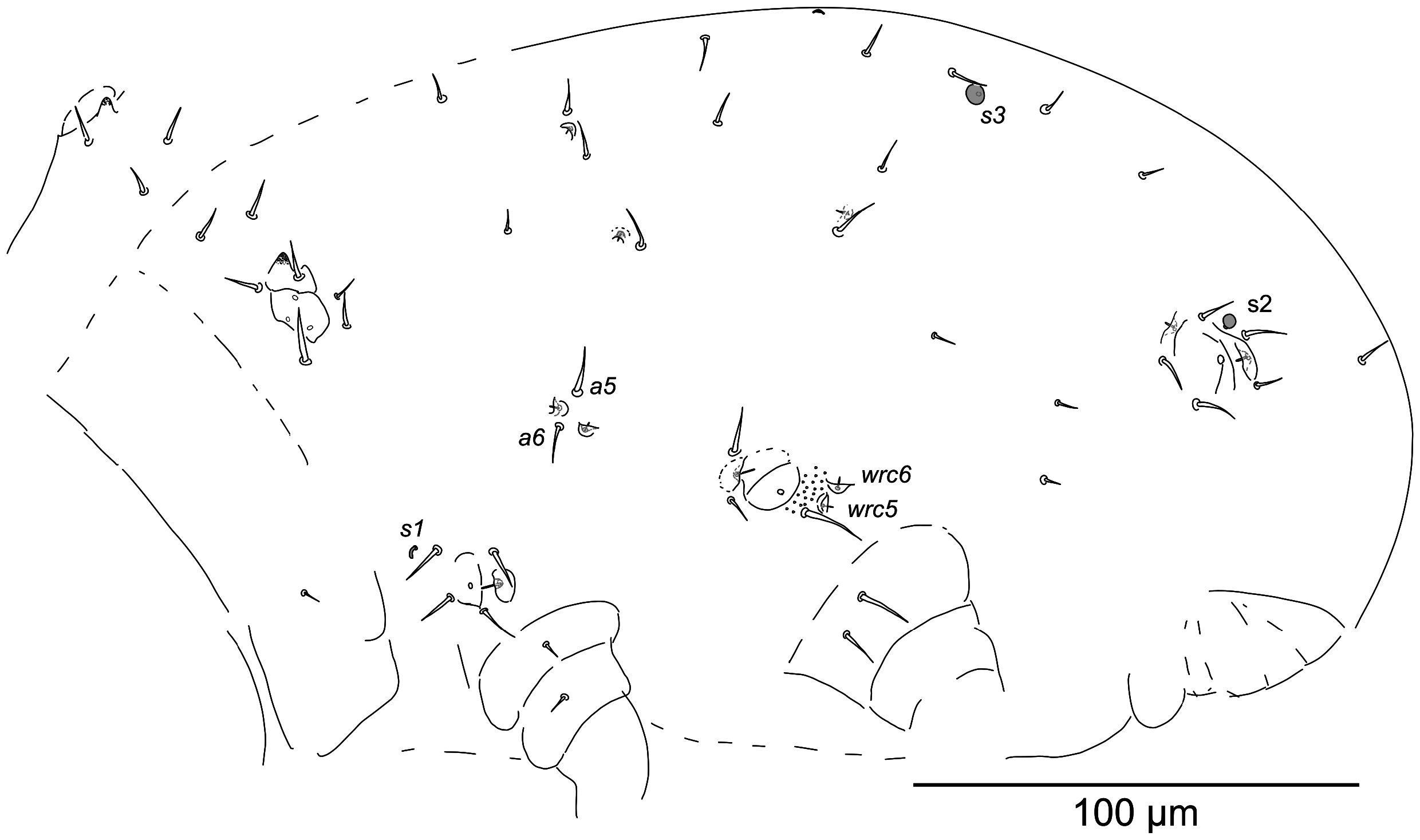
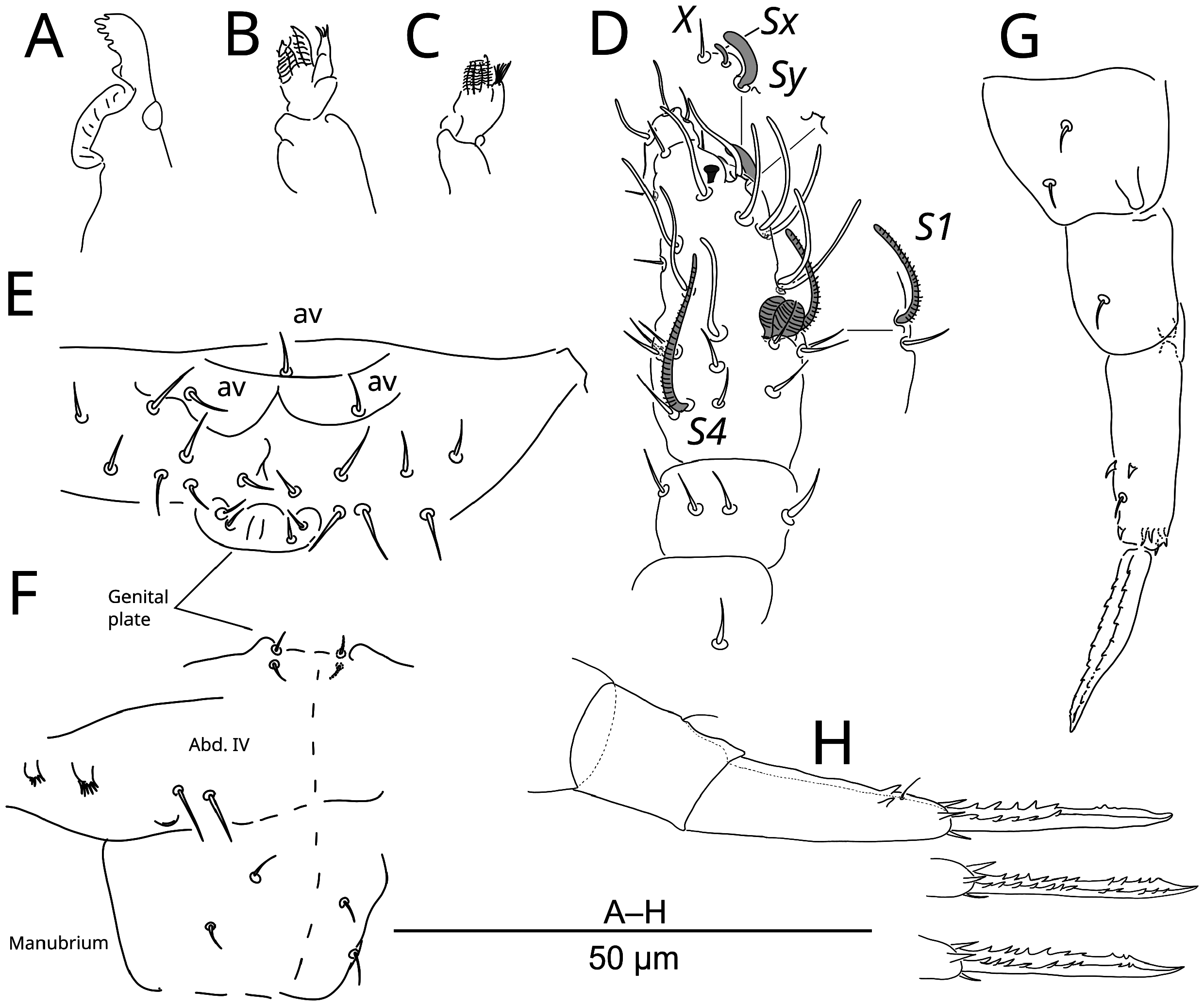
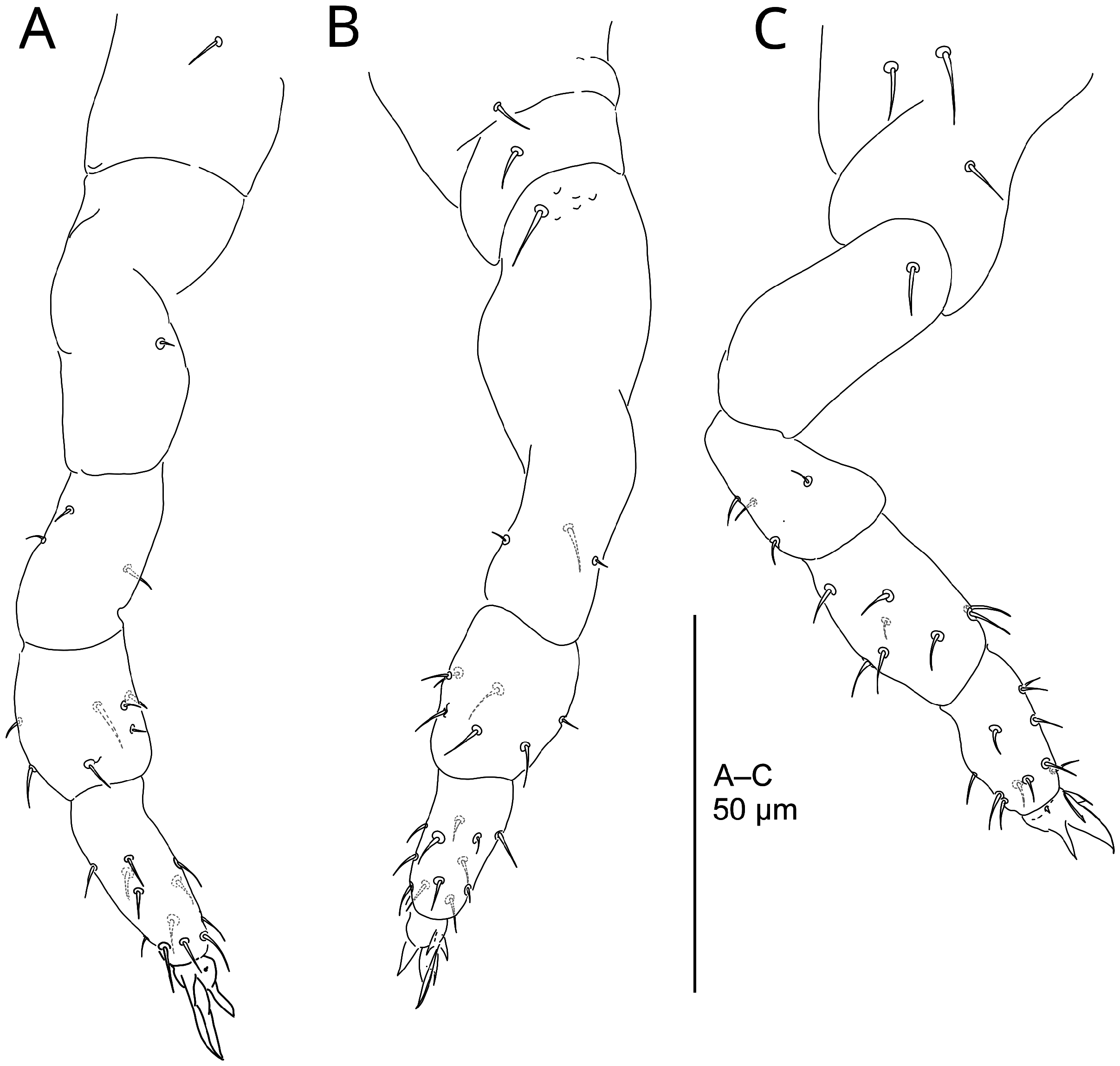
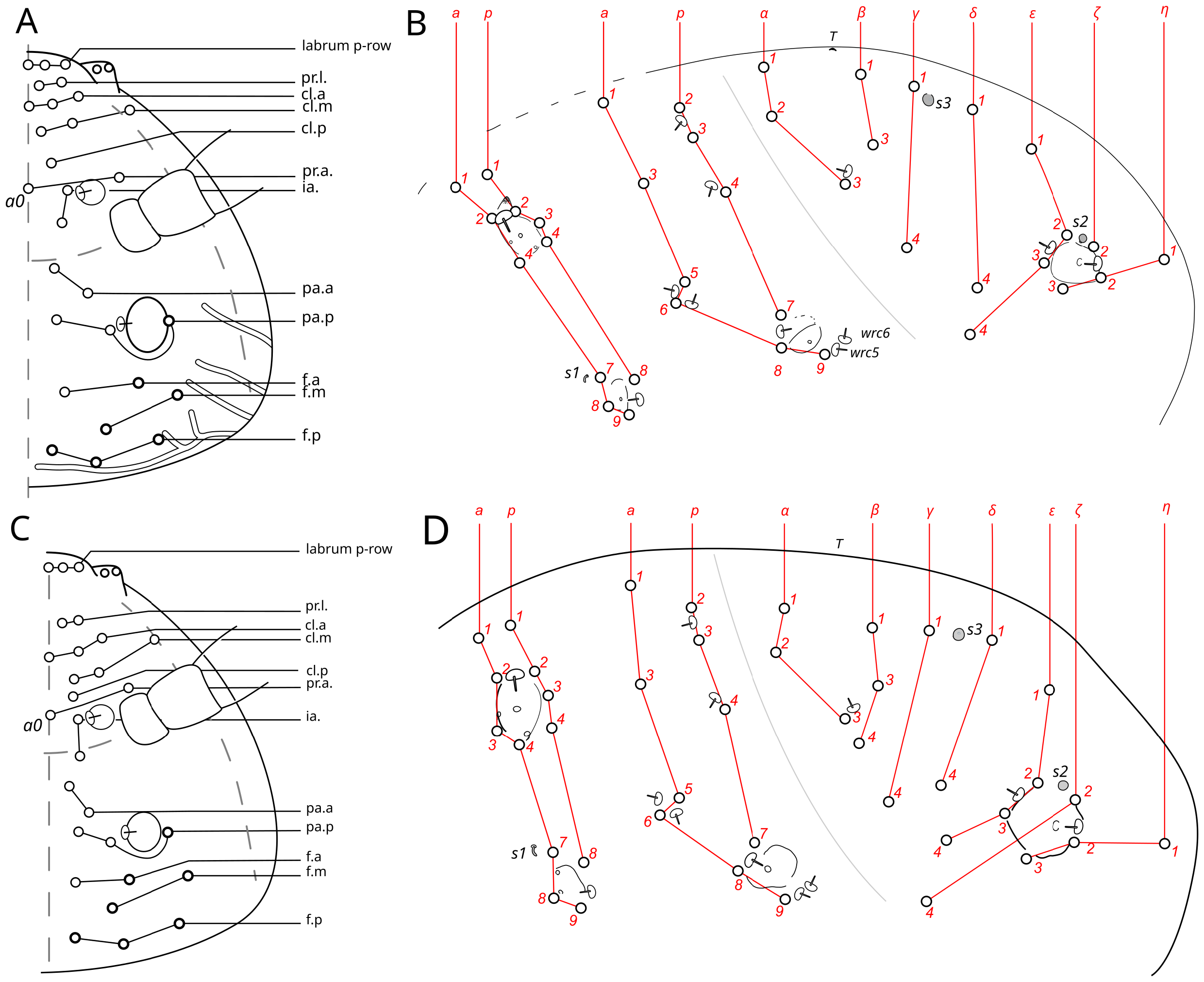
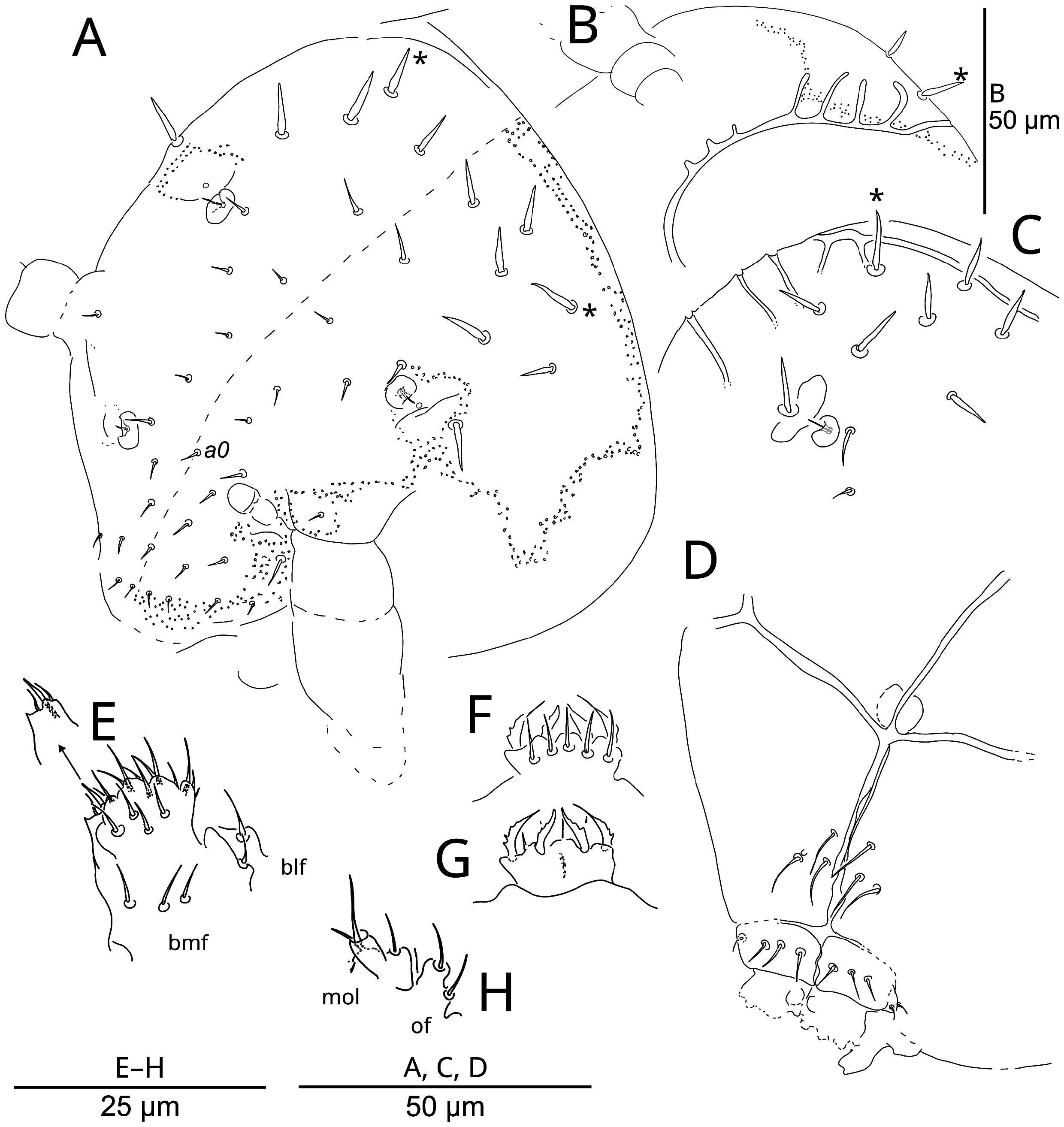
Description. General aspect. Habitus and segmentation typical of the genus. Length from labrum to anus: up to 350 µm. Colour whitish (in 96 % ethanol). Integument. Secondary granulation present dorsally on the head (Figs. 1 A, B), the thoracic region, the abdominal region and Abd. VI sternite. Integumentary channels limited to the lateral and posterior part of the head, with three short lateral crenelations (Fig. 1 B) and 5 – 6 terminal branches and no cycles (Fig. 1 B, C); no anterior channel, connection with linea ventralis crossed (Fig. 1 D). Channels absent on the trunk. Sensory fields and wax rods. Ordinary distribution of sensory fields and wax rods secretory crypts: 2 + 2 wrc on head, 12 + 12 wrc on body; including the ones associated with the 6 + 6 sensory fields (Fig. 2). Sensory fields include the swollen inner chaetae, all globular but often barely visible due to low contrast and small size: sf 1 – 6: 0, 1, 3, 2, 1. wrc 5 and 6 separated from sf 5 by at least 3 granules (Fig. 2). Head chaetotaxy. Number of chaetae: 12 + 12 in the postero-dorsal region, 10 + 10 and 2 unpaired in the antero-dorsal region, 1 + 1 in the antero-lateral region (Figs. 1 A, 8 A). With 7 + 7 postero-dorsal chaetae thickened, lanceolate (Fig. 1 A – C), anterior chaetae shorter and ordinary (Fig. 1 A). Ventrally, 3 + 3 post-labial chaetae (Fig. 1 D). Labium. Basomedian fields of labium with 3 + 3 chaetae, basolateral fields of labium with 2 + 2 chaetae (Fig. 1 D, E). Labial palps ordinary, as in Fig. 1 E. Labrum. Chaetae a 1, a 2 with coarse external teeth, a 1 with apical outward curvation (Fig. 1 F, G). Lamellae of the labral anterior process indistinct. Other mouthparts. Oral fold with 2 + 2 chaetae (Fig. 1 H). Maxilla outer lobe with two chaetae (apical and basal), sublobal plate with a strong hair (Fig. 1 H). Mandibula with 5 apical teeth, as in Fig. 3 A. Maxilla as in Fig. 3 B, C. Antenna. As in Fig. 3 D. Ant. I with one chaeta. Ant. II with four chaetae, the anterior one stronger than the three others. Ant. III with 10 chaetae and four S-chaetae S 1 – S 4 of the sensory organ; S 2 and S 3 clearly protruding from the cupule; all S 1 – S 4 with distinct ornamentation in light microscopy. Ant. IV with five ordinary chaetae (including X) and with 10 + 2 S-chaetae (Sb 1 – 5, Sa 1 – 5, Sx and Sy), Sb 3 implanted basally, on the same level as S 2 and S 3 of Ant. III. Organite (Or) well developed. Presence of a distinct cuticular process next to Or. Thoracic tergites. As in Fig. 3. τ-chaeta and pseudopores indistinct, not studied. Th. II with 11 + 11 chaetae (a 3 missing) and 1 + 1 s-chaetae s 1. Th. III with 10 + 10 chaetae, a 5 sensibly stronger than a 6, p 4 close to wrc 2. Diagram of chaetotaxy provided in Fig. 8 B. Abd. I – V tergites. With 17 + 17 ordinary chaetae, 2 + 2 globular s-chaetae (s 2, s 3) with s 3 sensibly bigger than s 2; chaetae β 2, β 4 and ζ 4 absent (Figs 2, 8 B). Abd. VI. Tergite with 4 + 4 and 1 unpaired chaetae. Each anal valve with one small chaeta. Sternite: female with 7 + 7 chaetae, male only partly observed, with at least 1 pair of enlarged (spine-like) postero-axial chaetae. Genital plate. Ordinary: female with 2 + 2 chaetae (Fig. 3 E, F). Abd. IV sternite. With 2 + 2 usual neosminthuroid chaetae, 2 + 2 ordinary chaetae and 1 + 1 small lobes (Fig. 3 F). Abdominal appendages. Manubrium with 2 + 2 posterior chaetae (Fig. 3 F). Dens ordinary, as in Fig. 3 G, H. Mucro with thin lamellae, with ~ 10 teeth on each posterior lamellae (Fig. 3 G), with possible variations (Fig. 3 H). Ventral tube with 2 + 2 apical chaetae, retinaculum with 3 + 3 distinct teeth. Legs. Chaetal composition on each legs subcoxa 1, 2, coxa, trochanter, femur and tibiotarsus: leg I — 1, 0, 1, 3, 7, 12 chaeta (e) (Fig. 4 A); leg II — 1, 1, 1, 3, 7 and 12 chaeta (e) (Fig. 4 B); leg III — 2, 1, 1, 4, 8 and 11 chaeta (e) (Fig. 4 C). Claws as in Fig. 4 A – C, ordinary, subequal in length. Basal and posterior lamellae of unguis well developed, anterior crest of unguis indistinct. Basal lobe of unguiculus not or feebly protruding. Affinities. The most similar species are M. perspicillum, M. boerneri sp. nov. and M. laevis Denis, 1948. The differential diagnosis is provided in Table 2. Also see the updated interactive key of the Megalothorax species of the world (Schneider 2022).
Schneider, Clément, Panina, Ksenia (2023): Revision of Megalothorax incertus Börner, 1903 reveals it to be another widespread Palearctic species of the genus (Collembola, Neelidae). Zootaxa 5318 (4): 474-488, DOI: 10.11646/zootaxa.5318.4.2, URL: http://dx.doi.org/10.11646/zootaxa.5318.4.2
Figs 1 – 4, 8 A, B; Tables 1 – 2
Schneider, Clément, Panina, Ksenia (2023): Revision of Megalothorax incertus Börner, 1903 reveals it to be another widespread Palearctic species of the genus (Collembola, Neelidae). Zootaxa 5318 (4): 474-488, DOI: 10.11646/zootaxa.5318.4.2, URL: http://dx.doi.org/10.11646/zootaxa.5318.4.2
Diagnosis. Colour whitish (in 96 % ethanol), connection of head channels with linea ventralis crossed, basomedian fields of labium with 3 + 3 chaetae, basolateral fields of labium with 2 + 2 chaetae, adult with reduced trunk chaetotaxy (Th. II without a 3, abdomen without β 2, β 4 and ζ 4), abdominal s-chaetae s 3 present and larger than s 2, 2 + 2 chaetae on Abd. IV sternite, retinaculum with 3 + 3 teeth, posterior lamellae of the mucro thin and serrated.
Schneider, Clément, Panina, Ksenia (2023): Revision of Megalothorax incertus Börner, 1903 reveals it to be another widespread Palearctic species of the genus (Collembola, Neelidae). Zootaxa 5318 (4): 474-488, DOI: 10.11646/zootaxa.5318.4.2, URL: http://dx.doi.org/10.11646/zootaxa.5318.4.2
Material examined. Neotype: female on slide (SMNG-APT-AA 00012), Italy, Sicily, Palermo, Botanical Garden, 14 Nov. 2014, 38.1126 ° N, 13.3742 ° E, upper soil under a Cycas revoluta Thunb., leg. C. Schneider, original collection code: CS. 011. IT. Five females on slides (SMNG-APT-AA 00013 – 17), same data as the neotype. All specimens deposited in the Apterygota collection of the Senckenberg Museum f ̧ r Naturkunde G ̂ rlitz. Other material. Two females on slides (SMNG-APT-AA 00018 – 19), Italy, Sicily, Scopella, Riserva naturale orientata dello Zingaro, coastal path, 22 Nov. 2014, 38.0995 ° N, 12.7969 ° E, mosses and upper layer of soil, leg. C. Schneider, original collection code: CS. 035. IT. Two females on slides (SMNG-APT-AA 00021, 22), France, Île-de-France, Essonne, Brunoy, Laboratoire d’Écologie Tropicale (garden), 01 May 2015, 48.6954 ° N, 2.4945 ° E, upper layer of soil under a rock, leg. C. Schneider, original collection code: Brunoy 06. Two females and one male on slide, Russia, Moscow region, near the village of Polyany, 27 June 2022, 55.459787 ° N, 37.229358 ° E, upper layer of soil (up to 10 cm), leg. K. Panina. Four females on slide, Russia, Krasnodar, 28 April 2021, 45.0644 ° N, 38.8144 ° E, upper layer of soil (up to 10 cm), leg. K. Panina. Molecular data. One individual from CS. 011. IT (same data as neotype) and one individual from Brunoy 06 (Genbank accession number in Table 1). Vouchers have not been recovered.
Schneider, Clément, Panina, Ksenia (2023): Revision of Megalothorax incertus Börner, 1903 reveals it to be another widespread Palearctic species of the genus (Collembola, Neelidae). Zootaxa 5318 (4): 474-488, DOI: 10.11646/zootaxa.5318.4.2, URL: http://dx.doi.org/10.11646/zootaxa.5318.4.2

Export occurrence data

Darwin Core Archive (ZIP)

CLASSIFICATION

Taxonomic Classification Tree

MULTIMEDIA

Media Files(5)

FIGURE 1. Megalothorax incertus sensu nov., Head (A) dorsal, (B) postero-lateral side and (C) dorso-lateral with details on the integumentary channels, a star indicates a corresponding chaeta in (A, B, C), (D) ventral side; (E) labium, bmf=basomedian field, blf=basolateral field; labrum anterior process (F) posterior side, (G) anterior side; (H) maxillary outer lobe (mol) and oral fold (of). Limit of the dorsal secondary granulation outlined in (A) and (B).

Imageimage/png© Schneider, Clément;Panina, KseniaSchneider, Clément;Panina, Ksenia

FIGURE 2. Megalothorax incertus sensu nov., trunk tergites chaetotaxy (Th. I–Abd. V).

Imageimage/png© Schneider, Clément;Panina, KseniaSchneider, Clément;Panina, Ksenia

FIGURE 3. Megalothorax incertus sensu nov., (A) mandibula; (B, C) maxilla; (D) antenna posterior side; Abd. V–VI sternites (E) female, av = anal valves; (F) Abd. IV–V sternites and manubrium; furca (G) topotype, (H) variations observed on russian individuals.

Imageimage/png© Schneider, Clément;Panina, KseniaSchneider, Clément;Panina, Ksenia

FIGURE 4. Megalothorax incertus sensu nov., (A) Leg I; (B) leg II; (D) leg III.

Imageimage/png© Schneider, Clément;Panina, KseniaSchneider, Clément;Panina, Ksenia

FIGURE 8. Chaetotaxy diagrams: M. incertus sensu nov. (A) head, (B) trunk, M. boerneri sp. nov. (A) head, (B) trunk.

Imageimage/png© Schneider, Clément;Panina, KseniaSchneider, Clément;Panina, Ksenia

IMAGES

Gallery(5)

See Gallery

Occurrences with images

Source Information

Revision of Megalothorax incertus Börner, 1903 reveals it to be another widespread Palearctic species of the genus (Collembola, Neelidae)

checklist

This dataset contains the digitized treatments in Plazi based on the original journal article Schneider, Clément, Panina, Ksenia (2023): Revision of Megalothorax incertus Börner, 1903 reveals it to be another widespread Palearctic species of the genus (Collembola, Neelidae). Zootaxa 5318 (4): 474-488, DOI: 10.11646/zootaxa.5318.4.2, URL: http://dx.doi.org/10.11646/zootaxa.5318.4.2

Abstract

Megalothorax incertus B̂rner, 1903 is the second species of Megalothorax to have been discovered. The brevity of the original description left the species insufficiently defined.

In this work, we redescribe M. incertus from topotypes (Sicily) and describe a new species of the incertus -group: M. boerneri sp. nov. (France). We report the presence of M. incertus sensu nov. in France and Russia and validate a previous record from China based on molecular data. New records are also provided for a third species of the incertus - group, M. perspicillum Schneider & D’Haese, 2013. Novel DNA data (28S rDNA, 16S rDNA, COI) are provided for the three species. The interactive key of the Megalothorax species of the world is updated.

The three species are distinguished on subtle morphological characteristics and are found to be well-separated on the molecular based phylogenetic tree.

Megalothorax incertus sensu nov. joins M. perspicillum, M. minimus Willem, 1900 and M. willemi Schneider & D’Haese, 2013 in the club of widespread Megalothorax species in the Palearctic, and can be found in co-occurrence with them. Thus, the ecological distinction between those species remains unprecise.

Schneider C, Panina K, plazi (2023). Revision of Megalothorax incertus Börner, 1903 reveals it to be another widespread Palearctic species of the genus (Collembola, Neelidae). Plazi.org taxonomic treatments database. Checklist dataset https://doi.org/10.15468/qbjyxp accessed via GBIF.org on 2026-06-19.

CC0Published 7/21/2023View dataset
GBIF Usage Key
212419408
Dataset Key
3c1eedbd-6795-4560-a147-fd1320d5da1a
Origin
source
Backbone Key
2122164
Taxon ID
03FC6644DC422C76FF79F8746E17FAAB.taxon
Last Crawled
6/18/2026
Last Interpreted
6/18/2026