
AnimaliaNot EvaluatedacceptedspeciesAccepted
Dimorphilus oophagus
Giglio, Salcedo, Watkins & Olivera, 2023
GBIF:213153404
0year
ABOUT
Descriptions(1)
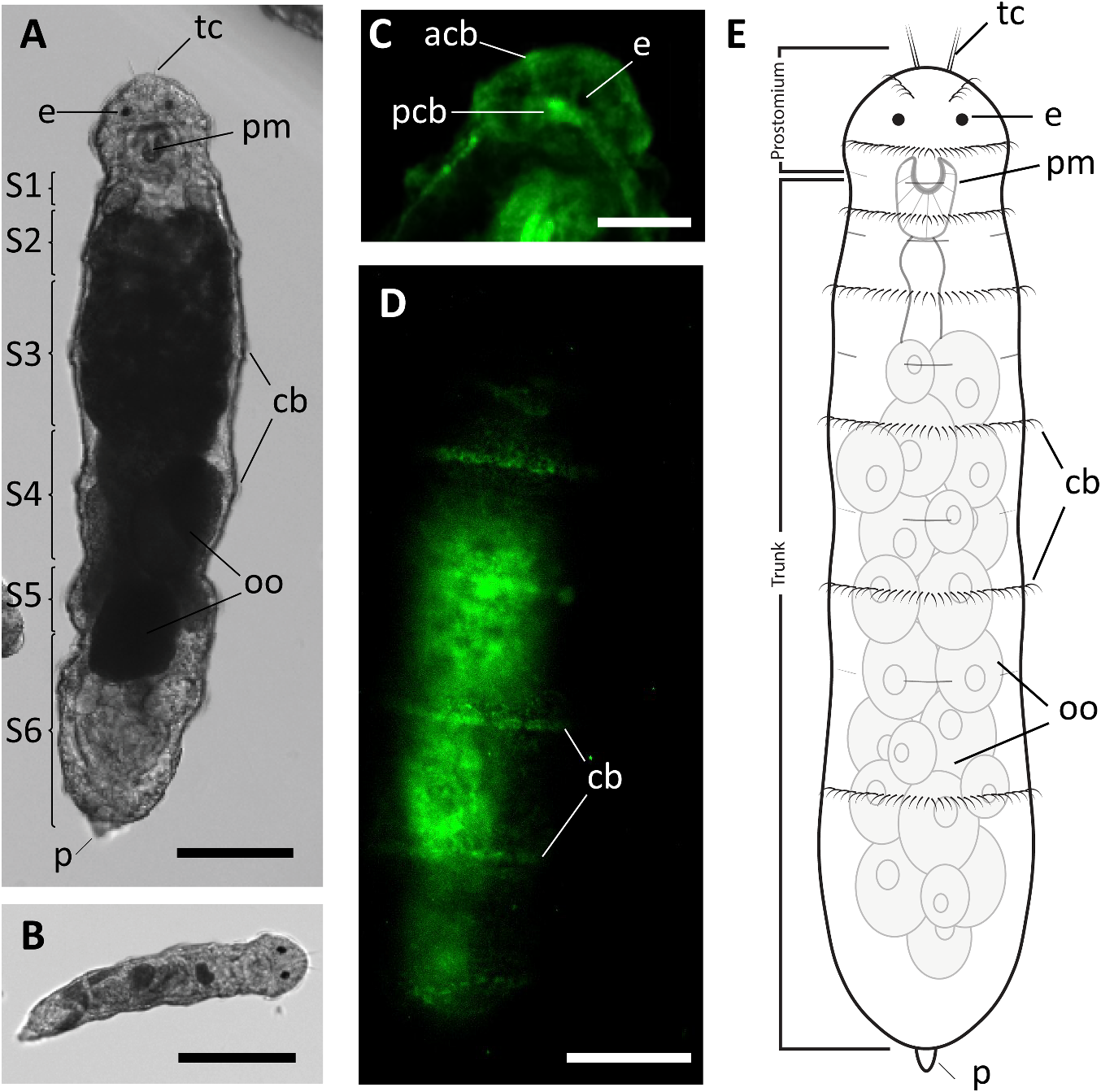
Material examined. Holotype: adult female collected inside the egg capsules of C. ermineus living in captivity at the University of Utah in June 2021 by Matías L. Giglio and Paula Flórez Salcedo, fixed and preserved in 70 % ethanol (Voucher # umnh. ann. 0001770); Paratype: same collection data and preservation as holotype (Voucher # umnh. ann. 0001771). Diagnosis. Based on females; prostomium with two ciliary tufts projecting anteriorly, and two ciliary bands, second one complete; eyespots rounded. Description. Adult s: Females body hyaline, cylindrical, plump shape 512.8 − 692.31 μ m long (mean = 615.35 μ m), with six segments between the prostomium and pygidium (fig. 5 A, E). Prostomium with two well-defined, round-shaped, pigmented eyespots, two ciliary tufts projecting terminally, and two sets of cilia organized in two bands (an incomplete band between eyespots and anterior end, and a complete band between eyes and mouth) (fig. 5 A, C, E). Each trunk segment with a central transversal ciliary band (fig. 5 A, D, E). Pygidium short, conical, lacking cilia. Prominent muscular pharynx well defined located at level of segment 1. Two thirds of mid body cavity full of pale white / grey oocytes (37.7 − 88.9 μ m in diameter). Males not observed. Juvenile: body elongated, slender (fig. 5 B), always smaller than the adult forms. Identical to adult females except for having less segments and lacking oocytes. Type locality. Salt Lake City, Utah, USA. Etymology: the specific epithet “ oophagus ” is the Greek form for “ egg eater, ” and refers to the atypical egg-feeding behaviour of the species. Remarks. Dimorphylus oophagus sp. nov. can be clearly distinguished from the other two species of the genus by a combination of traits including ciliary arrangement and eyespot shape (table 2). The three species have no males in their original descriptions, presumably due to the difficultness in finding them, as they are dwarf and have short lifespans, characteristic of other species of the genus. Unfortunately, we do not have enough material of females or juveniles, to further analyse the morphology of these specimens (i. e., using electron microscope or histology). and urn: lsid: zoobank. org: act: 5 F 04 BFD 0 - 4062 - 42 E 9 - 8 BD 8 - 48 A 979 C 4 FA 07 for the species.
Giglio, Matías L., Salcedo, Paula Flórez, Watkins, Maren, Olivera, Baldomero (2023): Insights into a putative polychaete-gastropod symbiosis from a newly identiFIed annelid worm that predates upon Conus ermineus eggs. Contributions to Zoology 92 (2): 97-111, DOI: 10.1163/18759866-bja10038, URL: http://dx.doi.org/10.1163/18759866-bja10038
Export occurrence data
Darwin Core Archive (ZIP)
CLASSIFICATION
Taxonomic Classification Tree

MULTIMEDIA
Media Files(1)
figure 5 Dimorphilus oophagus sp. nov.A:Adult female, dorsal view; cb:ciliary bands, e: eyespot, oo:intracelomic oocytes, pm:pharyngeal musculature, p: pygidium, tc: tuft of cilia.S1–S6 = segment 1–6 B: Juvenile female.C: Immunohistochemistry showing the prostomial ciliary arrangement of an adult female.Acb = anterior ciliary band, pcb = posterior ciliary band D: Immunohistochemistry showing the segmental ciliary bands of an adult female.E: Reconstruction of an adult female of Dimorphilus oophagus sp. nov.Scale bars: A= 100μm, B= 100μm, C= 50μm, D= 100μm.
Imageimage/png© Giglio, Matías L.;Salcedo, Paula Flórez;Watkins, Maren;Olivera, BaldomeroGiglio, Matías L.;Salcedo, Paula Flórez;Watkins, Maren;Olivera, Baldomero
IMAGES