
AnimaliaNot EvaluatedacceptedspeciesAccepted
Pallisentis himachalensis
Rana & Kaur, 2023
GBIF:213765861
0year
ABOUT
Descriptions(8)
Host: Channa punctata (Bloch, 1793)
Rana, Khushboo, Kaur, Harpreet (2023): Morphological and Molecular Characterization of Two New and Two Already Known Species of the Genus Pallisentis (Acanthocephala: Quadrigyridae) from India with an Update in Key to the Species. Zootaxa 5352 (4): 577-593, DOI: 10.11646/zootaxa.5352.4.8, URL: http://dx.doi.org/10.11646/zootaxa.5352.4.8
Site of infection: Small intestine.
Rana, Khushboo, Kaur, Harpreet (2023): Morphological and Molecular Characterization of Two New and Two Already Known Species of the Genus Pallisentis (Acanthocephala: Quadrigyridae) from India with an Update in Key to the Species. Zootaxa 5352 (4): 577-593, DOI: 10.11646/zootaxa.5352.4.8, URL: http://dx.doi.org/10.11646/zootaxa.5352.4.8
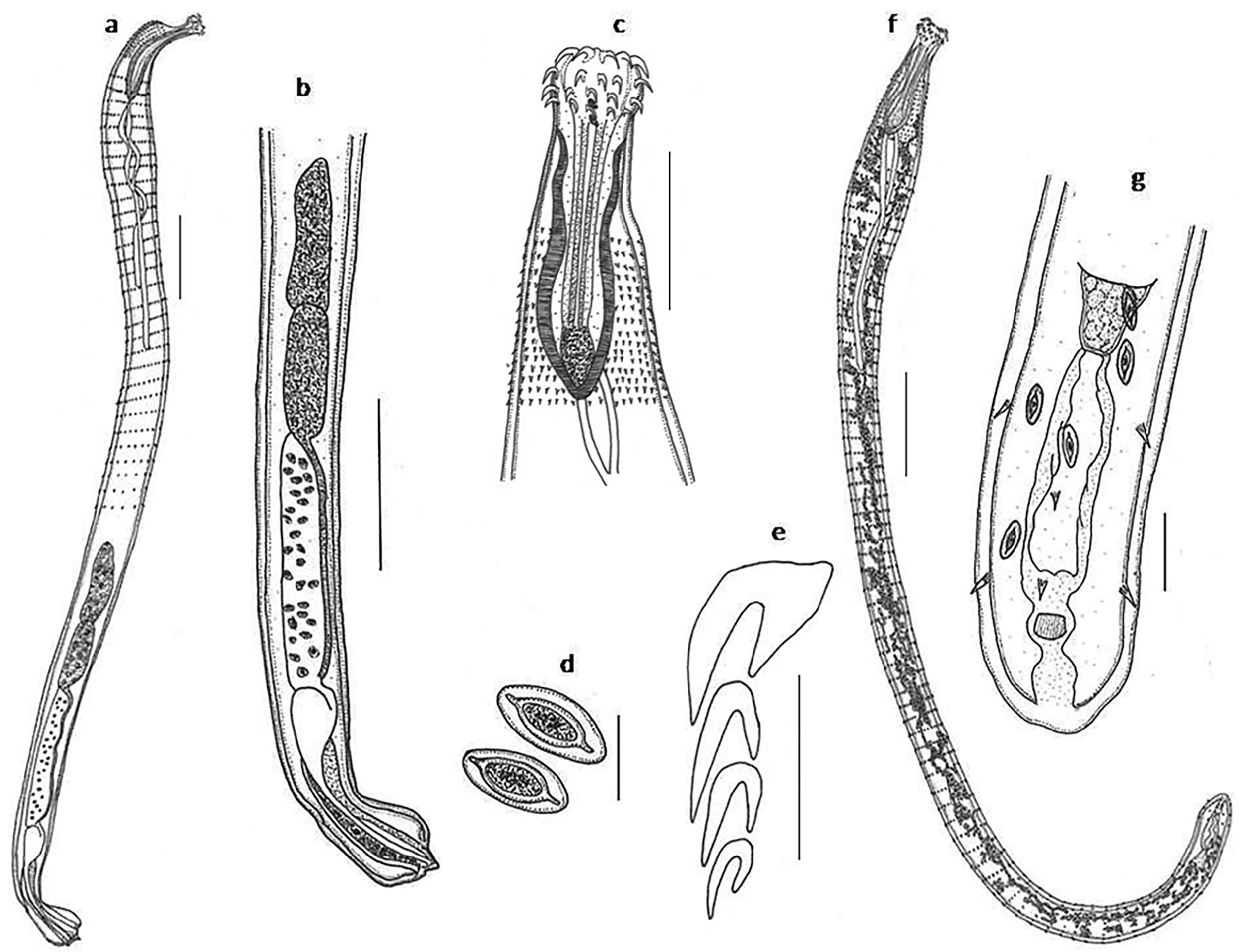
Morphological description (Figure 1) General: Proboscis squarish in shape, 4 circles of 8 – 10 hooks per circle, size of proboscis hooks gradually decline from anterior to posterior circle, 2 nuclei of apical organ below level of third circle of proboscis hooks, hook roots of 2 anterior proboscis circles are prominently visible, smaller than blades, posteriorly directed. Trunk with 2 sets of spines: anterior (collar) spines and posterior (trunk) spines. Y shaped collar spines, 15 – 16 circles. Trunk spines conical, last circle just above anterior testis in males, last circle reaching above anterior end of reproductive system in female, 3 – 4 circles (3 – 4 spines per circle) at posterior end of the trunk. Cement gland syncytial with 26 – 29 nuclei. Female gonopore centro – terminal. Egg with three membranes, with polar elongation of fertilization membrane. Male: Trunk length 9.0 – 14.0 (11.5) mm, maximum width 0.4 – 0.5 (0.5) mm at proximal region of trunk. Proboscis 170.5 – 204.4 (187.4) long × 200.9 – 209.0 (204.9) wide with 4 circles of proboscis hooks. H 1 82.4 – 108.9 (95.6) long × 16.9 – 18.3 (17.6) wide at base, H 2 67.9 – 77.5 (72.7) long × 9.8 – 11.1 (10.5) wide, H 3 45.9 – 59.0 (52.4) long × 8.4 – 8.6 (8.5) wide, H 4 34.5 – 46.8 (40.6) long × 6.9 – 7.8 (7.3) wide. Hook roots shorter than blade, HR 1 55.6 – 57.1 (56.4), HR 2 40.1 – 43.5 (41.8), HR 3 30.5 – 32.9 (31.7), HR 4 21.8 – 25.1 (23.4). Neck unarmed, 223.5 – 251.5 (237.5) long × 190.6 – 193.1 (191.9) wide. Proboscis receptacle 750.5 – 765.5 (758.0) long × 209.9 – 216.6 (213.2) wide. Lemnisci (L) unequal, L 1 3005.1 – 3194.6 (3099.9) long × 63.1 – 69.8 (66.4) wide, L 2 2337.7 – 2648.4 (2493.0) long × 51.9 – 58.9 (55.4) wide. Collar spines 15 – 16 circles, 27.5 – 34.6 (31.0) long, spine field covering 524.1 – 537.3 (530.7) region of trunk. Trunk spines in 27 – 37 (32) circles, 10 – 15 spines in each circle, 33.6 – 40.9 (37.3) in length. Testes post equatorial, anterior testis 899.0 – 1060.3 (979.7) long × 263.8 – 281.0 (272.4) wide, posterior testis 713.1 – 991.6 (852.3) long × 256.2 – 301.4 (278.8) wide. Cement gland elongated 1704.3 – 2179.0 (1941.6) long × 222.1 – 227.9 (225.0) wide. Cement reservoir 575.8 – 603.4 (589.6) long × 221.3 – 226.1 (223.7) wide branching posteriorly into two ducts. Seminal vesicle located postero – lateral to cement reservoir, 430.4 – 474.7 (452.6) long × 89.9 – 107.9 (98.9) wide, tapers into vas efferens anteriorly. Saefftigen’s pouch 654.6 – 690.7 (672.7) long, ventral, parallel to the seminal vesicle, posterior to cement reservoir tapering towards posterior margin of trunk. Vas deferens, ducts of saefftigen’s pouch and cement reservoir enter bursa. Bursa 524.3 – 550.7 (537.5) long × 371.2 – 490.1 (430.7) wide. Female: Cylindrical, 13 – 18 (15.5) mm long × 0.5 – 0.6 (0.6) mm wide anteriorly. Proboscis 184.0 – 231.0 (208.0) long × 193.0 – 294.0 (243.0) wide, H 1 84.0 – 114.0 (99.0) long × 17.0 – 25.2 (21.1) wide, H 2 65.9 – 79.9 (72.9) long × 10.6 – 15.2 (12.9) wide, H 3 48.3 – 61.3 (54.8) long × 6.8 – 9.4 (8.1) wide, H 4 35.1 – 49.6 (42.4) long × 6.2 – 7.9 (7.0) wide. HR 1 56.5 – 58.7 (57.6), HR 2 44.9 – 49.1 (47.0), HR 3 36.3 – 39.0 (37.6). Proboscis receptacle 790.7 – 826.6 (808.6) long × 170.1 – 202.6 (186.4) wide. Neck unarmed 258.5 – 323.1 (290.8) long × 218.3 – 294.4 (256.4) wide. L 1 2432.0 long × 52.0 wide, L 2 1878.0 long × 48.0 wide (one specimen). Collar spines 14 – 18 circles, 27.4 – 30.9 (29.2) long, spine field covering 526.1 – 569.8 (547.9) region of trunk. Trunk spines 55 – 73 circles (11 – 16 per circle), 7 – 11 in the posterior circles, 26.7 – 33.1 (29.9) long. Female reproductive system 605.1 – 695.3 (650.2) long, uterine bell well developed 95.1 – 102.5 (98.8) long, leading into muscular uterus 396.5 – 457.4 (426.9) long, vagina 121.6 – 134.6 (128.1) long, well developed vaginal sphincter, opens into centro – terminal gonopore. Egg 66.0 – 78.4 (72.2) long × 34.8 – 37.8 (36.3) wide.
Rana, Khushboo, Kaur, Harpreet (2023): Morphological and Molecular Characterization of Two New and Two Already Known Species of the Genus Pallisentis (Acanthocephala: Quadrigyridae) from India with an Update in Key to the Species. Zootaxa 5352 (4): 577-593, DOI: 10.11646/zootaxa.5352.4.8, URL: http://dx.doi.org/10.11646/zootaxa.5352.4.8
Remarks The present species is placed in the genus Pallisentis due to the presence of two well separated spined regions in the trunk and syncytial cement gland in males. According to the updated key to the species of the genus Pallisentis (Rana & Kaur 2021 b), four species namely P. kalriai Khan and Bilqees, 1985, P. meyeri, P. gomtii, and P. amini morphologically resembles P. himachalensis in having conical trunk spines not extending to posterior end of either sex and the presence of saefftigen’s pouch in males. However, the P. himachalensis shows closest resemblance to the P. gomtii in having similarity in the number of proboscis hooks and distribution of trunk spines. However, following differences have been observed: First, the size of proboscis is shorter in the P. himachalensis but comprises significantly longer proboscis hooks in comparison to the P. gomtii (Table 1). Second, the paired lemnisci are unequal and much longer in the present species in contrast to the equal and comparatively shorter lemnisci in P. gomtii (Table 2). Third, the trunk spines in case of female in both the species end some distance before the posterior end but in the case of present species additional 3 – 4 circles of trunk spines are present at the posterior tip of the female; however, it may show marked intraspecific variability. Fourth, the reproductive organs of the male and female P. himachalensis are notably longer than the P. gomtii (Table 2). Female gonopore is centro – terminal in the present species compared to the near – terminal position of gonopore in P. gomtii. P. himachalensis also differs from the other morphologically close species P. kalriai and P. meyeri in the distribution of trunk spines and post equatorial position of the testes. The size of reproductive organs significantly differs in P. himachalensis in comparison to the other two species, for example the testes are more than 1100 (1170 – 1190) long in P. kalriai and the anterior testis and posterior testis are 240 – 440 and 80 – 140 long, respectively, in P. meyeri, whereas the in P. himachalensis the anterior and posterior testis are 899 – 1060 and 713 – 991 long, respectively. Also, the cement gland nuclei in P. meyeri are 10 – 14, whereas 26 – 29 nuclei are reported in P. himachalensis (cement gland nuclei in P. kalriai not reported). The other species P. amini, which shows some morphological similarity with the P. himachalensis differs in the size of the proboscis hooks and the declining pattern of the proboscis hooks. The average length of lemnisci is longer than 1500 in P. himachalensis, whereas the lemnisci are shorter than 1500 in P. amini. The average size of testes in P. amini is much shorter (anterior testis: 375, posterior testis: 350) than that in P. himachalensis. Further, the number of cement gland nuclei in P. amini is 6 – 16, whereas 26 – 29 nuclei are observed in P. himachalensis.
Rana, Khushboo, Kaur, Harpreet (2023): Morphological and Molecular Characterization of Two New and Two Already Known Species of the Genus Pallisentis (Acanthocephala: Quadrigyridae) from India with an Update in Key to the Species. Zootaxa 5352 (4): 577-593, DOI: 10.11646/zootaxa.5352.4.8, URL: http://dx.doi.org/10.11646/zootaxa.5352.4.8
Etymology: The specific name is derived from the place of sample collection.
Rana, Khushboo, Kaur, Harpreet (2023): Morphological and Molecular Characterization of Two New and Two Already Known Species of the Genus Pallisentis (Acanthocephala: Quadrigyridae) from India with an Update in Key to the Species. Zootaxa 5352 (4): 577-593, DOI: 10.11646/zootaxa.5352.4.8, URL: http://dx.doi.org/10.11646/zootaxa.5352.4.8
Locality: Beas River, Dehra Gopipur, Himachal Pradesh (31.90 ° N, 76.22 ° E), India
Rana, Khushboo, Kaur, Harpreet (2023): Morphological and Molecular Characterization of Two New and Two Already Known Species of the Genus Pallisentis (Acanthocephala: Quadrigyridae) from India with an Update in Key to the Species. Zootaxa 5352 (4): 577-593, DOI: 10.11646/zootaxa.5352.4.8, URL: http://dx.doi.org/10.11646/zootaxa.5352.4.8
Specimens examined: 6 males and 5 females
Rana, Khushboo, Kaur, Harpreet (2023): Morphological and Molecular Characterization of Two New and Two Already Known Species of the Genus Pallisentis (Acanthocephala: Quadrigyridae) from India with an Update in Key to the Species. Zootaxa 5352 (4): 577-593, DOI: 10.11646/zootaxa.5352.4.8, URL: http://dx.doi.org/10.11646/zootaxa.5352.4.8
Specimens submitted: Registration number – HARC / ZSI / AC – 4 in slide P 4 containing whole worms Holotype male and Allotype female stained in Gower’s carmine mounted with DPX were submitted to High Altitude Regional Centre – Zoological Survey of India, Solan, India. Sequences generated: The sequences submitted to the NCBI database on the basis of 18 S, 28 S, and ITS 1 – 5.8 S – ITS have been allotted accession number OM 480738, OM 480742, and OM 501879, respectively.
Rana, Khushboo, Kaur, Harpreet (2023): Morphological and Molecular Characterization of Two New and Two Already Known Species of the Genus Pallisentis (Acanthocephala: Quadrigyridae) from India with an Update in Key to the Species. Zootaxa 5352 (4): 577-593, DOI: 10.11646/zootaxa.5352.4.8, URL: http://dx.doi.org/10.11646/zootaxa.5352.4.8
Export occurrence data
Darwin Core Archive (ZIP)
CLASSIFICATION
Taxonomic Classification Tree
AnimaliaAcanthocephalaEoacanthocephalaGyracanthocephalaQuadrigyridaePallisentisPallisentis himachalensis

MULTIMEDIA
Media Files(1)
FIG. 1 Line drawings of specimens of Pallisentis himachalensis n. sp. a– male; b– posterior end of male; c– proboscis (female); d– mature egg; e– proboscis hooks declining gradually in size; f– female; g– posterior end of female. Scale a– 1 mm; b–1000 µm; c– 500 µm; d–50 µm; e– 100 µm; f–1 mm; g– 100 µm.
Imageimage/png© Rana, Khushboo;Kaur, HarpreetRana, Khushboo;Kaur, Harpreet
IMAGES