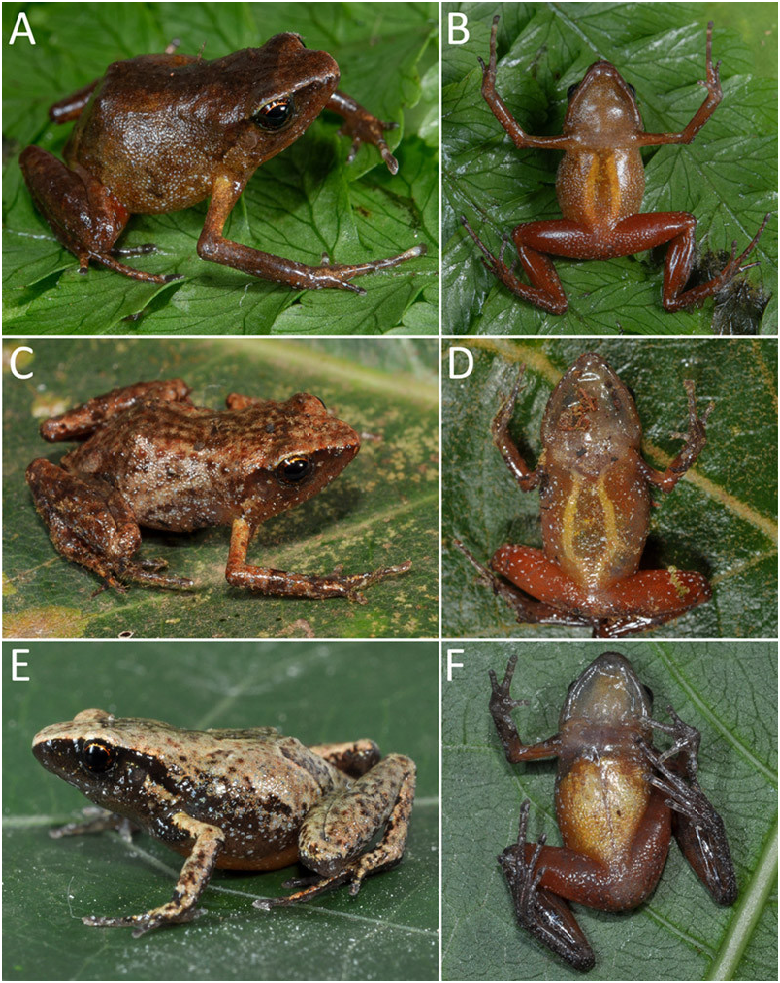
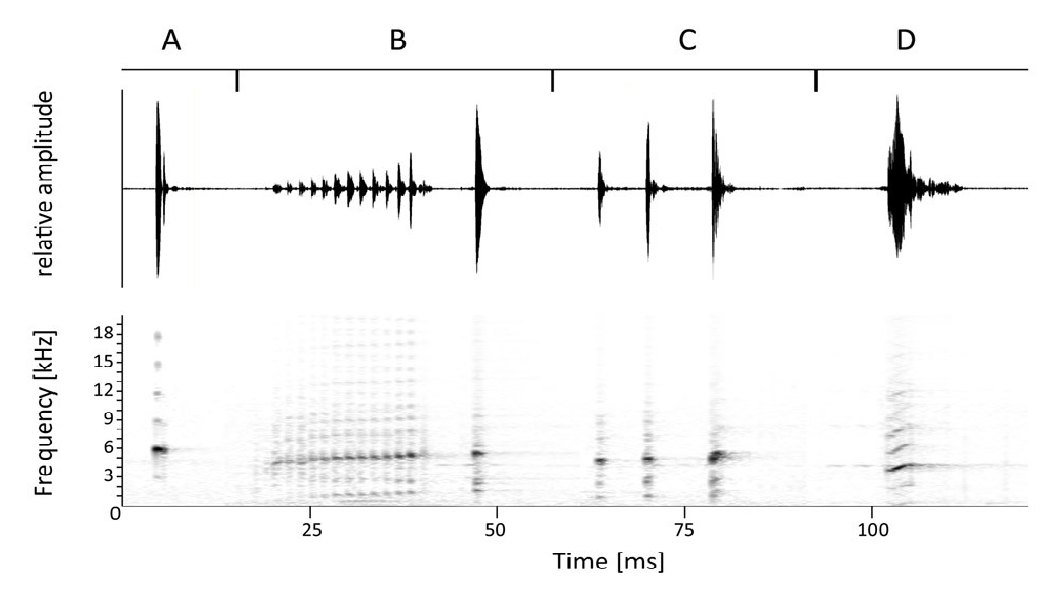
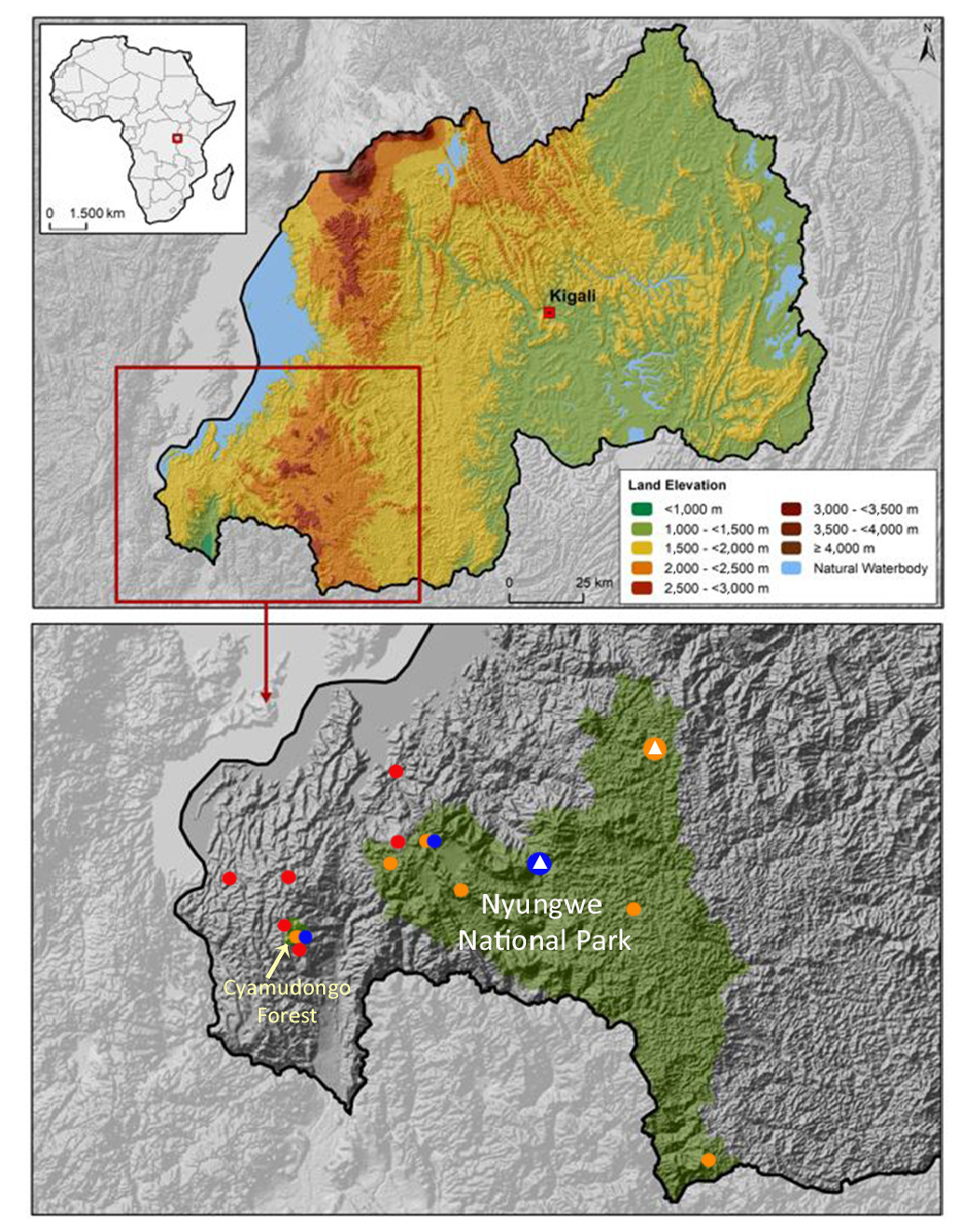
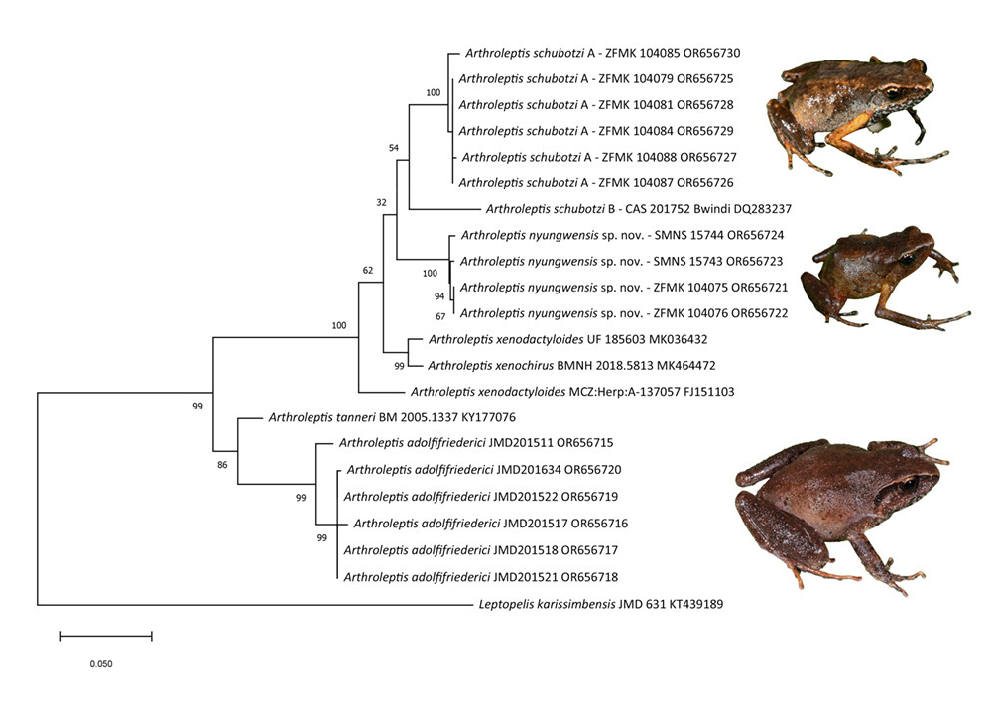
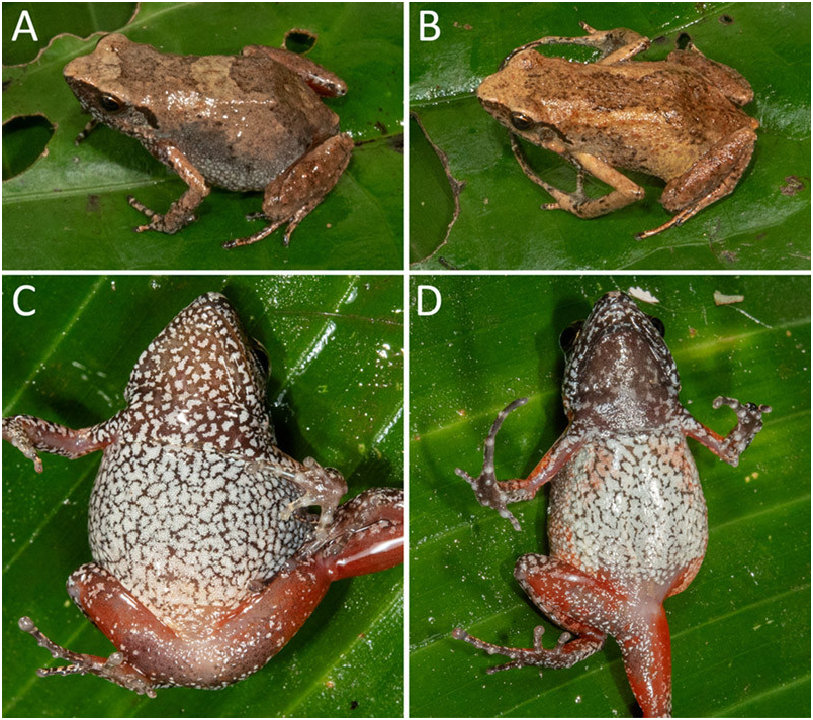
Phylogenetic relationships: The phylogenetic tree resulting from the ML analysis was well supported by nonparametric bootstrap values (Figure 4). All samples of Arthroleptis nyungwensis formed a clade that was weakly supported as being sister to a clade containing two deeply divergent clades assigned to A. schubotzi, one from Rwanda (A. schubotzi A), the other from Bwindi, Uganda (A. schubotzi B). The three clades are all from montane forests in the central and northern Albertine Rift. They were sister to a clade containing A. xenodactyloides and A. xenochirus (Figure 4), two species that are distributed from Angola to southern DRC, southern Tanzania and northwards to Kenya. Another sequence assigned to Arthroleptis xenodactyloides was resolved as sister to all aforementioned clades, suggesting that the identification of the source specimens of these three latter sequences need to be revised. The third Rwandan species, A. adolfifriederici, is only distantly related to A. nyungwensis and A. schubotzi and appears to be most closely related to A. tanneri from the Usambara Mountains in Tanzania (Figure 4). The samples of A. nyungwensis differed from each other by 0.00 – 0.54 % and from samples of all other species by at least 4.6 % in uncorrected p-distance. Samples of A. schubotzi A from Rwanda differed from the sample of A. schubotzi B from Uganda by 5.6 %. Morphological comparison: The very small size (SVL of adult males 16.0 – 16.5 mm) distinguishes A. nyungwensis sp. nov. from the other species in the wider region that are larger, i. e., A. adolfifriederici: males 27.6 – 32.0 mm; A. francei Loveridge, 1953: male 32 mm; A. phrynoides (Laurent, 1976): male 20.4 mm; A. reichei Nieden, 1911: males to 30 mm; A. schubotzi: males 19.9 – 21.2 mm (including Schoutedenella discodactyla Laurent, 1954 with males 17.5 – 19 mm); A. spinalis Boulenger, 1919: male 21.4 mm; A. stenodactylus Pfeffer, 1893: males to 33 mm; A. xenochirus Boulenger, 1905 (including Schoutedenella globosa de Witte, 1921 as well as A. lameeri de Witte, 1921 and Schoutedenella muta de Witte, 1933; see also [5]): males with enlarged third finger 16.5 – 24 mm; A. xenodactylus Boulenger, 1909: males to 26 mm; A. xenodactyloides Hewitt, 1933: males to 25 mm. The very small inner metatarsal tubercle distinguishes the new species from all remaining species with large, elongate, prominent inner metatarsal tubercle that is about two-thirds the length of the first metatarsus, i. e., A. loveridgei de Witte, 1933 (also outer palmar tubercle present, ventral side of thigh coarsely granular, discs of toes strongly enlarged vs. outer palmar tubercle absent, thigh smooth, discs of toes slightly enlarged); A. sylvaticus (Laurent, 1954) (also discs of toes strongly enlarged vs. slightly enlarged); and A. xenochirus Boulenger, 1905 (also venter uniformly off-white, throat grey in males vs. venter reddish to orange with longitudinal yellow stripes and white dots, throat yellowish brown with tiny dark brown speckles). Arthroleptis fichika Blackburn, 2009 and A. kidogo Blackburn, 2009 are known only from females that are much smaller (SVL 13.5 – 14.2 mm and 13.9 – 14.1 mm, respectively) than the new species, and differ in having a dappled ventral colour pattern [7]. Morphological differentiation between the similarly sized species of Arthroleptis from the Albertine Rift is hampered by the shortage of external diagnostic characters, especially in preserved specimens, in combination with the briefness of the original descriptions that specify only a handful of characteristics, some of which are not diagnostic. In addition, the whereabouts and the identity of the types of several species described by Laurent [3,16] are currently vague. The life colouration can be a useful character to easily distinguish between species if it is thoroughly documented. The distributional range of Arthroleptis nyungwensis sp. nov. overlaps with that of A. schubotzi in western Rwanda, although the two species are usually found in different habitats. The Rwandan specimens match the types of A. schubotzi and the types of its junior synonym Schoutedenella kivuensis de Witte, 1941, very well. Arthroleptis schubotzi (males 19.9 – 21.2 mm, male syntype of S. kivuensis 19.8 mm; females 21.1 – 21.6 mm; female holotype currently 19.2 mm, previously measured 21 mm [13] and 20 mm [20], female syntype of S. kivuensis 20.6 mm) is significantly larger than A. nyungwensis sp. nov. (males 16.0 – 16.5 mm), has relatively shorter legs (TFL / SVL 0.36 – 0.41 vs. 0.42 – 0.46 in A. nyungwensis), a relatively larger tympanum (TD / EYE in adult males> 0.60 vs. <0.48), a relatively shorter head (HL / SVL 0.31 – 0.33 vs. 0.35 – 0.37), and its dorsum is granular, covered with small, low tubercles, especially in males (Figure 5; vs. dorsum finely shagreened). It is most easily distinguished from A. nyungwensis sp. nov. (venter reddish to orange with longitudinal yellow stripes and white dots, Figure 1) by its conspicuous ventral pattern consisting of an off-white background with dark reticulation, with the ventral side of the head having a higher proportion of dark pattern than the breast and abdomen in females and the gular region of males being black with few whitish flecks, and bright red thighs (Figure 5). This colour pattern was also described in the female holotype of A. schubotzi [20] and described and depicted for the types of Schoutedenella kivuensis [15]. There are a number of similarly sized, but poorly defined taxa from eastern DRC that are only known from the type series [3,16] and whose taxonomic status is doubtful. A very similar ventral colour pattern to A. schubotzi is present in the types of Arthroleptis mossoensis (Laurent, 1954), Schoutedenella discodactyla (currently considered a junior synonym of A. schubotzi) and A. pyrrhoscelis Laurent, 1952, and these taxa are readily distinguished from A. nyungwensis sp. nov.: Arthroleptis mossoensis was described from Murugaragara, Mosso, Territoire de Rutana, Burundi, at an altitude of 1200 m, based on a single female (SVL 22.4 mm) that remains the only specimen of the species ever collected. It further differs from A. nyungwensis sp. nov. in its short hindlimbs (TFL / SVL 0.36 vs. 0.42 – 0.46), the tibio-tarsal articulation only reaching the shoulder (vs. reaching the eye). Arthroleptis pyrrhoscelis from the Kabobo Plateau in eastern DRC is similar in size (male types 15.1 – 16.2 mm) to A. nyungwensis sp. nov., but has shorter hindlimbs, the tibiotarsal joint reaching only to tympanum (vs. to eye). The posterior part of the abdomen and the ventral side of the thighs are coarsely granular (vs. weakly areolate), an outer palmar tubercle and several prominent metacarpal tubercles are present (vs. absent), and the inner metatarsal tubercle is large, elongate and prominent (vs. small and rounded). Schoutedenella discodactyla from Lutunguru in the North Kivu Province of DRC (currently referred to A. schubotzi) differs by its markedly dilated discs of fingers and toes (vs. tip of third finger only and tips of toes slightly enlarged). Arthroleptis vercammeni (Laurent, 1954) from Mwana in eastern DRC is a very small species (SVL of males 13 – 15 mm, of females 15 – 17 mm [3]) and thus even smaller than A. nyungwensis sp. nov. (males 16.0 – 16.5 mm), the throat is blackish in males (vs. yellowish brown with tiny dark brown speckles), the tibia is noticeably longer than the foot (TFL / FOT 1.10 – 1.25 vs. 0.97 – 1.03 in A. nyungwensis), and the tips of fingers and toes are clearly dilated [3] (vs. tip of third finger only and tips of toes slightly enlarged). Arthroleptis hematogaster (Laurent, 1954) is a poorly known species from the South Kivu Province in eastern DRC. The species is similar in size (only known male 16.5 mm), but is reported to have a uniform ventral colouration varying from orange-red to blood-red [3] (vs. yellowish brown) and lacks the distinct two longitudinal yellow ventral stripes and the white dots on venter, arms and thighs that are present in A. nyungwensis sp. nov., the foot is relatively shorter with FOL / SVL 0.38 – 0.41 (vs. 0.43 – 0.45), and finger tips and toe tips are strongly enlarged (vs. slightly enlarged). Bioacoustic comparison: The advertisement calls of only about half the species of Arthroleptis are known [1]. The advertisement call of Arthroleptis nyungwensis sp. nov. (single note, 17.4 ± 6.4 [11 – 32] ms duration, dominant frequency at 5861 ± 188 [5531 – 6029] Hz; Figure 2) differs from all described calls of its congeners. The call of one of the two other species of Arthroleptis recorded from Rwanda, A. adolfifriederici, is similar in consisting of a single, brief (52 – 65 ms) note, but has a much lower dominant frequency of about 2900 Hz [17]. The known advertisement calls of the phylogenetically closely related species differ markedly from the call of A. nyungwensis sp. nov., i. e., A. xenochirus: high-pitched trill, seven notes, repeated at a rate of 15 / s, dominant frequency at 4600 Hz [22]; A. xenodactylus: brief whistle, duration 50 ms, repeated two or three times per second, dominant frequency at 6400 – 7000 Hz [22]; A. xenodactyloides: single note, 88 – 95 ms, repeated at an interval of 340 – 390 ms, composed of three pulses, each lasting 16 – 24 ms, dominant frequency at 6300 – 6500 ms [30]; brief, cricket-like chirp, consisting of three brief clicks, dominant frequency at 5500 Hz [22]; call duration 0.05 – 0.1 s, repeated every 0.3 – 0.7 s, dominant frequency 5.2 – 6.4 kHz, 2 – 4 pulses [31]. Based on observations of males of its junior synonym Schoutedenella kivuensis, the call of A. schubotzi has been described onomatopoeically as “ cri-cri, cri-cri ” and characterized as “ extremely piercing and very characteristic cry, absolutely similar to that of S. globosa ” [= A. xenochirus], “ quite comparable to the ‘ song’ of our cricket, but much louder ” [15]. This was subsequently cited as a “ harsh series of double chirps ” [1,22]. The call description agrees with the results of the analysis of call recordings of A. schubotzi from Rwanda [17]: call duration 246 – 429 ms, 5 – 6 notes, each lasting 23 – 29 ms and composed of three pulses, internote interval 34 – 40 ms, dominant frequency 4331 – 4450 Hz. The advertisement call of males assigned to A. schubotzi from Kibale National Park, Uganda, differs from the advertisement call of Rwandan specimens in consisting of only either two or three notes, the first two being separated from each other by an interval of 80 [59 – 98] ms, the second and third by an interval of 94 [84 – 113] ms; in having a slightly higher dominant frequency of 4661 [4462 – 4892] Hz; and in a briefer call duration of 158 [92 – 273] ms [32]. The advertisement calls of both populations assigned to A. schubotzi differ from the advertisement call of A. nyungwensis.
Dehling, J. Maximilian (2023): A New Miniature Species of Arthroleptis (Anura: Arthroleptidae) from Nyungwe National Park, Rwanda. Diversity 15 (1104): 1-16, DOI: 10.3390/d15101104, URL: http://dx.doi.org/10.3390/d15101104