AnimaliaNot EvaluatedacceptedspeciesAccepted
Pocillopora tuahiniensis

Pocillopora tuahiniensis

Johnston & Burgess, 2023

GBIF:217757374

0year

ABOUT

Descriptions(4)

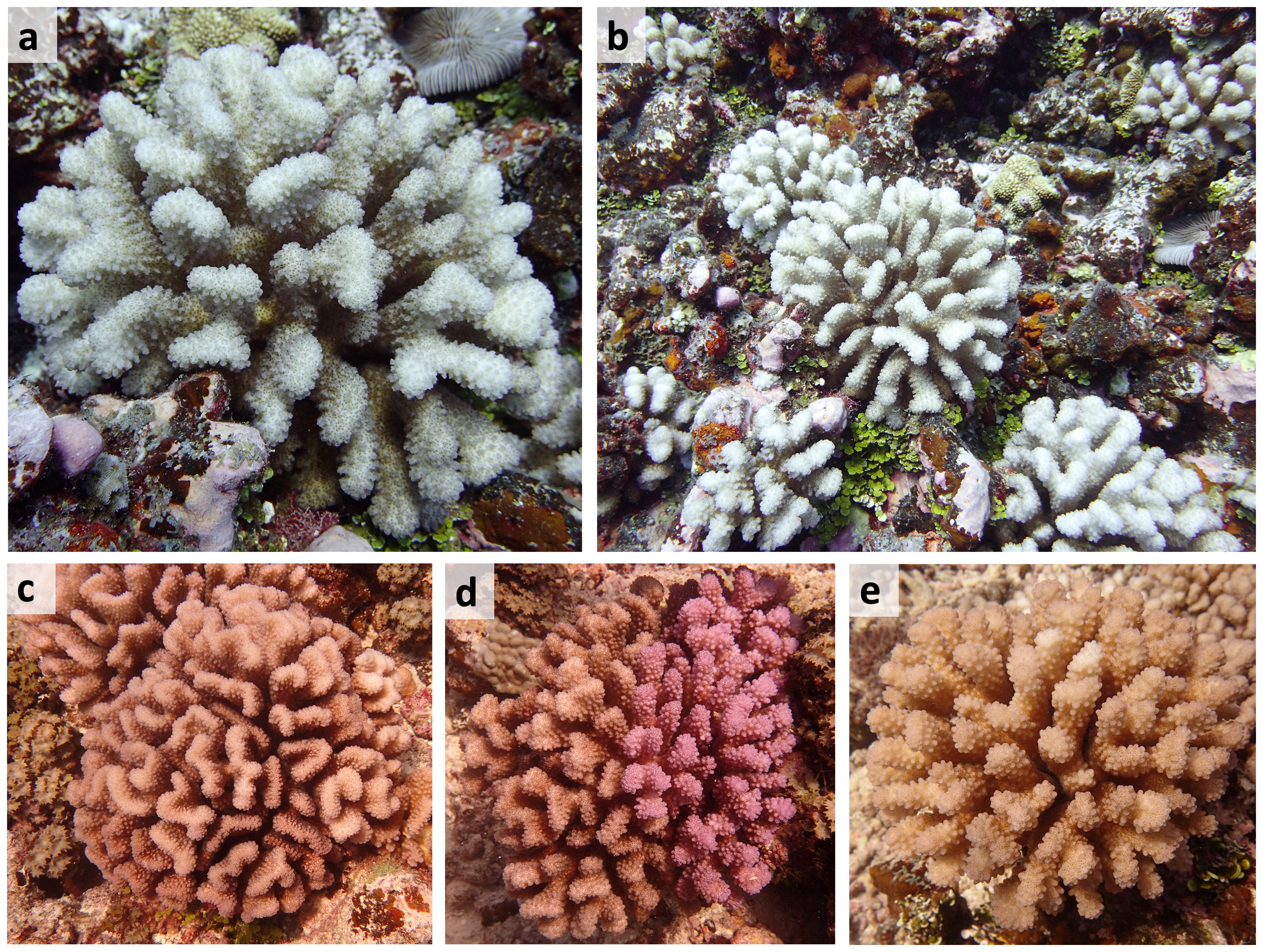
Remarks: Using the mtORF marker, Johnston et al. (2022 b) found that P. tuahiniensis sp. nov. is most abundant at depths around 10 m and greater on the fore reefs of Mo’orea, whereas co-occurring species have distinctly different relative abundance patterns across depth. Among these co-occurring species are P. meandrina Dana 1846 and P. verrucosa (Ellis and Solander 1786). Johnston et al. (2022 a) recognized P. verrucosa as a single lineage at Mo’orea (and includes mtORF haplotypes 3 a, 3 b, 3 e, 3 f, and 3 h; haplotype identification following Pinzón et al. (2013 )). Along with P. tuahiniensis sp. nov., these species are the most abundant species on the fore reefs of Mo’orea. The Great Barrier Reef is the type locality for P. verrucosa (Ellis and Solander 1786) and Schmidt-Roach et al. (2014) associated mtORF haplotypes 3 b, 3 d, 3 f, and 3 g to this species. Oury et al. (2023), however, resolved three different lineages associated with mtORF haplotype 3, with GSH 13 a containing haplotypes 3 c, 3 e, 3 g, 3 j, GSH 13 b containing haplotype 3 a, and GSH 13 c containing haplotypes 3 b, 3 d, 3 f, 3 h, 3 i. They conclude that GSH 13 a is restricted to the Red Sea, Arabian Gulf, and Western Indian Ocean (WIO) but that GSH 13 b and GSH 13 c are widespread based on the geographic distribution of the corresponding mtORF haplotypes reported in prior literature, despite in their study only sampling GSH 13 b from the WIO and GSH 13 c mostly from the Tropical South Pacific. While there may be some geographic segregation between mtORF 3 haplotypes found by Oury et al. (2023), the mtORF haplotypes recovered at Mo’orea were found to be a single genomic lineage (Johnston et al. 2022 a) and include those mtORF haplotypes used to identify P. verrucosa from its type locality, therefore we identify all mtORF 3 haplotypes at Mo’orea as P. verrucosa. Likewise, Oury et al. (2023) found two distinct lineages (GSH 9 a and GSH 9 b) associated with the mtORF haplotype 1 a + PocHistone lineage (genetic identification following Johnston et al. (2018 )) used to identify P. meandrina. GSH 9 a is found in both the Pacific and Indian Oceans, and encompasses the type locality, Hawai‘i, for P. meandrina Dana 1846. GSH 9 b is restricted to the Western Indian Ocean. We thus conclude that GSH 9 a, and what we call haplotype 1 a P. meandrina is P. meandrina Dana 1846, while GSH 9 b may be a regional endemic that needs further identification. The gross in situ colony appearance of P. tuahiniensis sp. nov. cannot easily be differentiated from that of P. meandrina or P. verrucosa at Mo’orea (Figure 2). The coralla of both P. tuahiniensis sp. nov. and P. meandrina are generally small, compact, and hemispherical, with branches that are flattened and meander towards the tips (Figure 1 – 3). Pocillopora grandis Dana 1846 also has branches that are flattened and meandering, but these branches can be paddle-like and are typically more robust than those of P. meandrina, P. tuahiniensis sp. nov., and P. verrucosa (Ellis and Solander 1786) (Figure 3 d). The branches of P. verrucosa typically do not meander and may be both flattened and cylindrical with swollen appearing branch tips (Figures 2 d, 3 b – 3 c). Both P. tuahiniensis sp. nov., P. meandrina, and P. grandis have neatly arranged verrucae that are equal in size (Figures 1 – 3), but the verrucae of P. tuahiniensis sp. nov. tend to have a more jagged, crown-like appearance (Figure 1 d – 1 e) in contrast to the rounded verrucae of P. meandrina, P. verrucosa, and P. grandis (Figure 3 b – f). The verrucae of P. verrucosa are verrucose and equally distributed, but in contrast to P. meandrina, P. grandis, and P. tuahiniensis sp. nov., they are irregular in size, shape, and height (Schmidt-Roach et al. 2014) (Figure 3 b – 3 c). The spinulae of P. tuahiniensis sp. nov. are much reduced, if present, and columellae are short and wide (Figures 1 e, 1 f, and 3 a). Columellae of P. meandrina are oval-convex to styloid and rarely obsolete (Schmidt-Roach et al. 2014). Pocillopora grandis can be differentiated from P. meandrina by its styliform columellae that may contain 1 – 3 stylae. The corallites of P. verrucosa are characterized as having many long, slender spinulae and absent to styloid columellae (Schmidt-Roach et al. 2014) (Figure 3 b). Mitochondrial and nuclear genomic data reveal that P. tuahiniensis sp. nov. is a unique species, sister to P. verrucosa, and in a clade different from that of P. meandrina (Johnston et al. 2022 a). By sequencing the mtORF region, P. tuahiniensis sp. nov. can be easily distinguished from other Pocillopora species. In French Polynesia, both P. tuahiniensis sp. nov. and P. verrucosa host the algal symbiont, Cladocopium pacificum Turnham, Sampayo, and LaJeunesse 2021, but P. tuahiniensis sp. nov. tends to host a population of C. pacificum that is genetically different from that hosted by P. verrucosa (Johnston et al. 2022 a).
Johnston, Erika C., Burgess, Scott C. (2023): Pocillopora tuahiniensis: a new species of scleractinian coral (Scleractinia Pocilloporidae) from French Polynesia. Zootaxa 5369 (1): 117-124, DOI: 10.11646/zootaxa.5369.1.5, URL: https://www.mapress.com/zt/article/download/zootaxa.5369.1.5/52231

Distribution: From genetic surveys of Pocillopora that have used the mtORF marker to date, P. tuahiniensis sp. nov. was initially thought to be endemic to French Polynesia (Edmunds et al. 2016; Forsman et al. 2013; Gélin et al. 2017; Johnston et al. 2018; Mayfield et al. 2015; Oury et al. 2020, 2021; De Palmas et al. 2018; Pinzón et al. 2013; Robitzch et al. 2015; Sawall et al. 2015; Schmidt-Roach et al. 2014). However, recent geographic sampling in the tropical South Pacific has recovered this species at Ducie Island and Rapa Nui using genomic data (Armstrong et al. 2023; Voolstra et al. 2023).
Johnston, Erika C., Burgess, Scott C. (2023): Pocillopora tuahiniensis: a new species of scleractinian coral (Scleractinia Pocilloporidae) from French Polynesia. Zootaxa 5369 (1): 117-124, DOI: 10.11646/zootaxa.5369.1.5, URL: https://www.mapress.com/zt/article/download/zootaxa.5369.1.5/52231
Etymology: The species name derives from the Tahitian word for sister, tuahine. Genomic data indicate that Pocillopora tuahiniensis sp. nov. is sister species to P. verrucosa (mtORF haplotypes 3 a, 3 b, 3 f, 3 h) in French Polynesia (Johnston et al. 2022 a). Haplotype identification following Pinzón et al. (2013). The species name attributed to mtORF haplotypes 3 b, 3 d, 3 f, 3 g on the Great Barrier Reef is P. verrucosa (Ellis and Solander 1786) (Schmidt-Roach et al. 2014); see comments in Remarks below. Because Pocillopora tuahiniensis sp. nov. had until recently only been found in French Polynesia, the etymology of its name, i. e., Tahitian, reflects this geographic location where it was first identified to be a unique species using genomics. Taxonomic history and previous records: Pocillopora solida Quelch 1886, P. setchelli Hoffmeister 1925, and P. squarrosa Dana 1846 have been described from French Polynesia. Pocillopora setchelli was considered a junior synonym of P. damicornis (Linnaeus, 1758) by Veron and Pichon (1976) but Hoeksema and Cairns (2023) currently consider it to be a synonym of P. brevicornis Lamarck 1816. Pocillopora solida and P. squarrosa are considered taxa inquirendum (Hoeksema & Cairns 2023). The holotype of P. solida is deposited in the National History Museum in London, England (BMNH 1886.12.9.22). The specimen is 14 cm in height and 12 cm in width and is neither compact nor spherical. The holotype of P. solida is described as a large specimen, distinct from all other known forms, which grew horizontal having branches that are elongated and much divided with verrucae that are very unequal, irregularly placed, rarely crowded, and generally separated by spaces more than their own diameter (Quelch 1886). Unlike P. tuahiniensis sp. nov., the verrucae of P. solida become obsolete towards the center of the colony (Figure 3 a). In contrast, the corallum of P. tuahiniensis sp. nov. colonies are round and compact with branches that are evenly spaced, and verrucae that are equal in size, regularly spaced, and continue along branches towards the center of the colony (Figures 1 and 2). The holotype of P. squarrosa is deposited in the Smithsonian Museum in Washington, D. C., USA (USNM 443). The corallum is described as rudely hemispherical with branches that are closely crowded, stout, nearly straight, unequally compressed, and uneven, with rounded summits (Dana 1846). Unlike P. tuahiniensis sp. nov., the USNM 443 specimen clearly presents styloid columellae within its corallites, similar to that observed in P. grandis Dana, 1846. The first documentation of P. tuahiniensis sp. nov. in the literature identified it using genetics from a morphologically undescribed sample. Forsman et al. (2013) first identified P. tuahiniensis sp. nov. as haplotype 10, a novel genetic lineage from Mo’orea using PCR amplification of the mtORF marker (Flot & Tillier 2007). mtORF haplotype 10 has also been identified as Primary Species Hypothesis (PSH) 14 by Gélin et al. (2017) using both the mtORF marker and 13 microsatellites. mtORF haplotype 10 was identified as the P. verrucosa morphotype in that study. Johnston et al. (2022 a) first identified mtORF haplotype 10 as a unique lineage of Pocillopora at Mo’orea using genomic and algal symbiont data. More recently, both Oury et al. (2023) and Voolstra et al. (2023) have recovered mtORF haplotype 10 as a distinct lineage from a greater geographic sampling effort using independent nuclear genomic approaches, identifying haplotype 10 as GSH 14 and SVD 5, respectively. Until recently, genetic sampling had only recovered P. tuahiniensis sp. nov. from French Polynesia (Edmunds et al. 2016; Forsman et al. 2013; Gélin et al. 2017; Johnston et al. 2018; Mayfield et al. 2015; Oury et al. 2020, 2021; De Palmas et al. 2018; Pinzón et al. 2013; Robitzch et al. 2015; Sawall et al. 2015; Schmidt-Roach et al. 2014). Within French Polynesia, P. tuahiniensis sp. nov. had been sampled from Nororotu, Maiao, Tetiaroa, and Mo’orea (Edmunds et al. 2016; Gélin et al. 2017; Mayfield et al. 2015). However, greater geographic sampling in the tropical south Pacific has recently identified this species at Ducie Island and Rapa Nui as well (Armstrong et al. 2023; Voolstra et al. 2023).
Johnston, Erika C., Burgess, Scott C. (2023): Pocillopora tuahiniensis: a new species of scleractinian coral (Scleractinia Pocilloporidae) from French Polynesia. Zootaxa 5369 (1): 117-124, DOI: 10.11646/zootaxa.5369.1.5, URL: https://www.mapress.com/zt/article/download/zootaxa.5369.1.5/52231
Holotype: The holotype (USNM-SI 1522390) was collected from Mo’orea, French Polynesia (17.517 S 149.762 W) at 20 m on December 20, 2021, by S. C. Burgess. The genetic identity of the holotype was confirmed using the mitochondrial open reading frame marker (mtORF; accession number OP 418359) (Flot & Tillier 2007) as mtORF haplotype 10 (Forsman et al. 2013). This mitochondrial marker as a species identifier of P. tuahiniensis sp. nov has been supported by multiple independent genomic studies (Johnston et al. 2022 a; Oury et al. 2023; Voolstra et al. 2023). Preserved DNA of the holotype is stored at the Smithsonian Institution and Florida State University. Skeletal characteristics of the holotype: The corallum measures 19 cm in length, 16 cm in width, and 15 cm in height (Figures 1 a, 2 a). The corallum is hemispherical and the branches are fairly evenly spaced, separated by approximately 1 – 2 cm. Branches are straight and robust, and most branches ramify. Verrucae are evenly distributed and are equal in size and shape, approximately 1 mm. Verrucae are not verrucose at their tips, but rather are jagged and crown shaped (Figures 1 b, 1 c). The inner corallite diameter ranges between 0.54 – 0.65 mm (Figures 1 d – 1 f). Within the corallite, short, wide columellae are present, and septa, if present, are weakly developed and form 1 – 3 hexamerally arranged rows (Figures 1 e, 1 f). Short spinulae are evenly distributed across the coenosteum (Figures 1 d – 1 f). Color and pigmentation of live colony: Colonies may be brown, pink, or pale yellow, and like many Pocillopora species, have pigment concentrated in the oral opening of the polyps, forming a dark ring. The holotype was pale yellow (Figure 2 a, b). Habitat and biology: On the fore reefs of Mo’orea, P. tuahiniensis sp. nov. is very abundant ≥ 10 m and is the most common Pocillopora species at these depths. It can also be found at a much lower abundance at 5 and 10 m on the fore reef (Johnston et al. 2022 b) as well as in the back reef lagoon. Reproduction has not been observed in P. tuahiniensis sp. nov but reproduction is hypothesized to occur via broadcast spawning based on the broadcast spawning observed in sister lineages, P. cf. verrucosa in the Red Sea (Bouwmeester et al. 2011, 2021), and P. meandrina Dana 1846 and P. grandis Dana 1846 on the Great Barrier Reef (Schmidt-Roach et al. 2012).
Johnston, Erika C., Burgess, Scott C. (2023): Pocillopora tuahiniensis: a new species of scleractinian coral (Scleractinia Pocilloporidae) from French Polynesia. Zootaxa 5369 (1): 117-124, DOI: 10.11646/zootaxa.5369.1.5, URL: https://www.mapress.com/zt/article/download/zootaxa.5369.1.5/52231

Export occurrence data

Darwin Core Archive (ZIP)

CLASSIFICATION

Taxonomic Classification Tree

MULTIMEDIA

Media Files(3)

FIGURE 1. Photographs and SEM of the P. tuahiniensis holotype USNM-SI 1522390 showing a) a side view of holotype, b) spacing and shape of verrucae, c) close up of verrucae, d) verrucae and corallites, and e) and f) close ups of corallites showing the wide, flattened columellae.

Imageimage/png© Johnston, Erika C.;Burgess, Scott C.Johnston, Erika C.;Burgess, Scott C.

FIGURE 2. In situ appearance of Pocillopora species photographed at Mo’orea, French Polynesia. a) Close up of P. tuahiniensis holotype USNM-SI 1522390 at 20 m depth; b) surroundings of holotype, with holotype USNM-SI 1522390 in the center; c) P. tuahiniensis sp. nov. at 10 m depth; d) P. tuahiniensis sp. nov., left, and P. verrucosa, right, at 10 m depth; e) P. meandrina at 10 m depth.All colonies were identified using the mtORF and PocHistone markers following the protocol described in Johnston et al. (2018). The identity of colonies in c, d, and e are included in the datasets of (Burgess et al. 2021; Johnston et al. 2022a).

Imageimage/png© Johnston, Erika C.;Burgess, Scott C.Johnston, Erika C.;Burgess, Scott C.

FIGURE 3. Types of Pocillopora species closely related to P. tuahiniensis sp. nov. for morphological comparison. a) Holotype of P. solida Quelch 1886 (BMNH1886.12.9.22) collected from Tahiti, French Polynesia. This taxon is considered inquirendum. Images captured by The Trustees of the Natural History Museum, London. b) Colony photograph and corallite SEM of P. verrucosa (Ellis and Solander 1786) neotype (MTQG65923) collected from Lizard Island Lagoon, Australia. c) Pocillopora danae Verrill 1864 holotype (USNM696) collected from Fiji. Pocillopora danae is considered a junior subjective synonym of P. verrucosa. d) Pocillopora grandis Dana 1846 syntype (USNM700) collected from Fiji. e) Pocillopora meandrina Dana 1846 syntype (YPMIZ001970.CN) collected from Hawai‘i. f) Pocillopora nobilis Verrill 1864 syntype (USNM658) collected from Hawai‘i. Pocillopora nobilis is considered a junior subjective synonym of P. meandrina.

Imageimage/png© Johnston, Erika C.;Burgess, Scott C.Johnston, Erika C.;Burgess, Scott C.

IMAGES

Gallery(3)

See Gallery

Occurrences with images

Source Information

Pocillopora tuahiniensis: a new species of scleractinian coral (Scleractinia Pocilloporidae) from French Polynesia

checklist

This dataset contains the digitized treatments in Plazi based on the original journal article Johnston, Erika C., Burgess, Scott C. (2023): Pocillopora tuahiniensis: a new species of scleractinian coral (Scleractinia Pocilloporidae) from French Polynesia. Zootaxa 5369 (1): 117-124, DOI: 10.11646/zootaxa.5369.1.5, URL: https://www.mapress.com/zt/article/download/zootaxa.5369.1.5/52231

Abstract

Pocillopora tuahiniensis sp. nov. is described based on mitochondrial and nuclear genomic data, algal symbiont genetic data, geographic isolation, and its distribution pattern within reefs that is distinct from other sympatric Pocillopora species (Johnston et al. 2022a, b). Mitochondrial and nuclear genomic data reveal that P. tuahiniensis sp. nov. is a unique species, sister to P. verrucosa, and in a clade different from that of P. meandrina (Johnston et al. 2022a). However, the gross in situ colony appearance of P. tuahiniensis sp. nov. cannot easily be differentiated from that of P. verrucosa or P. meandrina at Mo’orea. By sequencing the mtORF region, P. tuahiniensis sp. nov. can be easily distinguished from other Pocillopora species. Pocillopora tuahiniensis sp. nov. has so far been sampled in French Polynesia, Ducie Island, and Rapa Nui (Armstrong et al. 2023; Edmunds et al. 2016; Forsman et al. 2013; Gélin et al. 2017; Mayfield et al. 2015; Oury et al. 2021; Voolstra et al. 2023). On the fore reefs of Mo’orea, P. tuahiniensis sp. nov. is very abundant ≥ 10 m and is one of the most common Pocillopora species at these depths (Johnston et al. 2022b). It can also be found at a much lower abundance at shallow depths on the fore reef and back reef lagoon. The holotype is deposited at the Smithsonian Institution as USNM-SI 1522390 and the mtORF Genbank accession number is OP418359.

Johnston E C, Burgess S C, plazi (2023). Pocillopora tuahiniensis: a new species of scleractinian coral (Scleractinia Pocilloporidae) from French Polynesia. Plazi.org taxonomic treatments database. Checklist dataset https://doi.org/10.15468/n85sy5 accessed via GBIF.org on 2026-06-16.

CC0Published 11/8/2023View dataset
GBIF Usage Key
217757374
Dataset Key
04386fe9-fba5-460a-9925-aa99aa9fbffe
Origin
source
Taxon ID
8F1587B5DC20B8390DEDFE84FB6EFCFD.taxon
Last Crawled
6/9/2026
Last Interpreted
6/9/2026