
AnimaliaNot EvaluatedacceptedspeciesAccepted
Phyzelaphryne nimio

Phyzelaphryne nimio

Simoes, 2018

GBIF:221744890

0year

ABOUT

Descriptions(1)

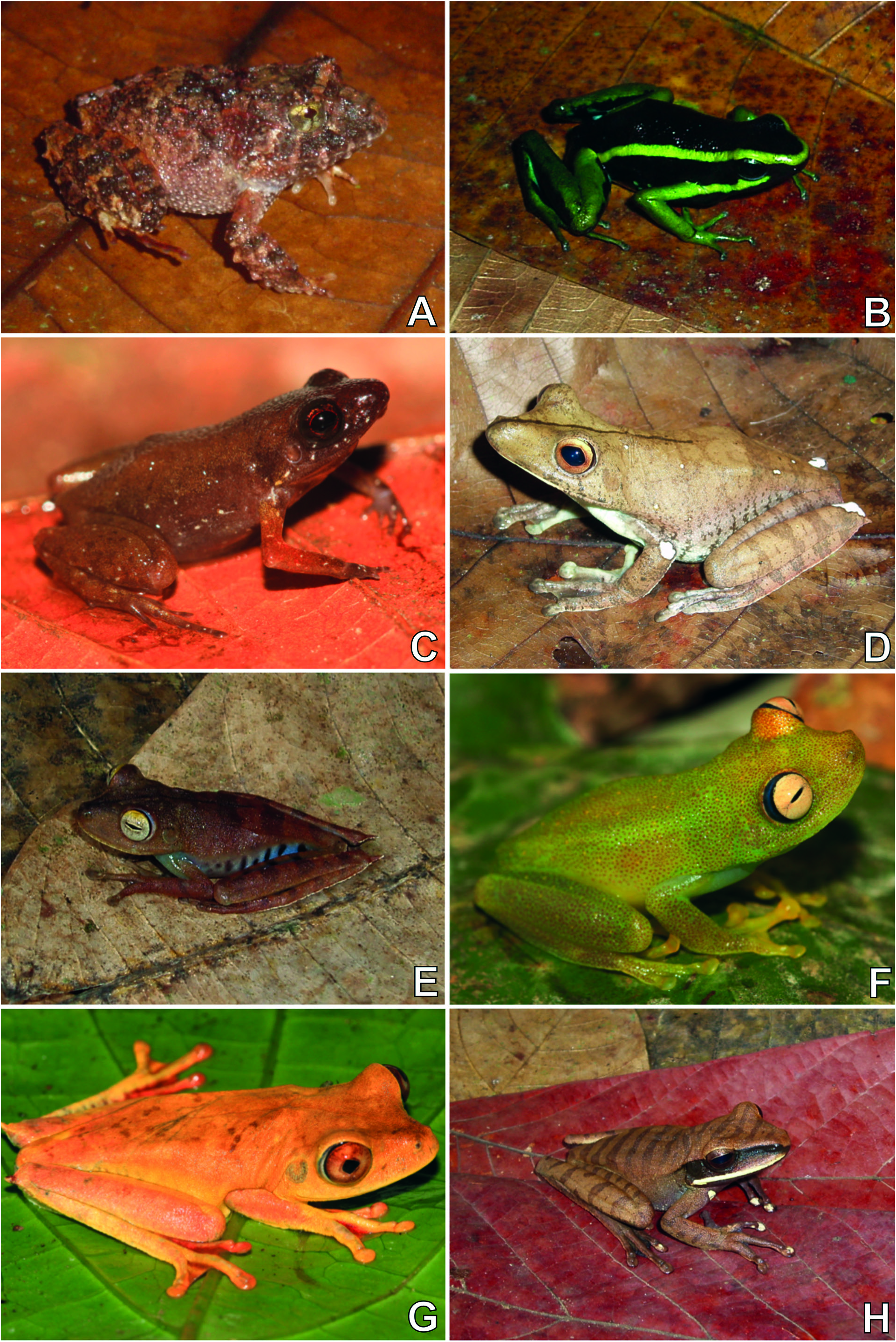
(Fig. 5 C) Several populations of small eleutherodactylids in lowland Amazonia are historically attributed to a single taxon of the genus Phyzelaphryne Heyer, 1997 (Phyzelaphryne miriamae Heyer, 1977). Recently, the real diversity within the widespread P. miriamae has been clarified, indicating that at least two molecularly divergent lineages representing candidate new species were masqueraded under this name (Simões et al., 2018). Considering this taxonomic history, we initially thought that specimens from the RBJ could be conspecific with the " candidate new species 1 ″ sensu Simões et al. (2018), which occur at the middle Juruá River basin, or representatives of a never sampled new species. Surprisingly, our molecular and morphological evidence supports the identity of this population as conspecific with the recently described P. nimio, known only from the Japurá River basin (Simões et al., 2018). This record represents a southeast extension of ca. 280 km for the distributional range of P. nimio, as well as the first evidence of its occurrence at the southern bank of the Amazon River.
Moraes, Leandro João Carneiro de Lima, Rainha, Raíssa do Nascimento, Werneck, Fernanda de Pinho, Oliveira, Alan Filipe de Souza, Gascon, Claude, Carvalho, Vinícius Tadeu de (2022): Amphibians and reptiles from a protected area in western Brazilian Amazonia (Reserva Extrativista do Baixo Juruá). Papéis Avulsos de Zoologia 62: 1-34, DOI: 10.11606/1807-0205/2022.62.054, URL: http://dx.doi.org/10.11606/1807-0205/2022.62.054

Export occurrence data

Darwin Core Archive (ZIP)

CLASSIFICATION

Taxonomic Classification Tree

MULTIMEDIA

Media Files(1)

Figure 5. Amphibians recorded at the Reserva Extrativista do Baixo Juruá. (A) Strabomantis sulcatus; (B) Ameerega trivittata; (C) Phyzelaphryne nimio; (D) Boana boans; (E) Boanacalcarata; (F) Boana cinerascens; (G) Boanageographica; (H) Boana lanciformis.Photographs byVTC (A,B,D,E,H) and LJCLM (C,F,G).

Imageimage/png© Moraes, Leandro João Carneiro de Lima;Rainha, Raíssa do Nascimento;Werneck, Fernanda de Pinho;Oliveira, Alan Filipe de Souza;Gascon, Claude;Carvalho, Vinícius Tadeu deMoraes, Leandro João Carneiro de Lima;Rainha, Raíssa do Nascimento;Werneck, Fernanda de Pinho;Oliveira, Alan Filipe de Souza;Gascon, Claude;Carvalho, Vinícius Tadeu de

IMAGES

Gallery(1)

See Gallery

Occurrences with images

Source Information

Amphibians and reptiles from a protected area in western Brazilian Amazonia (Reserva Extrativista do Baixo Juruá)

checklist

This dataset contains the digitized treatments in Plazi based on the original journal article Moraes, Leandro João Carneiro de Lima, Rainha, Raíssa do Nascimento, Werneck, Fernanda de Pinho, Oliveira, Alan Filipe de Souza, Gascon, Claude, Carvalho, Vinícius Tadeu de (2022): Amphibians and reptiles from a protected area in western Brazilian Amazonia (Reserva Extrativista do Baixo Juruá). Papéis Avulsos de Zoologia 62: 1-34, DOI: 10.11606/1807-0205/2022.62.054, URL: http://dx.doi.org/10.11606/1807-0205/2022.62.054

Abstract. Sampling gaps across the logistically challenging and extremely biodiverse Amazonia largely hamper our understanding of broad-scale amphibian and reptile diversity patterns in this ecosystem.The Juruá River basin,a southwestern tributary of the Amazon River, is one of these undersampled areas, with only punctual information documented for these vertebrates that are spatially or temporally biased.This is especially the case for the lower-middle courses of the Juruá River, which also has comparatively less protected areas than its upper course. In order to fill some biodiversity knowledge gaps associated with amphibians and reptiles in this river basin, we combined results of our field expeditions carried out in 1992, 2005-2007, and 2018 to the Reserva Extrativista (Extractive Reserve) do Baixo Juruá, a Brazilian protected area in the right bank of the lower Juruá River. Amphibians and reptiles were sampled using four complementary methods: active surveys, pitfall traps,funnel traps, and trammel nets.We identified species or updated their taxonomic status with a reanalysis of the external morphology of the preserved material in the light of novel taxonomic literature (more than 1,500 specimens) and employment of DNA barcoding analyses for some newly collected specimens with contentious taxonomic status.Our combined sampling evidenced 149 species of amphibians and reptiles occurring in this protected area (72 amphibians, 68 squamates, six chelonians, and three crocodilians). Recorded species highlight the value of the lower Juruá River region as harboring quite diverse assemblages for these vertebrates,with species typical of the western and southwestern Amazonia sub-regions. Remarkable species records are presented, as well as accounts on species with lower taxonomic resolution. Furthermore, we discuss the biogeographic affinities of recorded assemblages based on the species geographic range and preferred habitats, and the value of this protected area to preserve the regional biological diversity.

Moraes L J C D L, Rainha R D N, Werneck F D P, Oliveira A F D S, Gascon C, Carvalho V T D, felipe (2022). Amphibians and reptiles from a protected area in western Brazilian Amazonia (Reserva Extrativista do Baixo Juruá). Plazi.org taxonomic treatments database. Checklist dataset https://doi.org/10.15468/uhpmtw accessed via GBIF.org on 2026-06-15.

CC0Published 10/4/2022View dataset
GBIF Usage Key
221744890
Dataset Key
06b62079-71ca-496c-b1fe-c26963a71765
Origin
source
Backbone Key
10248134
Taxon ID
03AF65788F428C37172EF924FB3DFDD9.taxon
Last Crawled
6/9/2026
Last Interpreted
6/9/2026