
AnimaliaNot EvaluatedacceptedspeciesAccepted
Palaeotreta shannanensis

Palaeotreta shannanensis

Zhang, Holmer, Chen & Brock, 2020

GBIF:225017208

0year

ABOUT

Descriptions(4)

(Figs 2 – 7; Table 1) Derivation of name. After the occurrence in Shannan, southern Shaanxi Province.
Zhang, Zhiliang, Holmer, Lars E., Chen, Feiyang, Brock, Glenn A. (2020): Ontogeny and evolutionary significance of a new acrotretide brachiopod genus from Cambrian Series 2 of South China. Journal of Systematic Palaeontology 18 (19): 1569-1588, DOI: 10.1080/14772019.2020.1794991, URL: http://dx.doi.org/10.1080/14772019.2020.1794991
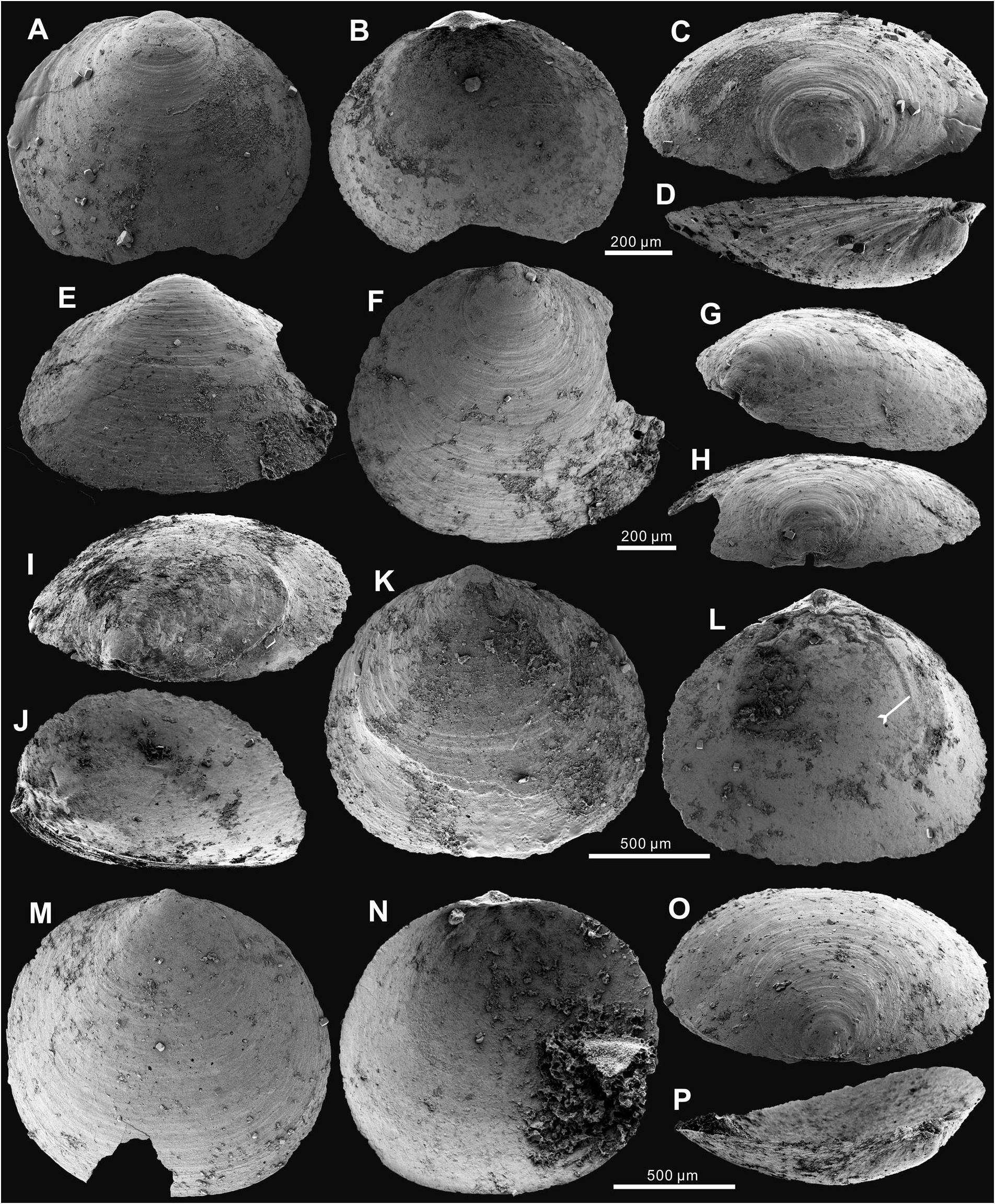
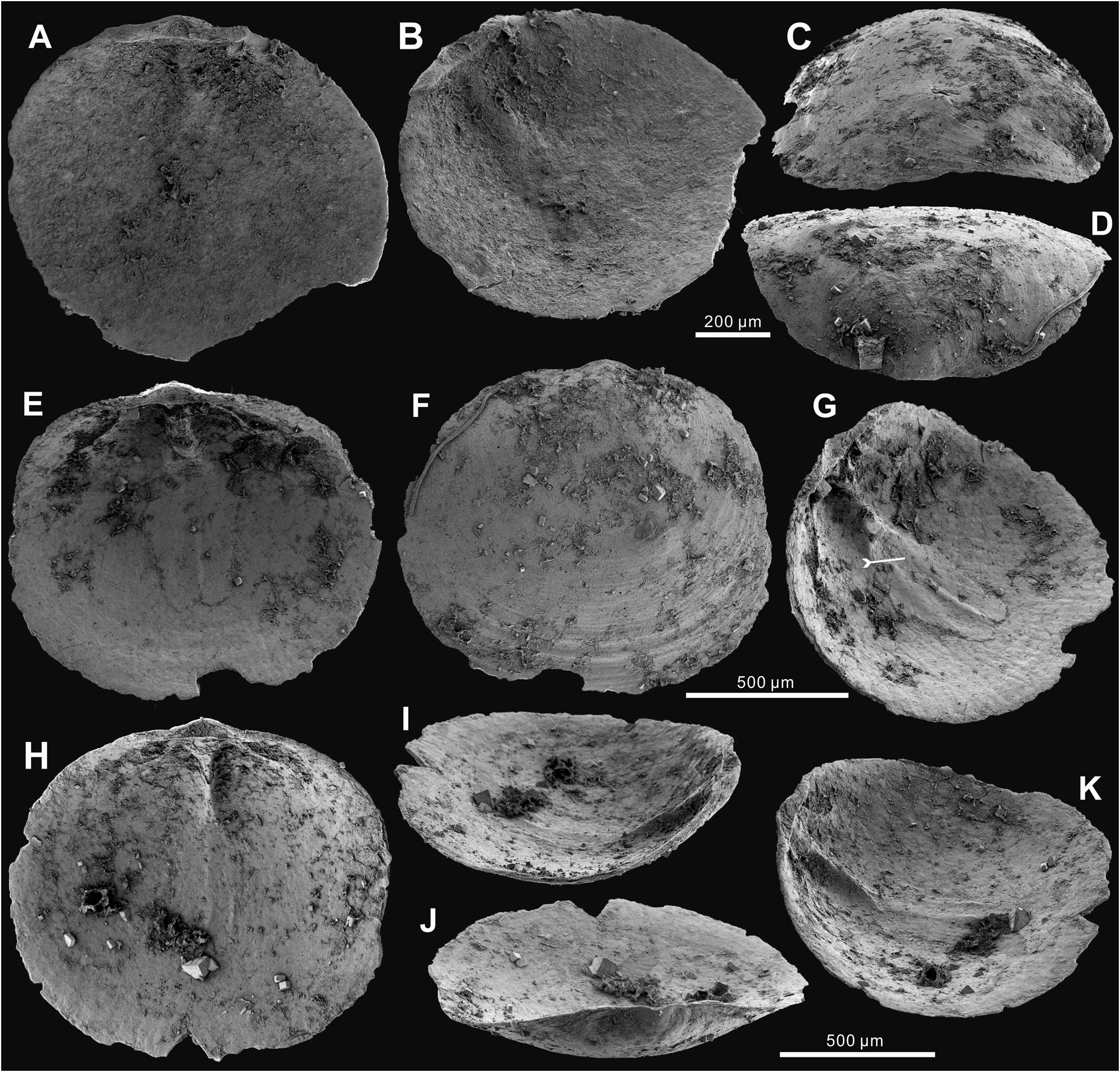
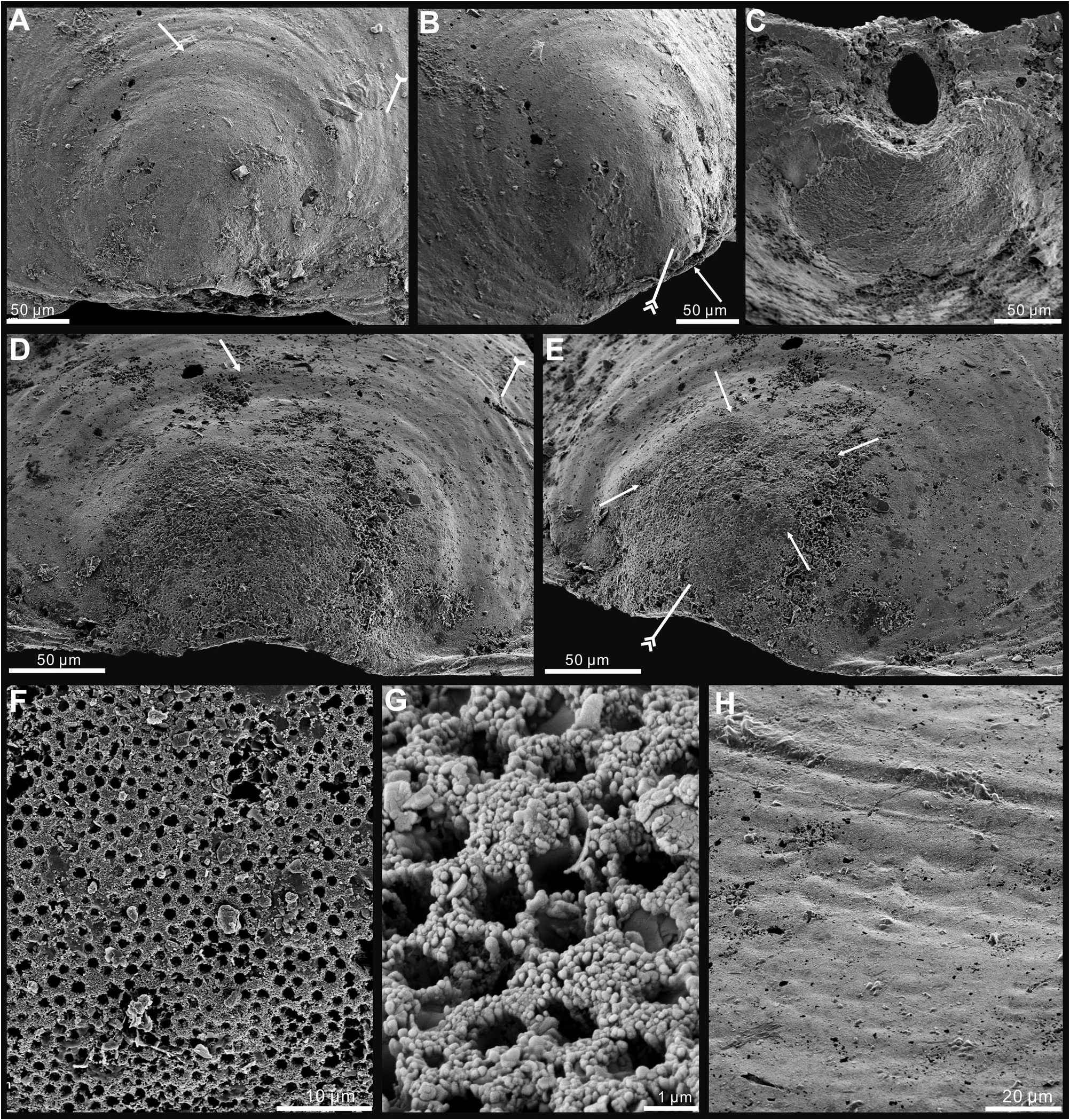
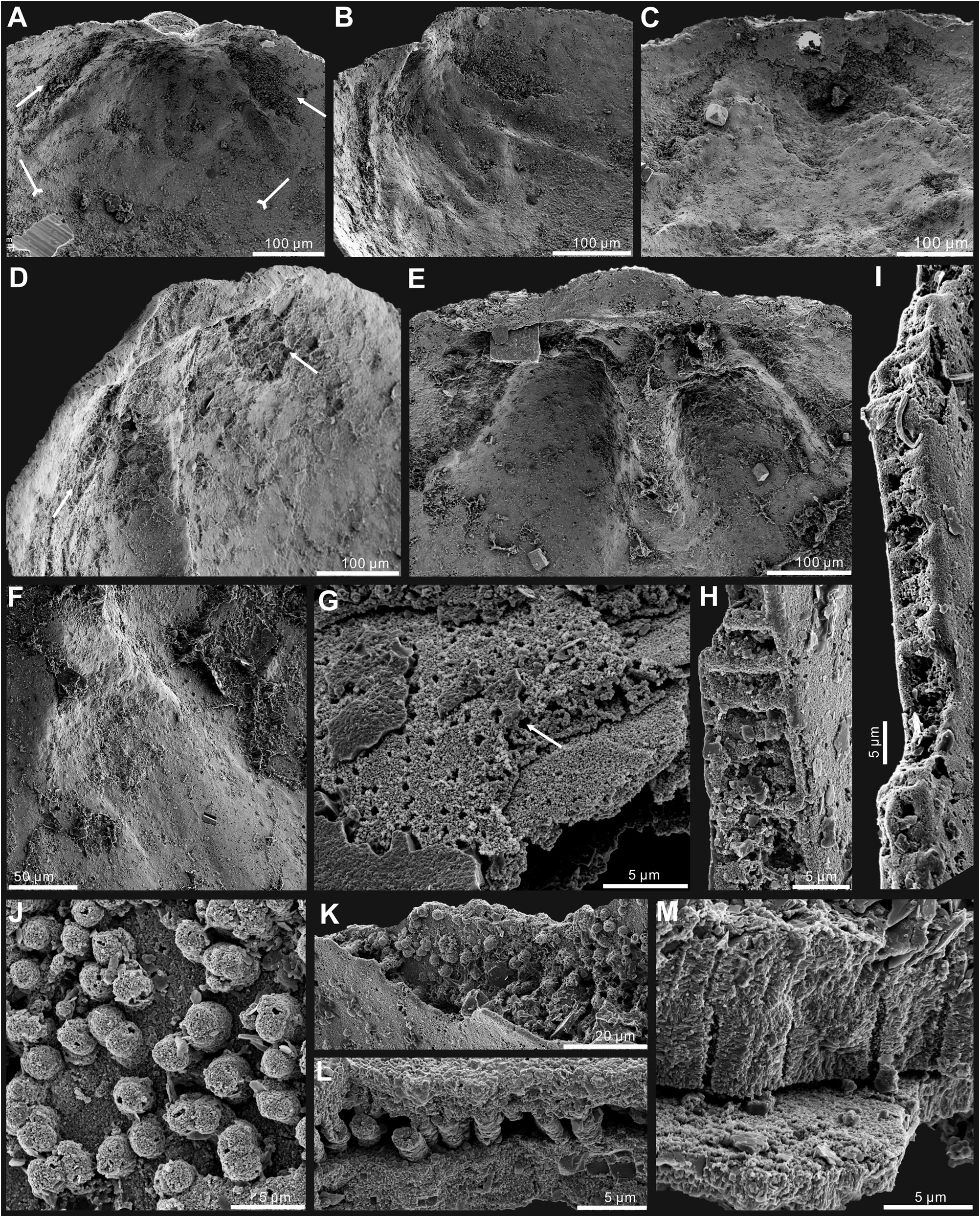
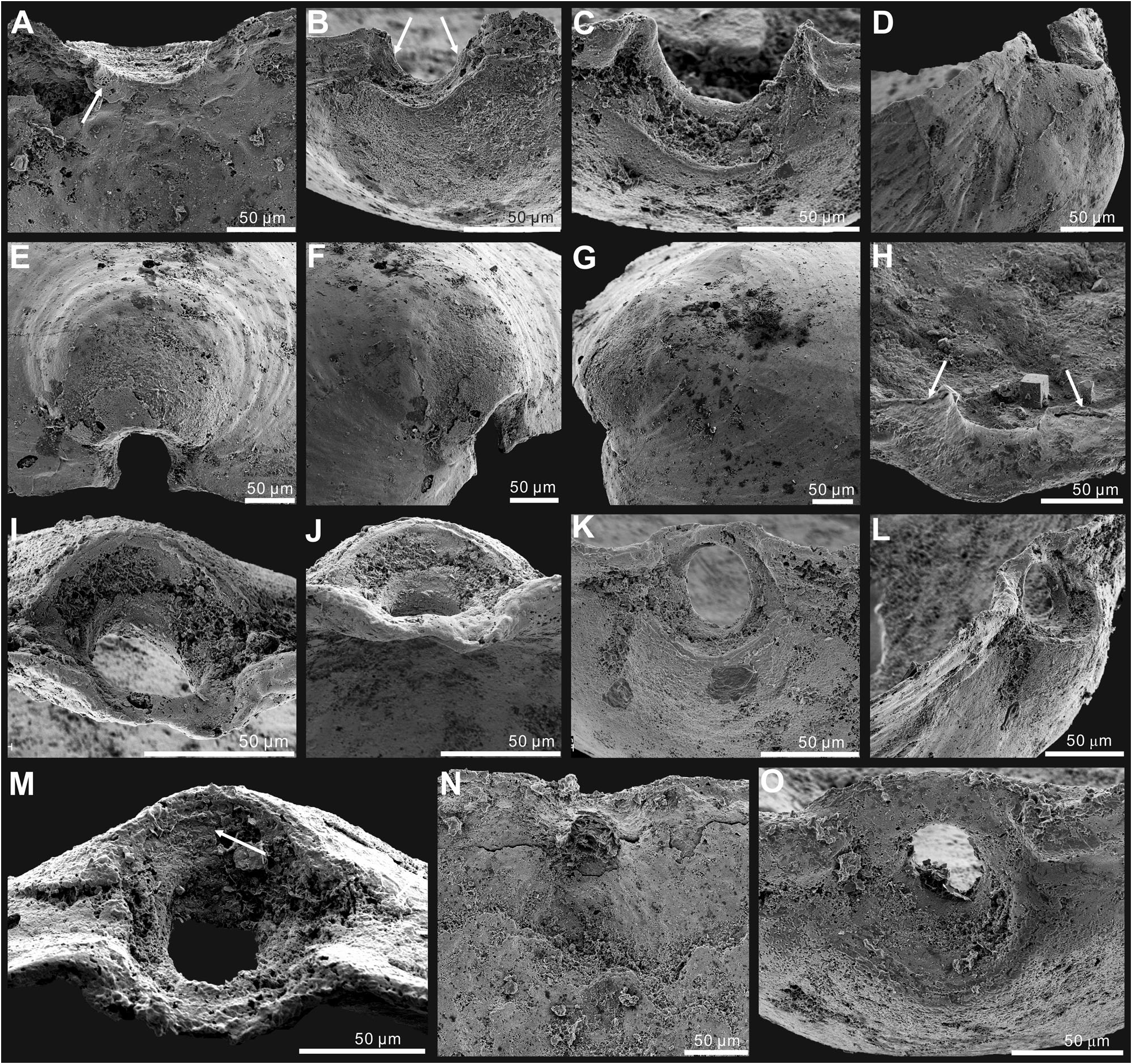
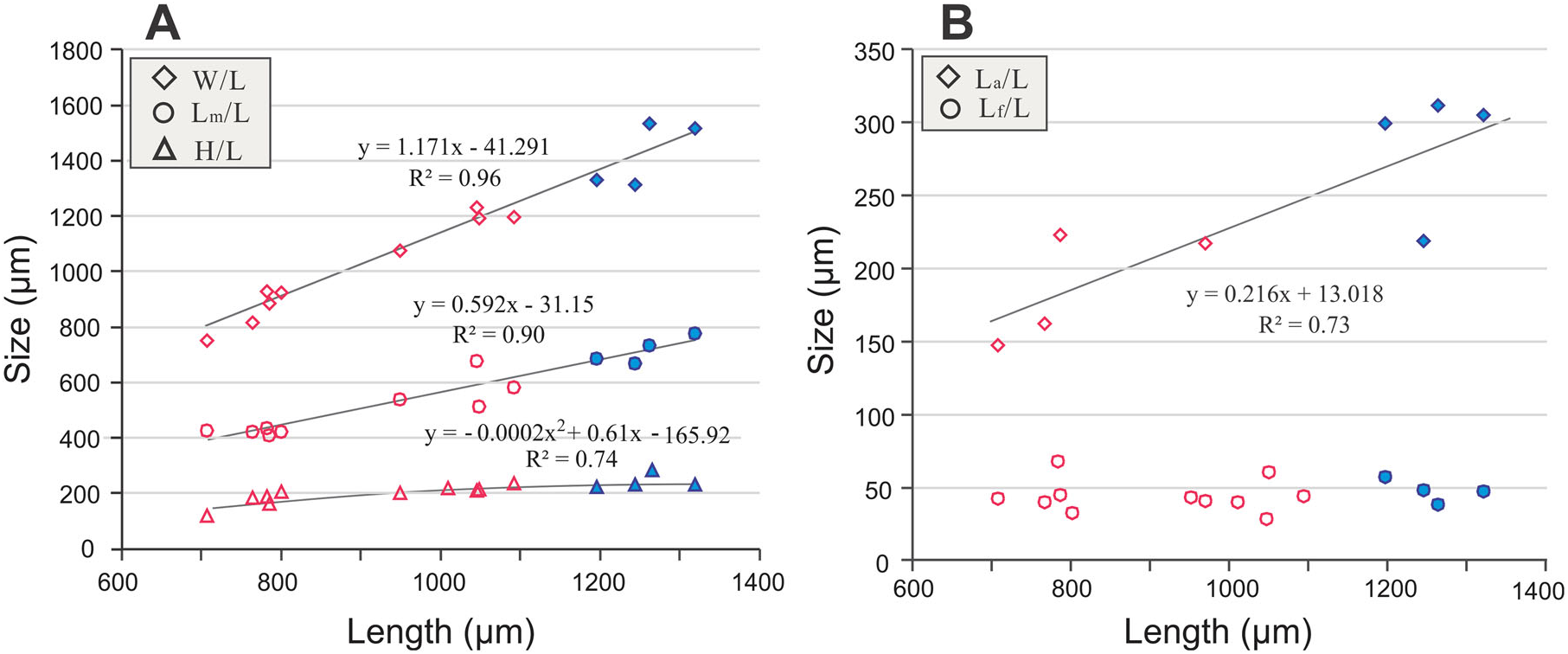
Description. Shell ventribiconvex, sub-circular in outline with round posterior margin (Figs 2, 3). 1.1 M m hemispherical pits evenly distributed on the whole metamorphic shell surface without overlapping (Fig. 4 F, G), while the post-metamorphic shell is covered by finely circular growth lines and drape structures (Fig. 4 H). Shell structure consists of thin-lamella (2 M m) primary layer and thin-lamina (5 M m) secondary columnar layers (Fig. 5 H – M). Ventral valve sub-circular, on average 89 % as long as wide with maximum width at mid-length (Table 1). The valve is convex, with a cap-like shape (Fig. 2), on average 21 % as deep as long, with maximum height almost at mid-valve. Metamorphic shell pronounced at the apex (Fig. 2 C, N), occupying 13 % of valve length. Pseudointerarea weakly developed, catacline to apsacline. Intertrough poorly defined, very short, occupying on average about 2 % of the length and 6 % of the width of the valve (Fig. 2 I – P). Apical process vestigial, only observed in adult specimens, close to pedicle foramen, occupying 20 % of valve length (Fig. 4 B, C). Enclosed pedicle foramen almost circular, about 50 M m in diameter, located mostly directly outside of the metamorphic shell, until valve reaches about 1100 M m in length. Growth lines developed at the posterior margin of the metamorphic shell and the lateral side of the pedicle foramen (Fig. 4 C). Cardinal muscle scars and vascula lateralia weakly impressed. Dorsal valve sub-circular, on average 87 % as long as wide, with maximum width almost at mid-valve (Table 1). It is slightly convex (Fig. 5), on average about 19 % as deep as long. Pseudointerarea small, orthocline, occupying 6 % of the valve length and 36 % of valve width (Fig. 5 E, H). Median groove sub-triangular, short, about 31 % of the pseudointerarea width (Fig. 4 E). Median buttress generally developed, fading anteriorly (Fig. 4 E, F). Median septum vestigial, only developed in adult valve, extending anteriorly for 59 % of valve length (Fig. 5 H – K). Cardinal muscle scars weakly impressed, occupying 17 % of the length and 45 % of the width of the valve (Fig. 5 D).
Zhang, Zhiliang, Holmer, Lars E., Chen, Feiyang, Brock, Glenn A. (2020): Ontogeny and evolutionary significance of a new acrotretide brachiopod genus from Cambrian Series 2 of South China. Journal of Systematic Palaeontology 18 (19): 1569-1588, DOI: 10.1080/14772019.2020.1794991, URL: http://dx.doi.org/10.1080/14772019.2020.1794991
Remarks. Palaeotreta shannanensis gen. et sp. nov. shares a similar morphology in outline with Eohadrotreta zhenbaensis (from the same locality). However, the new species has a low cap-like shape, small pseudointerarea with very short intertrough, apsacline pseudointerarea in the adult valve, prolonged pedicle foramen-forming stage and a pedicle foramen that is located outside of the metamorphic shell (Figs 6, 7). Furthermore, the new species has a less developed intertrough as compared with E. zhenbaensis (Z. - L. Zhang et al. 2018 a); in the latter species the intertrough is becoming remarkably prominent in stage T 3, which does not happen in the new species. The shell structure of P. shannanensis is similar to that of E. zhenbaensis. However, the former species has a very thin primary layer about 2 M m thick, and very thin secondary columnar layers. The thickness of columns in P. shannanensis is variable in different parts of the shell, ranging from 4 M m to 8 M m, and are quite short compared to the columns of E. zhenbaensis. The secondary layer insignificantly increases the overall thickness of the ventral valve (Z. - L. Zhang et al. 2016), being composed of one to two columnar laminae, resulting in a low cap-like shape in P. shannanensis. Palaeotreta shannanensis differs from Vandalotreta djagoran (Kruse, 1990) and Linnarssonia rowelli (Pelman, 1973) in having a lower ventral valve, weakly developed apical process and median septum, apsacline ventral pseudointerarea, as well as a pedicle foramen that is mostly located outside the metamorphic shell (Holmer et al. 1996, pl. 13; Ushatinskaya & Korovnikov 2019, pl. 4). P. shannanensis has a similar inclination of the ventral pseudointerarea as Aphelotreta khemangarensis (Popov et al. 2015), while the ornamentation of the metamorphic shell, pedicle foramen size and the median groove allow the distinction of the two species (Popov et al. 2015, fig. 21). At the Xiaoyangba section, P. shannanensis occurs at the base of the Shuijingtuo Formation, while E. zhenbaensis first occurs 60 cm higher. Therefore, P. shannanensis represents the oldest known acrotretide brachiopod in southern Shaanxi. The diachronous nature of the stratigraphic hiatus at the base of Cambrian Series 2 across southern Shaanxi and western Hubei makes the biostratigraphic correlation between these regions imprecise, and more index fossils from new sections are required to better constrain the time gap and better resolve correlation.
Zhang, Zhiliang, Holmer, Lars E., Chen, Feiyang, Brock, Glenn A. (2020): Ontogeny and evolutionary significance of a new acrotretide brachiopod genus from Cambrian Series 2 of South China. Journal of Systematic Palaeontology 18 (19): 1569-1588, DOI: 10.1080/14772019.2020.1794991, URL: http://dx.doi.org/10.1080/14772019.2020.1794991
Holotype. ELI-XYB S 4 - 3 AU- 01, ventral valve (Fig. 2 I – L, length [L] = 1196 M m, width [W] = 1331 M m). Paratype. ELI-XYB S 4 - 3 AV- 18, dorsal valve (Fig. 3 H – K, L = 1008 M m, W = 1226 M m). Type locality. Shuijingtuo Formation (layer S 4 - 3, 0.7 m above the base) at Xiaoyangba section (32 Ǫ 29, 29 ,, N, 107 Ǫ 57, 2 ,, E), Zhenba County, south-eastern Shaanxi, South China. Cambrian Series 2. Other material. A total of 21 ventral valves and nine dorsal valves were recovered from the same layer (S 4 - 3) in the Shuijingtuo Formation.
Zhang, Zhiliang, Holmer, Lars E., Chen, Feiyang, Brock, Glenn A. (2020): Ontogeny and evolutionary significance of a new acrotretide brachiopod genus from Cambrian Series 2 of South China. Journal of Systematic Palaeontology 18 (19): 1569-1588, DOI: 10.1080/14772019.2020.1794991, URL: http://dx.doi.org/10.1080/14772019.2020.1794991

Export occurrence data

Darwin Core Archive (ZIP)

CLASSIFICATION

Taxonomic Classification Tree

MULTIMEDIA

Media Files(6)

Figure 2. Ontogenetic development of ventral valve of Palaeotreta shannanensis gen. et sp. nov. from the Shuijingtuo Formation of southern Shaanxi. A–H, ventral valves demonstrating pedicle foramen forming stage (T1); A–D, juvenile with unrestricted pedicle notch, ELI-XYB S4-3 AU-06; E–H, small valve with pedicle opening, ELI-XYB S4s-3 AV-04; I–P, ventral valves demonstrating pedicle foramen-enclosing stage (T2); I–L, adult with enclosed pedicle foramen, ELI-XYB S4-3 AU-01; L, interior view, noting vascula lateralia (tailed arrow); M–P, larger valve with very short intertrough, ELI-XYB S4-3 AU-08.
Imageimage/png© Zhang, Zhiliang;Holmer, Lars E.;Chen, Feiyang;Brock, Glenn A.Zhang, Zhiliang;Holmer, Lars E.;Chen, Feiyang;Brock, Glenn A.

Figure 3. Ontogenetic development of dorsal valve of Palaeotreta shannanensis gen. et sp. nov. from the Shuijingtuo Formation of southern Shaanxi. A–D, juvenile with rudiment median buttress, ELI-XYB S4-3 AV-19; E–G, larger valve with developed median buttress, ELI-XYB S4-3 AU-12; G, oblique lateral view showing weakly developed median septum (arrow); H–K, adult valve with weakly developed median septum, ELI-XYB S4-3 AV-18.
Imageimage/png© Zhang, Zhiliang;Holmer, Lars E.;Chen, Feiyang;Brock, Glenn A.Zhang, Zhiliang;Holmer, Lars E.;Chen, Feiyang;Brock, Glenn A.

Figure 4. Ornamentation and ultrastructure of the earliest ontogeny of Palaeotreta shannanensis gen. et sp. nov. from the Shuijingtuo Formation of southern Shaanxi. A, enlarged ventral apex, note pronounced halo (arrow) and drape structures (tailed arrow), ELI-XYB S4-3 AU-08; B, oblique lateral view of A, showing the pedicle foramen (arrow) and protegulum (tailed arrow); C, posterior view of ventral apex, show enclosed pedicle foramen outside of metamorphic shell, ELI-XYB S4-3 AU-01; D, enlarged dorsal apex, note pronounced halo (arrow) and drape structures (tailed arrow), ELI-XYB S4-3 AV-15 E, obliquely lateral view of D, showing the protegulum (tailed arrow) and two pairs of larval setal sacs (arrows); F, evenly distributed pitting structures on metamorphic shell, ELI-XYB S4-3 AU-13; G, enlargement of F; H, growth lines and drape structures on post-metamorphic shell, ELI-XYB S4-3 AU-13.
Imageimage/png© Zhang, Zhiliang;Holmer, Lars E.;Chen, Feiyang;Brock, Glenn A.Zhang, Zhiliang;Holmer, Lars E.;Chen, Feiyang;Brock, Glenn A.

Figure 5. Internal morphology and ultrastructure of Palaeotreta shannanensis gen. et sp. nov. from the Shuijingtuo Formation of southern Shaanxi. A, enlarged ventral posterior end, showing cardinal muscle scars (arrows) and paired vascula lateralia (tailed arrows), ELI-XYB S4- 3AU-07; B, oblique lateral view of A; C, enlarged ventral posterior end, ELI-XYB S4-3 AV-07; D, lateral view of dorsal posterior end, noting cardinal muscle scars by arrows, XYB S4-3 AV-18; E, enlarged dorsal pseudointerarea and median buttress, ELI-XYB S4-3AU-12; F, enlargement of the terminal of median buttress of E, note weakly developed median septum; G, fine pores on the exterior of columnar lamella by exfoliation of the primary layer, ELI-XYB S4-3 AU-09; H, I, one layer of the secondary columnar structures on valve margin, ELI-XYB S4-3 AV-09, XYB S4-3AU-07; J, K, remaining base of columns after exfoliation of the covering lamella of H; L, one lamella of very short secondary columns, ELI-XYB S4-3AU-08; M, re-crystallization of the columns, note hollow in the centre, ELI-XYB S4-3 AV-13.
Imageimage/png© Zhang, Zhiliang;Holmer, Lars E.;Chen, Feiyang;Brock, Glenn A.Zhang, Zhiliang;Holmer, Lars E.;Chen, Feiyang;Brock, Glenn A.

Figure 6. Ontogenetic development of pedicle foramen of Palaeotreta shannanensis gen. et sp. nov. from the Shuijingtuo Formation of southern Shaanxi. A, B, juvenile with unrestricted pedicle notch, note raised propareas (arrows), ELI-XYB S4-3 AV-09; C, D, juvenile with unrestricted pedicle notch, ELI-XYB S4-3 AV-17; E–G, semicircular pedicle foramen soon to be enclosed, ELI-XYB S4-3 AV-05; H, raised propareas (arrows), ELI-XYB S4-3 AV-11; I–L, pedicle foramen, just enclosed with very short intertrough, XYB S4-3 AU-07; M, N, adult with enclosed pedicle foramen, showing the successive growth of propareas at the posterior margin of the metamorphic shell (arrow), ELI-XYB S4-3 AU-01; O, enclosed pedicle foramen is mostly outside the metamorphic shell, ELI- XYB S4-3 AV-07.
Imageimage/png© Zhang, Zhiliang;Holmer, Lars E.;Chen, Feiyang;Brock, Glenn A.Zhang, Zhiliang;Holmer, Lars E.;Chen, Feiyang;Brock, Glenn A.

Figure 7. Bivariate plots of ventral valves of Palaeotreta shannanensis gen. et sp. nov. from the Shuijingtuo Formation showing ontogenetic stage T1 (red) and stage T2 (blue). A, plots of valve width – length ratio (W/L), length at maximum width – valve length ratio (Lm/L), and valve height – length ratio (H/L). B, plots of apical process length – valve length ratio (La/L), pedicle foramen length – valve length ratio (Lf/L).

Imageimage/png© Zhang, Zhiliang;Holmer, Lars E.;Chen, Feiyang;Brock, Glenn A.Zhang, Zhiliang;Holmer, Lars E.;Chen, Feiyang;Brock, Glenn A.

IMAGES

Gallery(6)

See Gallery

Occurrences with images

Source Information

Ontogeny and evolutionary significance of a new acrotretide brachiopod genus from Cambrian Series 2 of South China

checklist

This dataset contains the digitized treatments in Plazi based on the original journal article Zhang, Zhiliang, Holmer, Lars E., Chen, Feiyang, Brock, Glenn A. (2020): Ontogeny and evolutionary significance of a new acrotretide brachiopod genus from Cambrian Series 2 of South China. Journal of Systematic Palaeontology 18 (19): 1569-1588, DOI: 10.1080/14772019.2020.1794991, URL: http://dx.doi.org/10.1080/14772019.2020.1794991

Zhang Z, Holmer L E, Chen F, Brock G A, felipe (2020). Ontogeny and evolutionary significance of a new acrotretide brachiopod genus from Cambrian Series 2 of South China. Plazi.org taxonomic treatments database. Checklist dataset https://doi.org/10.15468/ttdedb accessed via GBIF.org on 2026-06-15.

CC0Published 8/7/2020View dataset
GBIF Usage Key
225017208
Dataset Key
886e6be0-29c4-42fa-93f6-7ba938cb2b85
Origin
source
Backbone Key
11217714
Taxon ID
03EE8790FF92FFF42FDBFA2FA0A9EDEF.taxon
Last Crawled
6/9/2026
Last Interpreted
6/9/2026