AnimaliaNot EvaluatedacceptedspeciesAccepted
Dyscritella felixi

Dyscritella felixi

Ernst, Claussen, Seuss & Wyse Jackson, 2022

GBIF:226325005

0year

ABOUT

Descriptions(6)

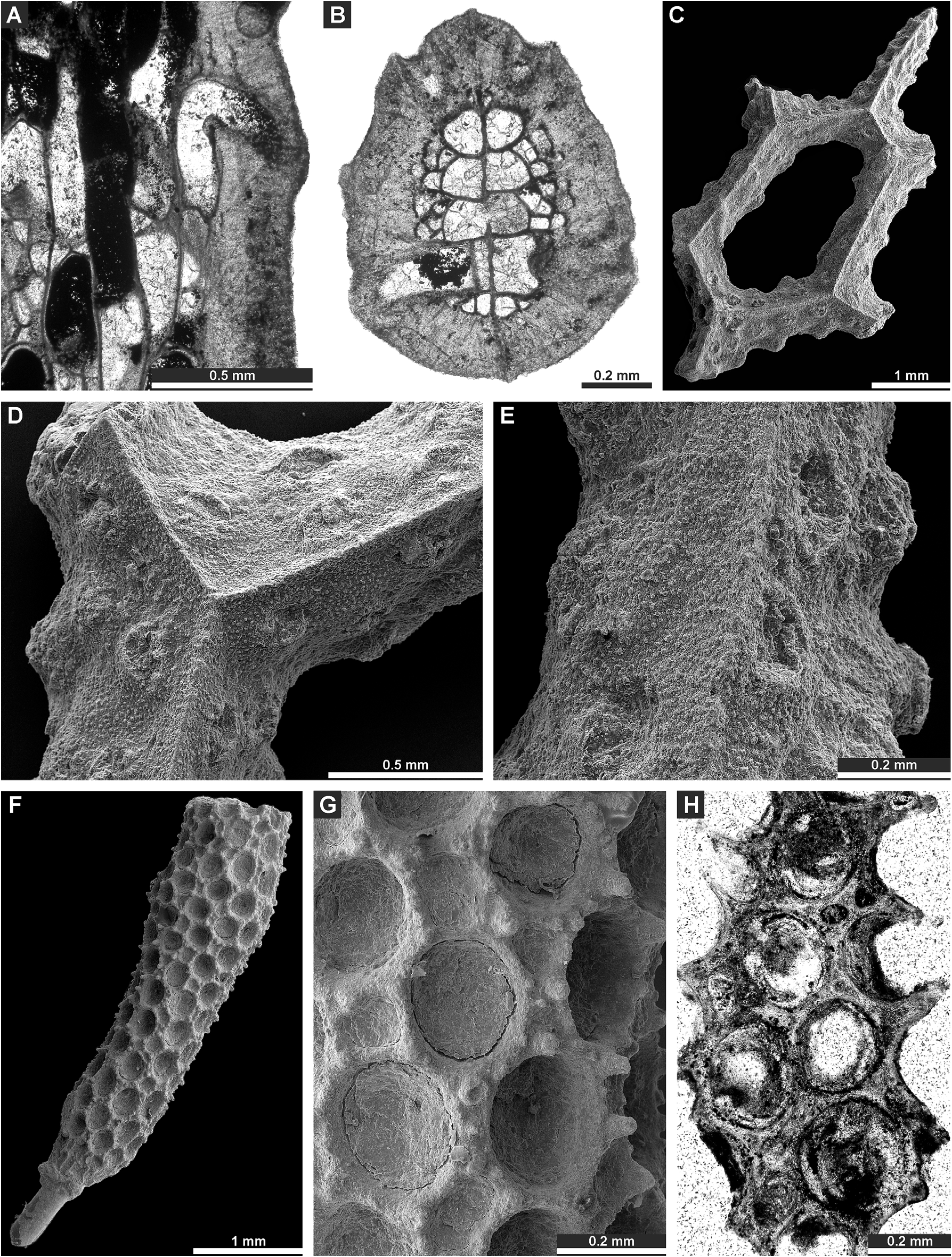
Description. Encrusting colony, 0.40 – 0.50 mm in thickness. Autozooecial chambers tubular, growing from a thin epitheca. Acanthostyles common to abundant, 5 – 7 surrounding each autozooecial aperture, originating from base of exozone, moderate to large in size. Diaphragms absent. Exilazooecia small to moderate in size, rounded-angular, 1 – 4 surrounding each autozooecial aperture. Autozooecial walls granular, 0.008 – 0.013 mm thick in endozone; thick, merged, laminated without distinct zooecial boundaries, 0.033 – 0.055 mm thick in exozone. Maculae absent.
Ernst, Andrej, Claussen, Anna Lene, Seuss, Barbara, Wyse Jackson, Patrick N. (2022): Stenolaemate bryozoans from the Graham Formation, Pennsylvanian (Virgilian) at Lost Creek Lake, Texas, USA. Palaeontologia Electronica (a 15) 25 (2): 1-56, DOI: 10.26879/1174, URL: http://dx.doi.org/10.26879/1174
Figures 6 F-H, 7 A-B; Appendix zoobank. org / B 5 FFF 8 E 9 - 7 B 9 E- 4132 - 8 C 26 - 2 AF 97 A 7 F 089 B
Ernst, Andrej, Claussen, Anna Lene, Seuss, Barbara, Wyse Jackson, Patrick N. (2022): Stenolaemate bryozoans from the Graham Formation, Pennsylvanian (Virgilian) at Lost Creek Lake, Texas, USA. Palaeontologia Electronica (a 15) 25 (2): 1-56, DOI: 10.26879/1174, URL: http://dx.doi.org/10.26879/1174
Diagnosis. Thin encrusting colonies; 5 – 7 acanthostyles and 1 – 4 exilazooecia surrounding each autozooecial aperture; maculae absent.
Ernst, Andrej, Claussen, Anna Lene, Seuss, Barbara, Wyse Jackson, Patrick N. (2022): Stenolaemate bryozoans from the Graham Formation, Pennsylvanian (Virgilian) at Lost Creek Lake, Texas, USA. Palaeontologia Electronica (a 15) 25 (2): 1-56, DOI: 10.26879/1174, URL: http://dx.doi.org/10.26879/1174
Remarks. Dyscritella felixi n. sp. is similar to D. inaequalis Girty, 1911, from the Fayetteville Shale (Mississippian) of Arkansas. The latter species developed ramose colony instead of encrusting ones as in the present species. Furthermore, it has smaller autozooecial apertures. Girty (1911, p. 194) measured 0.14 mm as the maximum size of the autozooecial apertures for his species in contrast to 0.15 – 0.24 mm in the studied material. Dyscritella felixi n. sp. differs from D. incrustans Dunaeva, 1964, from the Carboniferous (Serpukhovian-Bashkirian) of the Ukraine in possessing larger autozooecial apertures (aperture width. 0.15 – 0.24 mm vs. 0.12 – 0.15 mm in D. incrustans).
Ernst, Andrej, Claussen, Anna Lene, Seuss, Barbara, Wyse Jackson, Patrick N. (2022): Stenolaemate bryozoans from the Graham Formation, Pennsylvanian (Virgilian) at Lost Creek Lake, Texas, USA. Palaeontologia Electronica (a 15) 25 (2): 1-56, DOI: 10.26879/1174, URL: http://dx.doi.org/10.26879/1174
Etymology. The species is named after Felix, son of Barbara Seuss.
Ernst, Andrej, Claussen, Anna Lene, Seuss, Barbara, Wyse Jackson, Patrick N. (2022): Stenolaemate bryozoans from the Graham Formation, Pennsylvanian (Virgilian) at Lost Creek Lake, Texas, USA. Palaeontologia Electronica (a 15) 25 (2): 1-56, DOI: 10.26879/1174, URL: http://dx.doi.org/10.26879/1174
Holotype. SNSB-BSPG 2020 XCI 101. Paratypes. Thin sections: SNSB-BSPG 2020 XCI 86, SNSB-BSPG 2020 XCI 87, SNSB-BSPG 2020 XCI 88, SNSB-BSPG 2020 XCI 89. Type locality. TXV- 200 (“ Spillway section at Lost Creek Lake ”), Texas, USA. Type stratum. Graham Formation, Pennsylvanian (Virgilian).
Ernst, Andrej, Claussen, Anna Lene, Seuss, Barbara, Wyse Jackson, Patrick N. (2022): Stenolaemate bryozoans from the Graham Formation, Pennsylvanian (Virgilian) at Lost Creek Lake, Texas, USA. Palaeontologia Electronica (a 15) 25 (2): 1-56, DOI: 10.26879/1174, URL: http://dx.doi.org/10.26879/1174

Export occurrence data

Darwin Core Archive (ZIP)

CLASSIFICATION

Taxonomic Classification Tree

MULTIMEDIA

Media Files(1)

FIGURE 6. Cystodictya formosa Moore, 1929 (A–B): A – deep tangential section showing autozooecial chambers with hemisepta and vesicular skeleton (XCI 27); B – branch transverse section showing mesotheca, autozooecial chambers and vesicles (XCI 23c). Goniocladia grahamensis Moore, 1929 (C–E): branch fragment showing the shape of fenestrule, ridges on branches and autozooecial apertures with lunaria (XCI 100). Dyscritella felixi n. sp. (F–H): F – colony encrusting a brachiopod spine (holotype XCI 101); G – colony surface showing autozooecial apertures, exilazooecia, and acanthostyles; H – tangential thin section showing autozooecial apertures, exilazooecia, and acanthostyles (paratype XCI 86).

Imageimage/png© Ernst, Andrej;Claussen, Anna Lene;Seuss, Barbara;Wyse Jackson, Patrick N.Ernst, Andrej;Claussen, Anna Lene;Seuss, Barbara;Wyse Jackson, Patrick N.

IMAGES

Gallery(1)

See Gallery

Occurrences with images

Source Information

Stenolaemate bryozoans from the Graham Formation, Pennsylvanian (Virgilian) at Lost Creek Lake, Texas, USA

checklist

This dataset contains the digitized treatments in Plazi based on the original journal article Ernst, Andrej, Claussen, Anna Lene, Seuss, Barbara, Wyse Jackson, Patrick N. (2022): Stenolaemate bryozoans from the Graham Formation, Pennsylvanian (Virgilian) at Lost Creek Lake, Texas, USA. Palaeontologia Electronica (a 15) 25 (2): 1-56, DOI: 10.26879/1174, URL: http://dx.doi.org/10.26879/1174

ABSTRACT

An exceptionally well-preserved bryozoan fauna has been described from the Finis Shale Member, Graham Formation, Pennsylvanian (Virgilian) at Lost Creek Lake, Texas, USA. Nineteen bryozoan species (four cystoporates, one trepostome, two rhabdomesine cryptostomes, and 12 fenestrates) have been identified in two profiles which cut the most vertical range, at the level of the outcrop-base, of the Finis Shale. Two species are new: a trepostome Dyscritella felixi n. sp. and a fenestrate Laxifenestella texana n. sp. The fauna was studied on a combined basis of external and internal morphology, using a SEM and thin sections, respectively. Bryozoans from the Finis Shale Member exhibit a variety of growth forms from encrusting unilaminar, erect ramose, erect reticulate robust, and erect reticulate delicate, to erect pinnate morphologies. The erect growth forms clearly dominate, and bryozoans become more robust in the upper level of the profiles. The distribution pattern of bryozoan growth forms indicates gradual shallowing in the profiles supporting the assumption of a transgressive-regressive cycle in the Finis Shale. Bryozoan richness, abundance, and α-diversity increase toward the top of the profiles. Palaeobiogeographic relations of the Finis Shale bryozoans are mostly restricted to the American realm, with some connections to the Pennsylvanian of Europe.

Andrej Ernst. Institut für Geologie, Universität Hamburg, Bundesstr. 55, 20146 Hamburg, Germany. Andrej.Ernst@uni-hamburg.de

Anna Lene Claussen. GeoZentrum Nordbayern, Friedrich-Alexander University Erlangen-Nürnberg (FAU), Loewenichstrasse 28, D-91054 Erlangen, Germany. anna.lene.claussen@fau.de

Barbara Seuss. GeoZentrum Nordbayern, Friedrich-Alexander University Erlangen-Nürnberg (FAU), Loewenichstrasse 28, D-91054 Erlangen, Germany. barbara.seuss@fau.de

Patrick N. Wyse Jackson. Department of Geology, Trinity College, Dublin 2, Ireland. wysjcknp@tcd.ie

http://zoobank.org/ A4A07D50-3DDB-4E45-A255-1ECCF45F147A

Keywords: Finis Shale; cyclothem; North American Midcontinent; morphology; taxonomy; ecology

Submission: 1 July 2021. Acceptance: 29 April 2022.

Ernst A, Claussen A L, Seuss B, Wyse Jackson P N, felipe (2022). Stenolaemate bryozoans from the Graham Formation, Pennsylvanian (Virgilian) at Lost Creek Lake, Texas, USA. Plazi.org taxonomic treatments database. Checklist dataset https://doi.org/10.15468/baaezv accessed via GBIF.org on 2026-06-14.

CC0Published 5/31/2022View dataset
GBIF Usage Key
226325005
Dataset Key
77c06bea-bbd5-46af-8ef1-f434aa25c6a8
Origin
source
Backbone Key
11545940
Taxon ID
03C387F19A1639742EF00238F6074CDB.taxon
Last Crawled
6/9/2026
Last Interpreted
6/9/2026
