
AnimaliaNot EvaluatedacceptedspeciesAccepted
Cystodictya formosa
Moore, 1929
GBIF:226325009
0year
ABOUT
Descriptions(4)
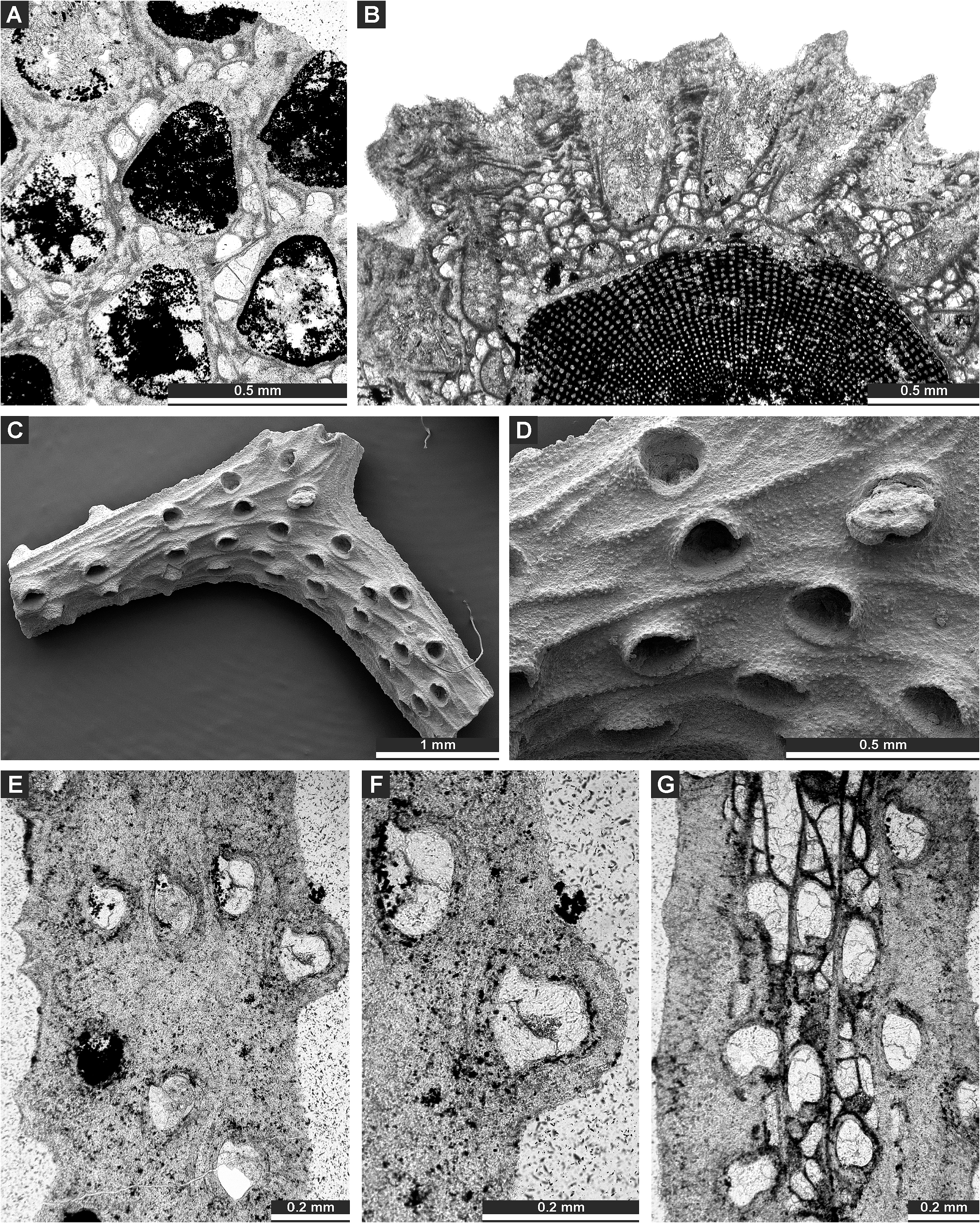
Description. Bifoliate branches, 0.67 – 1.07 mm wide and 0.40 – 0.92 mm thick. Mesotheca 0.008 – 0.010 mm thick, granular. Autozooecia tubular, teardrop-shaped at their bases, trapezoidal to semicircular in transverse quadrate in cross-section, recumbent on the mesotheca for a relatively short distance, then bending upwards at low angles in exozone and intersecting the surface almost perpendicularly. Diaphragms lacking; long proximolateral hemisepta at zooecial bend present. Autozooecial apertures circular to oval, arranged in 4 – 6 alternating rows on the colony surface. Lunaria distinct, horseshoe-shaped. Vesicular skeleton well-developed, covered in exozone by thick stereom. Vesicles small, rectangular in tangential section, with rounded roofs, completely separating autozooecia in exozone in 1 – 2 rows. Autozooecial walls granular, 0.008 – 0.010 mm thick in endozone. Stereom well developed, 0.13 – 0.18 mm thick, consisting of laminated material, completely separating autozooecia in exozone.
Ernst, Andrej, Claussen, Anna Lene, Seuss, Barbara, Wyse Jackson, Patrick N. (2022): Stenolaemate bryozoans from the Graham Formation, Pennsylvanian (Virgilian) at Lost Creek Lake, Texas, USA. Palaeontologia Electronica (a 15) 25 (2): 1-56, DOI: 10.26879/1174, URL: http://dx.doi.org/10.26879/1174
Figures 5 C-G, 6 A-B; Appendix 1929 Cystodictya formosa Moore, p. 150 - 151, pl. 18, figs. 4, 12, 13. 1929 Cystodictya formosa var. robusta Moore, p. 151, pl. 18, figs. 14, 29, 31. 1929 Cystodictya formosa var. striata Moore, p. 153, pl. 18, figs. 20 - 22.
Ernst, Andrej, Claussen, Anna Lene, Seuss, Barbara, Wyse Jackson, Patrick N. (2022): Stenolaemate bryozoans from the Graham Formation, Pennsylvanian (Virgilian) at Lost Creek Lake, Texas, USA. Palaeontologia Electronica (a 15) 25 (2): 1-56, DOI: 10.26879/1174, URL: http://dx.doi.org/10.26879/1174
Remarks. Moore (1929) established several varieties of the species Cystodictya formosa from the Graham Formation of Texas. Of these varieties, Cystodictya formosa var. robusta and C. formosa var. striata differ only in the branch width and thickness from the species C. formosa Moore, 1929. The differences in the branch width and thickness are indeed minimal and do not exceed normal variation within an assemblage from a restricted biotope (branch width 0.96 mm for C. formosa, 1.15 mm for C. formosa var. robusta, and 1.1 mm for C. formosa var. striata; branch thickness 0.72 mm for C. formosa, 1.3 mm for C. formosa var. robusta, and 0.72 mm for C. formosa var. striata, as given by Moore (1929). Cystodictya formosa Moore, 1929, differs from C. modesta Moore, 1929, in possessing thicker and wider branches as well as in larger and wider spaced autozooecial apertures (aperture width 0.10 – 0.18 mm vs. 0.057 – 0.085 mm in C. modesta). Occurrence. Upper Graham Formation, Pennsylvanian (Virgilian); Texas, USA. Graham Formation, Pennsylvanian (Virgilian); TXV- 200 (“ Spillway section at Lost Creek Lake ”), Texas, USA.
Ernst, Andrej, Claussen, Anna Lene, Seuss, Barbara, Wyse Jackson, Patrick N. (2022): Stenolaemate bryozoans from the Graham Formation, Pennsylvanian (Virgilian) at Lost Creek Lake, Texas, USA. Palaeontologia Electronica (a 15) 25 (2): 1-56, DOI: 10.26879/1174, URL: http://dx.doi.org/10.26879/1174
Material. SNSB-BSPG 2020 XCI 23 a, b, SNSB-BSPG 2020 XCI 27, SNSB-BSPG 2020 XCI 28, SNSB-BSPG 2020 XCI 33, SNSB-BSPG 2020 XCI 99.
Ernst, Andrej, Claussen, Anna Lene, Seuss, Barbara, Wyse Jackson, Patrick N. (2022): Stenolaemate bryozoans from the Graham Formation, Pennsylvanian (Virgilian) at Lost Creek Lake, Texas, USA. Palaeontologia Electronica (a 15) 25 (2): 1-56, DOI: 10.26879/1174, URL: http://dx.doi.org/10.26879/1174
Export occurrence data
Darwin Core Archive (ZIP)
CLASSIFICATION
Taxonomic Classification Tree

MULTIMEDIA
Media Files(1)
FIGURE 5. Eridopora beilensis Perkins and Perry in Perkins et al., 1962 (A–B): A – tangential thin section showing autozooecial apertures and vesicles (XCI 36); B – longitudinal thin section of a colony on echinoderm fragment showing autozooecial chambers and vesicles (XCI 59a). Cystodictya formosa Moore, 1929 (C–G): C, D – branch fragment with autozooecial apertures and lunaria (XCI 99); E–F: tangential thin section showing autozooecial apertures with lunaria (XCI 23a); G – deep tangential section showing autozooecial chambers with hemisepta and vesicular skeleton (XCI 23a).
Imageimage/png© Ernst, Andrej;Claussen, Anna Lene;Seuss, Barbara;Wyse Jackson, Patrick N.Ernst, Andrej;Claussen, Anna Lene;Seuss, Barbara;Wyse Jackson, Patrick N.
IMAGES