
AnimaliaNot EvaluatedacceptedspeciesAccepted
Fistulipora nodulifera
Meek, 1872
GBIF:226325015
0year
ABOUT
Descriptions(4)
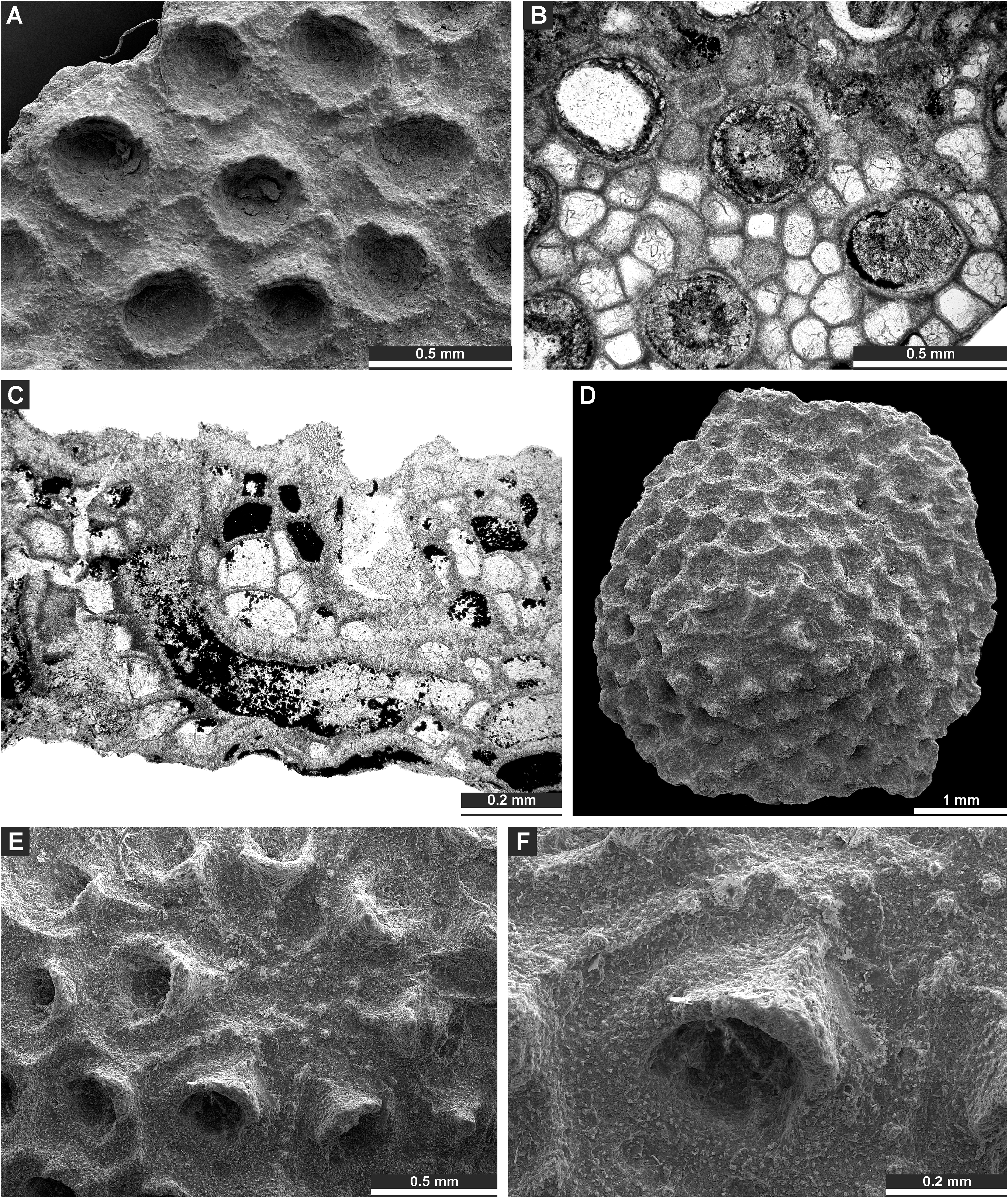
Description. Encrusting colonies, 0.63 – 0.80 mm thick. Autozooecia growing from thin epitheca, bending in the early exozone to the colony surface. Basal diaphragms rare. Autozooecial apertures circular to oval. Lunaria well-developed, rounded; ends of lunaria not indenting into autozooecia. Vesicles small to large, separating autozooecia in 1 – 2 rows, 10 – 15 surrounding each autozooecia aperture, with rounded to flat roofs, polygonal in tangential section. Microacanthostyles in outer layer of the calcite material, 0.020 – 0.035 mm in diameter. Autozooecial walls granular prismatic, 0.013 – 0.018 mm thick. Depressed maculae consisting of vesicles present, 0.81 – 1.26 mm in diameter, spaced 5 – 6 mm from centre to centre.
Ernst, Andrej, Claussen, Anna Lene, Seuss, Barbara, Wyse Jackson, Patrick N. (2022): Stenolaemate bryozoans from the Graham Formation, Pennsylvanian (Virgilian) at Lost Creek Lake, Texas, USA. Palaeontologia Electronica (a 15) 25 (2): 1-56, DOI: 10.26879/1174, URL: http://dx.doi.org/10.26879/1174
Figure 4 A-C; Appendix 1872 Fistulipora nodulifera Meek, p. 143, pl. 5, 5 a-d. 1894 Fistulipora nodulifera Meek, 1872; Keyes, pl. 34, fig. 3. 1903 a Fistulipora nodulifera Meek, 1872; Condra, p. 30 - 31, pl. 1, figs. 1 - 5. 1929 Fistulipora nodulifera var. maculosa Moore, p. 5, pl. 1, figs. 9, 12. 1930 Fistulipora nodulifera Meek, 1872; Sayre, p. 87 - 88, pl. 2, figs. 4 - 6. 2017 Fistulipora nodulifera Meek, 1872; Ernst and Vachard, p. 18, figs. 6 A-D. 2021 Fistulipora nodulifera Meek, 1872; Ernst, Krainer and Lucas, p. 220 - 222, figs. 4 c-f.
Ernst, Andrej, Claussen, Anna Lene, Seuss, Barbara, Wyse Jackson, Patrick N. (2022): Stenolaemate bryozoans from the Graham Formation, Pennsylvanian (Virgilian) at Lost Creek Lake, Texas, USA. Palaeontologia Electronica (a 15) 25 (2): 1-56, DOI: 10.26879/1174, URL: http://dx.doi.org/10.26879/1174
Remarks. Fistulipora nodulifera Meek, 1872, differs from F. vaccula Moore, 1929, from the Graham Formation (Virgilian) of Texas in possessing smaller autozooecial apertures (aperture width 0.22 – 0.35 mm vs. 0.35 – 0.50 mm in F. vaccula). Fistulipora nodulifera differs from F. distincta Schulga-Nesterenko, 1955, from the Pennsylvanian (Moscovian) of the Russian Platform in having smaller autozooecial apertures (aperture width 0.22 – 0.35 mm vs. 0.30 – 0.35 mm in F. distincta). Moore (1929) distinguished a variety Fistulipora nodulifera var. maculosa Moore, 1929 from the Graham Formation (Virgilian) of Texas by presence of maculae. However, maculae were also mentioned in other materials of F. nodulifera. Occurrence. Carboniferous, Pennsylvanian (Virgilian); Texas, Nebraska, Missouri, New Mexico (USA). Horquilla Formation, Carboniferous, Pennsylvanian, Desmoinesian (late Moscovian); Cerros de Tule, Sonora, Mexico. Gray Mesa Formation, Pennsylvanian (Desmoinesian); Fra Cristobal Mountains, New Mexico, USA. Graham Formation, Pennsylvanian (Virgilian); TXV- 200 (“ Spillway section at Lost Creek Lake ”), Texas, USA.
Ernst, Andrej, Claussen, Anna Lene, Seuss, Barbara, Wyse Jackson, Patrick N. (2022): Stenolaemate bryozoans from the Graham Formation, Pennsylvanian (Virgilian) at Lost Creek Lake, Texas, USA. Palaeontologia Electronica (a 15) 25 (2): 1-56, DOI: 10.26879/1174, URL: http://dx.doi.org/10.26879/1174
Material. SNSB-BSPG 2020 XCI 29, SNSB-BSPG 2020 XCI 34, SNSB-BSPG 2020 XCI 56 a-d, SNSB-BSPG 2020 XCI 57, SNSB-BSPG 2020 XCI 76, SNSB-BSPG 2020 XCI 97.
Ernst, Andrej, Claussen, Anna Lene, Seuss, Barbara, Wyse Jackson, Patrick N. (2022): Stenolaemate bryozoans from the Graham Formation, Pennsylvanian (Virgilian) at Lost Creek Lake, Texas, USA. Palaeontologia Electronica (a 15) 25 (2): 1-56, DOI: 10.26879/1174, URL: http://dx.doi.org/10.26879/1174
Export occurrence data
Darwin Core Archive (ZIP)
CLASSIFICATION
Taxonomic Classification Tree

MULTIMEDIA
Media Files(1)
FIGURE 4. Fistulipora nodulifera Meek, 1872 (A–C): A – colony surface with autozooecial apertures and lunaria (XCI 97); B – tangential thin section showing autozooecial apertures with lunaria and vesicles (XCI 29); C – longitudinal thin section showing autozooecial chambers and vesicles (XCI 56b). Eridopora beilensis Perkins and Perry in Perkins et al., 1962 (D–F): discoidal colony showing autozooecial apertures with triangular lunaria (XCI 98).
Imageimage/png© Ernst, Andrej;Claussen, Anna Lene;Seuss, Barbara;Wyse Jackson, Patrick N.Ernst, Andrej;Claussen, Anna Lene;Seuss, Barbara;Wyse Jackson, Patrick N.
IMAGES