
AnimaliaNot EvaluatedacceptedspeciesAccepted
Rhombopora lepidodendroides
GBIF:226325023
ABOUT
Descriptions(4)
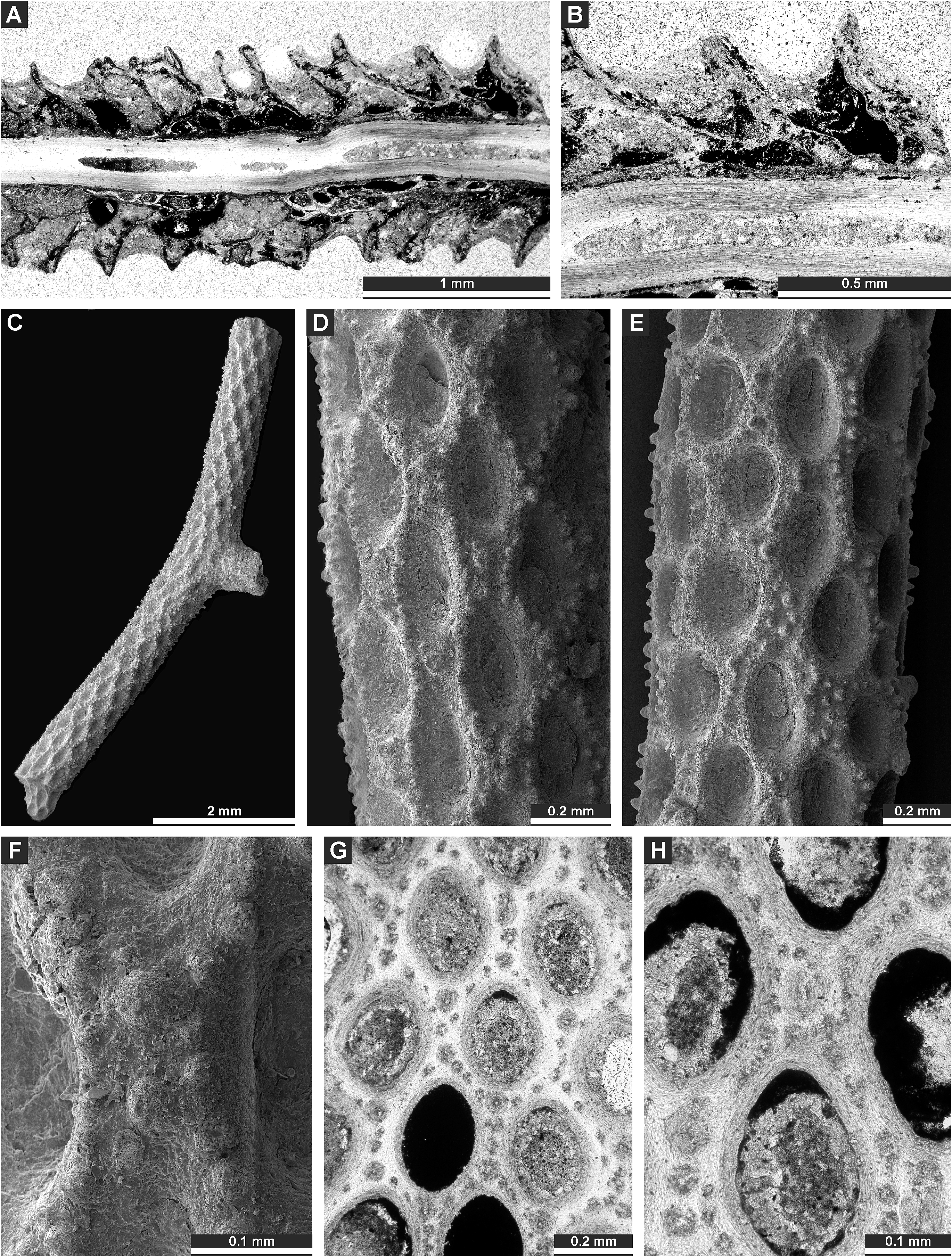
Description. Ramose colonies, branches 0.73 – 1.48 mm in diameter, with 0.19 – 0.40 mm wide exozones and 0.27 – 0.68 mm wide endozones. Autozooecia short, growing in spiral pattern from a distinct median axis at angles of 32 – 55 ° in endozone, abruptly bending in exozones and intersecting colony surface at angles of 77 – 86 °; triangular to rhombic, teardrop-shaped in transverse sections of endozone. Autozooecial apertures oval, arranged in quincunx on colony surface. Aktinotostyles abundant, arranged in a single row between autozooecial apertures forming relatively regular hexagons. One or two large acanthostyles between successive autozooecial apertures, with narrow hyaline core and wide laminated sheaths. Metazooecia rare to absent. Autozooecial walls laminated, without distinct boundaries in exozone. Autozooecial walls hyaline, 0.008 – 0.013 mm thick in endozone; laminated in exozone. Mural spines in outer exozonal walls, 0.01 - 0.02 mm in diameter.
Ernst, Andrej, Claussen, Anna Lene, Seuss, Barbara, Wyse Jackson, Patrick N. (2022): Stenolaemate bryozoans from the Graham Formation, Pennsylvanian (Virgilian) at Lost Creek Lake, Texas, USA. Palaeontologia Electronica (a 15) 25 (2): 1-56, DOI: 10.26879/1174, URL: http://dx.doi.org/10.26879/1174
Figures 7 C-H, 8 A-C; Appendix 1872 Rhombopora lepidodendroides Meek, p. 141 - 143, pl. 7, figs. 2 a- 2 f. 1877 Rbombipora lepidodendroides Meek, 1872; White, p. 99, pl. 6, figs. 5 a-d. 1884 Rhombopora lepidodendroidea Meek, 1872; Ulrich, p. 27, pl. 1, figs. 1 - 1 b. 1887 Rhombopora lepidodendroidea Meek, 1872; Foerste, pl. 7, figs. 3 a, b. 1888 Rhombopora lepidodendroides Meek, 1872; Keyes, p. 225. 1894 Rhombopora lepidodendroides Meek, 1872; Keyes, p. 35, pl. 33, figs. 4 a, b. 1896 Rhombopora lepidodendroides Meek, 1872; Smith, p. 237. 1899 Rhombopora lepidodendroides? Meek, 1872; Knight, p. 366. 1903 a Rhombopora lepidodendroides Meek, 1872; Condra, p. 99, pl. 6, figs. 2 - 4, p. 7, figs. 1 - 12. 1903 b Rhombopora lepidodendroides Meek, 1872; Condra, p. 22, pl. 2, figs. 1 - 11. 1908 Rhombopora aff. lepidodendroides Meek, 1872; Girty, p. 153, pl. 31, fig. 17. 1915 Rhombopora lepidodendroides Meek, 1872; Mather, p. 132, pl. 6, figs. 8, 9.? 1915 Rhombopora lepidodendroides Meek, 1872; Girty, p. 46 - 48. 1922 Rhombopora lepidodendroides Meek, 1872; Plummer and Moore, p. 169, pl. 23, figs. 20 - 27. 1922 Rhombopora lepidodendroidea Meek, 1872; Morningstar, p. 163 - 164. 1924 Rhombopora lepidodendroides Meek, 1872; Coryell in Morgan, pl. 38, figs. 3 - 5.? 1929 Rhombopora communis Moore, p. 139 - 140, pl. 17, fig. 12, text-figs. 4 l, m. 1930 Rhombopora lepidodendroides Meek, 1872; Sayre, p. 92, pl. 1, figs. 6 - 8. 1935 Rhombopora lepidodendroides Meek, 1872; Twenhofel and Shrock, figs. 85 K-L. 1944 Rhombopora lepidodendroides Meek, 1872; Shimer and Shrock, pl. 101, figs. 4 - 6. 1953 Rhombopora lepidodendroides Meek, 1872; Bassler, p. G 134, figs. 95, 4 a-c. 1953 Rhombopora lepidodendroides Meek, 1872; Shrock and Twenhofel, p. 246, fig. 7. 1962 Rhombopora lepidodendroides Meek, 1872; Perkins, Perry and Hattin, p. 18 - 20, pl. 3, figs. 5 - 7. 1970 Rhombopora lepidodendroides Meek, 1872; Huffman, p. 673, pl. 105, figs. 1 - 7, pl. 106, figs. 1 - 6. 1970 Rhombopora cf. lepidodendroides Meek, 1872; Fritz, p. 74 - 76, pl. 15, figs. 1, 4. 1971 Rhombopora lepidodendroides Meek, 1872; Newton, p. 28 - 29, pl. 1, figs. 1 - 6, 11, 12, pl. 2, 1 - 8, 11 - 16. 1985 Rhombopora lepidodendroides Meek, 1872; Gorjunova, p. 121, pl. 7, fig. 5. 1995 Rhombopora lepidodendroides Meek, 1872; Sakagami, 1995, p. 261 - 262, figs. 1.1 - 6. 2005 Rhombopora lepidodendroides Meek, 1872; Ernst, Schäfer, and Reijmer, p. 307, pl. 2, figs. 6 - 7. 2006 Rhombopora lepidodendroides Meek, 1872; Ernst and Minwegen, p. 579, figs. 5 J-M. 2008 Rhombopora lepidodendroides Meek, 1872; Ernst and Winkler Prins, p. 24, pl. 12, 4 - 6. 2021 Rhombopora lepidodendroides Meek, 1872; Ernst, Krainer and Lucas, p. 225 - 227, figs. 6 f-i, 7 a-c.
Ernst, Andrej, Claussen, Anna Lene, Seuss, Barbara, Wyse Jackson, Patrick N. (2022): Stenolaemate bryozoans from the Graham Formation, Pennsylvanian (Virgilian) at Lost Creek Lake, Texas, USA. Palaeontologia Electronica (a 15) 25 (2): 1-56, DOI: 10.26879/1174, URL: http://dx.doi.org/10.26879/1174
Remarks. Rhombopora lepidodendroides Meek, 1872, differs from R. corticata Moore, 1929, in having smaller autozooecial apertures (average aperture width 0.15 mm vs. 0.17 mm in R. corticata; data from Ernst and Winkler Prins, 2008) and shorter distances between apertures along branch (average distance 0.47 mm vs. 0.72 mm in R. corticata; data from Ernst and Winkler Prins, 2008). Rhombopora lepidodendroides differs from R. vera Dunaeva, 1961 from the Moscovian of Ukraine in possessing larger autozooecial apertures (aperture width 0.11 – 0.17 mm vs. 0.07 – 0.09 mm in R. vera). Rhombopora communis Moore, 1929, is apparently synonymous with R. lepidodendroides Meek, 1872. The original description of R. communis is short, and differences between the two species, noted by Moore (1929, p. 140) are minimal. Occurrence. Studied material comes from the Graham Formation, Pennsylvanian (Virgilian) at the TXV- 200 (“ Spillway section at Lost Creek Lake ”), Texas, USA. The majority of the records of Rhombopora lepidodendroides Meek, 1872 (see synonymy list), come from the Pennsylvanian to the lower Permian of the USA and Canada. This species has also been recorded from the Pennsylvanian of the Cantabrian Mountains, Spain: Valdeteja Formation (Bashkirian) of Valdeteja, León; San Emiliano Formation (Westphalian B / C) of Valverdín; Picos de Europa Formation (Moscovian) of La Hermida;? Las Llacerias Formation (Kasimovian) of Sotres, Asturias. One record of R. lepidodendroides is known from the Pennsylvanian of Bolivia (Sakagami 1995).
Ernst, Andrej, Claussen, Anna Lene, Seuss, Barbara, Wyse Jackson, Patrick N. (2022): Stenolaemate bryozoans from the Graham Formation, Pennsylvanian (Virgilian) at Lost Creek Lake, Texas, USA. Palaeontologia Electronica (a 15) 25 (2): 1-56, DOI: 10.26879/1174, URL: http://dx.doi.org/10.26879/1174
Material. SNSB-BSPG 2020 XCI 44 a-c, SNSB-BSPG 2020 XCI 45 a, b, SNSB-BSPG 2020 XCI 58 a, b, SNSB-BSPG 2020 XCI 63, SNSB-BSPG 2020 XCI 66, SNSB-BSPG 2020 XCI 80 a, b, SNSB-BSPG 2020 XCI 102, SNSB-BSPG 2020 XCI 103.
Ernst, Andrej, Claussen, Anna Lene, Seuss, Barbara, Wyse Jackson, Patrick N. (2022): Stenolaemate bryozoans from the Graham Formation, Pennsylvanian (Virgilian) at Lost Creek Lake, Texas, USA. Palaeontologia Electronica (a 15) 25 (2): 1-56, DOI: 10.26879/1174, URL: http://dx.doi.org/10.26879/1174
Export occurrence data
Darwin Core Archive (ZIP)
CLASSIFICATION
Taxonomic Classification Tree

MULTIMEDIA
Media Files(1)
FIGURE 7. Dyscritella felixi n. sp. (A–B): longitudinal thin section of a colony encrusting a brachiopod spine (paratype XCI 87). Rhombopora lepidodendroides Meek, 1872 (C–H): C – branch fragment (XCI 102); D, F – colony surface with autozooecial apertures, acanthostyles and aktinotostyles (XCI 102); E – colony surface with autozooecial apertures, acanthostyles and aktinotostyles (XCI 103); G, H – tangential thin section showing autozooecial apertures, acanthostyles and aktinotostyles (XCI 80b).
Imageimage/png© Ernst, Andrej;Claussen, Anna Lene;Seuss, Barbara;Wyse Jackson, Patrick N.Ernst, Andrej;Claussen, Anna Lene;Seuss, Barbara;Wyse Jackson, Patrick N.
IMAGES