AnimaliaNot EvaluatedacceptedspeciesAccepted
Streblotrypa multipora

Streblotrypa multipora

Warthin, 1930

GBIF:226325026

0year

0

Synonyms

ABOUT

Descriptions(4)

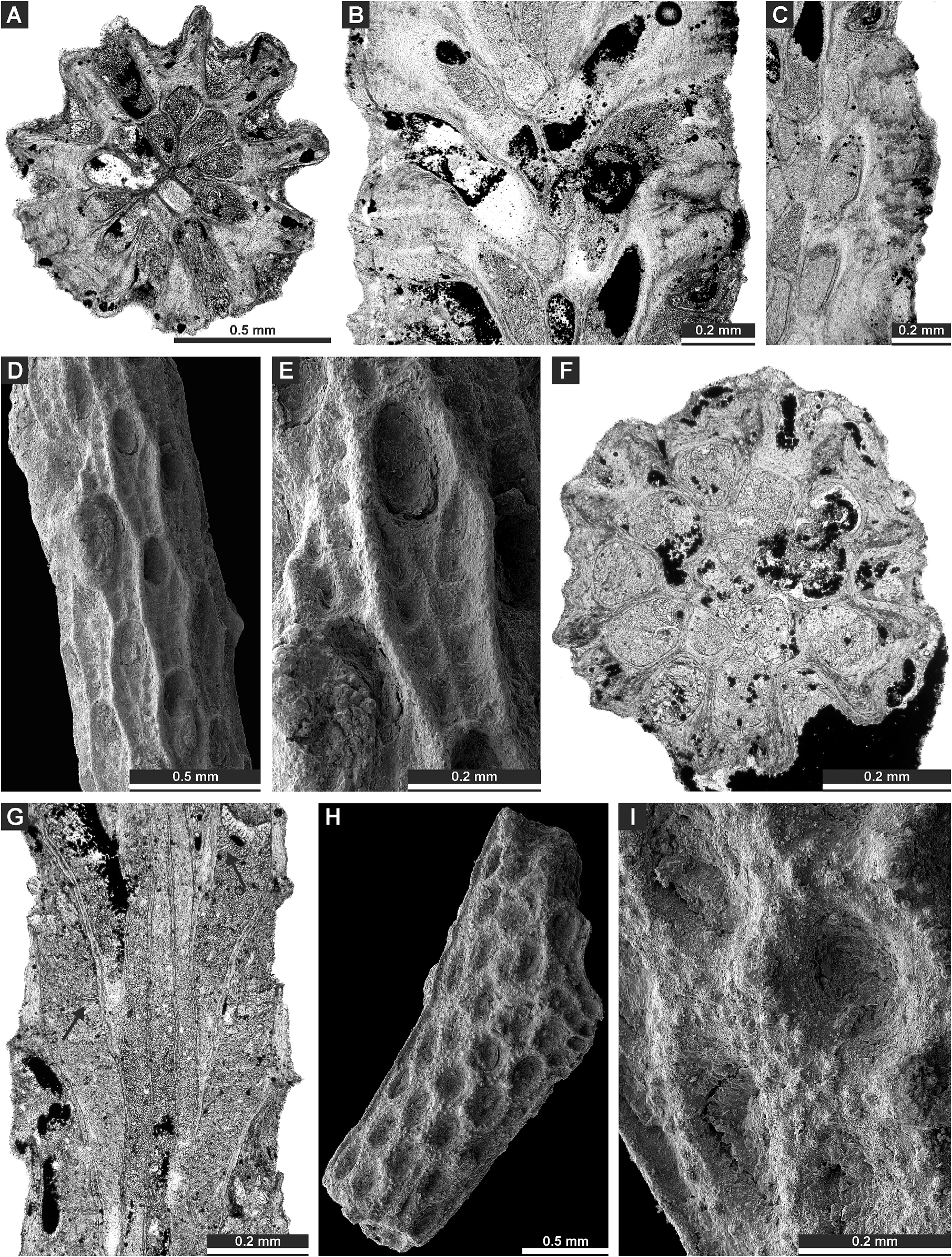
Description. Ramose colonies, branches 0.43 – 0.76 mm in diameter, with 0.19 – 0.38 mm wide endozones and 0.10 – 0.20 mm wide exozones. Branch transverse sections rounded to oval. Autozooecia budding from the axial bundle in a regular spiral pattern at angles of 18 – 28 °, bending in exozones and intersecting colony surface at angles of 60 – 80 °, having long inflated proximal parts, rounded-polygonal in transverse section in the endozone. Axial bundle indistinct, formed by 2 – 5 axial zooecia, 0.11 – 0.15 mm in diameter. Autozooecial apertures oval, opening around the branches in regular diagonal rows. Autozooecial boundaries marked by sharp ridges on the colony surface, which form a roughly hexagonal pattern. Superior hemisepta absent; inferior hemisepta well-developed, thin, placed approximately in the middle of the chamber, curved proximally. Autozooecial diaphragms rarely occurring. Metazooecia oval to rounded, usually 7 – 10 arranged in 2 – 3 rows between apertures, but often clustered in parts of branches lacking apertures. Autozooecial walls hyaline, 0.010 – 0.015 mm thick in endozone; laminated in exozone.
Ernst, Andrej, Claussen, Anna Lene, Seuss, Barbara, Wyse Jackson, Patrick N. (2022): Stenolaemate bryozoans from the Graham Formation, Pennsylvanian (Virgilian) at Lost Creek Lake, Texas, USA. Palaeontologia Electronica (a 15) 25 (2): 1-56, DOI: 10.26879/1174, URL: http://dx.doi.org/10.26879/1174
Figure 8 D-G; Appendix
Ernst, Andrej, Claussen, Anna Lene, Seuss, Barbara, Wyse Jackson, Patrick N. (2022): Stenolaemate bryozoans from the Graham Formation, Pennsylvanian (Virgilian) at Lost Creek Lake, Texas, USA. Palaeontologia Electronica (a 15) 25 (2): 1-56, DOI: 10.26879/1174, URL: http://dx.doi.org/10.26879/1174
Remarks. Streblotrypa (Streblotrypa) multipora Warthin, 1930, differs from S. (S.) merceri Morningstar, 1922, from the Pennsylvanian of Ohio by presence of 7 – 10 metazooecia between autozooecial apertures instead of four in the latter species. Streblotrypa (Streblotrypa) multipora differs from S. (S.) heltzelae Ernst et al., 2016, from the Boggy Formation of Oklahoma by its absence of acanthostyles. Occurrence. Upper Wetumka – lower Wewoka Formation, Pennsylvanian (Desmoinesian), Oklahoma, USA. Graham Formation, Pennsylvanian (Virgilian); TXV- 200 (“ Spillway section at Lost Creek Lake ”), Texas, USA.
Ernst, Andrej, Claussen, Anna Lene, Seuss, Barbara, Wyse Jackson, Patrick N. (2022): Stenolaemate bryozoans from the Graham Formation, Pennsylvanian (Virgilian) at Lost Creek Lake, Texas, USA. Palaeontologia Electronica (a 15) 25 (2): 1-56, DOI: 10.26879/1174, URL: http://dx.doi.org/10.26879/1174
Material. SNSB-BSPG 2020 XCI 39 b, SNSB-BSPG 2020 XCI 40, SNSB-BSPG 2020 XCI 41, SNSB-BSPG 2020 XCI 43, SNSB-BSPG 2020 XCI 104.
Ernst, Andrej, Claussen, Anna Lene, Seuss, Barbara, Wyse Jackson, Patrick N. (2022): Stenolaemate bryozoans from the Graham Formation, Pennsylvanian (Virgilian) at Lost Creek Lake, Texas, USA. Palaeontologia Electronica (a 15) 25 (2): 1-56, DOI: 10.26879/1174, URL: http://dx.doi.org/10.26879/1174

Export occurrence data

Darwin Core Archive (ZIP)

CLASSIFICATION

Taxonomic Classification Tree

MULTIMEDIA

Media Files(1)

FIGURE 8. Rhombopora lepidodendroides Meek, 1872 (A–C): A – branch transverse section (XCI 58a); B, C – branch longitudinal section showing autozooecial chambers and aktinotostyles in autozooecial wall (XCI 45b). Streblotrypa (Streblotrypa) multipora Warthin, 1930 (D–G): D, E – branch fragment showing autozooecial apertures and metazooecia (XCI 104); F – branch transverse section showing autozooecial chambers and axial bundle (XCI 39b); G – branch longitudinal section showing branch transverse section showing autozooecial chambers with hemisepta (arrows) and axial bundle (XCI 40). Rhombocladia delicata Rogers, 1900 (XCI 105) (H–I) – branch fragment (H) and colony surface showing autozooecial apertures, acanthostyles and paurostyles (I).

Imageimage/png© Ernst, Andrej;Claussen, Anna Lene;Seuss, Barbara;Wyse Jackson, Patrick N.Ernst, Andrej;Claussen, Anna Lene;Seuss, Barbara;Wyse Jackson, Patrick N.

IMAGES

Gallery(1)

See Gallery

Occurrences with images

Source Information

Stenolaemate bryozoans from the Graham Formation, Pennsylvanian (Virgilian) at Lost Creek Lake, Texas, USA

checklist

This dataset contains the digitized treatments in Plazi based on the original journal article Ernst, Andrej, Claussen, Anna Lene, Seuss, Barbara, Wyse Jackson, Patrick N. (2022): Stenolaemate bryozoans from the Graham Formation, Pennsylvanian (Virgilian) at Lost Creek Lake, Texas, USA. Palaeontologia Electronica (a 15) 25 (2): 1-56, DOI: 10.26879/1174, URL: http://dx.doi.org/10.26879/1174

ABSTRACT

An exceptionally well-preserved bryozoan fauna has been described from the Finis Shale Member, Graham Formation, Pennsylvanian (Virgilian) at Lost Creek Lake, Texas, USA. Nineteen bryozoan species (four cystoporates, one trepostome, two rhabdomesine cryptostomes, and 12 fenestrates) have been identified in two profiles which cut the most vertical range, at the level of the outcrop-base, of the Finis Shale. Two species are new: a trepostome Dyscritella felixi n. sp. and a fenestrate Laxifenestella texana n. sp. The fauna was studied on a combined basis of external and internal morphology, using a SEM and thin sections, respectively. Bryozoans from the Finis Shale Member exhibit a variety of growth forms from encrusting unilaminar, erect ramose, erect reticulate robust, and erect reticulate delicate, to erect pinnate morphologies. The erect growth forms clearly dominate, and bryozoans become more robust in the upper level of the profiles. The distribution pattern of bryozoan growth forms indicates gradual shallowing in the profiles supporting the assumption of a transgressive-regressive cycle in the Finis Shale. Bryozoan richness, abundance, and α-diversity increase toward the top of the profiles. Palaeobiogeographic relations of the Finis Shale bryozoans are mostly restricted to the American realm, with some connections to the Pennsylvanian of Europe.

Andrej Ernst. Institut für Geologie, Universität Hamburg, Bundesstr. 55, 20146 Hamburg, Germany. Andrej.Ernst@uni-hamburg.de

Anna Lene Claussen. GeoZentrum Nordbayern, Friedrich-Alexander University Erlangen-Nürnberg (FAU), Loewenichstrasse 28, D-91054 Erlangen, Germany. anna.lene.claussen@fau.de

Barbara Seuss. GeoZentrum Nordbayern, Friedrich-Alexander University Erlangen-Nürnberg (FAU), Loewenichstrasse 28, D-91054 Erlangen, Germany. barbara.seuss@fau.de

Patrick N. Wyse Jackson. Department of Geology, Trinity College, Dublin 2, Ireland. wysjcknp@tcd.ie

http://zoobank.org/ A4A07D50-3DDB-4E45-A255-1ECCF45F147A

Keywords: Finis Shale; cyclothem; North American Midcontinent; morphology; taxonomy; ecology

Submission: 1 July 2021. Acceptance: 29 April 2022.

Ernst A, Claussen A L, Seuss B, Wyse Jackson P N, felipe (2022). Stenolaemate bryozoans from the Graham Formation, Pennsylvanian (Virgilian) at Lost Creek Lake, Texas, USA. Plazi.org taxonomic treatments database. Checklist dataset https://doi.org/10.15468/baaezv accessed via GBIF.org on 2026-06-14.

CC0Published 5/31/2022View dataset
GBIF Usage Key
226325026
Dataset Key
77c06bea-bbd5-46af-8ef1-f434aa25c6a8
Origin
source
Backbone Key
10772840
Taxon ID
03C387F19A1239772E4C0178F4EA484C.taxon
Last Crawled
6/9/2026
Last Interpreted
6/9/2026
