AnimaliaNot EvaluatedacceptedspeciesAccepted
Rhombocladia delicata

Rhombocladia delicata

Rogers, 1900

GBIF:226325032

0year

ABOUT

Descriptions(4)

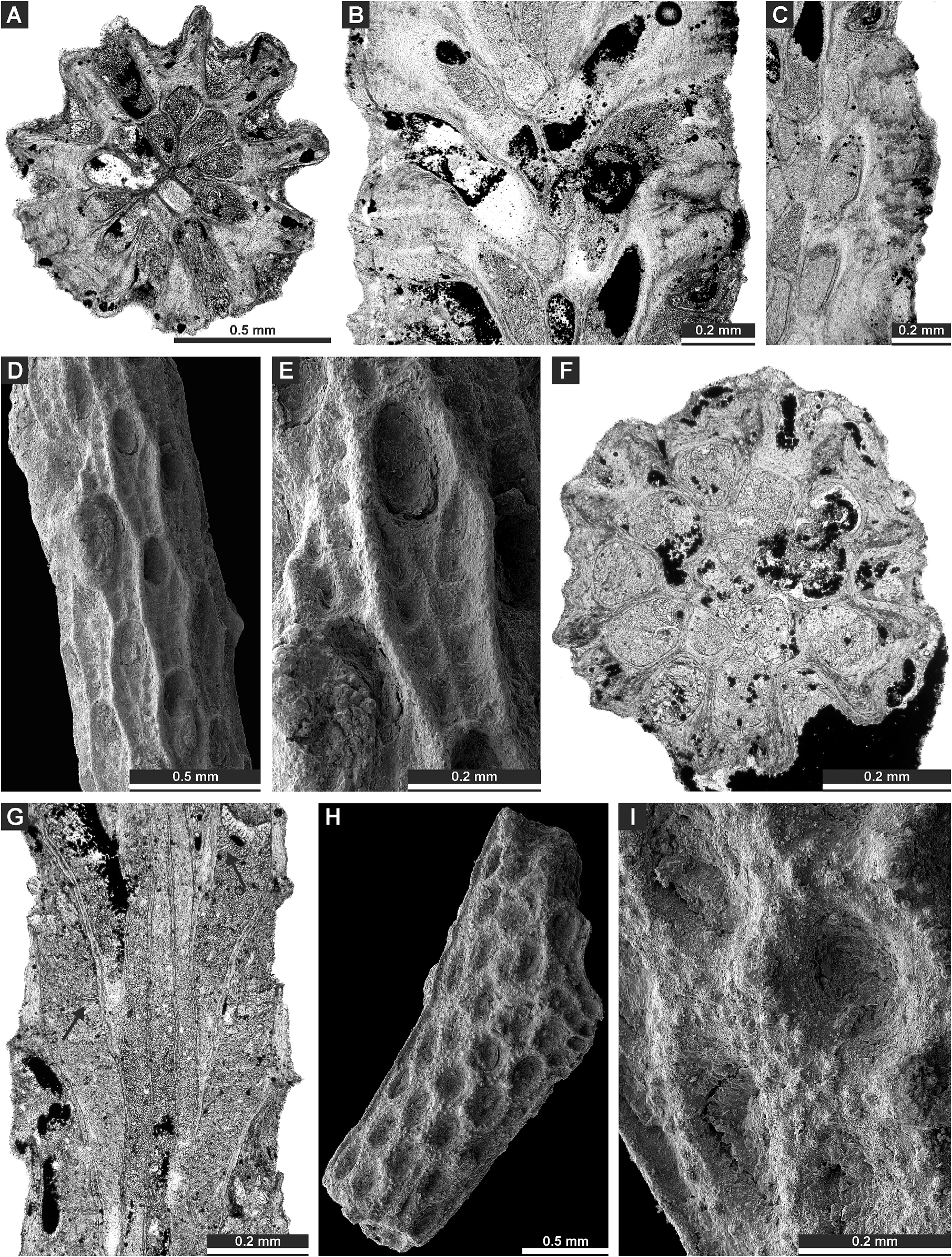
Description. Ramose colonies, branches 0.74 – 1.07 mm wide, 0.40 - 0.50 mm deep, flattened, bearing 5 – 6 zooecial rows; dorsal wall rugose. Diaphragms not observed. Superior hemisepta present. Oval apertures arranged in a diagonal pattern. Autozooecial chambers rhombic in mid-tangential section. Single macroacanthostyle at the distal end of each autozooecial aperture present. Microacanthostyles arranged in few irregular rows between autozooecial apertures, 0.008 – 0.013 mm in diameter. Leptozooecia not observed in present material. Autozooecial walls in endozone 0.015 – 0.020 mm thick, hyaline; finely laminated in exozone.
Ernst, Andrej, Claussen, Anna Lene, Seuss, Barbara, Wyse Jackson, Patrick N. (2022): Stenolaemate bryozoans from the Graham Formation, Pennsylvanian (Virgilian) at Lost Creek Lake, Texas, USA. Palaeontologia Electronica (a 15) 25 (2): 1-56, DOI: 10.26879/1174, URL: http://dx.doi.org/10.26879/1174
Figures 8 H-I, 9 A-B; Appendix 1900 Rhombocladia delicata Rogers, p. 12, pl. 1, figs. 1 - 1 d. pars 1906 Rhombocladia delicata Rogers, 1900; Johnsen, p. 58, pl. 11, fig. 30 a [? non 30 b]. pars 1929 Rhombocladia delicata Rogers, 1900; Moore, p. 149, pl. 17, figs. 26 - 28, 30, 31 [non 29, 32]. 1930 Rhombocladia delicata Rogers, 1900; Warthin, p. 42, pl. 3, fig. 17. 1963 Rhombocladia delicata Rogers form A; Ceretti, p. 327, pl. 7, fig. 10. 1964 Rhombocladia delicata Rogers; Ceretti, p. 184, 185, pl. 33, fig. 2 a, b, 4 a, b. 2003 Rhombocladia delicata Rogers, 1900; Ernst, p. 63, 64, pl. 5, figs. 4 - 7; text-fig. 3. 2016 Rhombocladia delicata Rogers, 1900; Ernst et al., p. 530, figs. 6 b-f, 8 a, d, 9 a. 2021 Rhombocladia delicata Rogers, 1900; Ernst, Krainer, and Lucas, p. 228, figs. 7 d-h.
Ernst, Andrej, Claussen, Anna Lene, Seuss, Barbara, Wyse Jackson, Patrick N. (2022): Stenolaemate bryozoans from the Graham Formation, Pennsylvanian (Virgilian) at Lost Creek Lake, Texas, USA. Palaeontologia Electronica (a 15) 25 (2): 1-56, DOI: 10.26879/1174, URL: http://dx.doi.org/10.26879/1174
Remarks. Rhombocladia delicata Rogers, 1900, differs from R. coronata Schulga-Nesterenko, 1955, from the Moscovian of Russian Platform by presence of macroacanthostyles. It differs from R. carnica Ceretti, 1964, from the Pennsylvanian (lower Gzhelian) of Italy by having wider branches (0.74 – 1.07 mm vs. 0.63 – 0.96 mm). Occurrence. Carboniferous, Pennsylvanian; Kansas, USA. Carboniferous, Middle Pennsylvanian (Wewoka Formation); Oklahoma, USA. Carboniferous, Pennsylvanian, Corona Formation (early Gzhelian); Kron Alpe (Monte Corona), Carnic Alps (Austria). Carboniferous, Pennsylvanian, Auernig Formation (Lower Gzhelian); Auernig, Carnic Alps (Udine, Italy). Strata probably attributable to the Las Llacerias Formation, Pennsylvanian (Kasimovian); Cantabrian Mountains, Asturias, NW Spain. Carboniferous, Pennsylvanian, Missourian (Kasimovian), Deese Group, Boggy Formation; Buckhorn Asphalt Quarry near Sulphur, Oklahoma, USA. Gray Mesa Formation, Pennsylvanian (Desmoinesian); Fra Cristobal Mountains, New Mexico, USA. Graham Formation, Pennsylvanian (Virgilian); TXV- 200 (“ Spillway section at Lost Creek Lake ”), Texas, USA.
Ernst, Andrej, Claussen, Anna Lene, Seuss, Barbara, Wyse Jackson, Patrick N. (2022): Stenolaemate bryozoans from the Graham Formation, Pennsylvanian (Virgilian) at Lost Creek Lake, Texas, USA. Palaeontologia Electronica (a 15) 25 (2): 1-56, DOI: 10.26879/1174, URL: http://dx.doi.org/10.26879/1174
Material. SNSB-BSPG 2020 XCI 22 a-c, SNSB-BSPG 2020 XCI 105.
Ernst, Andrej, Claussen, Anna Lene, Seuss, Barbara, Wyse Jackson, Patrick N. (2022): Stenolaemate bryozoans from the Graham Formation, Pennsylvanian (Virgilian) at Lost Creek Lake, Texas, USA. Palaeontologia Electronica (a 15) 25 (2): 1-56, DOI: 10.26879/1174, URL: http://dx.doi.org/10.26879/1174

Export occurrence data

Darwin Core Archive (ZIP)

CLASSIFICATION

Taxonomic Classification Tree

MULTIMEDIA

Media Files(1)

FIGURE 8. Rhombopora lepidodendroides Meek, 1872 (A–C): A – branch transverse section (XCI 58a); B, C – branch longitudinal section showing autozooecial chambers and aktinotostyles in autozooecial wall (XCI 45b). Streblotrypa (Streblotrypa) multipora Warthin, 1930 (D–G): D, E – branch fragment showing autozooecial apertures and metazooecia (XCI 104); F – branch transverse section showing autozooecial chambers and axial bundle (XCI 39b); G – branch longitudinal section showing branch transverse section showing autozooecial chambers with hemisepta (arrows) and axial bundle (XCI 40). Rhombocladia delicata Rogers, 1900 (XCI 105) (H–I) – branch fragment (H) and colony surface showing autozooecial apertures, acanthostyles and paurostyles (I).

Imageimage/png© Ernst, Andrej;Claussen, Anna Lene;Seuss, Barbara;Wyse Jackson, Patrick N.Ernst, Andrej;Claussen, Anna Lene;Seuss, Barbara;Wyse Jackson, Patrick N.

IMAGES

Gallery(1)

See Gallery

Occurrences with images

Source Information

Stenolaemate bryozoans from the Graham Formation, Pennsylvanian (Virgilian) at Lost Creek Lake, Texas, USA

checklist

This dataset contains the digitized treatments in Plazi based on the original journal article Ernst, Andrej, Claussen, Anna Lene, Seuss, Barbara, Wyse Jackson, Patrick N. (2022): Stenolaemate bryozoans from the Graham Formation, Pennsylvanian (Virgilian) at Lost Creek Lake, Texas, USA. Palaeontologia Electronica (a 15) 25 (2): 1-56, DOI: 10.26879/1174, URL: http://dx.doi.org/10.26879/1174

ABSTRACT

An exceptionally well-preserved bryozoan fauna has been described from the Finis Shale Member, Graham Formation, Pennsylvanian (Virgilian) at Lost Creek Lake, Texas, USA. Nineteen bryozoan species (four cystoporates, one trepostome, two rhabdomesine cryptostomes, and 12 fenestrates) have been identified in two profiles which cut the most vertical range, at the level of the outcrop-base, of the Finis Shale. Two species are new: a trepostome Dyscritella felixi n. sp. and a fenestrate Laxifenestella texana n. sp. The fauna was studied on a combined basis of external and internal morphology, using a SEM and thin sections, respectively. Bryozoans from the Finis Shale Member exhibit a variety of growth forms from encrusting unilaminar, erect ramose, erect reticulate robust, and erect reticulate delicate, to erect pinnate morphologies. The erect growth forms clearly dominate, and bryozoans become more robust in the upper level of the profiles. The distribution pattern of bryozoan growth forms indicates gradual shallowing in the profiles supporting the assumption of a transgressive-regressive cycle in the Finis Shale. Bryozoan richness, abundance, and α-diversity increase toward the top of the profiles. Palaeobiogeographic relations of the Finis Shale bryozoans are mostly restricted to the American realm, with some connections to the Pennsylvanian of Europe.

Andrej Ernst. Institut für Geologie, Universität Hamburg, Bundesstr. 55, 20146 Hamburg, Germany. Andrej.Ernst@uni-hamburg.de

Anna Lene Claussen. GeoZentrum Nordbayern, Friedrich-Alexander University Erlangen-Nürnberg (FAU), Loewenichstrasse 28, D-91054 Erlangen, Germany. anna.lene.claussen@fau.de

Barbara Seuss. GeoZentrum Nordbayern, Friedrich-Alexander University Erlangen-Nürnberg (FAU), Loewenichstrasse 28, D-91054 Erlangen, Germany. barbara.seuss@fau.de

Patrick N. Wyse Jackson. Department of Geology, Trinity College, Dublin 2, Ireland. wysjcknp@tcd.ie

http://zoobank.org/ A4A07D50-3DDB-4E45-A255-1ECCF45F147A

Keywords: Finis Shale; cyclothem; North American Midcontinent; morphology; taxonomy; ecology

Submission: 1 July 2021. Acceptance: 29 April 2022.

Ernst A, Claussen A L, Seuss B, Wyse Jackson P N, felipe (2022). Stenolaemate bryozoans from the Graham Formation, Pennsylvanian (Virgilian) at Lost Creek Lake, Texas, USA. Plazi.org taxonomic treatments database. Checklist dataset https://doi.org/10.15468/baaezv accessed via GBIF.org on 2026-06-14.

CC0Published 5/31/2022View dataset
GBIF Usage Key
226325032
Dataset Key
77c06bea-bbd5-46af-8ef1-f434aa25c6a8
Origin
source
Backbone Key
10770834
Taxon ID
03C387F19A1339692E9E056DF4B84AE6.taxon
Last Crawled
6/9/2026
Last Interpreted
6/9/2026
