
AnimaliaNot EvaluatedacceptedspeciesAccepted
Penniretepora oculata
(Moore, 1929)
GBIF:226325038
0year
ABOUT
Descriptions(3)
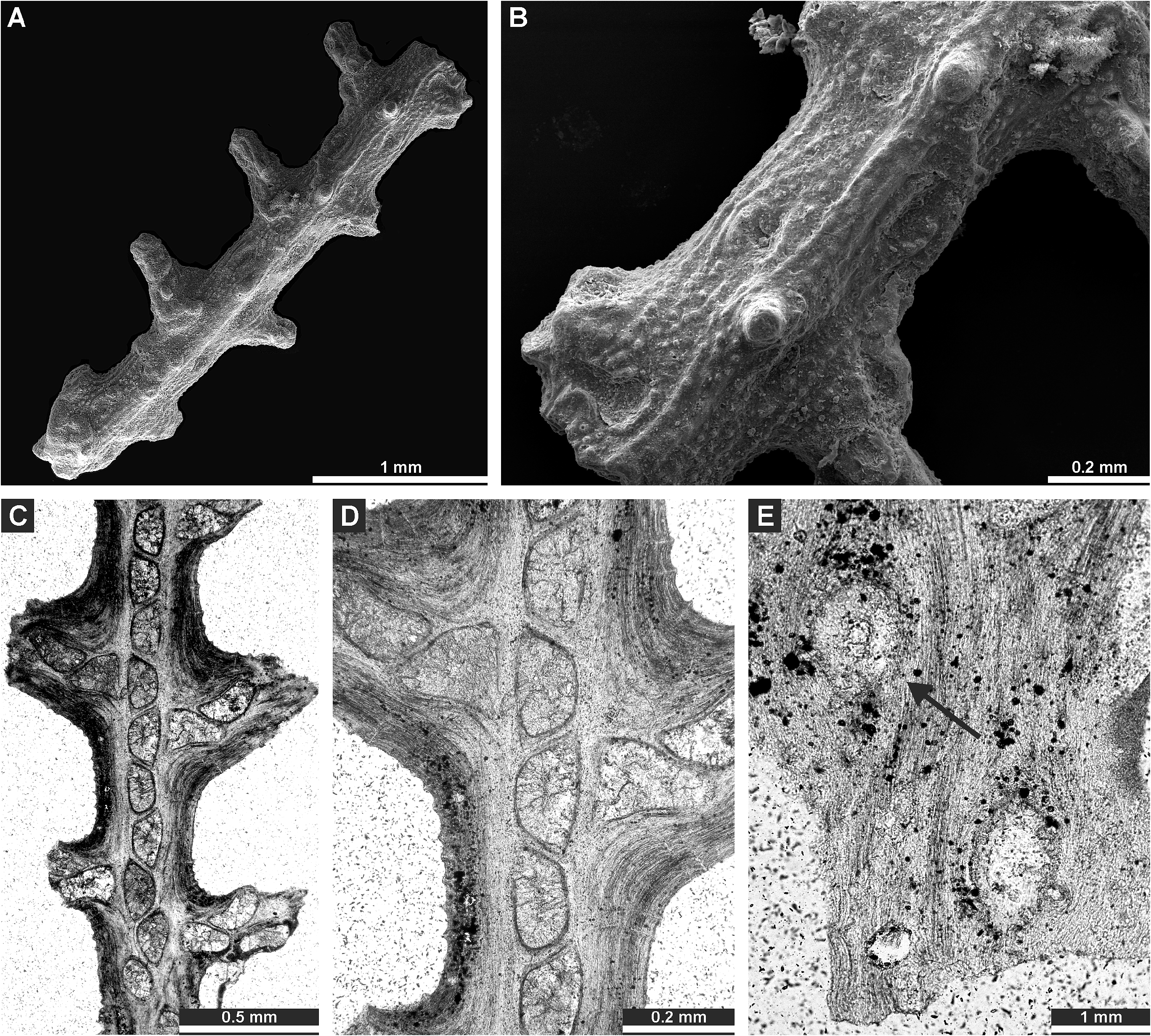
Figure 19 A-E; Appendix 1929 Pinnatopora oculata Moore, p. 125 - 126, pl. 15, figs. 4, 5, 9. 1930 Pinnatopora oculata Moore, 1929; Warthin, p. 38, pl. 3, fig. 5.
Ernst, Andrej, Claussen, Anna Lene, Seuss, Barbara, Wyse Jackson, Patrick N. (2022): Stenolaemate bryozoans from the Graham Formation, Pennsylvanian (Virgilian) at Lost Creek Lake, Texas, USA. Palaeontologia Electronica (a 15) 25 (2): 1-56, DOI: 10.26879/1174, URL: http://dx.doi.org/10.26879/1174
Remarks. Penniretepora oculata (Moore, 1929) is similar to P. rossica Shishova, 1959, from the Upper Carboniferous (Gzhelian) of Russia but differs in having narrower branches (main branch width 0.27 – 0.49 mm vs. 0.45 – 0.50 mm in P. rossica) and smaller apertures (aperture width 0.05 – 0.08 mm vs. 0.09 – 0.12 mm in P. rossica). Penniretepora oculata differs from P. mariae (Shishova, 1959) from the Upper Carboniferous (Gzhelian) of Russia in possessing large widely spaced nodes on branches instead of a narrow keel with a row of small closely spaced nodes in P. mariae. Furthermore, lateral branches in Penniretepora oculata are spaced wider than in P. mariae (distance between branch centres 0.68 – 1.00 mm vs. 0.67 – 0.71 in P. mariae). Occurrence. Pennsylvanian of Oklahoma, USA. Upper Graham Formation, Pennsylvanian (Virgilian); Texas, USA. Graham Formation, Pennsylvanian (Virgilian); TXV- 200 (" Spillway section at Lost Creek Lake "), Texas, USA.
Ernst, Andrej, Claussen, Anna Lene, Seuss, Barbara, Wyse Jackson, Patrick N. (2022): Stenolaemate bryozoans from the Graham Formation, Pennsylvanian (Virgilian) at Lost Creek Lake, Texas, USA. Palaeontologia Electronica (a 15) 25 (2): 1-56, DOI: 10.26879/1174, URL: http://dx.doi.org/10.26879/1174
Material. SNSB-BSPG 2020 XCI 31, SNSB-BSPG 2020 XCI 51, SNSB-BSPG 2020 XCI 92, SNSB-BSPG 2020 XCI 94, SNSB-BSPG 2020 XCI 95, SNSB-BSPG 2020 XCI 96, SNSB-BSPG 2020 XCI 124. Exterior description. Pinnate colonies consisting of straight main branches with frequent lateral branches. Main branches 0.27 – 0.49 mm wide, lateral branches 0.19 – 0.30 mm wide, diverging at angles 68 – 81 ° from main branches, spaced 0.68 – 1.00 mm from centre to centre. Autozooecia having oval apertures, arranged in two rows both on main and lateral branches; regularly one aperture at the base of each lateral branch and one aperture between two neighbouring lateral branches. Median keels low, straight, containing widely spaced elliptical nodes. Interior description. Autozooecial chambers arranged in alternating order in one row on branches, trapezoid to roughly pentagonal in mid-tangential section both on main and secondary branches, relatively long, inflated, with moderately long vestibules. Axial wall strongly undulating from base to crest. Hemisepta absent. Extrazooecial skeleton moderately developed, traversed by abundant microstylets; microstylets with distinct hyaline cores and dark laminated sheaths, diverging from inner hyaline skeleton, regularly spaced across entire colony surface, 0.010 – 0.015 mm in diameter. Reverse side containing longitudinal rows of microstylets. Nanozooecia present.
Ernst, Andrej, Claussen, Anna Lene, Seuss, Barbara, Wyse Jackson, Patrick N. (2022): Stenolaemate bryozoans from the Graham Formation, Pennsylvanian (Virgilian) at Lost Creek Lake, Texas, USA. Palaeontologia Electronica (a 15) 25 (2): 1-56, DOI: 10.26879/1174, URL: http://dx.doi.org/10.26879/1174
Export occurrence data
Darwin Core Archive (ZIP)
CLASSIFICATION
Taxonomic Classification Tree

MULTIMEDIA
Media Files(1)
FIGURE 19. Penniretepora oculata Moore, 1929 (A–E): A, B – branch fragment with autozooecial apertures divided by keel with nodes (XCI 124); C, D – tangential section showing autozooecial chambers (XCI 96); E – tangential section showing autozooecial apertures (arrow: nanozooecium) (XCI 96).
Imageimage/png© Ernst, Andrej;Claussen, Anna Lene;Seuss, Barbara;Wyse Jackson, Patrick N.Ernst, Andrej;Claussen, Anna Lene;Seuss, Barbara;Wyse Jackson, Patrick N.
IMAGES