
AnimaliaNot EvaluatedacceptedspeciesAccepted
Mioproteus wezei
Estes, 1984
GBIF:226325447
0year
ABOUT
Descriptions(4)
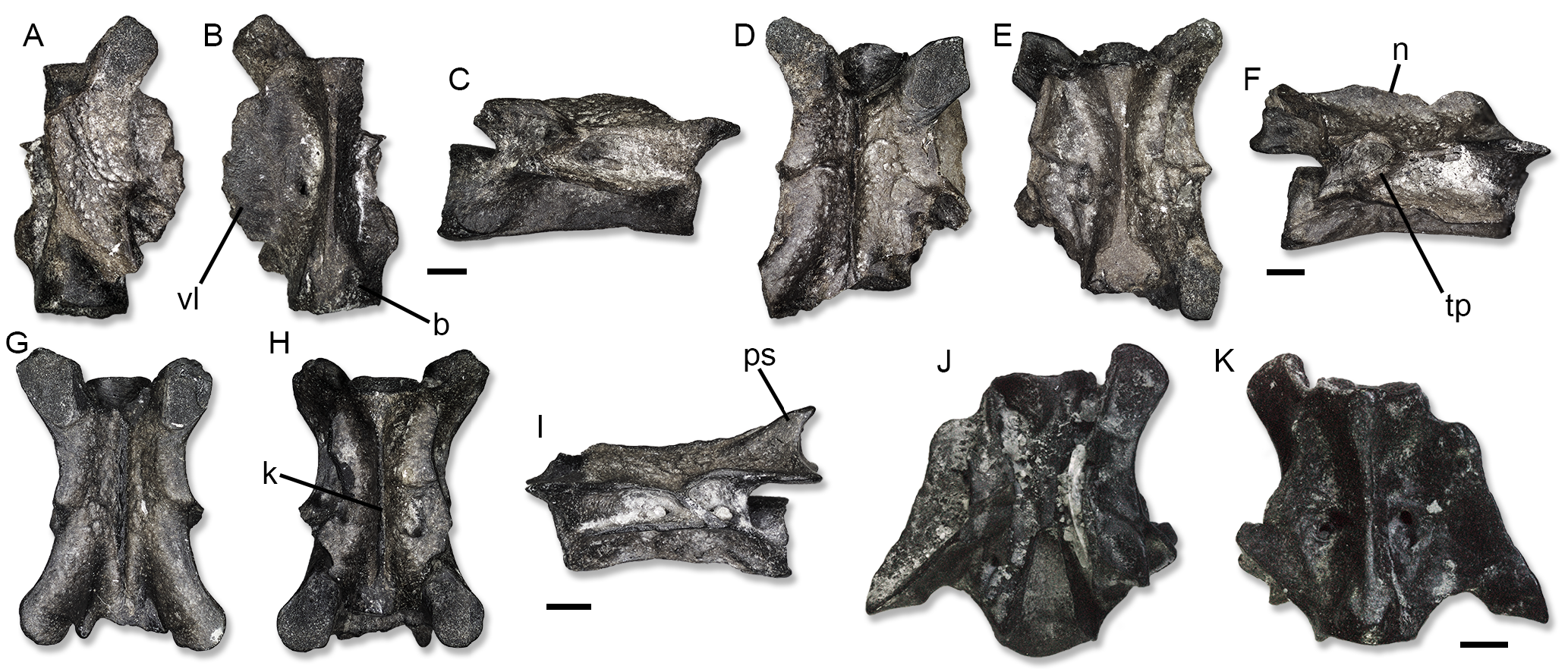
Description. These vertebrae (Figure 6) reach a large size and are robustly ossified. The largest one has a centrum length of about 6.5 mm. They display a range of different degree of preservational statuses, from very fragmentary to well preserved. The centrum is amphicoelous and pierced by a wide notochordal canal. Ventrally, the centrum bears a robust and high keel, which is more or less narrow (from sharp to slightly thicker). By the anterior and posterior ends, the keel expands into triangular and flat ventral surfaces. The keel is flanked by small subcentral foramina, sometimes more than one per side. Posteriorly, poorly-developed basapophyses are present. The neural arch is low, without a significant rising posteriorly, and dorsally flat. A neurapophysis is present, being either rather low or slightly higher. It runs almost entirely along the dorsal surface of the arch. The anterior margin of the arch appears straight in dorsal view, even though it is never completely preserved. It is located roughly at midlength of the prezygapophyses. The posterior margin is rather straight (but very slightly wavy, even though with no median notch) and ends well before the end of the postzygapophyses. By each side of the neurapophysis, the posterior end of the dorsal surface of the neural arch carries a well-developed spine, which projects well beyond the posterior margin, but not beyond the postzygapophyses. The spines are well spaced in dorsal view, not strongly extended anteriorly (they do not reach the level of the transverse processes) and not connected to the neurapophysis medially. The zygapophyses are suboval and almost horizontal. The ventral lamina has a subtrapezoidal shape, originated by very well-developed anterior ventral crests and less-developed posterior ones. The zygapophyseal crests are also well developed, but not as much as the anterior ventral crests. The posterior zygapophyseal crests are distinctly convex dorsally in lateral view. Due to the strong development of both the ventral lamina and the zygapophyseal crests, the vertebrae assume a wide appearance in both ventral and dorsal views. The transverse processes are reduced to a small single structure, which is slender and posterolaterally directed. Individualized para- and diapophyses are not clearly discernible. A more-or-less large foramen is visible anterior to the base of the transverse process.
Villa, Andrea, Macaluso, Loredana, Mörs, Thomas (2024): Miocene and Pliocene amphibians from Hambach (Germany): New evidence for a late Neogene refuge in northwestern Europe. Palaeontologia Electronica (a 3) 27 (1): 1-56, DOI: 10.26879/1323, URL: http://dx.doi.org/10.26879/1323
Figure 6
Villa, Andrea, Macaluso, Loredana, Mörs, Thomas (2024): Miocene and Pliocene amphibians from Hambach (Germany): New evidence for a late Neogene refuge in northwestern Europe. Palaeontologia Electronica (a 3) 27 (1): 1-56, DOI: 10.26879/1323, URL: http://dx.doi.org/10.26879/1323
Remarks. These vertebrae are referred to Mioproteus because of the following combination of features (Estes and Darevsky, 1977): robust and wellossified aspect; well-spaced posterior spines; wide appearance in dorsal and ventral views (i. e., wide neural arch, wide ventral lamina); presence of basapophyses. Three species of Mioproteus are currently known: Mioproteus caucasicus Estes and Darevsky, 1977, M. gardneri, and M. wezei. The vertebrae from Hambach are concordant in size with both M. caucasicus and M. wezei, whereas they are larger than M. gardneri. Regarding their morphology, they differ from M. gardneri in the more developed zygapophyseal crests, the taller neurapophysis, and the more laterally-trending prezygapophyses (Venczel and Codrea, 2018). Most characters reported to be diagnostic for M. wezei are variable, but at least the consistent absence of a connection between the posterior spines and the neurapophysis seems to be sufficiently reliable (Syromyatnikova et al., 2021). This condition is shown by the Hambach material, whereas M. caucasicus either has posterior spine that connect or not to the neurapophysis medially. Strongly dorsally-convex posterior zygapophyseal crests may also be typical for M. wezei (Młynarski et al., 1984; Bailon, 1995; even though Syromyatnikova et al., 2021, mentioned some variation of this feature in Mioproteus vertebrae). Considering this, we here tentatively attribute the Hambach Mioproteus vertebrae to M. wezei, even though pointing out uncertainty over this identification pending a clarification of the diagnostic features within Neogene Mioproteus.
Villa, Andrea, Macaluso, Loredana, Mörs, Thomas (2024): Miocene and Pliocene amphibians from Hambach (Germany): New evidence for a late Neogene refuge in northwestern Europe. Palaeontologia Electronica (a 3) 27 (1): 1-56, DOI: 10.26879/1323, URL: http://dx.doi.org/10.26879/1323
Material. Hambach 11: nine trunk vertebrae (IPB-HaR 2000 / 2007, IPB-HaR 2013). Hambach 11 C: six trunk vertebrae (IPB-HaR 2400 / 2403, IPB-HaR 2427 / 2428).
Villa, Andrea, Macaluso, Loredana, Mörs, Thomas (2024): Miocene and Pliocene amphibians from Hambach (Germany): New evidence for a late Neogene refuge in northwestern Europe. Palaeontologia Electronica (a 3) 27 (1): 1-56, DOI: 10.26879/1323, URL: http://dx.doi.org/10.26879/1323
Export occurrence data
Darwin Core Archive (ZIP)

MULTIMEDIA
Media Files(1)
FIGURE 6. Mioproteus cf. wezei from Hambach: trunk vertebra (IPB-HaR 2000) in dorsal (A), ventral (B) and right lateral (C) views; trunk vertebra (IPB-HaR 2006) in dorsal (D), ventral (E) and right lateral (F) views; trunk vertebra (IPB-HaR 2007) in dorsal (G), ventral (H) and left lateral (I) views; trunk vertebra (IPB-HaR 2403) in dorsal (J) and ventral (K) views. Scale bars equal 1 mm. Abbreviations: b, basapophysis; k, keel; n, neurapophysis; ps, posterior spine; tp, transverse process; vl, ventral lamina.
Imageimage/png© Villa, Andrea;Macaluso, Loredana;Mörs, ThomasVilla, Andrea;Macaluso, Loredana;Mörs, Thomas
IMAGES