AnimaliaNot EvaluatedacceptedspeciesAccepted
Palaeoproteus miocenicus

Palaeoproteus miocenicus

(Vasilyan & Yanenko, 2020)

GBIF:226325453

0year

ABOUT

Descriptions(4)

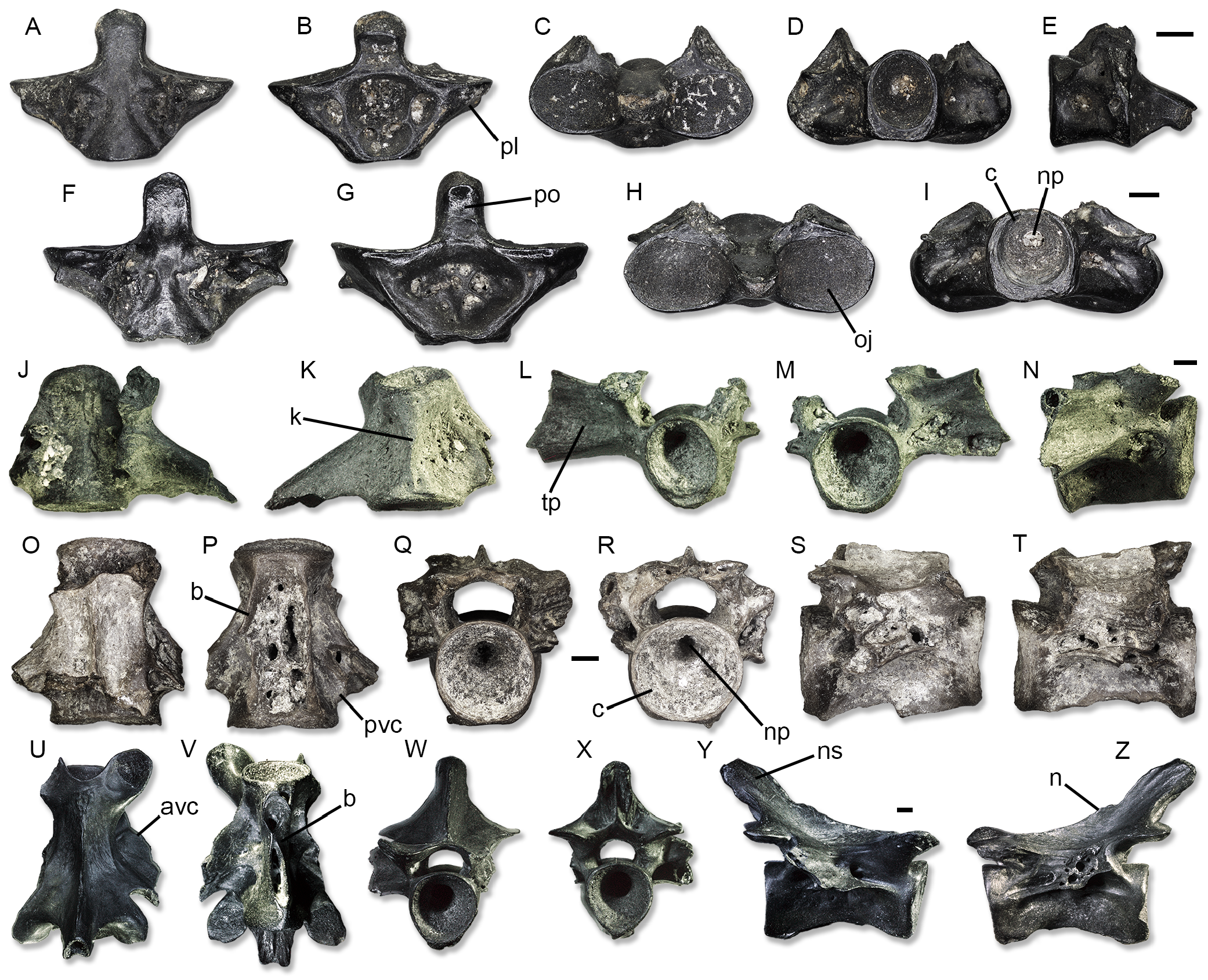
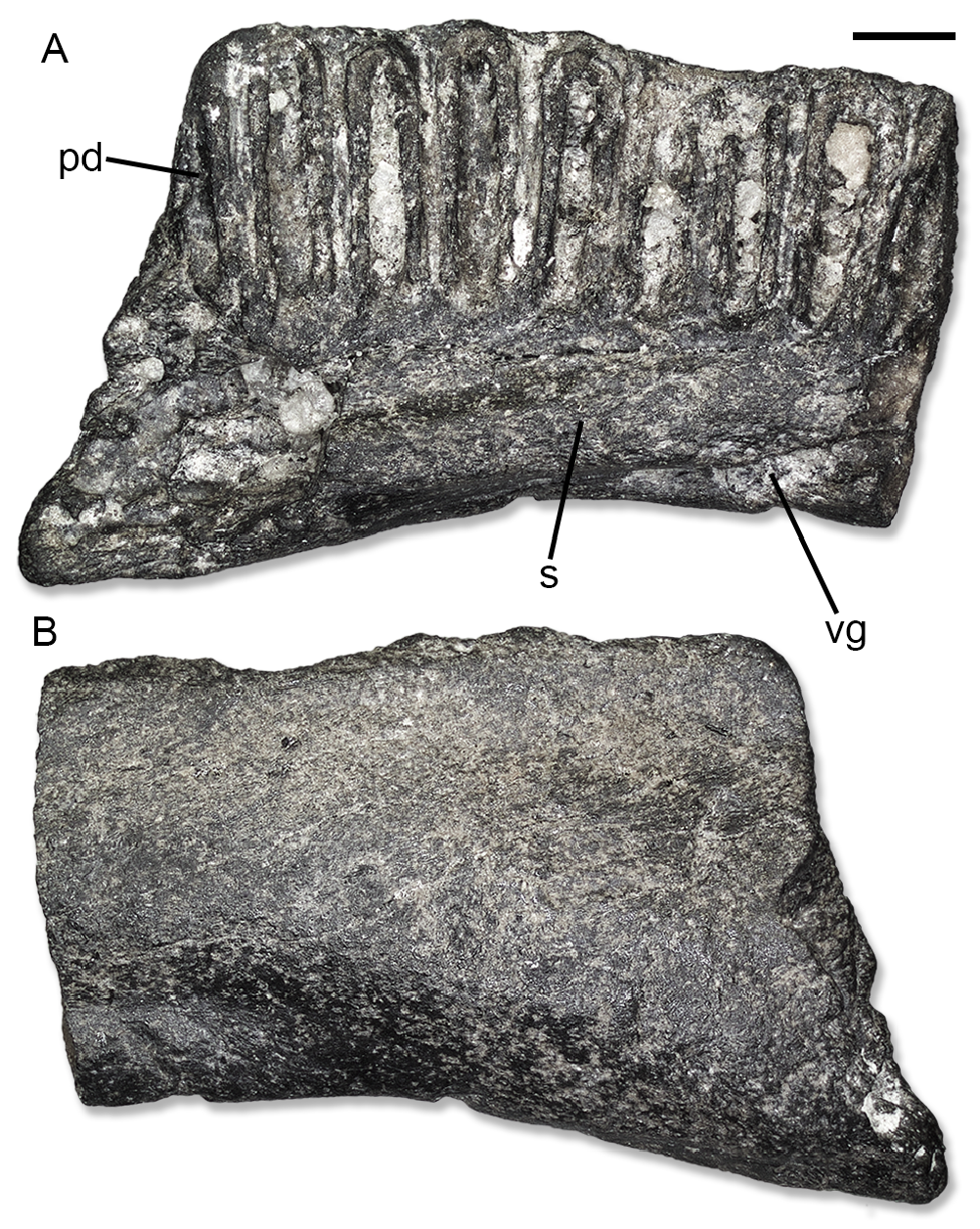
Description. IPB-HaR 2071 (Figure 3) represents part of the posterior end of a very large dentary. It is very fragmentary. IPB-HaR 2043 is also very large and robust. It represents a portion originally located somewhere in the middle of the dentary. The pars dentalis of the dentary is composed by a very high dental lamina and a very low subdental lamina. On the medial side, nine tooth positions are visible, hosting the poorly-preserved remains of pleurodont, very high, rather narrow and closely spaced teeth provided with thick walls. Ventral to the pars dentalis, there is a robust shelf, which is not strongly developed medially. The preservation of this shelf is rather poor, but a narrow and shallow groove is visible ventrally. The groove moves towards the medial surface near the anterior end of the fragment. The lateral surface is smooth. In lateral / medial view, the ventral margin is somehow concave, suggesting ventral development of the posterior part of the dentary. IPB-HaH 2164 is a very small atlas, but the other ones are larger. The length of the largest atlas, IPB-HaH 2175 (Figure 4 F-I), is 6 mm. All atlases miss almost completely the neural arch, preserving only the centrum. Anteriorly, the occipital joints are wide and mediolaterally elongated, with a suboval / subelliptical shape (i. e., slightly dorsoventrally compressed) in anterior view. They are very shallowly concave and do not coalesce in the middle, being separated by a thin and long processus odontoideus. The processus is slightly slenderer in IPB-HaH 2175 than in the other two specimens. It has a flat dorsal surface and an anteroventrally-directed and strip-like articular surface that is not separated into two distinct lateral areas. There is no postodontoideus foramen at the base of the process. The posterior end of the centrum is represented by a posterior cotyle with a notochordal pit in the middle. The cotyle is circular in IPB-HaH 2175 (Figure 4 I) and more mediolaterally compressed in IPB-HaH 2117 (Figure 4 D). In both specimens, it is larger than the processus odontoideus. This feature cannot be evaluated in IPB-HaH 2164 because the area is damaged. In IPB-HaH 2715, the ventral surface of the centrum shows a concave area with a number of large foramina (Figure 4 G). On the other hand, IPB-HaH 2117 bears a very deep fossa in the middle of the centrum, which is flanked by two smaller symmetrical foramina by the sides and by other even smaller foramina posteriorly (Figure 4 B). The ventral surface of IPB-HaH 2164 displays a depressed area by each side of the centrum. Foramina also cover the lateral surface of each processus lateralis in all specimens. Both IPB-HaR 2008 (Figure 4 O-T) and IPB-HaR 2408 (Figure 4 U-Z) are amphicoelous and large sized (the centrum length reaches 6.5 mm and 9.5 mm, respectively). A notochordal pit is present in the middle of the large and hourglassshaped centrum. The cotyles are circular in both anterior and posterior views. The ventral surface of the centrum bears two high and sharp longitudinal basapophyses, which run parallel along the entire length of the vertebra. Only in IPB-HaR 2408, the basapophyses contact in the middle at about one third of the centrum length (Figure 4 V). Between the basapophyses, various central foramina are present. At least three large ones are visible on IPB-HaR 2008 (Figure 4 P), surrounded by other smaller ones, whereas only a number of small ones are visible on IPB-HaR 2408 (Figure 4 V). The neural arch is robust and dorsally flattened, being better preserved in IPB-HaR 2408. A neurapophysis is present. It is low anteriorly, but rises to a moderate degree posteriorly. A robust spine is present at the posterior end of the arch, strongly projecting posterodorsally beyond the postzygapophyses. The posterior end of the spine is truncated. A wide and deep, U-shaped anterior notch on the neural arch is visible on IPB-HaR 2408 (Figure 4 U), allowing the anterior cotyle to be visible in dorsal view. The deepest part of the notch reaches the posterior margin of the prezygapophyses. The zygapophyses are more or less horizontal in both anterior and posterior view. The zygapophyseal facets are suboval. In posterior view, two shallow depressions are visible on the posteroventral surface of the neural arch, flanking a low longitudinal ridge running along the ventral side of the neural spine. The transverse processes are moderately developed and posterolaterally directed. Ventrally, they are connected to the centrum by moderately- (IPB-HaR 2008) or well-developed (IPB-HaR 2408) anterior ventral crests (anterior alar process in Vasilyan and Yanenko, 2020) and little-developed posterior ventral crests. On the other hand, the zygapophyseal crests are not developed. The other vertebrae only preserve isolated centra or fragments of centra, some of them being much smaller than the two previously described (IPB-HaR 2406 is about 4 mm long). Nevertheless, they share the same morphology. IPB-HaR 2183 (Figure 4 J-N) is the only trunk vertebra displaying some differences from the other ones. This large vertebra has a very massive, almost 6 mm long centrum, which is amphicoelous, hour-glass-shaped and notochordal. The overall aspect is relatively shorter compared to the trunk vertebra IPB-HaR 2008, coming from the same level. The anterior cotyle is moderately mediolaterally compressed, appearing subelliptical in anterior view. The posterior cotyle, on the other hand, is subcircular in posterior view. The ventral surface of the centrum bears a narrow keel and no basapophyses. A number of small foramina are present by the ventrolateral sides of the centrum, in place of real subcentral foramina. Most of the neural arch is missing, preserving only the right lateral wall and the base of the left one. The transverse processes are long and moderately robust; they are directed posterolaterally. The anterior ventral crest is very low, whereas the posterior one is slightly more developed. Zygapophyseal crests are not developed. The base of the right prezygapophysis is also preserved, but not the zygapophysis itself. The shortness of this vertebra, together with its ventral keel, identify it as an anterior trunk vertebra (Estes et al., 1967).
Villa, Andrea, Macaluso, Loredana, Mörs, Thomas (2024): Miocene and Pliocene amphibians from Hambach (Germany): New evidence for a late Neogene refuge in northwestern Europe. Palaeontologia Electronica (a 3) 27 (1): 1-56, DOI: 10.26879/1323, URL: http://dx.doi.org/10.26879/1323
Figures 3 – 4
Villa, Andrea, Macaluso, Loredana, Mörs, Thomas (2024): Miocene and Pliocene amphibians from Hambach (Germany): New evidence for a late Neogene refuge in northwestern Europe. Palaeontologia Electronica (a 3) 27 (1): 1-56, DOI: 10.26879/1323, URL: http://dx.doi.org/10.26879/1323
Remarks. The diagnostic features recently reported by Vasilyan and Yanenko (2020) allow a rather straightforward identification for these remains as a batrachosauroidid salamander. The dentaries of these urodeles have thick-walled teeth and a ventrally-projecting posterior part. Trunk vertebrae are amphicoelous, with subcircular cotyles, basapophyses, and a posterodorsally-projecting neural spine. The atlases are provided with both anterior and posterior cotyles with a rounded outline, among which the former are large and concave. The well-developed paired ventral basapophyses, as well as maybe the flat neural arch and developed anterior ventral crest, suggest that the batrachosauroidid from Hambach is a member of the European genus Palaeoproteus (Vasilyan and Yanenko, 2020). In particular, the following combination of features observed in the studied material is diagnostic of P. miocenicus following Vasilyan and Yanenko (2020): overall large size; poorly-developed subdental shelf of dentary; vertebrae with a long neural spine; weakly-concave and slightly dorsoventrally-compressed anterior cotyles of the atlas; external surface of the atlas pierced by foramina of different sizes; strongly pronounced, lip-shaped odontoid process of the atlas (Vasilyan and Yanenko, 2020: p. 8, stated that “ In P. miocenicus, the odontoid process is very large in comparison to all known batrachosauroidids ”). However, the atlases from Hambach 6 C show no postodontoid foramen, in contrast with the type and referred material of P. miocenicus (Vasilyan and Yanenko, 2020). All four P. miocenicus atlases share the presence of this foramen, whereas it is absent in Palaeoproteus klatti Herre, 1935, and Palaeoproteus gallicus Estes et al., 1967. Despite this difference, we refrain to name a new species here and attribute the fossils from Hambach 6 C to Palaeoproteus cf. miocenicus, due to the overall similarity between bones of P. miocenicus and the German taxon as well as the low sample of atlases that hinders a complete understanding of the real variation of this feature in these animals. Material coming from the youngest level in Hambach also shares the same attribution, given that atlases from this level are currently unknown, and so it is not possible to verify the presence or absence of a postodontoid foramen.
Villa, Andrea, Macaluso, Loredana, Mörs, Thomas (2024): Miocene and Pliocene amphibians from Hambach (Germany): New evidence for a late Neogene refuge in northwestern Europe. Palaeontologia Electronica (a 3) 27 (1): 1-56, DOI: 10.26879/1323, URL: http://dx.doi.org/10.26879/1323
Material. Hambach 6 C: three atlases (IPB-HaH 2117, IPB-HaH 2175, IPB-HaH 2164); one trunk vertebra (IPB-HaH 2162). Hambach 11: two dentaries (IPB-HaR 2043, IPB-HaR 2071); one anterior trunk vertebra (IPB-HaR 2183); one trunk vertebra (IPB-HaR 2008). Hambach 11 C: five trunk vertebrae (IPB-HaR 2404 / 2408).
Villa, Andrea, Macaluso, Loredana, Mörs, Thomas (2024): Miocene and Pliocene amphibians from Hambach (Germany): New evidence for a late Neogene refuge in northwestern Europe. Palaeontologia Electronica (a 3) 27 (1): 1-56, DOI: 10.26879/1323, URL: http://dx.doi.org/10.26879/1323

Export occurrence data

Darwin Core Archive (ZIP)

CLASSIFICATION

Taxonomic Classification Tree

MULTIMEDIA

Media Files(2)

FIGURE 3. Skull elements of Palaeoproteus cf. miocenicus from Hambach: left dentary (IPB-HaR 2043) in medial (A) and lateral (B) views. Scale bar equals 1 mm. Abbreviations: pd, pars dentalis; s, shelf; vg, ventral groove.

Imageimage/png© Villa, Andrea;Macaluso, Loredana;Mörs, ThomasVilla, Andrea;Macaluso, Loredana;Mörs, Thomas

FIGURE 4. Vertebrae of Palaeoproteus cf. miocenicus from Hambach: atlas (IPB-HaH 2117) in dorsal (A), ventral (B), anterior (C), posterior (D) and right lateral (E) views; atlas (IPB-HaH 2175) in dorsal (F), ventral (G), anterior (H) and posterior (I) views; anterior trunk vertebra (IPB-HaR 2183) in dorsal (J), ventral (K), anterior (L), posterior (M) and right lateral (N) views; trunk vertebra (IPB-HaR 2008) in dorsal (O), ventral (P), anterior (Q), posterior (R), right lateral (S) and left lateral (T) views; trunk vertebra (IPB-HaR 2408) in dorsal (U), ventral (V), anterior (W), posterior (X), right lateral (Y) and left lateral (Z) views. Scale bars equal 1 mm. Abbreviations: avc, anterior ventral crest; b, basapophyses; c, cotyle; k, keel; n, neurapophysis; np, notochordal pit; ns, neural spine; oj, occipital joint; pl, processus lateralis; po, processus odontoideus; pvc, posterior ventral crest; tp, transverse process.

Imageimage/png© Villa, Andrea;Macaluso, Loredana;Mörs, ThomasVilla, Andrea;Macaluso, Loredana;Mörs, Thomas

IMAGES

Gallery(2)

See Gallery

Occurrences with images

Source Information

Miocene and Pliocene amphibians from Hambach (Germany): New evidence for a late Neogene refuge in northwestern Europe

checklist

This dataset contains the digitized treatments in Plazi based on the original journal article Villa, Andrea, Macaluso, Loredana, Mörs, Thomas (2024): Miocene and Pliocene amphibians from Hambach (Germany): New evidence for a late Neogene refuge in northwestern Europe. Palaeontologia Electronica (a 3) 27 (1): 1-56, DOI: 10.26879/1323, URL: http://dx.doi.org/10.26879/1323

ABSTRACT

The Hambach lignite mine in northwestern Germany is a renowned fossil locality, which has yielded remains of several vertebrates dated back to the Middle Miocene and the Late Pliocene. Among these is a recently-described and peculiar proteid urodele, Euronecturus grogu, currently known only from the Middle Miocene level in Hambach. Here, we provide detailed descriptions and identifications of the remaining fossil amphibians (both urodeles and anurans) from the Hambach mine, in total identifying at least 12 Middle Miocene taxa (Cryptobranchidae indet., Palaeoproteus cf. miocenicus, E. grogu, Chelotriton sp., Lissotriton sp., Triturus sp., Latonia sp.,? Palaeobatrachidae indet., Pelobatidae indet., Hyla sp., Pelophylax sp., Rana sp.) and at least nine Late Pliocene ones (Palaeoproteus cf. miocenicus, Mioproteus cf. wezei, Lissotriton sp., Latonia sp., Palaeobatrachus eurydices, cf. Eopelobates sp., Hyla sp., Bufo gr. bufo, Ranidae indet.). The high diversity of amphibians in both Miocene and Pliocene levels at Hambach supports a very humid climate persisting in the area for most of the Neogene, possibly originating a refugium for these animals in northwestern Europe that persisted until the Late Pliocene (and possibly even the Early Pleistocene). Urodeles such as Palaeoproteus and Mioproteus and anurans such as Latonia, the palaeobatrachids, and possibly Eopelobates are all significant occurrences in such a northern latitude at the end of the Pliocene, a period when southward withdrawal of thermophilic animals as well as the first effects of a deteriorizing climate ultimately leading to the Quaternary glaciation had already started in the European continent.

Andrea Villa. Institut Català de Paleontologia Miquel Crusafont (ICP-CERCA), Universitat Autònoma de Barcelona, Edifici ICTA-ICP, c/ Columnes s/n, Campus de la UAB, 08193 Cerdanyola del Vallès, Barcelona, Spain. andrea.villa@icp.cat

Loredana Macaluso. Natural Sciences Collections, Martin Luther University Halle-Wittenberg, Domplatz 4, 06108 Halle (Saale), Germany. loredana.macaluso@zns.uni-halle.de

Thomas Mörs. Department of Palaeobiology, Swedish Museum of Natural History, PO Box 50007, SE 10405, Stockholm, Sweden; Bolin Centre for Climate Research, Department of Environmental Science, Stockholm University, Geovetenskapens hus, Svante Arrhenius väg 8, Stockholm, Sweden.

thomas.moers@nrm.se

Villa A, Macaluso L, Mörs T, felipe (2024). Miocene and Pliocene amphibians from Hambach (Germany): New evidence for a late Neogene refuge in northwestern Europe. Plazi.org taxonomic treatments database. Checklist dataset https://doi.org/10.15468/e5mg5t accessed via GBIF.org on 2026-06-14.

CC0Published 12/31/2024View dataset
GBIF Usage Key
226325453
Dataset Key
dbf14828-431e-497d-9703-0a53b1864567
Origin
source
Taxon ID
03F52665D050FF8FFC609E34FB8C74CD.taxon
Last Crawled
6/9/2026
Last Interpreted
6/9/2026