AnimaliaacceptedfamilyAccepted
Ranidae

Ranidae

Batsch, 1796

GBIF:226325455

0year

ABOUT

Descriptions(4)

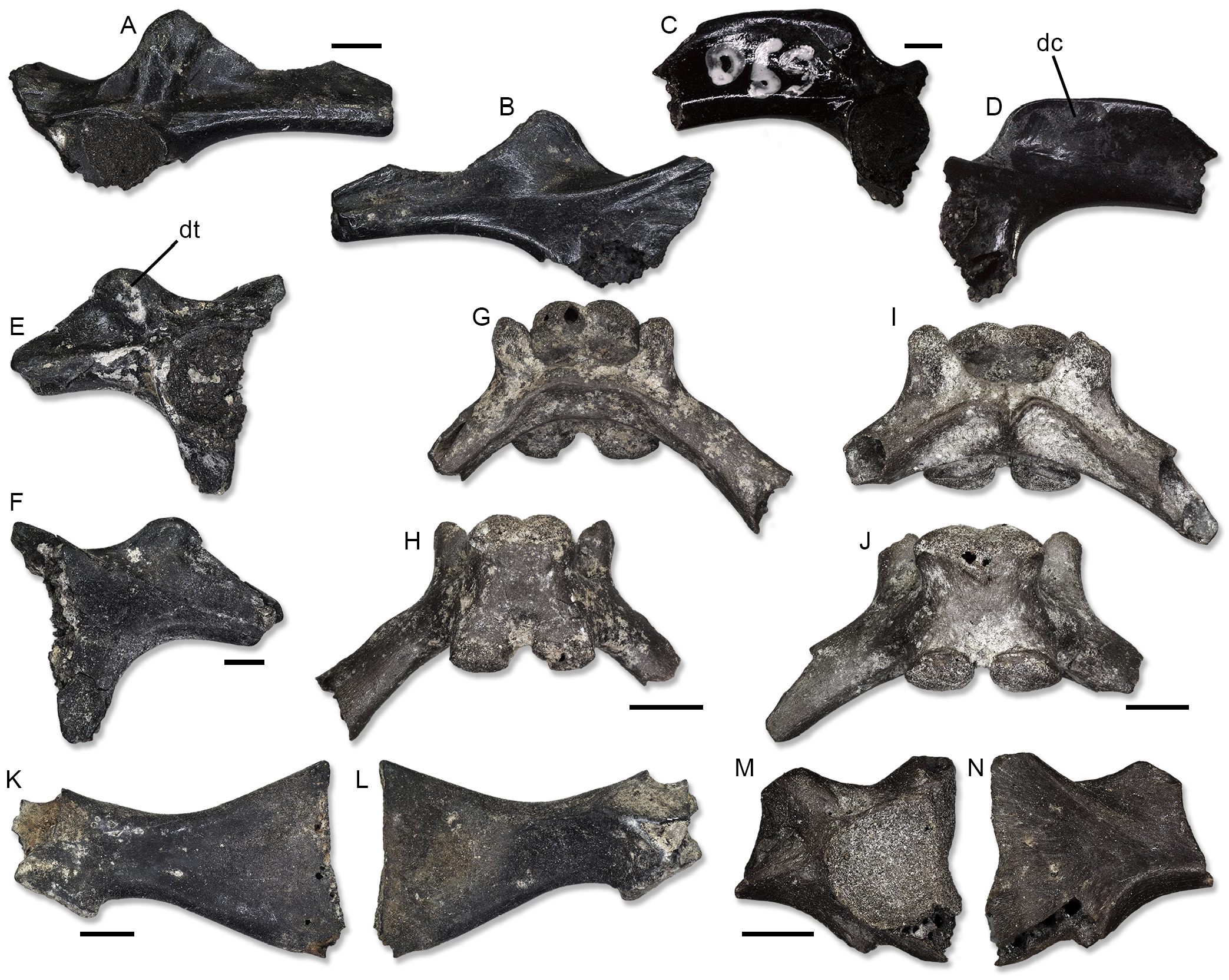
Description. IPB-HaR 2184 is a small and amphicoelous trunk vertebra, with a short neural arch and laterally directed transverse processes. Sacral vertebrae (Figure 22 G-J) are small and provided with one anterior and two posterior condyles. They have cylindrical transverse processes. IPB-HaH 2323 (Figure 22 K-L) is an elongated scapula. It has no ridges on the anterior margin, but it is provided with a ridge on the inner surface. The cavitas glenoidalis opens in posterior direction and is partially hidden by the pars acromialis in ventral view. The ilium (Figure 22 M-N) is small and poorly preserved, missing completely the shaft. It has a large and subcircular acetabular fossa. Dorsal to the latter, a deep supraacetabular fossa is present. The dorsal tubercle is also present, even though mostly broken away. Nevertheless, it appears moderately distinct. Anteriorly, it is in continuation with a dorsal crest. Both the dorsal and ventral acetabular expansions are broken, but the former appears well developed based on what is preserved. Medially, there is no interiliac groove or tubercle. The ilioischiatic juncture seems rather low and large, but it is not completely preserved.
Villa, Andrea, Macaluso, Loredana, Mörs, Thomas (2024): Miocene and Pliocene amphibians from Hambach (Germany): New evidence for a late Neogene refuge in northwestern Europe. Palaeontologia Electronica (a 3) 27 (1): 1-56, DOI: 10.26879/1323, URL: http://dx.doi.org/10.26879/1323
Figure 22 G-N
Villa, Andrea, Macaluso, Loredana, Mörs, Thomas (2024): Miocene and Pliocene amphibians from Hambach (Germany): New evidence for a late Neogene refuge in northwestern Europe. Palaeontologia Electronica (a 3) 27 (1): 1-56, DOI: 10.26879/1323, URL: http://dx.doi.org/10.26879/1323
Remarks. All these specimens present a combination of features supporting attribution to indeterminate ranids according to the criteria presented by Bailon (1999). For the trunk vertebra, this combination includes amphicoely, the short neural arch, and the laterally directed processes; this further suggests that it represents the eighth vertebra in the column (Bailon, 1999). In the sacral vertebra, the diagnostic combination consists of the anterior condyle, the two posterior condyles, and the cylindrical processes. For the scapula, significant are the elongation, the absence of crista anterior, the cavitas glenoidalis hidden in ventral view, as well as the presence of an inner ridge on scapula. The attribution of the ilium is supported by the presence of the dorsal crest and the absence of interiliac tubercles and grooves. The low and large juncture could hint at green frogs for the ilium (Gleed-Owen, 1998), but it is not clear how much this apparent morphology may be influenced by the preservation.
Villa, Andrea, Macaluso, Loredana, Mörs, Thomas (2024): Miocene and Pliocene amphibians from Hambach (Germany): New evidence for a late Neogene refuge in northwestern Europe. Palaeontologia Electronica (a 3) 27 (1): 1-56, DOI: 10.26879/1323, URL: http://dx.doi.org/10.26879/1323
Material. Hambach 6 C: nine sacral vertebrae (IPB-HaH 2193 / 2194, IPB-HaH 2209 / 2215); one scapula (IPB-HaH 2323). Hambach 11: one trunk vertebra (IPB-HaR 2184); three sacral vertebrae (IPB-HaR 2018 / 2019; IPB-HaR 2031); one ilium (IPB-HaR 2087).
Villa, Andrea, Macaluso, Loredana, Mörs, Thomas (2024): Miocene and Pliocene amphibians from Hambach (Germany): New evidence for a late Neogene refuge in northwestern Europe. Palaeontologia Electronica (a 3) 27 (1): 1-56, DOI: 10.26879/1323, URL: http://dx.doi.org/10.26879/1323

Export occurrence data

Darwin Core Archive (ZIP)

CLASSIFICATION

Taxonomic Classification Tree

MULTIMEDIA

Media Files(1)

FIGURE 22. Ranids from Hambach: right ilium (IPB-HaH 2307) of Pelophylax sp. in lateral (A) and medial (B) views; left ilium (IPB-HaH 2387) of Pelophylax sp. in lateral (C) and medial (D) views; left ilium (IPB-HaH 2321) of Rana sp. in lateral (E) and medial (F) views; sacral vertebra (IPB-HaR 2018) of Ranidae indet. in dorsal (G) and ventral (H) views; sacral vertebra (IPB-HaR 2019) of Ranidae indet. in dorsal (I) and ventral (J) views; left scapula (IPB-HaH 2323) of Ranidae indet. in ventral (K) and dorsal (L) views; left ilium (IPB-HaR 2087) of Ranidae indet. in lateral (M) and medial (N) views. Scale bars equal 1 mm. Abbreviations: dc, dorsal crest; dt, dorsal tubercle.

Imageimage/png© Villa, Andrea;Macaluso, Loredana;Mörs, ThomasVilla, Andrea;Macaluso, Loredana;Mörs, Thomas

IMAGES

Gallery(1)

See Gallery

Occurrences with images

Source Information

Miocene and Pliocene amphibians from Hambach (Germany): New evidence for a late Neogene refuge in northwestern Europe

checklist

This dataset contains the digitized treatments in Plazi based on the original journal article Villa, Andrea, Macaluso, Loredana, Mörs, Thomas (2024): Miocene and Pliocene amphibians from Hambach (Germany): New evidence for a late Neogene refuge in northwestern Europe. Palaeontologia Electronica (a 3) 27 (1): 1-56, DOI: 10.26879/1323, URL: http://dx.doi.org/10.26879/1323

ABSTRACT

The Hambach lignite mine in northwestern Germany is a renowned fossil locality, which has yielded remains of several vertebrates dated back to the Middle Miocene and the Late Pliocene. Among these is a recently-described and peculiar proteid urodele, Euronecturus grogu, currently known only from the Middle Miocene level in Hambach. Here, we provide detailed descriptions and identifications of the remaining fossil amphibians (both urodeles and anurans) from the Hambach mine, in total identifying at least 12 Middle Miocene taxa (Cryptobranchidae indet., Palaeoproteus cf. miocenicus, E. grogu, Chelotriton sp., Lissotriton sp., Triturus sp., Latonia sp.,? Palaeobatrachidae indet., Pelobatidae indet., Hyla sp., Pelophylax sp., Rana sp.) and at least nine Late Pliocene ones (Palaeoproteus cf. miocenicus, Mioproteus cf. wezei, Lissotriton sp., Latonia sp., Palaeobatrachus eurydices, cf. Eopelobates sp., Hyla sp., Bufo gr. bufo, Ranidae indet.). The high diversity of amphibians in both Miocene and Pliocene levels at Hambach supports a very humid climate persisting in the area for most of the Neogene, possibly originating a refugium for these animals in northwestern Europe that persisted until the Late Pliocene (and possibly even the Early Pleistocene). Urodeles such as Palaeoproteus and Mioproteus and anurans such as Latonia, the palaeobatrachids, and possibly Eopelobates are all significant occurrences in such a northern latitude at the end of the Pliocene, a period when southward withdrawal of thermophilic animals as well as the first effects of a deteriorizing climate ultimately leading to the Quaternary glaciation had already started in the European continent.

Andrea Villa. Institut Català de Paleontologia Miquel Crusafont (ICP-CERCA), Universitat Autònoma de Barcelona, Edifici ICTA-ICP, c/ Columnes s/n, Campus de la UAB, 08193 Cerdanyola del Vallès, Barcelona, Spain. andrea.villa@icp.cat

Loredana Macaluso. Natural Sciences Collections, Martin Luther University Halle-Wittenberg, Domplatz 4, 06108 Halle (Saale), Germany. loredana.macaluso@zns.uni-halle.de

Thomas Mörs. Department of Palaeobiology, Swedish Museum of Natural History, PO Box 50007, SE 10405, Stockholm, Sweden; Bolin Centre for Climate Research, Department of Environmental Science, Stockholm University, Geovetenskapens hus, Svante Arrhenius väg 8, Stockholm, Sweden.

thomas.moers@nrm.se

Villa A, Macaluso L, Mörs T, felipe (2024). Miocene and Pliocene amphibians from Hambach (Germany): New evidence for a late Neogene refuge in northwestern Europe. Plazi.org taxonomic treatments database. Checklist dataset https://doi.org/10.15468/e5mg5t accessed via GBIF.org on 2026-06-14.

CC0Published 12/31/2024View dataset
GBIF Usage Key
226325455
Dataset Key
dbf14828-431e-497d-9703-0a53b1864567
Origin
source
Backbone Key
6746
Taxon ID
03F52665D074FFA8FE309AC3FA7F74B3.taxon
Last Crawled
6/9/2026
Last Interpreted
6/9/2026
