
AnimaliaNot EvaluatedacceptedspeciesAccepted
Palaeobatrachus eurydices

Palaeobatrachus eurydices

Villa, Rocek, Tschopp & van den Hoek

GBIF:226325464

ABOUT

Descriptions(4)

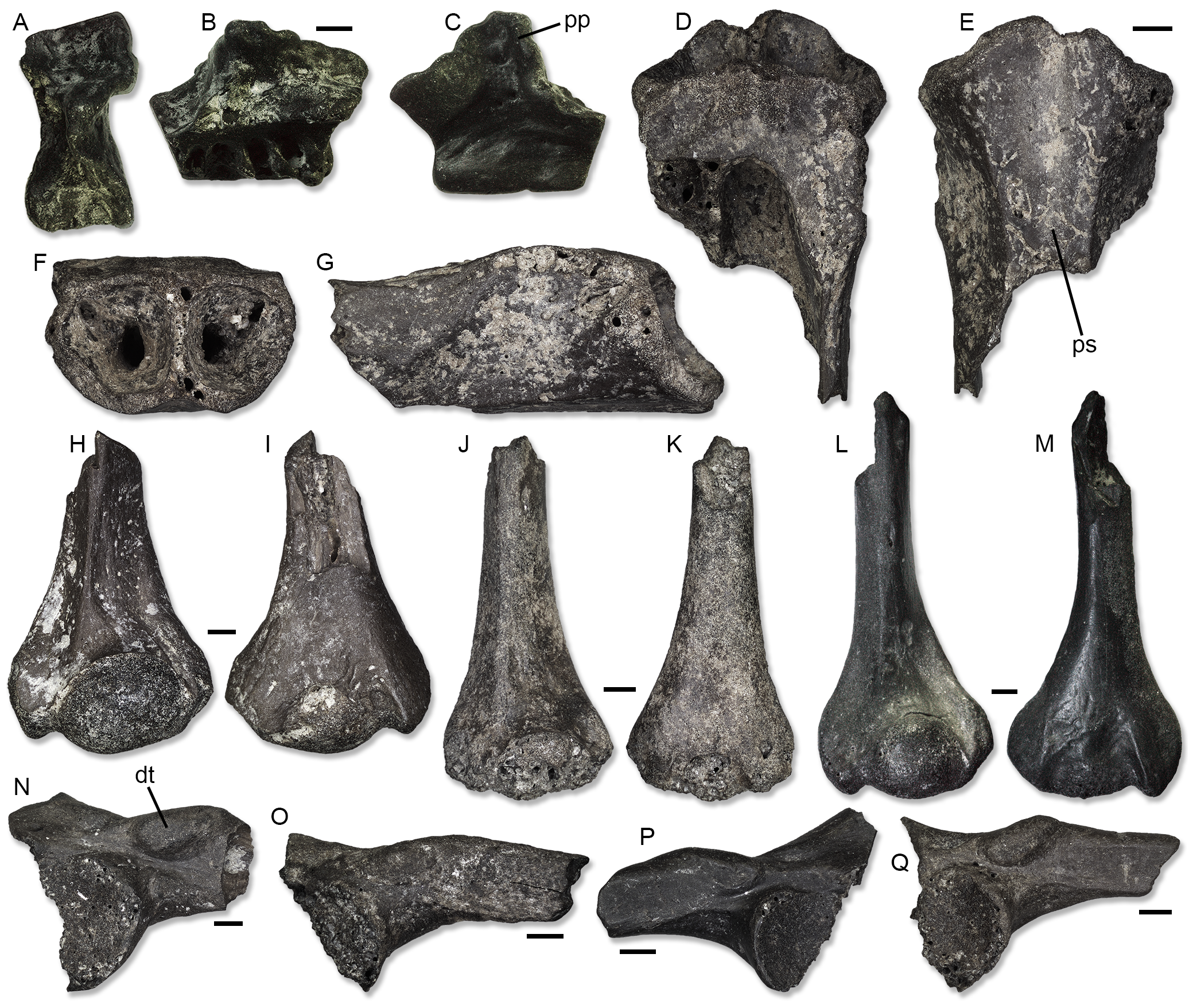
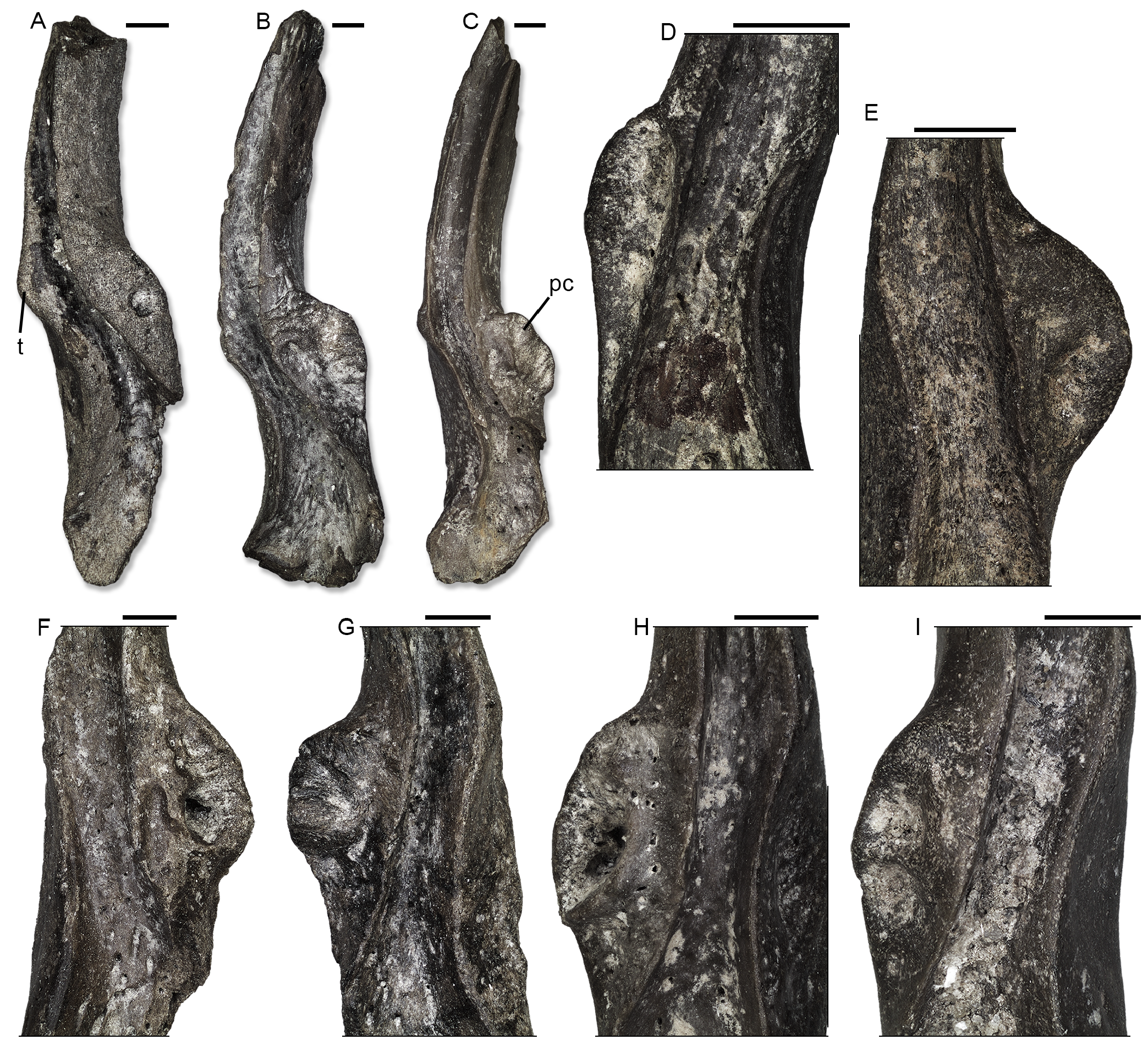
Description. IPB-HaR 2429 (Figure 16 A-C) is a fragment of maxilla, measuring about 5.5 mm in length and preserving only the area of the processus palatinus. The bone is robustly built. On the medial side, part of the tooth row is preserved, even though in bad conditions. Four wide tooth positions are preserved, one of them still hosting the base of a tooth. The tooth positions are separated by knob-like structures. The lamina horizontalis is mostly broken, but it clearly extended medially with a toothless portion. No clear ridge is visible ventrally separating the toothed and toothless portion of the lamina. On its dorsal side, a deep recessus vaginiformis is present. The processus palatinus is represented in this specimen by a low, subtriangular structure with a truncated dorsal tip. In dorsal view, it is shifted medially, thus originating a concavity on the lateral surface of the maxilla. Both the anterior and posterior margins of the process are distinctly irregular, and its lateral surface displays few foramina. IPB-HaR 2021 (Figure 16 D-G) is a fragmentary sphenethmoid. It is anteroposteriorly elongated and large-sized. The lateral margins of the bone are rather eroded, but distinctly developed laminae supraorbitalis and trabecula seem not to be present. In dorsal view, a long and U-shaped fenestra frontoparietalis is recognizable, even if the left portion of the bone is lacking. Anteriorly to the fenestra, the dorsal surface of the bone is smooth. The contact surface with the parasphenoid is visible on the ventral surface: it is delimited laterally by two low ridges and widens anteriorly. Angulars are robust and large-sized. They have a rather deep sulcus cartilagine Meckeli and an anteroposteriorly elongate, stocky and dorsoventrally compressed processus coronoideus. The dorsal surface of the latter is strongly irregular, with pits and / or ridges, and shows a certain degree of individual variation (Figure 17). A few angulars, such as e. g., IPB-HaR 2111 (Figure 17 A) and IPB-HaR 2418, bear a small tubercle on the lateral side, in correspondence with the anterior end of the processus coronoideus. The extremitas spatulata is short and broad. IPB-HaR 2030 is a fragmentary trunk vertebra provided with a very dorsoventrally compressed centrum. The latter is procoelous, wide, and shows numerous small pits on the ventral surface. Humeri (Figure 16 H-M) are very large-sized and lack a fossa cubitalis ventralis. The eminentia capitata and the epicondyles are distally eroded and were probably partly cartilaginous in the living animal. The epicondylus ulnaris is only slightly larger than the epicondylus radialis. The olecranon scar is depressed, but the articular surface with the olecranon of the radioulna is small and poorly developed. All specimens but IPB-HaR 2420 preserve only the distal epiphysis and the distal part of the diaphysis. IPB-HaR 2420 is more preserved, but the proximal end of the bone is still missing. A hint of a robust crista ventralis is recognizable on the ventral surface of the humeri. This is particularly evident in IPB-HaR 2420, which also express the base of a crista paraventralis. Cristae medialis and lateralis are not developed. Ilia (Figure 16 N-Q) show a well-developed and elongated dorsal tubercle, but no dorsal crest. The tubercle bends in lateral direction. The large acetabular fossa has a prominent anteroventral rim. The ventral acetabular expansion is not developed, whereas the dorsal one is moderately developed. A supraacetabular fossa is visible dorsally to the acetabulum. A wide and deep interiliac groove is visible on the medial surface of the body of the bone.
Villa, Andrea, Macaluso, Loredana, Mörs, Thomas (2024): Miocene and Pliocene amphibians from Hambach (Germany): New evidence for a late Neogene refuge in northwestern Europe. Palaeontologia Electronica (a 3) 27 (1): 1-56, DOI: 10.26879/1323, URL: http://dx.doi.org/10.26879/1323
Figures 16 – 17
Villa, Andrea, Macaluso, Loredana, Mörs, Thomas (2024): Miocene and Pliocene amphibians from Hambach (Germany): New evidence for a late Neogene refuge in northwestern Europe. Palaeontologia Electronica (a 3) 27 (1): 1-56, DOI: 10.26879/1323, URL: http://dx.doi.org/10.26879/1323
Remarks. Clear diagnostic features of palaeobatrachid anurans in the above-described material are the following (Wuttke et al., 2012; Roček, 2013; Roček et al., 2021): knob-like structures separating tooth positions in the maxilla; elongated sphenethmoid, provided with frontoparietal fenestra longer than half the total length of the bone and with two parallel ridges delimiting the articulation area for the parasphenoid on the ventral surface; coronoid process of the angular either smooth or bearing muscle scars on dorsal surface; vertebral centrum strongly dorsoventrally compressed and with numerous pits on the ventral surface; humerus devoid of fossa cubitalis ventralis (different from Eocene palaeobatrachids, though) and provided with a comparatively small eminentia capitata that is located on or near the long axis of bone, as well as similar-sized epicondyles; ilium with massive dorsal acetabular expansion; large acetabular fossa extending anteroventrally beyond the margin of the ilial body, thus concealing the ventral expansion; dorsal tubercle protruding only slightly in dorsal direction, but more prominent laterally and bearing muscle scars on the lateral surface; distinct horizontal depression on the inner surface of the iliac shaft. Specific attribution to P. eurydices appears also justified, due to the following combination of features (Villa et al., 2016): the interorbital section of the processus cultriformis of the parasphenoid was narrow, but the process becomes wider towards the anterior (as suggested by the divergent longitudinal ridges on the ventral side of sphenethmoid, which delimit laterally the area of attachment of the parasphenoid); the sphenethmoid lacks articular facets for the nasals; the dorsal surface of the sphenethmoid shows no median ridge; the processus coronoideus of the angular extends parallel to most of the extremitas spatulata; the extremitas spatulata is short and broad; the fossa cubitalis ventralis of humerus is absent. Despite its very fragmentary status, the maxilla IPB-HaR 2429 is also very similar in morphology to maxillae of P. eurydices. In particular, it could be somehow representative of a sort of “ intermediate ” stage between the supposed juvenile maxilla reported by Villa et al. (2016) and the adult ones. Similar to the purported juvenile specimen, IPB-HaR 2429 has a subtriangular processus palatinus, which gives to the bone a concave lateral appearance in dorsal view due to a slight medial shifting. However, the size of the specimen, as well as the number of teeth in the processus palatinus area and the absence of a ridge separating the toothed and toothless portions of the ventral surface of the lamina horizontalis, seem to be more comparable with the adult holotype maxilla of P. eurydices.
Villa, Andrea, Macaluso, Loredana, Mörs, Thomas (2024): Miocene and Pliocene amphibians from Hambach (Germany): New evidence for a late Neogene refuge in northwestern Europe. Palaeontologia Electronica (a 3) 27 (1): 1-56, DOI: 10.26879/1323, URL: http://dx.doi.org/10.26879/1323
Material. Hambach 11: one sphenethmoid (IPB-HaR 2021); 11 angulars (IPB-HaR 2110 / 2113, IPB-HaR 2129 / 2132, IPB-HaR 2144 / 2146); one trunk vertebra (IPB-HaR 2030); five humeri (IPB-HaR 2148 / 2152); five ilia (IPB-HaR 2099 / 2102, IPB-HaR 2147). Hambach 11 C: one maxilla (IPB-HaR 2429); one angular (IPB-HaR 2418); two humeri (IPB-HaR 2419 / 2420).
Villa, Andrea, Macaluso, Loredana, Mörs, Thomas (2024): Miocene and Pliocene amphibians from Hambach (Germany): New evidence for a late Neogene refuge in northwestern Europe. Palaeontologia Electronica (a 3) 27 (1): 1-56, DOI: 10.26879/1323, URL: http://dx.doi.org/10.26879/1323

Export occurrence data

Darwin Core Archive (ZIP)

CLASSIFICATION

Taxonomic Classification Tree

MULTIMEDIA

Media Files(2)

FIGURE 16. Palaeobatrachus eurydices from Hambach: right maxilla (IPB-HaR 2429) in dorsal (A), medial (B) and lateral (C) views; sphenethmoid (IPB-HaR 2021) in dorsal (D), ventral (E), anterior (F) and right lateral (G) views; left humerus (IPB-HaR 2148) in ventral (H) and dorsal (I) views; left humerus (IPB-HaR 2152) in ventral (J) and dorsal (K) views; left humerus (IPB-HaR 2420) in ventral (L) and dorsal (M) views, right ilium (IPB-HaR 2099) in lateral view (N); right ilium (IPB-HaR 2100) in lateral view (O); left ilium (IPB-HaR 2101) in lateral view (P); right ilium (IPB-HaR 2147) in lateral view (Q). Scale bars equal 1 mm. Abbreviations: dt, dorsal tubercle; pp, processus palatinus; ps, contact surface for the parasphenoid.
Imageimage/png© Villa, Andrea;Macaluso, Loredana;Mörs, ThomasVilla, Andrea;Macaluso, Loredana;Mörs, Thomas

FIGURE 17. Individual variation in the angulars of Palaeobatrachus eurydices from Hambach: left angular (IPB-HaR 2111) in dorsal view (A); left angular (IPB-HaR 2132) in dorsal view (B); left angular (IPB-HaR 2144) in dorsal view (C); right angular (IPB-HaR 2110), detail of the processus coronoideus in dorsal view (D); left angular (IPB-HaR 2112), detail of the processus coronoideus in dorsal view (E); left angular (IPB-HaR 2130), detail of the processus coronoideus in dorsal view (F); right angular (IPB-HaR 2131), detail of the processus coronoideus in dorsal view (G); right angular (IPB-HaR 2145), detail of the processus coronoideus in dorsal view (H); right angular (IPB-HaR 2146), detail of the processus coronoideus in dorsal view (I). Scale bars equal 1 mm. Abbreviations: pc, processus coronoideus; t, tubercle.

Imageimage/png© Villa, Andrea;Macaluso, Loredana;Mörs, ThomasVilla, Andrea;Macaluso, Loredana;Mörs, Thomas

IMAGES

Gallery(2)

See Gallery

Occurrences with images

Source Information

Miocene and Pliocene amphibians from Hambach (Germany): New evidence for a late Neogene refuge in northwestern Europe

checklist

This dataset contains the digitized treatments in Plazi based on the original journal article Villa, Andrea, Macaluso, Loredana, Mörs, Thomas (2024): Miocene and Pliocene amphibians from Hambach (Germany): New evidence for a late Neogene refuge in northwestern Europe. Palaeontologia Electronica (a 3) 27 (1): 1-56, DOI: 10.26879/1323, URL: http://dx.doi.org/10.26879/1323

ABSTRACT

The Hambach lignite mine in northwestern Germany is a renowned fossil locality, which has yielded remains of several vertebrates dated back to the Middle Miocene and the Late Pliocene. Among these is a recently-described and peculiar proteid urodele, Euronecturus grogu, currently known only from the Middle Miocene level in Hambach. Here, we provide detailed descriptions and identifications of the remaining fossil amphibians (both urodeles and anurans) from the Hambach mine, in total identifying at least 12 Middle Miocene taxa (Cryptobranchidae indet., Palaeoproteus cf. miocenicus, E. grogu, Chelotriton sp., Lissotriton sp., Triturus sp., Latonia sp.,? Palaeobatrachidae indet., Pelobatidae indet., Hyla sp., Pelophylax sp., Rana sp.) and at least nine Late Pliocene ones (Palaeoproteus cf. miocenicus, Mioproteus cf. wezei, Lissotriton sp., Latonia sp., Palaeobatrachus eurydices, cf. Eopelobates sp., Hyla sp., Bufo gr. bufo, Ranidae indet.). The high diversity of amphibians in both Miocene and Pliocene levels at Hambach supports a very humid climate persisting in the area for most of the Neogene, possibly originating a refugium for these animals in northwestern Europe that persisted until the Late Pliocene (and possibly even the Early Pleistocene). Urodeles such as Palaeoproteus and Mioproteus and anurans such as Latonia, the palaeobatrachids, and possibly Eopelobates are all significant occurrences in such a northern latitude at the end of the Pliocene, a period when southward withdrawal of thermophilic animals as well as the first effects of a deteriorizing climate ultimately leading to the Quaternary glaciation had already started in the European continent.

Andrea Villa. Institut Català de Paleontologia Miquel Crusafont (ICP-CERCA), Universitat Autònoma de Barcelona, Edifici ICTA-ICP, c/ Columnes s/n, Campus de la UAB, 08193 Cerdanyola del Vallès, Barcelona, Spain. andrea.villa@icp.cat

Loredana Macaluso. Natural Sciences Collections, Martin Luther University Halle-Wittenberg, Domplatz 4, 06108 Halle (Saale), Germany. loredana.macaluso@zns.uni-halle.de

Thomas Mörs. Department of Palaeobiology, Swedish Museum of Natural History, PO Box 50007, SE 10405, Stockholm, Sweden; Bolin Centre for Climate Research, Department of Environmental Science, Stockholm University, Geovetenskapens hus, Svante Arrhenius väg 8, Stockholm, Sweden.

thomas.moers@nrm.se

Villa A, Macaluso L, Mörs T, felipe (2024). Miocene and Pliocene amphibians from Hambach (Germany): New evidence for a late Neogene refuge in northwestern Europe. Plazi.org taxonomic treatments database. Checklist dataset https://doi.org/10.15468/e5mg5t accessed via GBIF.org on 2026-06-15.

CC0Published 12/31/2024View dataset
GBIF Usage Key
226325464
Dataset Key
dbf14828-431e-497d-9703-0a53b1864567
Origin
source
Backbone Key
9247332
Taxon ID
03F52665D043FF92FCEB98DBFD3E70B3.taxon
Last Crawled
6/9/2026
Last Interpreted
6/9/2026