
AnimaliaNot EvaluatedacceptedspeciesAccepted
Phlyctimantis leonardi
(Boulenger, 1906) Photo
GBIF:228888614
0year
ABOUT
Descriptions(6)
Petropedetidae Noble, 1931 Petropedetes Reichenow, 1874 Petropedetes cameronensis Reichenow, 1874
Sánchez-Vialas, Alberto, Calvo-Revuelta, Marta, Castroviejo-Fisher, Santiago, De, Ignacio (2020): Synopsis of the Amphibians of Equatorial Guinea based upon the Authors’ Field Work and Spanish Natural History Collections. Proceedings of the California Academy of Sciences 66 (8): 137-230, DOI: 10.5281/zenodo.11105986
COMMENTS. — There is a second described species of Phlyctimantis inhabiting west-central Africa, namely Phlyctimantis boulengeri Perret, 1986 (Type locality: “ Fainchang, région de Mamfe, Cameroon occidental ”), considered as a subspecies of P. leonardi by some authors (Amiet 2012; Amiet and Goutte 2017). The identity of several populations from west and central-western Africa remains problematic (Amiet 2007; Köhler et al. 2005). Although there are records identified as P. leonardi from Bioko and Río Muni, the taxonomic allocation of both mainland and insular populations needs to be revised. Köhler et al. (2005) suggested that several populations from Cameroon, Gabon, Equatorial Guinea and Democratic Republic of Congo probably belong to P. boulengeri. Bosch et al. (2000) provided a call spectrogram of putative Phlyctimantis leonardi from Bome, Río Muni, which are highly similar to those of P. boulengeri from Barrage de Tchimbélé, Gabon (Köhler et al. 2005). However, both species names (P. boulengeri and P. leonardi) are likely representing still more undescribed species (Köhler et al. 2005; Amiet 2007; Onadeko and Rödel 2009). The specimen in the EBD collection came from Bata region, Río Muni, and morphologically resembles P. leonardi. Thus, we tentatively keep the populations from Equatorial Guinea as P. cf. leonardi until more studies help to clarify these questions. SPECIMENS EXAMINED. — Asonga, Bata, 1984 (EBD 18254).
Sánchez-Vialas, Alberto, Calvo-Revuelta, Marta, Castroviejo-Fisher, Santiago, De, Ignacio (2020): Synopsis of the Amphibians of Equatorial Guinea based upon the Authors’ Field Work and Spanish Natural History Collections. Proceedings of the California Academy of Sciences 66 (8): 137-230, DOI: 10.5281/zenodo.11105986
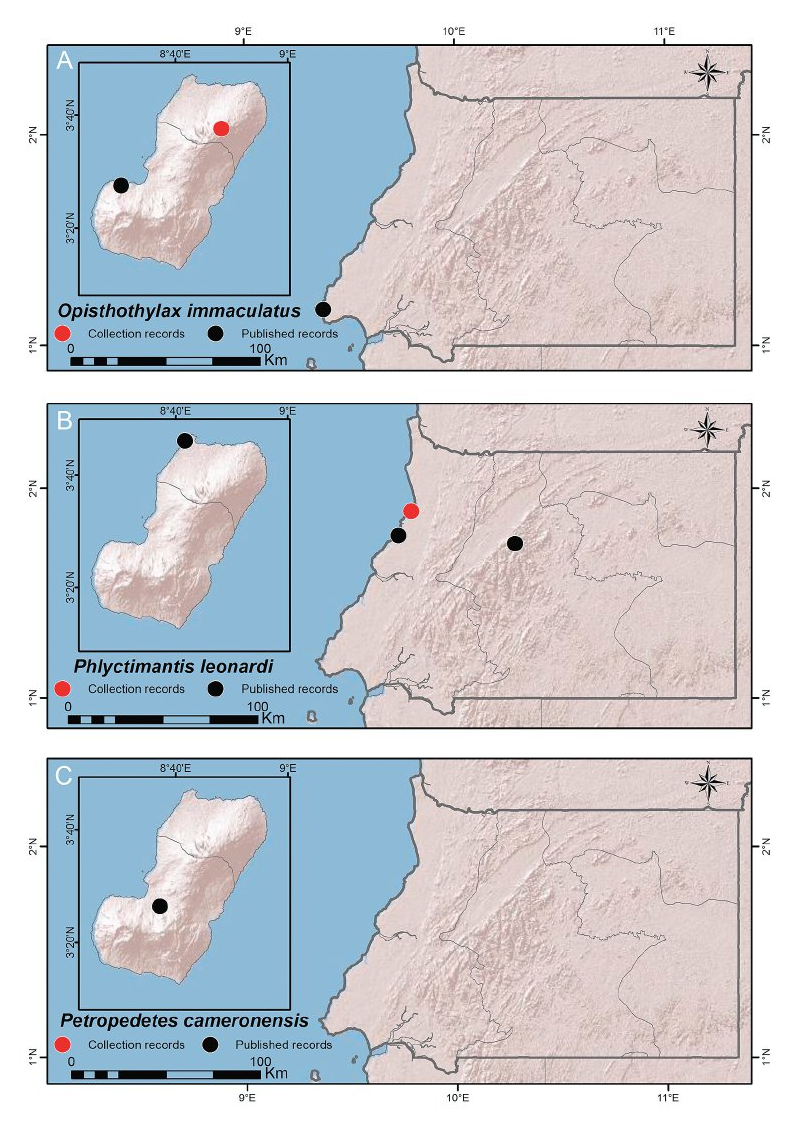
DISTRIBUTION. — It ranges from southeastern Nigeria to southwestern Cameroon, including Bioko, the only place in Equatorial Guinea where it has been recorded, at Musola (Boulenger 1906 a) (Map 19 C). SPECIMENS EXAMINED. — No specimens were found at the collections examined by us in this study.
Sánchez-Vialas, Alberto, Calvo-Revuelta, Marta, Castroviejo-Fisher, Santiago, De, Ignacio (2020): Synopsis of the Amphibians of Equatorial Guinea based upon the Authors’ Field Work and Spanish Natural History Collections. Proceedings of the California Academy of Sciences 66 (8): 137-230, DOI: 10.5281/zenodo.11105986
DISTRIBUTION. — This species is distributed from Cameroon to Gabon, Republic of Congo and Democratic Republic of Congo. In Equatorial Guinea, it has been cited in Río Muni, over the coast of Bome, and Monte Alén (De la Riva 1994), and on Bioko at Punta Europa (= Punta Frailes) (Boulenger 1906 a) (Map 19 B).
Sánchez-Vialas, Alberto, Calvo-Revuelta, Marta, Castroviejo-Fisher, Santiago, De, Ignacio (2020): Synopsis of the Amphibians of Equatorial Guinea based upon the Authors’ Field Work and Spanish Natural History Collections. Proceedings of the California Academy of Sciences 66 (8): 137-230, DOI: 10.5281/zenodo.11105986
TYPE LOCALITY. — “ Gebirgsbach bei Bimbia, in den Vorbergen des Camerun ”, Limbé, Cameroon.
Sánchez-Vialas, Alberto, Calvo-Revuelta, Marta, Castroviejo-Fisher, Santiago, De, Ignacio (2020): Synopsis of the Amphibians of Equatorial Guinea based upon the Authors’ Field Work and Spanish Natural History Collections. Proceedings of the California Academy of Sciences 66 (8): 137-230, DOI: 10.5281/zenodo.11105986
TYPE LOCALITY. — “ Punta Frailes, Fernando Po ”, Bioko, Equatorial Guinea and “ N’Djolè, French Congo ” Ndjolé, Gabon. Capocaccia (1957) restricted the type locality by lectotype designation to “ N’Djolè ”, Gabon.
Sánchez-Vialas, Alberto, Calvo-Revuelta, Marta, Castroviejo-Fisher, Santiago, De, Ignacio (2020): Synopsis of the Amphibians of Equatorial Guinea based upon the Authors’ Field Work and Spanish Natural History Collections. Proceedings of the California Academy of Sciences 66 (8): 137-230, DOI: 10.5281/zenodo.11105986
Export occurrence data
Darwin Core Archive (ZIP)
CLASSIFICATION
Taxonomic Classification Tree

MULTIMEDIA
Media Files(1)
MAPS 19A–C. Distribution maps for Equatorial Guinean records of (A) Opisthothylax immaculatus; (B) Phlyctimantis cf. leonardi; (C) Petropedetes cameronensis.
Imageimage/png© Sánchez-Vialas, Alberto;Calvo-Revuelta, Marta;Castroviejo-Fisher, Santiago;De, IgnacioSánchez-Vialas, Alberto;Calvo-Revuelta, Marta;Castroviejo-Fisher, Santiago;De, Ignacio
IMAGES