
AnimaliaNot EvaluatedacceptedspeciesAccepted
Nectophryne afra
Buchholz & Peters, 1875
GBIF:228888633
0year
ABOUT
Descriptions(5)
Nectophryne batesii Boulenger, 1913 Photo figures 9 B – C TYPE LOCALITY. — “ Neighbourhood of Bitye, on the Ja River (Congo System) ”, Cameroon. DISTRIBUTION. — Netophryne batesii is known from Nigeria, Cameroon, Gabon, and Democratic Republic of Congo. In Equatorial Guinea, it has been found both at Río Muni and Bioko (Map 11 A).
Sánchez-Vialas, Alberto, Calvo-Revuelta, Marta, Castroviejo-Fisher, Santiago, De, Ignacio (2020): Synopsis of the Amphibians of Equatorial Guinea based upon the Authors’ Field Work and Spanish Natural History Collections. Proceedings of the California Academy of Sciences 66 (8): 137-230, DOI: 10.5281/zenodo.11105986
COMMENTS. — Nectophryne afra was the only species of the genus present in Equatorial Guinea until this work (see N. batesii section). Juveniles of Nectophryne afra are characterized by a dorsal pattern based on thin whitish lines that form rings or loops over the nostril and mid-body region respectively, together with additional transversal stripes over a blackish surface (Scheel 1970). SPECIMENS EXAMINED. — Thirteen specimens. Cabo San Juan, Río Muni, 15 October 1901 (MNCN 3152 – 3161, 3163); path behind church in Bakelele forest, Batete, Bioko, 03 ° 26 ʹ 37.34 ʺN, 8 ° 30 ʹ 24.76 ʺE, 02 December 2003 (MNCN 48824); north of Caldera de Luba, 3 ° 21 ʹ 28.73 ʺN, 8 ° 31 ʹ 55.01 ʺE, 13 March 2007 (MNCN 46704).
Sánchez-Vialas, Alberto, Calvo-Revuelta, Marta, Castroviejo-Fisher, Santiago, De, Ignacio (2020): Synopsis of the Amphibians of Equatorial Guinea based upon the Authors’ Field Work and Spanish Natural History Collections. Proceedings of the California Academy of Sciences 66 (8): 137-230, DOI: 10.5281/zenodo.11105986
COMMENTS. — The presence of N. batesii in Río Muni and Bioko had gone unnoticed until this work. The distribution of the species needs to be revised and, following the work of Blackburn and Droissart (2008), we suggest that the records of N. afra from Fernand-Vaz (Gabon) provided by Boulenger (1906 a) and from Ijebu Oru (Nigeria) by Onadeko and Rödel (2009), correspond to N. batesii, as both records were based on juveniles showing the typical pattern of this species (Blackburn and Droissart 2008). The phenotype of juveniles of N. batesii is formed by four solid and wide transversal whitish stripes located at roughly equal intervals over a black dorsal surface, lacking the loops and ring pattern present in the juveniles of N. afra (Blackburn and Droissart 2008). The specimen from north of Bioko (Rebola) presents osteological singularities when compared with other specimens (author’s unpublished data) suggesting that more field work should be carried out at this region for the study of additional individuals throughout integrative approaches including molecular analyses and detailed morphological and ecological studies. We herein provide the first records of N. batesii for Río Muni and Bioko. SPECIMENS EXAMINED. — Eight specimens. Cabo San Juan, Río Muni, 15 October 1901 (MNCN 3162); north of Campamento Hormiga, Caldera de Luba, 03 ° 18 ʹ 27.34 ʺN 08 ° 28 ʹ 15.68 ʺE, 08 March 2007 (MNCN 46715 – 46716); Campamento UPM-Campamento Hormiga, Caldera de Luba, 3 ° 20 ʹ 46.54 ʺN 8 ° 29 ʹ 48.20 ʺE, 08 March 2007 (MNCN 46717); River Osa, creek Chopepe, San Antonio de Ureca, 03 ° 14 ʹ 52.19 ʺN, 08 ° 32 ʹ 23.77 ʺE, 22 November 2003 (MNCN 48823); BBPP Camp, Caldera de Luba, 03 ° 20 ʹ 47.32 ʺN, 08 ° 29 ʹ 48.44 ʺE, 26 November 2003 (MNCN 48822); San Joaquín de Ndyiacom (EBD 31487); Rebola, Bioko, January 1933 (MNCN 3151).
Sánchez-Vialas, Alberto, Calvo-Revuelta, Marta, Castroviejo-Fisher, Santiago, De, Ignacio (2020): Synopsis of the Amphibians of Equatorial Guinea based upon the Authors’ Field Work and Spanish Natural History Collections. Proceedings of the California Academy of Sciences 66 (8): 137-230, DOI: 10.5281/zenodo.11105986
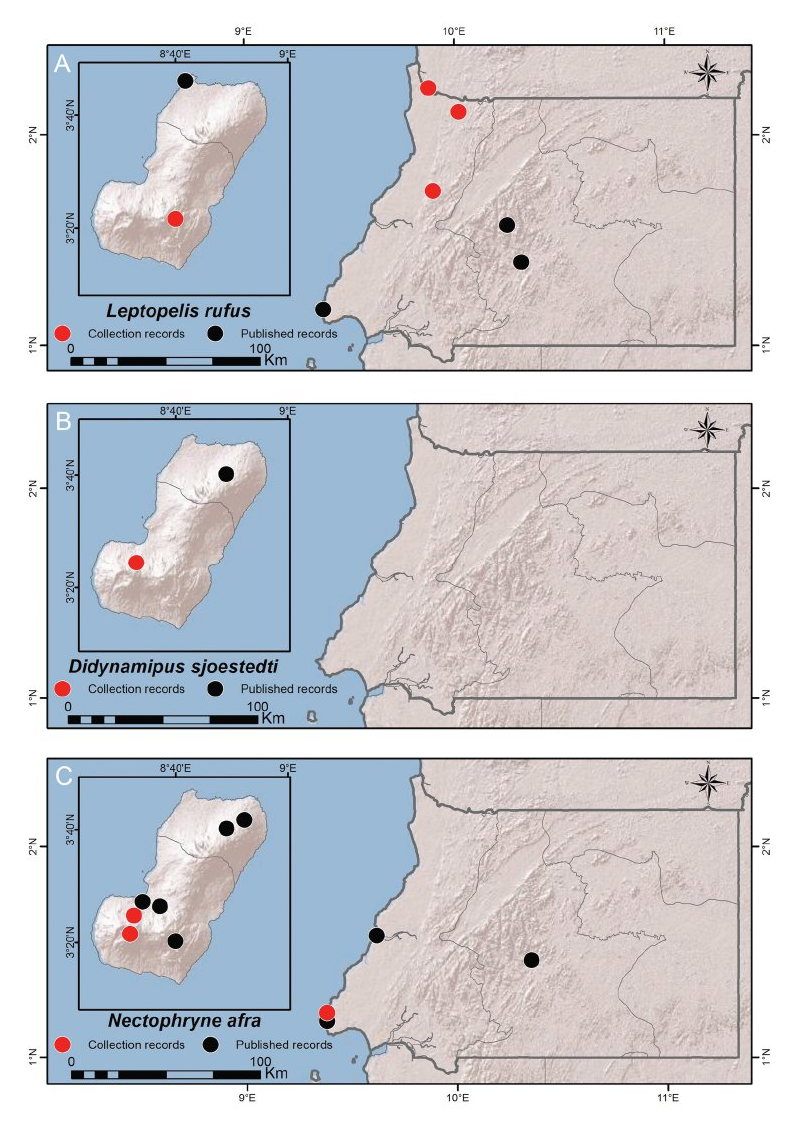
DISTRIBUTION. — Nectophryne afra occurs throughout West Africa including Nigeria, Cameroon, Equatorial Guinea, Gabon and Democratic Republic of Congo. In Equatorial Guinea, N. afra has been recorded from mainland at Cabo San Juan (Boulenger 1903), Benito River (Boulenger 1900), and Monte Alén (Lasso et al. 2002), and on Bioko at Basilé, Bahía de San Carlos, Musola (Boulenger 1906 a), Río Iladyi (Mertens 1965) and along the road to Pico Basilé (Hydeman et al. 2017) (Map 10 C).
Sánchez-Vialas, Alberto, Calvo-Revuelta, Marta, Castroviejo-Fisher, Santiago, De, Ignacio (2020): Synopsis of the Amphibians of Equatorial Guinea based upon the Authors’ Field Work and Spanish Natural History Collections. Proceedings of the California Academy of Sciences 66 (8): 137-230, DOI: 10.5281/zenodo.11105986
TYPE LOCALITY. — “ Cameruns ”, restricted to Douala by Frétey et al. (2014).
Sánchez-Vialas, Alberto, Calvo-Revuelta, Marta, Castroviejo-Fisher, Santiago, De, Ignacio (2020): Synopsis of the Amphibians of Equatorial Guinea based upon the Authors’ Field Work and Spanish Natural History Collections. Proceedings of the California Academy of Sciences 66 (8): 137-230, DOI: 10.5281/zenodo.11105986
Export occurrence data
Darwin Core Archive (ZIP)

MULTIMEDIA
Media Files(2)
MAPS 10A–C. Distribution maps for Equatorial Guinean records of (A) Leptopelis rufus; (B) Didynamipus sjostedti; (C) Nectophryne afra.
Imageimage/png© Sánchez-Vialas, Alberto;Calvo-Revuelta, Marta;Castroviejo-Fisher, Santiago;De, IgnacioSánchez-Vialas, Alberto;Calvo-Revuelta, Marta;Castroviejo-Fisher, Santiago;De, Ignacio
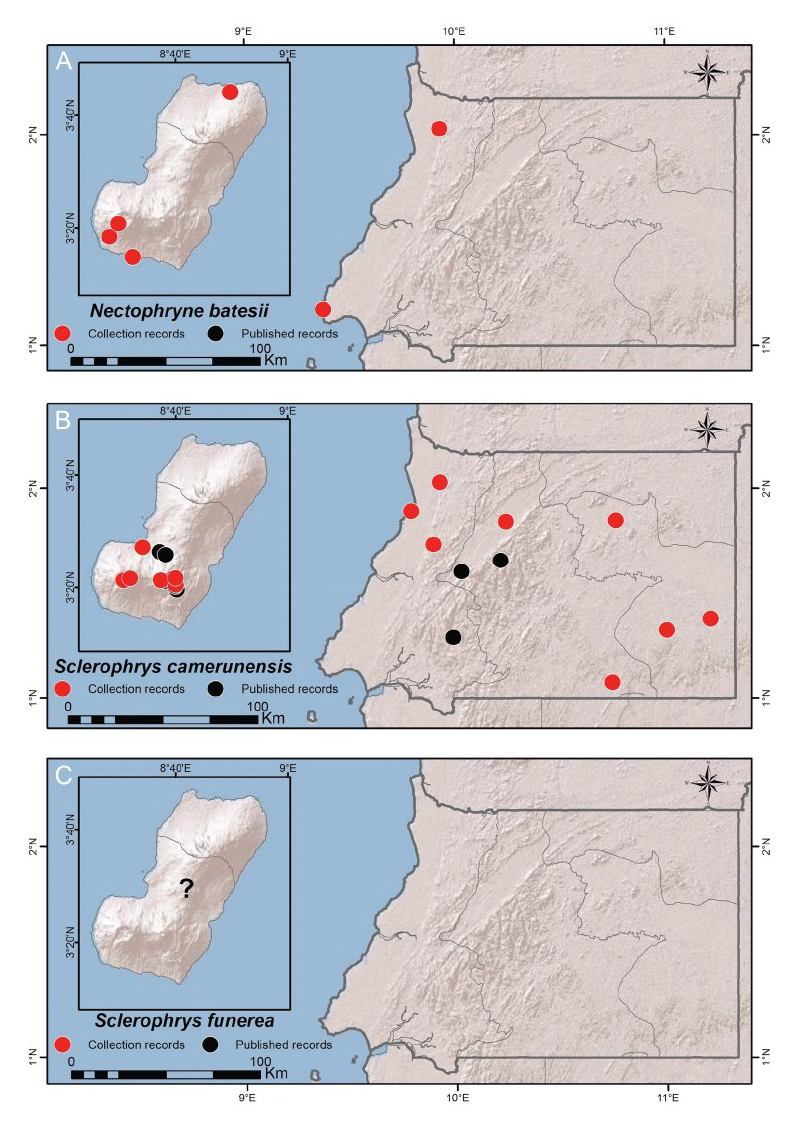
MAPS 11A–C. Distribution maps for Equatorial Guinean records of (A) Nectophryne batesii; (B) Sclerophrys camerunensis; (C) Sclerophrys funerea.
Imageimage/png© Sánchez-Vialas, Alberto;Calvo-Revuelta, Marta;Castroviejo-Fisher, Santiago;De, IgnacioSánchez-Vialas, Alberto;Calvo-Revuelta, Marta;Castroviejo-Fisher, Santiago;De, Ignacio
IMAGES