
AnimaliaNot EvaluatedacceptedspeciesAccepted
Arthroleptis sylvaticus
(Laurent, 1954) Photo
GBIF:228888682
0year
ABOUT
Descriptions(3)
COMMENTS. — This taxon may comprise several undescribed cryptic species (Blackburn 2008). Frost et al. (2006) included in their study a specimen (CAS 207926) from Moka, Bioko, identified as Schoutedenella taeniata, which was previously assigned to A. sylvaticus by Blackburn (2008), and briefly described as a juvenile with a pair of light dorsolateral lines. This striped phenotype exhibited by some specimens of A. sylvaticus could have led Mertens (1965) to misidentify his specimens of Arthroleptis from Moka as A. bivittatus Müller, 1885. At that time, Mertens (1965) considered A. bivittatus as a senior synomym of A. taeniatus Boulenger, 1906 (another taxon in which the dorsal pattern can be formed by light dorsolateral lines). However, both taxa (A. bivittatus and A. taeniatus) are currently recognized as different species (Perret 1991); while A. bivittatus is restricted to its type locality (Tumbo-Insel [Tumbo Island, Sierra Leone]), A. taeniatus is widespread along the Gulf of Guinea mainland. Mertens (1965) compared the specimen from Moka with specimens of A. taeniatus from Cameroon, noting morphological similarity. The conservative morphological evolution undergone by some species groups of the genus Arthroleptis, sometimes only revealed by molecular data, suggests that at the times of Mertens’ work, the limitations for studying the diversity of this group of frogs were considerable, and consequently, yielded misidentifications, especially for the smallest species of Arthroleptis, such as the Merten’s specimens. Thus, based on current evidences, it is likely that the specimen from Moka recorded by Mertens (1965) is neither A. bivittatus nor A. taeniatus; despite further sampling efforts carried out at Moka surroundings, no specimens of A. taeniatus have been recorded, but some other congeneric species such as A. poecilonotus, A. variabilis, and A. sylvaticus are commonly found. Consequently, we consider that the identity of Mertens’ (1965) specimen from Moka corresponds to A. sylvaticus, a taxon that can also exhibit the dorsolateral light stripes shown by the sequenced specimen (CAS 207926) from the same locality (Blackburn 2008). Therefore, we exclude the taxon A. taeniatus (or A. bivittatus sensu Mertens [1965]) from the checklist of amphibians of Equatorial Guinea. However, A. taeniatus could be found during future field work in Río Muni. SPECIMENS EXAMINED. — Seven specimens. Moka, Bioko Sur, 23 July 1984 (EBD 18612 – 18614); Belebu to Ureca, along the path, Bioko, 03 ° 24 ʹ 25.81 ʺN, 08 ° 33 ʹ 03.23 ʺE, 19 November 2003 (MNCN 48884); Illadji River, Bioko, 03 ° 19 ʹ 46.04 ʺN, 08 ° 40 ʹ 26.13 ʺE, 14 November 2003 (MNCN 48883); surroundings of BBPP camp, Caldera de Luba, Bioko, 03 ° 20 ʹ 47.32 ʺN, 08 ° 29 ʹ 48.44 ʺE, 27 November 2003 (MNCN 48834); Caldera de Luba, Bioko, 03 ° 21 ʹ 17.59 ʺN, 08 ° 31 ʹ 42.35 ʺE, 14 March 2007 (MNCN 46705).
Sánchez-Vialas, Alberto, Calvo-Revuelta, Marta, Castroviejo-Fisher, Santiago, De, Ignacio (2020): Synopsis of the Amphibians of Equatorial Guinea based upon the Authors’ Field Work and Spanish Natural History Collections. Proceedings of the California Academy of Sciences 66 (8): 137-230, DOI: 10.5281/zenodo.11105986
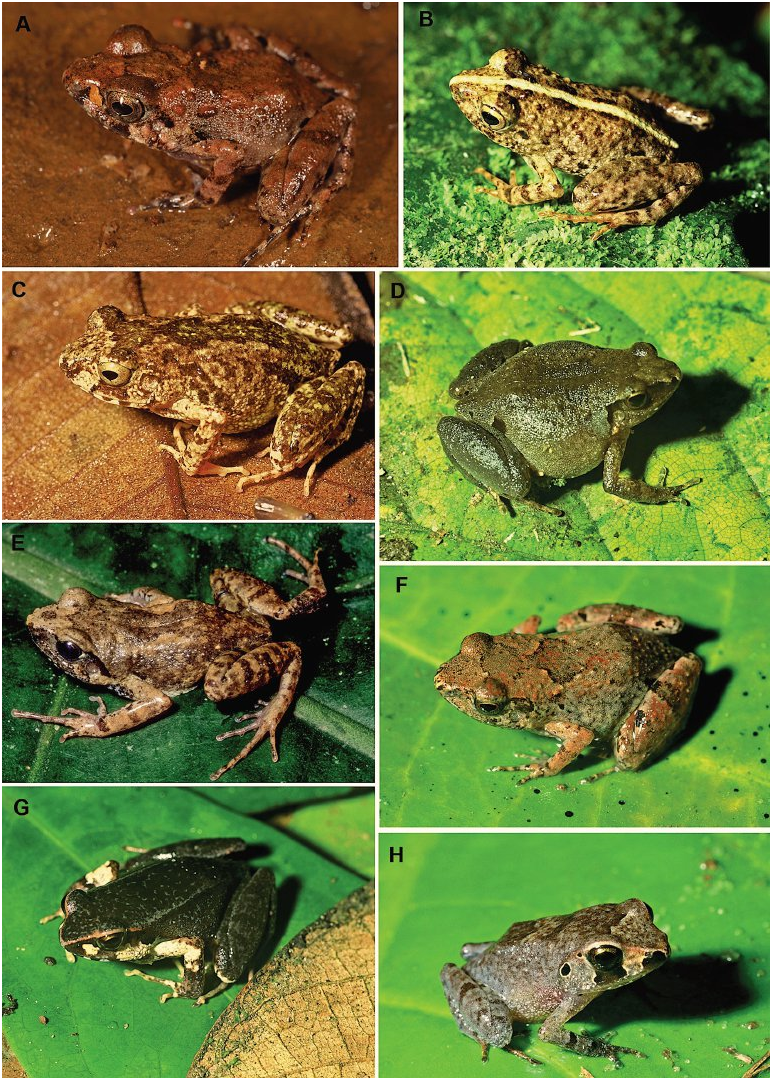
DISTRIBUTION. — Arthroleptis sylvaticus (sensu lato) ranges from southern Cameroon and Gabon to Republic of Congo, Democratic Republic of Congo and Central African Republic. In Equatorial Guinea, this species is known from Bioko, where it has been recorded near Moka (Blackburn 2008; Hydeman et al. 2017) (Map 3 A). It is present in Monte Alén, Río Muni (IDlR, Fig. 3 F).
Sánchez-Vialas, Alberto, Calvo-Revuelta, Marta, Castroviejo-Fisher, Santiago, De, Ignacio (2020): Synopsis of the Amphibians of Equatorial Guinea based upon the Authors’ Field Work and Spanish Natural History Collections. Proceedings of the California Academy of Sciences 66 (8): 137-230, DOI: 10.5281/zenodo.11105986
TYPE LOCALITY. — “ Buta ”, Uele, Dem. Rep. Congo.
Sánchez-Vialas, Alberto, Calvo-Revuelta, Marta, Castroviejo-Fisher, Santiago, De, Ignacio (2020): Synopsis of the Amphibians of Equatorial Guinea based upon the Authors’ Field Work and Spanish Natural History Collections. Proceedings of the California Academy of Sciences 66 (8): 137-230, DOI: 10.5281/zenodo.11105986
Export occurrence data
Darwin Core Archive (ZIP)
CLASSIFICATION
Taxonomic Classification Tree

MULTIMEDIA
Media Files(2)
FIGURE 3. A. Arthroleptis adelphus (Caldera de Luba, Bioko Sur, Bioko). Photo IM.; B–C. Arthroleptis adelphus (Monte Alén National Park, Río Muni). Photos IDlR.; D. Arthroleptis aff. poecilonotus, female (Monte Alén National Park, Río Muni). Photo IDlR.; E. Arthroleptis aff. poecilonotus, male (Río Muni). Photo TL.; F. Arthroleptis sylvaticus (Monte Alén National Park, Río Muni). Photo IDlR.; G–H. Arthroleptis variabilis (Monte Alén National Park, Río Muni). Photos IDlR.
Imageimage/png© Sánchez-Vialas, Alberto;Calvo-Revuelta, Marta;Castroviejo-Fisher, Santiago;De, IgnacioSánchez-Vialas, Alberto;Calvo-Revuelta, Marta;Castroviejo-Fisher, Santiago;De, Ignacio
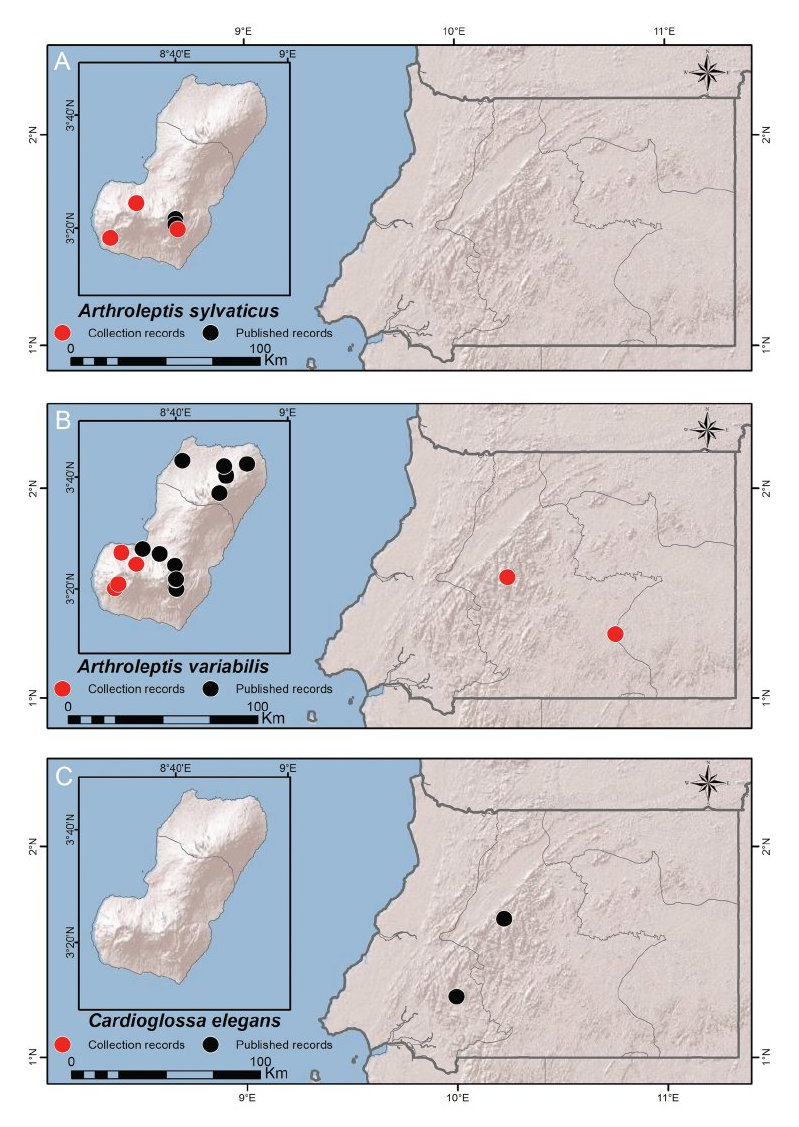
MAPS 3A–C. Distribution maps for Equatorial Guinean records of (A) Arthroleptis sylvaticus; (B) Arthroleptis variabilis; (C) Cardioglossa elegans.
Imageimage/png© Sánchez-Vialas, Alberto;Calvo-Revuelta, Marta;Castroviejo-Fisher, Santiago;De, IgnacioSánchez-Vialas, Alberto;Calvo-Revuelta, Marta;Castroviejo-Fisher, Santiago;De, Ignacio
IMAGES