
AnimaliaNot EvaluatedacceptedspeciesAccepted
Charina prebottae
Brattstrom, 1958
GBIF:229732085
0year
ABOUT
Descriptions(4)
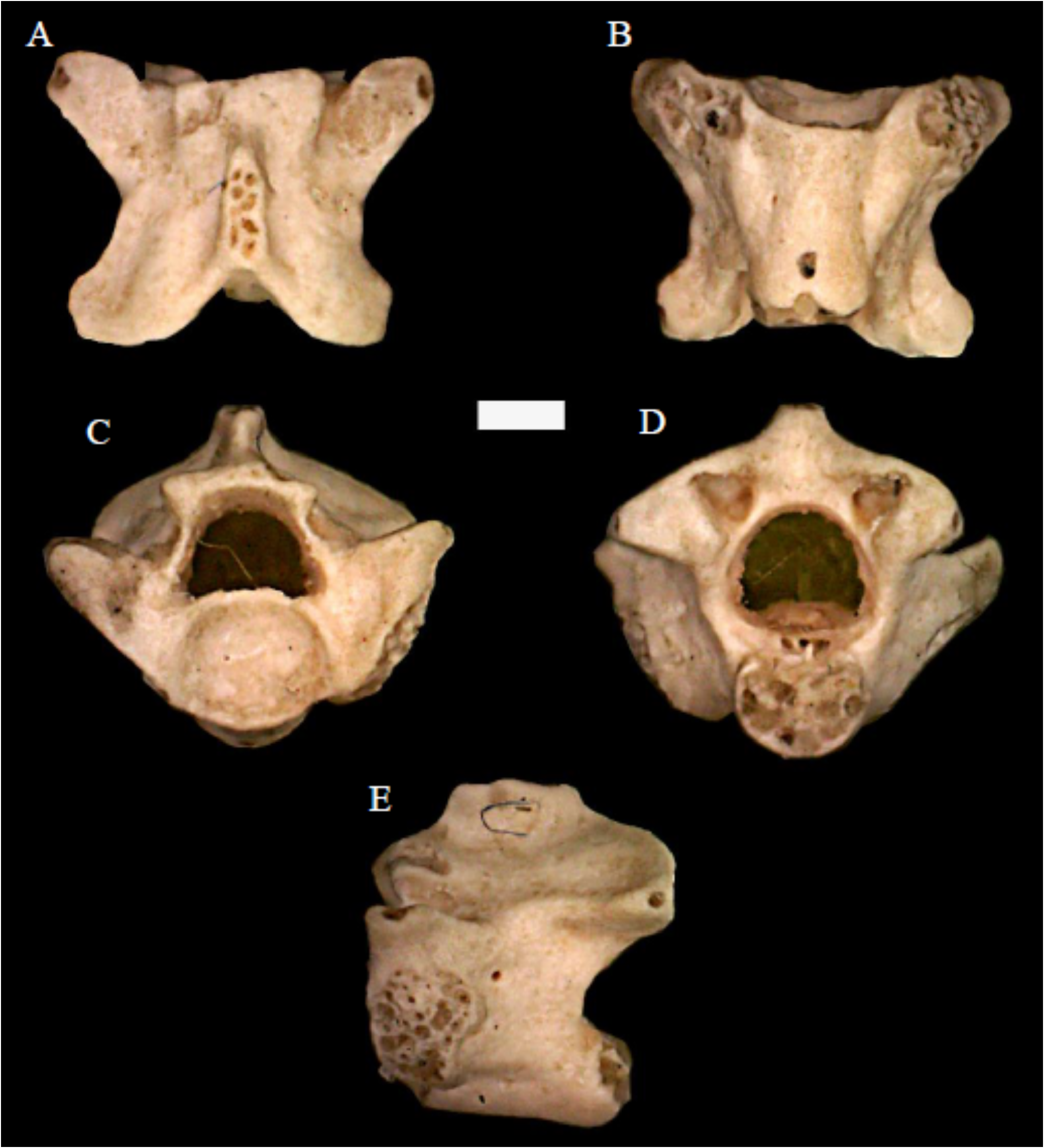
Description. The vertebra appears near square in shape from dorsal view, but is slightly wider at the prezygapophyses than the postzygapophyses. The postzygapophyses are rounded, while the prezygapophyses are moderately pointed with reduced accessory processes, and are raised antero-laterally. The neural spine is low, broad, and is longer than it is tall or wide. The top of the neural spine is weathered, but this does not appear to affect the overall shape of the neural spine in dorsal view. The neural spine tapers in width anteriorly and is incised posteriorly. The zygosphene is dorsally flat and v-shaped overall, with somewhat rounded lateral edges that extend slightly forward on the anterior face. In anterior view, the zygosphene is concave. The neural arch is somewhat flattened and deeply incised posteriorly. The cotyle is round and mildly angled ventrally, with the dorsal edge extending more anteriorly and the ventral edge extending more posteriorly. Paracotylar foramina are absent. The hemal keel is wide, flat, and smooth ending just before reaching the condylar head. It is bordered laterally by a flat indentation, primarily on the anterior end.
Jacisin Iii, John J., Lawing, A. Michelle (2024): Fossil snakes of the Penny Creek Local Fauna from Webster County, Nebraska, USA, and the first record of snakes from the Early Clarendonian (12.5 - 12 Ma) of North America. Palaeontologia Electronica (a 2) 27 (1): 1-42, DOI: 10.26879/1220, URL: http://dx.doi.org/10.26879/1220
Figure 5
Jacisin Iii, John J., Lawing, A. Michelle (2024): Fossil snakes of the Penny Creek Local Fauna from Webster County, Nebraska, USA, and the first record of snakes from the Early Clarendonian (12.5 - 12 Ma) of North America. Palaeontologia Electronica (a 2) 27 (1): 1-42, DOI: 10.26879/1220, URL: http://dx.doi.org/10.26879/1220
Remarks. The fossil described here is similar in size and morphology to known species of Charina (see above for description and comparisons with Lichanura). It is most similar to Charina prebottae specimens from other Nebraska localities, as it possesses a more strongly developed hemal keel when compared to the same vertebral region in extant species of Charina (Holman, 1987) and no break in the slope of the anterior neural spine in lateral view as it descends to the zygosphene (Bell and Mead, 1996). Other characters described by Brattstrom (1958) for C. prebottae may represent individual and intracolumnar variation as well as differences between his fossils from California and the fossils from Nebraska. Holman (2000) noted that Charina prebottae also exhibits notable variation across a wide geographic area throughout the Miocene. Previous literature suggests that C. prebottae may be a catch-all taxon for multiple species, as Brattstrom’s (1958) un-illustrated account and subsequent illustrated accounts do not completely match, warranting further in-depth study (Bell and Mead, 1996; Holman, 2000). Although this vertebra is weathered and missing the extreme parts of several of its structures, it exhibits features of the neural spine (Brattstrom, 1958; Bell and Mead, 1996) and hemal keel (Holman, 2000) matching those of C. prebottae. As such, we confer this vertebra to C. prebottae until the taxon is more comprehensively assessed and re-diagnosed.
Jacisin Iii, John J., Lawing, A. Michelle (2024): Fossil snakes of the Penny Creek Local Fauna from Webster County, Nebraska, USA, and the first record of snakes from the Early Clarendonian (12.5 - 12 Ma) of North America. Palaeontologia Electronica (a 2) 27 (1): 1-42, DOI: 10.26879/1220, URL: http://dx.doi.org/10.26879/1220
Material. UNSM 139981 (posterior middle trunk vertebra).
Jacisin Iii, John J., Lawing, A. Michelle (2024): Fossil snakes of the Penny Creek Local Fauna from Webster County, Nebraska, USA, and the first record of snakes from the Early Clarendonian (12.5 - 12 Ma) of North America. Palaeontologia Electronica (a 2) 27 (1): 1-42, DOI: 10.26879/1220, URL: http://dx.doi.org/10.26879/1220
Export occurrence data
Darwin Core Archive (ZIP)

MULTIMEDIA
Media Files(1)
FIGURE 5. Trunk vertebra of Charina cf. Charina prebottae from the Penny Creek local fauna. From top left: dorsal, ventral, anterior, posterior, and lateral views (anterior to the left). Scale bar equals 1 mm.
Imageimage/png© Jacisin Iii, John J.;Lawing, A. MichelleJacisin Iii, John J.;Lawing, A. Michelle
IMAGES